Review – Pilot Precise v5 Black, Blue, and Red

Times are tough if one wants to write smoothly and precisely on a budget. Technical pens wear out fast, and fountain pens cost money and time to maintain. I use both, but sometimes I just want to write easily and precisely without all of the maintenance and hassle. This is where the Pilot Precise series of pens come in. Today I’ll be looking at the v5 set in black, red, and blue.

20140603-232945.jpg

The cap and barrel are simple and straight. The cap has nothing on it but a simple metal clip that does its job well but can bend easily. The barrel has the necessary info about the product and an ink window so that if ink starts to run low you can get a general idea. Removing the cap shows a transparent section and feed system, which is more for being cool looking than any sort of functionality regarding ink level. At the end of the section is a series of plastic step downs that lead to a metal rolling ball tip. At the bottom of the section is a small clear plastic window that allows one to easily see if there is little or no ink left in the pen. The transparent section and barrel are both a slick plastic, but provide enough surface area that slipping off or letting go of the pen is not an issue.

20140603-232950.jpg

The tips of the pens write fairly smoothly. Older ones get a bit stiffer, but even on the extra-fine v5 they are never scratchy. The rolling ball delivers a nice “precise” line to the paper. Although it does have more variation than a technical pen in width, it has less than a standard ballpoint does, and it doesn’t blob. Like I said, writing is smooth: almost as smooth as a fountain pen, but not quite there. I’d say they are wonderful for writing (especially if ballpoints cramp one’s hands) but are not as good for drawing. Still better than a ballpoint, though.

20140603-232940.jpg

The three colors I have are Black, Blue, and Red: fairly standard colors with a fairly standard execution. The black is a warm black (this is an older pen, and Pilot may have changed formulas. The other two are brand new.) and noticeably less saturated than the thicker v7. The blue is quite dark, darker than most other Pilot inks, and quite work-appropriate. It’s almost a deep water blue, but not quite as dark as, say, Bic blue. The red is bright, bright to the point of being aggressive. Don’t grade papers with it unless you really want to say they’re wrong. It shows up almost from across the room and is quite a contrast to the deep red body of the pen. I’d say it has the fewest practical applications of the bunch. All of these inks are liquid-based and soak into the paper, meaning that they take a bit of moisture to run, but when they do they never stop. The red is the worst in this case.

In the end I’d say simply that these pens are great for writing, and all right for drawing. They aren’t the best but are great and ubiquitous for what they are.


Review – Plaid 10 Detail Brush Set

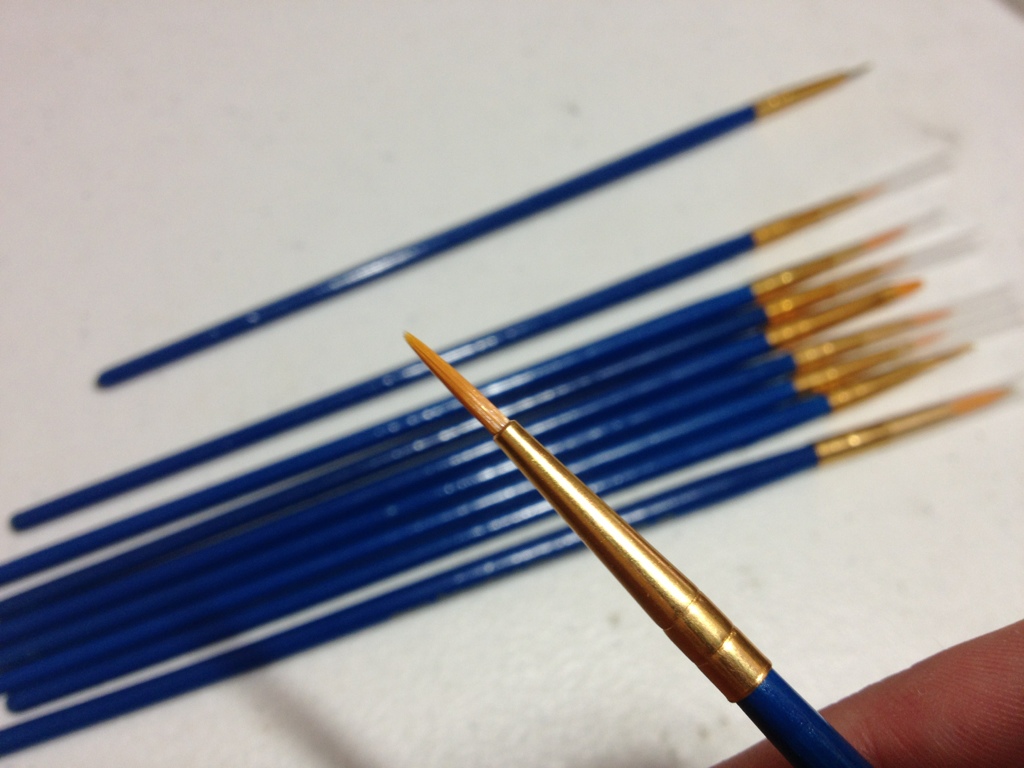
Well, while perusing my archives, I found a review of Testor’s plastic cement. And that is when I realized I have a whole set of Modeling stuff that I would count as art supplies. So today I’ll be looking at some of those, starting with one of the cheapest and most universal things, a Plaid 10-piece detail brush set.

20140527-232159.jpg
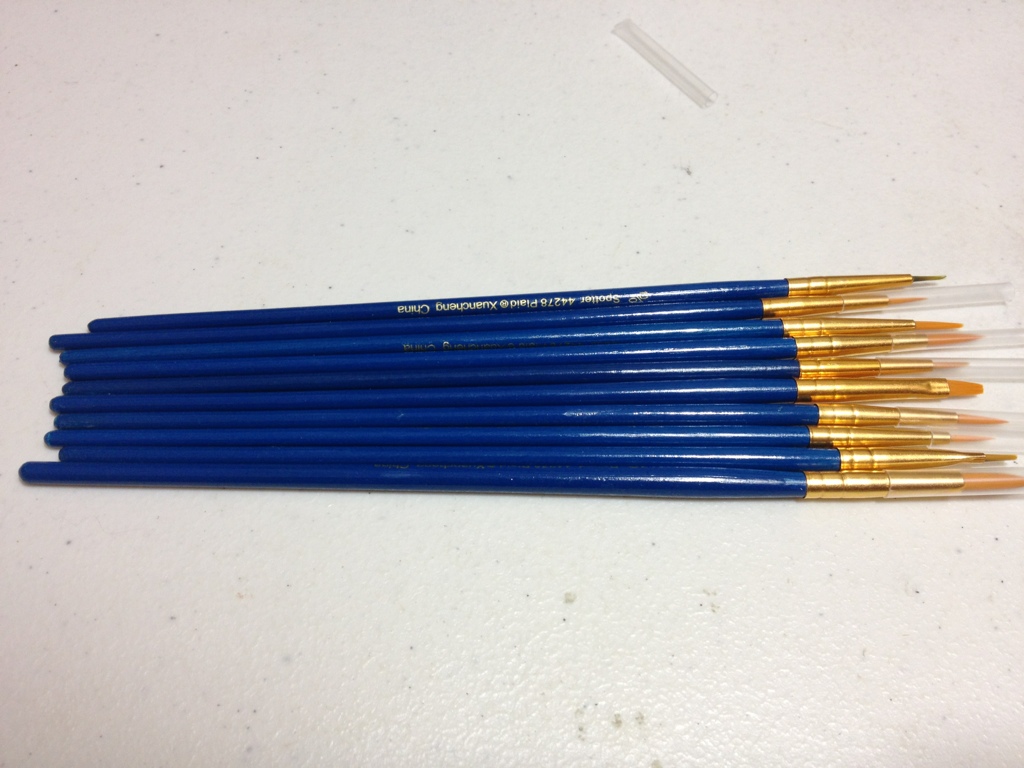
This will be general and cover only the quality of the brushes and not the individual brushes themselves, which might be covered in future installments. First off, the bodies are made of cheap wood that is poorly painted with quite good lettering telling you what everything is. There is a brass-colored section near the end, and some very ugly orange bristles pointing out of it. The section and body are quite sturdy for their thickness and not at all slippery, but not too nice in the hand either.

20140527-232204.jpg
The bristles themselves are all right. As previously stated, they are an ugly orange, which doesn’t really matter too much. They are synthetic and have a bit of pop to them, which I like, but others might not. At first they are quite soft and strong, but they may easily become frayed and bent. This is more of a problem with individual bristles and not the brush as a whole. This makes it difficult to get a good edge when you paint, until you cut the offending bristle out of the brush. The brush’s life is likely shorter than most brushes (considering they are sold in Wal-Mart), but, honestly, for the price they work very well. They get floppy pretty quick (which some people might prefer) and they do wear out shortly after that. But they have a lifespan the I’d expect for the price, and getting a 10-brush set this cheap is incredible. They’re even relatively hard to stain.

Overall, if you need only limited detailing done on paintings, or are looking to start painting models and miniatures, this is a great starter brush set. One might want to upgrade to a well-know brush brand later, or even to hair brushes, but for a starter set these are excellent.

Review – Crayola Twistables Crayons

Now, crayons are impractical for most art types, usually because they are fragile and fiddly. What if these two problems were fixed, and crayons were easy to take and use anywhere? What would their value be? Well, Crayola has a set of twistable crayons which have plastic bodies with a twist action, so let’s take a look.

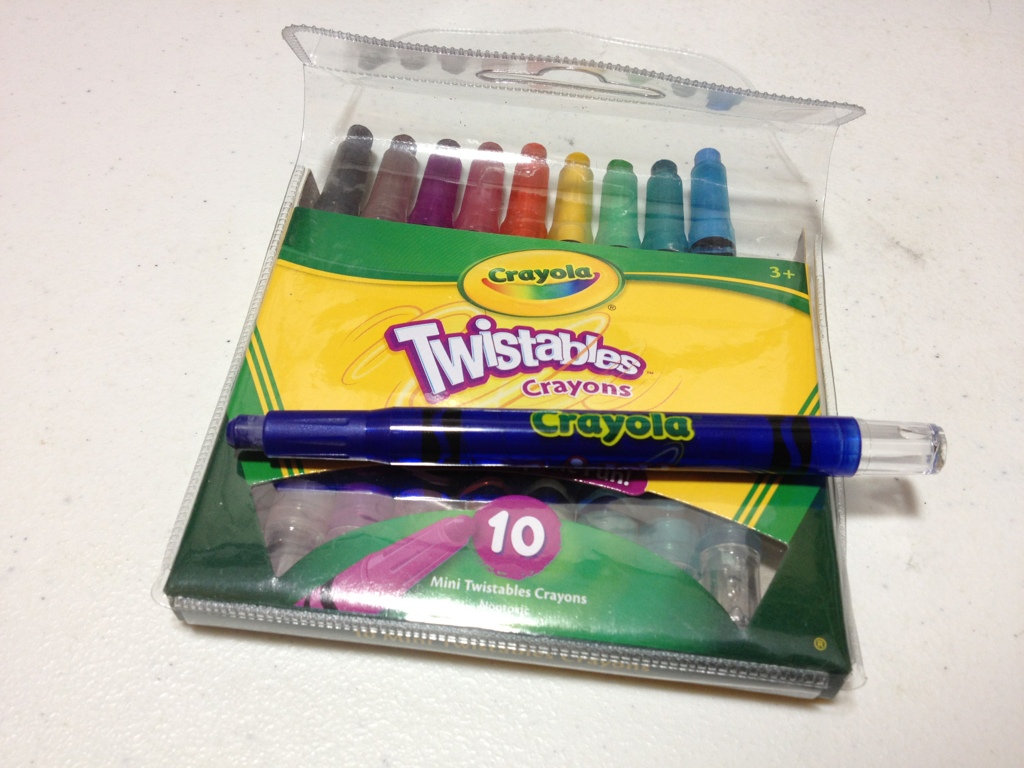
20140521-003833.jpg
First off, the crayons come in a quite nice plastic-and-card-stock carrying case, which, while handy, seems like it would fall apart rather quickly. And, just for me personally, I would want to store these somewhere else, but have a problem throwing plastic things away so I keep them in it.

20140521-003839.jpg
The crayon barrels are made of plastic and have Crayola and Twistables written on each one, with no indication as to color, though the body is see-through so the color is fairly apparent. Near the tips is a tapered and grippy section which works quite well, especially since the rest of the body is very slick. At the other end is a twisting knob which operates easily and can be used to both push the crayon out and retract it.

20140521-003845.jpg
That’s almost all there is to say. The crayons themselves are nothing special, they’re just kept in place by a plastic tube and screw. They are, of course, for kids so they are bright and not very natural. They are also non-toxic, which is a bonus. They stay alright on the paper, but not as well as more “professional” crayon and oil pastels.

So, overall they are better crayons, but they don’t change what Crayola crayons really are. Which is good for the people who use Crayola crayons. They aren’t particularly serious art supplies, and that’s fine. For more advanced things I’d recommend picking up one of the larger cases with more colors rather than the standard 10 pack I got. Past that there really isn’t anything special about them.

Review – Pilot Easytouch Pro

While not necessarily an art supply, the Pilot EasyTouch Pro claims to use a hybrid ink formula to make a smooth writing, quick drying, waterproof ink, which sounds super handy. Let’s see what it’s all about.

20140516-011941.jpg

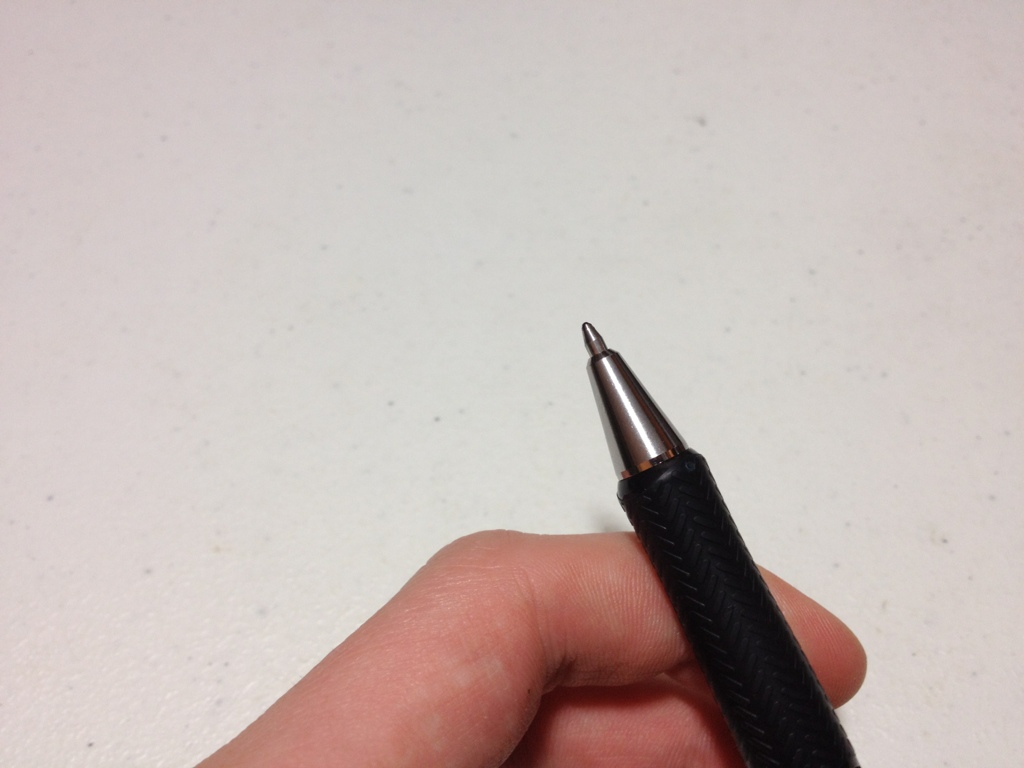
First the body of the pen features a “modern design”. The tip is a metal cone similar to most click pens. The grip is nicely tapered and flares out at the end. The barrel is fairly straight, but with a little engraving and minimal information. The clip is simple, and tight, with a “modern design”. At the end is a click button and a strange cutoff design. The click mechanism works well but has a grating sound.

20140516-011947.jpg

The ink itself is a slightly dark black, but really more of a grey. The tip is medium and there are no options. It does flow quite easily, with very little pressure on the paper. It isn’t as smooth as a fountain pen, or even a gel pen. It does offer some line variation when one presses harder, and it becomes considerably blacker when one does so. It dries fairly fast, though not the fastest. All of this is quite nice until at some points when one is writing (especially when one has just started) a large blob of ink spills out of the point and bleeds though the paper. This is not really unusual for a ballpoint, but the amount and the bleed through make it quite a problem. It’a not really a problem when writing, but a problem when doing anything else.

So overall, this is not a drawing pen, but a writing pen, and not a long writing pen either, because of blobbing, but if one merely wants to sign a paper, or write one page it is quite a smooth-writing fine instrument.

Review – Pentel Finito Porous Point Pen

Looking for a porous-point pen, and none of the standard ones are doing it for you? Maybe you might want to look at the Pentel Finito porous-point extra fine pen.

20140409-014922.jpg

The cap is all plastic, with a clip molded into it that does the job, but isn’t spectacular in any way. Inside is a small piece of plastic that covers the tip and is held in place by a spring, keeping a tight seal on the tip. This is visible through the clear plastic of the cap. The barrel is a black-covered plastic and has all necessary info on it. The grip section is clear and through it one can see the fins of the feed and a small bit of the ink reservoir. The grip section is very smooth and can easily become slippery. After a small bit of metal tapering, there is an extra-fine porous point at the end.

20140409-014928.jpg

The ink is fairly black, and fairly standard, not really permanent or fade-proof. The point does spew a lot of ink out: in fact, I would tend to call this pen a fine rather than an extra fine point due to the sheer amount of ink it leaves on the page. This makes the line considerably wider than just the point of the pen. This gushing also leads to points of bleed-through that are not seen in higher-quality porous point pens like Sharpies or Microns.

Overall I’d say the Finito is a mediocre pen that has no purpose as an art supply. There are many pens out there that do what this pen does better, and for the same price. If you want a pen that gushes, or will not dry out for long periods of time this pen may be worth a look, but I’d try something else first.


Review – Papermate Inkjoy Green, Pink, Orange, and Light Blue

In a previous entry I looked at the more standard Papermate Inkjoy colors, now it’s time for the less standard colors, like light blue, pink, orange, and green.

inkjoy tests 2

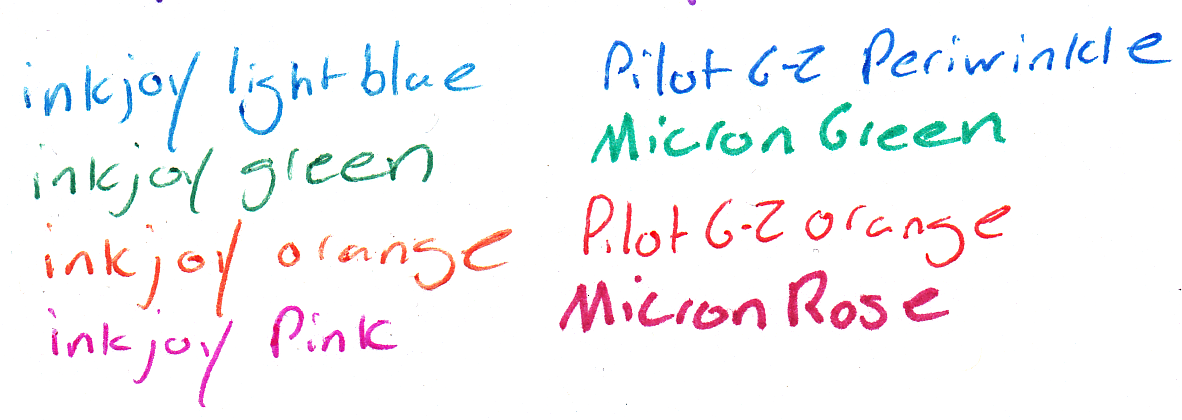
The light blue is a sky-colored blue. It is the hardest to read of any of the Inkjoy colors, though it is still fairly visible when not cluttered. It has a very natural feel and is very sky-like. It is very neutral anyway. It doesn’t look like a color that takes a stance, if that makes any sense. It’d make a nice color for both drawing and work.

Next pink, which thankfully isn’t a very aggressive pink. It’s definitely not hot, it’s more of a magenta color, but not quite. It is not a very natural color, though, as it doesn’t look like a rock or a flower. Might be good for a personal thing, or some corrections or something similar.

Third is orange, which I must say looks almost exactly like Pilot G-2 Orange, which I have previously reviewed. Subtle, but not very useful, perhaps flowers or the fruit, but it could be work-friendly, if you’re in a less formal office setting.

Finally green, which is a quite deep, more forest color. A very natural and neutral color. Again a fine informal office color, and a nice forest or swamp color. Though very limited in its natural colors. One of the least useful, but most usable, colors in the set.

Overall these four colors are unintrusive and subtle, with various office and home applications, but very little artistic applications save a few specific places.

Review – Papermate Inkjoy Black, Red, Blue, and Purple

In my tradition (now) of taking a look at the uses of standard office supplies in art, I’ll be looking at the Papermate Inkjoy pens and their different colors. Today will be the standard colors of black, red, blue, and purple.

inkjoy inks 2

Not Entirely Representative

Papermate tends to make standard colors, and their black is no exception. One of the deeper Papermate blacks, the Inkjoy black is nice and constant, though is a bit blue-greyish. Not quite black, but very good for a ballpoint pen.

The red is also fairly standard. It’s light, but not light enough to say it’s pinkish. It is very subdued and pleasant, not as aggressive as most reds, making it a bit more natural.

The blue is very deep, but not very saturated. In low light it still looks blue, but one wouldn’t mistake it for a sky blue. Again, like the red, the low saturation makes it look less aggressive than some other hues. It’s got a very nice, watery feel to it.

And finally the purple, which again is deep but not saturated. It is unmistakably purple but not very aggressive. Unlike the others, though, this leads to a less natural look as most natural purples are deep and aggressive or light and flowery. This one is in between, which means it would be at home on your papers but not in artwork.

Overall, Papermate did a good job with these colors for the workplace. They definitely weren’t designed for art, though they could be worked in. Not superb but good enough. We’ll see what the next four have in store.

Review – Bic Tech Ballpoint and Stylus

Well, sometimes now-a-days art isn’t always done on a physical medium. Tablets, smart phones, and touch-screen devices are becoming more prevalent these days and for artistic purposes your finger isn’t the most precise thing in the world. Fortunately, Bic has a solution for both mediums (maybe) the Bic Tech pen and stylus.

20140206-232018.jpg

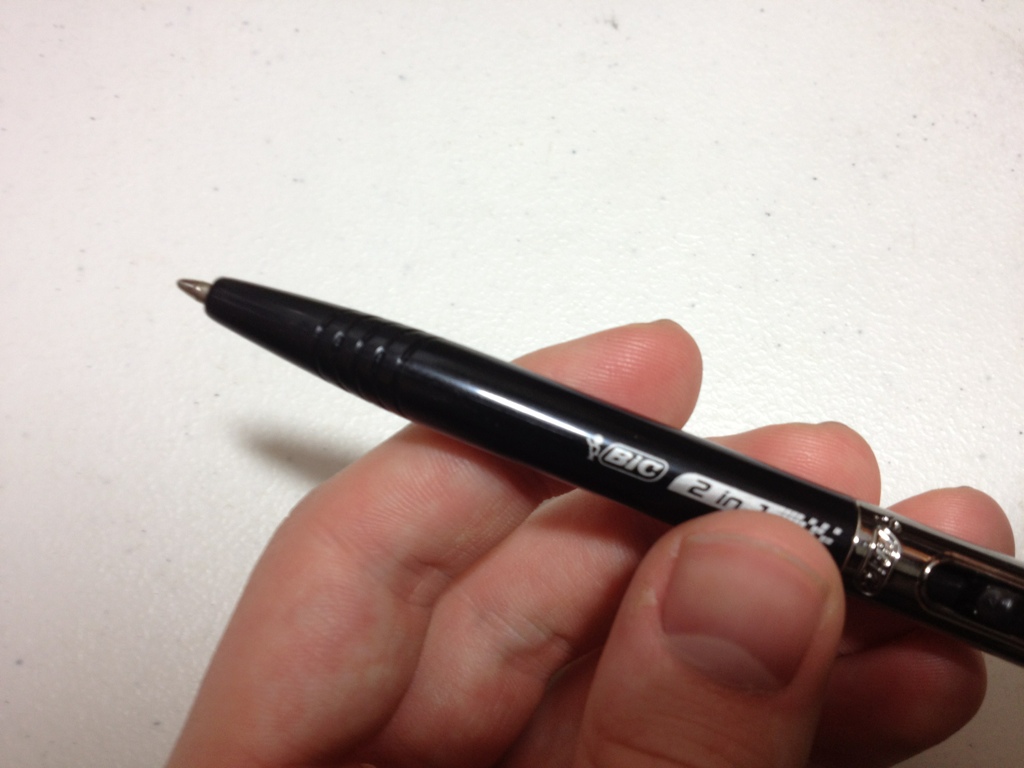
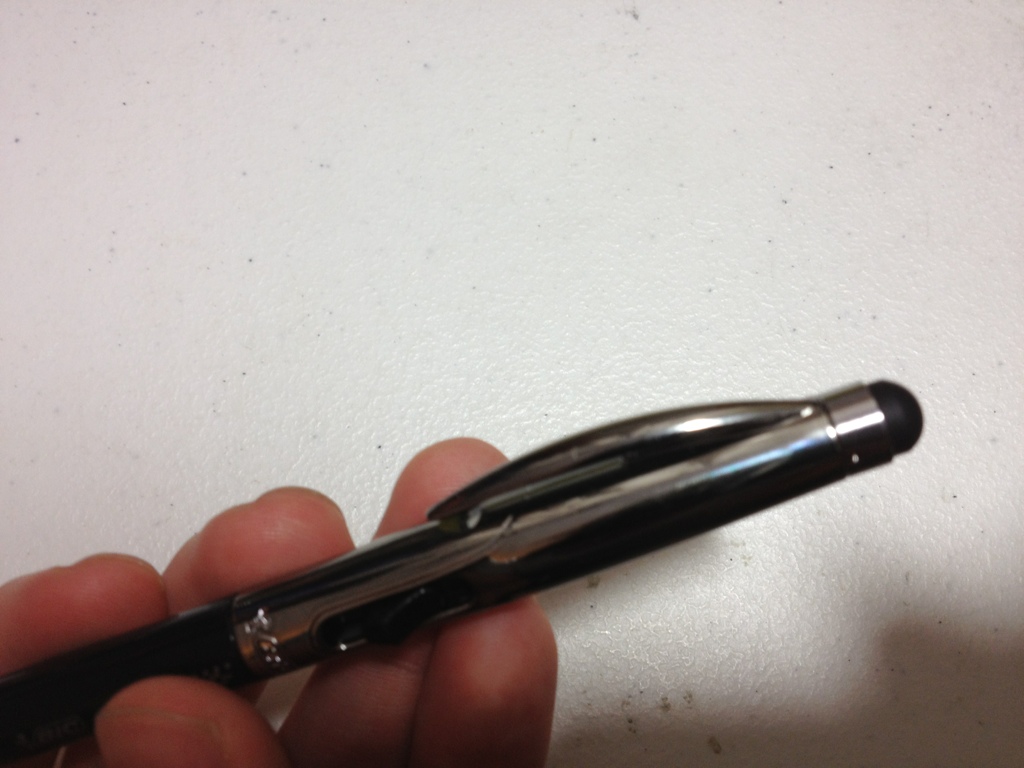
The barrel of the pen is a fairly standard Bic barrel with a slightly grippy (grip) section, a hole for the ballpoint and a logo. Halfway up the pen is where things get interesting. The top half of the pen is a chrome-colored plastic which I personally don’t like but doesn’t look terrible. Just above another Bic logo in the center is the click mechanism, which is unique in its side mounting. The lever protrudes out to the side sightly, but not enough to really get caught or accidentally pulled. It has a slight curve to it, making it a great finger place and making for easy disengagement of the fingers or caught objects (again preventing accidental usage). I would say my only problem with it is it gets scratches from fingernails far too easily. The clip is absolutely nothing special, in fact it doesn’t even clip, it more just hangs on a pocket or something so that’s cheap. At the top is the stylus which I’ll talk about in just a second.

20140206-232024.jpg

The pen itself is nothing remarkable. It does appear to be smoother than a normal Bic ballpoint. But it is almost the exact same shade of unimpressive grey-black as every Bic pen.

20140206-232030.jpg

Now on to the stylus, which is the standard stylus end that has been popping up all over the place recently. It works. It is obviously not the most expensive or precise thing but it gets the job done. It is better than a finger, I can tell you that much. I can’t attest to the durability of such things, but I can say that it feels likely to break, though the pen isn’t expensive and by that time you’ve probably gotten your money’s worth out of it.

So what is the Bic Teach pen like overall? Mediocre. It does an alright job at being both a stylus and a pen, but does neither fantastically. But for the money it really shouldn’t. If you’re looking into the prospect of such a device or are on a very slim budget (or possibly don’t care) this might work for you, otherwise I’d suggest looking elsewhere.

Review – Sheaffer Maxi Kit Calligraphy Nibs

Now, for the second part of the Sheaffer Maxi Calligraphy Kit review. This one might be a bit short as I’m going to be looking at the three included nib sizes: Fine (1mm), Medium (1.5 mm), and Broad (2 mm).

20140128-234823.jpg

The nibs themselves are Italic, meaning that they are flattened and straight at the tip, thus producing a wide up-and-down stroke and a thin left-to-right stroke. They are true Italics, with no tipping material, and sharp edges that may cut into the paper if one isn’t careful, but they are a bit more rounded off than a dip pen Italic would be. Because there is no tipping material, the stainless steel of the nib is easier to wear away and damage from rough use. Although this doesn’t happen often as steel is still a very robust material, it is worth noting.

20140129-001212.jpg

Each nib has almost the same left-to-right width, but the up-and-down stroke width is equal to the size of the nib stated above (1mm,1.5 mm,2 mm). The fine nib can be used for regular cursive writing, but the medium and broad nibs should not be used for cursive writing as the size necessary would render writing impractical or illegible. Although the corners of the sharp nibs can cut into the paper, they aren’t quite sharp enough to make the sharpest of line turns. To most eyes, the angles appear spot on, especially when compared to the round corners of regular fountain pens, but when compared to a dip nib they are a bit lacking. Overall, the nibs a very functional and useful in a variety of situations (at least calligraphy situations). They provide enough variation to not be bored with inking up three pens, and even without a tipping material will last through quite some use.

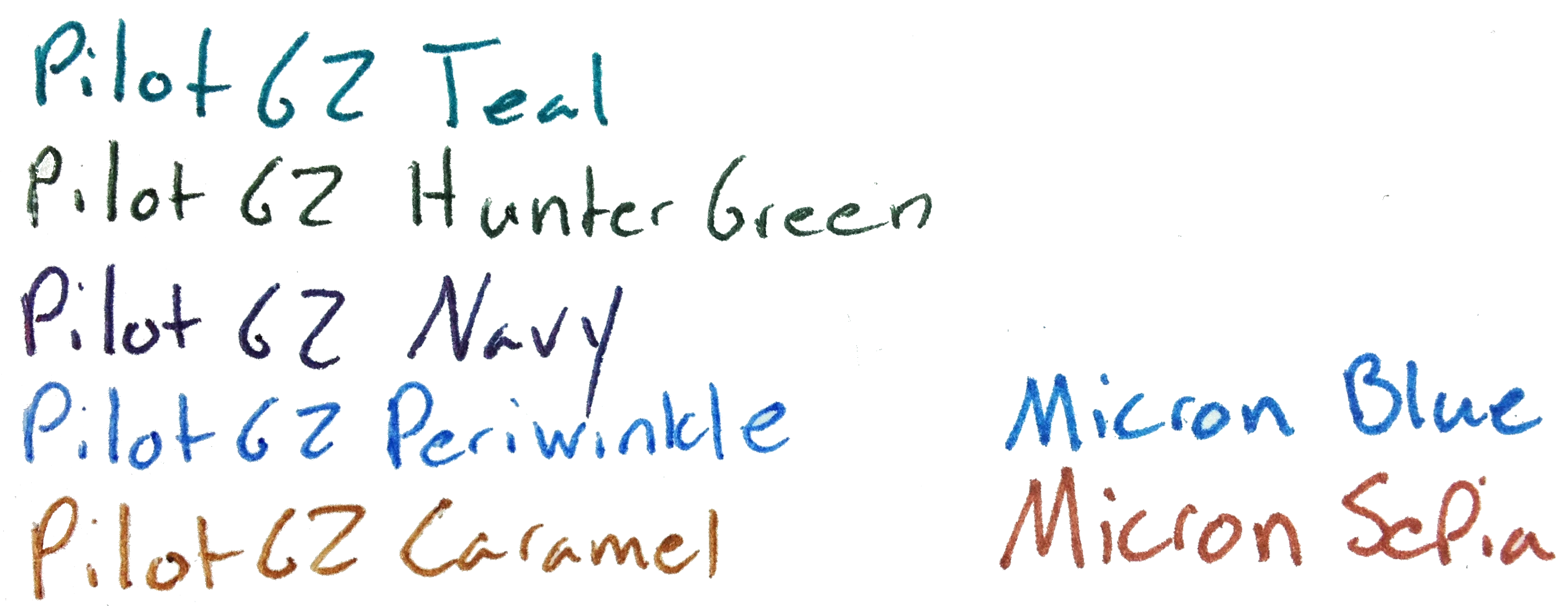
Review – Pilot G2 Teal, Hunter Green, Navy, Periwinkle, and Caramel

This week I’m gonna take a look at some of the weirder colors of Pilot’s G2 pens. Let’s dive right in.

third pilot pen comparison

First up is teal, which is a deep, bluish-green, almost like an aquatic plant. It’s very subdued and seems almost workplace-friendly (sort of like a blue-black, but with green). It goes on the page a bit thick and is a bit of a hard start when it’s not been written with for a while. A very soothing color overall.

Next up is hunter green, which is a deep, swampy green. It looks like a camouflage color, which I guess it’s supposed to. It isn’t the most pleasant of colors to stare at, but it is quite subtle. This color is probably the thickest ink and has the most problems with startup and skipping of the bunch.

Third is navy, which is a blue-black. It doesn’t really remind me of any previous navy colors I’ve seen, it is simply a very dark blue, but not a deep blue. It looks just like a combination of blue and black. Very work-friendly, I would say, but has no real art application save for maybe a night ocean.

Fourth is periwinkle, which is a light, sky blue. This is one of the lightest and easiest to read light blues I’ve seen. It isn’t quite as light as possible, but that makes it readable. It has a bit of shading (inconsistent color) but not too much. This is likely the most versatile ink color of the bunch, being a close to work-friendly “happy” color, and a realistic color that could be found in both water and skies.

And finally is caramel. Caramel is a light, almost hard-to-read brown. Again it is subdued enough to not hurt one’s eyes, but is very light and not particularly pretty. It does flow well, and really looks like caramel, so if you need a caramel colored ink, this is the ink for you.

That concludes my look at the Pilot G2 pen color types. I hope these were useful, they really do cover the gamut and provide ink colors for a variety of different uses. Unfortunately, I believe they only come in a large, expensive pack, so I would recommend having uses for a few of these pens before purchasing them.  They are great reliable writers with most of the ink colors, especially the more common ones (which are available individually) and can be used almost anywhere.