Review – Bienfang 12 Watercolor Brush Pens

If water color trays aren’t your style, there are of course other options. Like the Bienfang watercolor brush pens for example.

20121001-174311.jpg

The pens come in a dozen colors and with a blending pen. The colors are roughly two of the standard assortment: two greens, two yellows, two reds, two blues, an orange, a brown, a black and a purple. They vary in shades enough to make them unique from the standard assortment of bright crayola colors, but they still aren’t the most natural of colors.

20121001-174317.jpg

They come with the color separated from the brush like most brush pens. One must remove a ring to expose more thread that the cap can screw into to connect the two. The design is one of the best I’ve seen but leaves no room for more color. Once a pen is used fully there is no option but to discard it. The color must also drain into the brush before use and the body of the pen must be constantly squeezed to keep fresh color in the brush. But this is common on many cheaper brush pens and is no real problem.

20121001-174323.jpg

The brushes themselves are nice and tend to keep a point (once they are full of color). They do have a tendency to have a problem with the cap but that may just be me having a problem putting them back on. The color is applied in nice, smooth strokes if the brush is full and does layer and blend as expected. They are rather muted, though, and are hardly distinguishable from similar colors in the set until multiple coats are applied. Even then it is hard to tell the two reds or yellows apart. The color is also not true water color and is resistant when dry and stains clothes, so one should be careful when using it.

If one likes the watercolor esthetic but does not want the hassle of the tubes or trays, I’d say this is a good replacement. It does not, however, have all of the benefits of full water color. It is pleasant looking and nice to use but simply cannot capture the full water color appeal. I personally have found very little use for full water color and only a little more for this. I am not a fan of using either, but if you find that you are in need of a watercolor look, I would recommend a look.

Review – Pentel 18 Color Pens Fine Point Markers

Markers are fun. They’re not the type of thing one thinks of as a serious art supply, though. When one says markers, one most often thinks of the Crayola variety. But I have here a set of 18 Pentel color pen – fine point markers. I wonder how they compare?

the box


First thing, the pentel is is not to be used at all like a Crayola marker. It is thin, like a pen, and obviously can’t be pressed. They don’t fill very well, so coloring is not and option. But that is not really what one would be doing with these. They make a very fine line, almost like a ballpoint pen, but thicker. It is suited to detail work. They are good for mixed media or a sketch style. Blending is an option and a good one with these pens, in my opinion. They are not particularly suitable for larger images, however, because of their small size. They may even work better as just regular pens (even for writing) than as a marker.

The nib


The body of the pen is slick but holdable. The side is marked with gold lettering that indicates what they pen is, but it is hard to read and rubs off easily. The lids do not snap into place but they do fit snugly enough to not dry out after extensive periods of time. I have had them for long enough to confirm this. The case fits all of them and keeps them organized with ridges. The top folds over and Velcro’s shut preventing the markers from falling out.

The body


These pens are very nice but not exactly like the markers. They are more like colored pens but with felt tips. While they have a very limited application range they are very nice and quite usable. They are however, quite expensive little things, especially for how quickly they can be used, I would only recommend getting them if you do have a known use for them.

Review – Pigma Micron 05 Technical Pen

Ah, another Micron, this one is the 05 (.45mm) black version. Its main difference from other Microns of course being its nib size.

The pen body is slick but doesn’t slip when pressure is applied. Aesthetically it looks old school with its graphic design, but all the necessary info is readable and in intuitive places. The top of the cap is marked with the size, making finding the correct pen for the job from storage much easier. The overall length and weight of the pen is nice and makes it easy to handle.

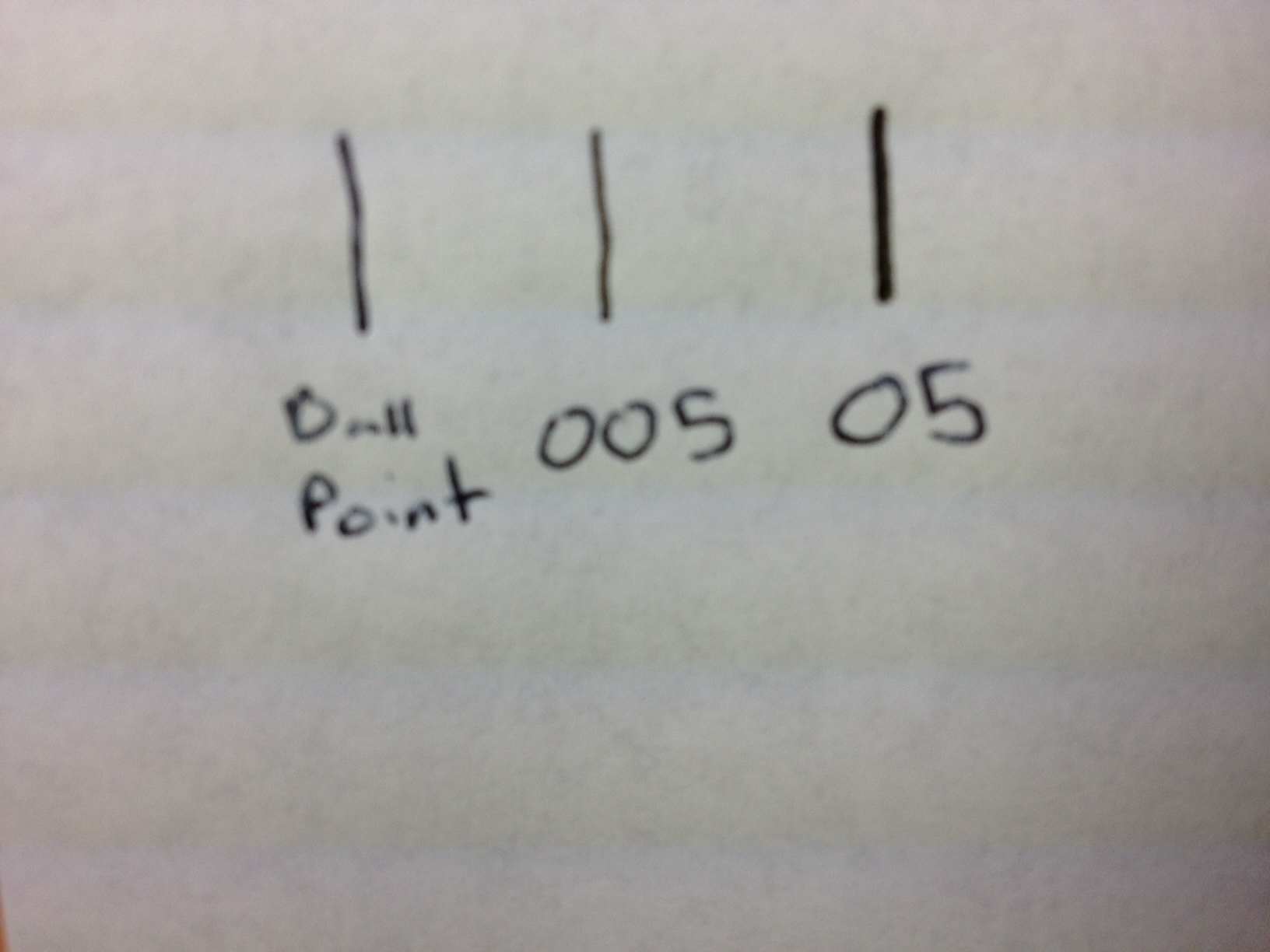
Of course the main difference between this Micron and other Microns is the nib size. The 05 nib is a medium size, good for main lines and other things that should be noticed but that you don’t want to emphasize as much (assuming you’re using a broad range of pen sizes). The nib also takes considerably longer to wear out then its smaller counterparts, and one will find the ink becoming grey or stopping almost entirely before wear from normal use is noticeable.

The ink is of course the wonderful Pigma ink, which resist fading and running. It does fade after prolonged times, but not entirely and it is hardly noticeable. It also begins to fade as an eraser is rubbed over it, but this is minor and will only happen once or twice.

Overall the pen is nice and a great value. It is more of a writing size pen then the other pens in the Micron range, making it one of the most versatile of the line.

Review – Imagine Plus 110-pound Card Stock

By: Austin Smith

After paper the new thing that one would most likely move on to is card stock, in this case Imagine Plus 110-pound 8.5″x11″ card stock. This stuff is a little more “advanced” and one could actually create “finished” projects on it. “Finished” being a subjective term.

110-pound card stock is obviously much thicker and heavier then paper. It takes pencil and ink well; heavy inking and even light painting also work well. The stock does buckle under water quite easily, though, so over-inking and water-based paints aren’t recommended. And painting on anything lighter than Water-color type paper could lead to buckling.

The stock itself is smooth, with enough friction to not go sliding around. Pencil is taken and erased well. Ink is quickly absorbed. The grain is noticeable at times but rarely affects the work that is on it. Heavy ink shows through, but the likelihood of someone seeing the back is negligible.

The size of the paper being 8.5″x11″ makes it a rarely seen art surface. The size, like that of copy paper, is simply unconventional. It is a good material for people just “graduating” into “finished” artwork.

While the stock is nice and useful, most will quickly pass it up for superior art surfaces.

Review – Office Depot 20-Pound Copy Paper

By: Austin Smith

When one is starting to review art supplies, it’s difficult to find a starting place. So I picked the thing all art is put on; paper. More specifically I’m starting with Office Depot, 20-pound copy paper. The kind of thing that everyone has access to. And the kind of thing you’re most likely to start making art on. (or at least preliminary designs)

20-pound paper isn’t that thick, take it off the table and you can see right through it (not clearly, but you can). It obviously won’t hold much and buckles almost instantly in moisture. Thus it won’t be useful for anything more then pencil or light ink. Although it being copy paper and 8.5″ X 11″ it probably won’t be what your finished piece is on.


The paper is slick, mostly, it’s got enough grip and texture to not feel glossy and go sliding around on you. It takes both ink and pencil very well. When using a good eraser, pencil almost completely disappears. The ink shows through the paper, the pencil does not. And the texture is fine enough that it is barely noticeable to the naked eye. Which is something good if you’re planning on creating a workable draft of something and not just sketching.

The fact that this type of paper is almost universal and its small size make it great for sketches and drafts. Its main limitation is that, aside from copy paper, its dimensions are almost never used. Most printed and official online “art” documents use different aspect ratios from copy paper, making it almost exclusively for drafts and amateur art projects (in the art world).

It’s always good to have some around, to sketch or to find out how things fit together, and it can always be scanned and posted on a Blog with ease. It’s obviously a starting material, but one that never really leaves the desks of experts.

It’s also really cheap, which is a bonus.