Review – PaperMate Flair Colors – Olive, Lilac, Navy, Plum, and Turquoise

And now for part 3 of my look at the 20 colors of Papermate Flair pens. This time I’ll be looking at five of the cooler colors in the lineup. I’ll just get started.

Papermate flair colors part 3

Olive – Olive is a nice green, forest-y color that looks quite natural and is very pleasant. It is quite conservative and laid back. One might be able to get away with using it at an office, but it’s unlikely. In poor lighting it almost blends in with dark blues and blacks, though. On the smearing side it’s one of the worst, easily smearing and becoming unreadable with contact with water.

Lilac – It’s a light purplish color that is smooth and quite easy to look at. It wouldn’t be appropriate in most offices, but in many a field of flowers there are similar colors. The color looks almost washed out before water is applied, but it smears and feathers probably the least out of the entire set.

Navy – Navy is a very dark, office-appropriate blue that goes well in most places. Artistically, it would be most at home in the dark, but there may be other applications. It does smear, but very little, and it is often readable afterwards. The main problem when water is applied is that there is so much pigment that it covers a wide area with a bluish tinge.

Plum – A bit off from most of the fruit I’ve seen, this plum is a dark, red-ish, purple color. It could pass for a plum still, just not one from a supermarket. It could also make its home in an office for a bit of fun, but not for everything. It bleeds, feathers, and smears pretty badly, but does stay mostly readable.

Turquoise – Turquoise is a nice color at points, but it shades quite a bit, and the color variation can at times be unpleasant. It’s a good sky, but doesn’t look like the stone, and going over it multiple times will turn it into more of an aquamarine. If your work doesn’t have a problem with blue, it should still work. With a wipe from water nothing changes, but if left for a few moments the color dissolves completely and is unreadable.

And that’s it for part 3. These colors are some of my favorites in the set, and much more usable than their warm counterparts. Next time I’ll be taking a look at the remaining 4 pens, which aren’t officially named anywhere I can find.
Review – PaperMate Flair Colors – Black, Blue, Red, Green, Purple, and Yellow

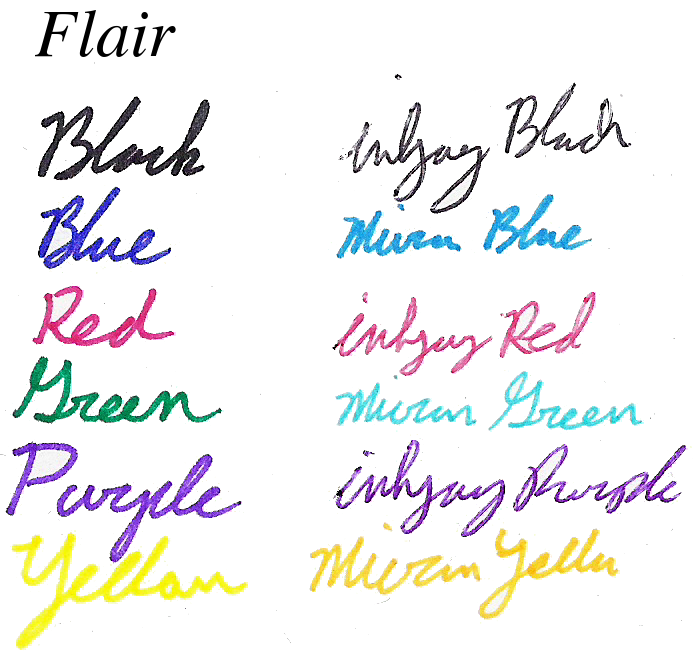
The Papermate Flair is a good porous-point pen; I’ve looked at both the black and red versions in the past. But they do come in a host of colors. I got the largest pack I could find, which seems to be exclusive to Sam’s Club, with 20 colors. And it’s so exclusive that I can’t find official color names for 4 of them. Those 4 will be in the last part of this series, the first 3 being Standard, Warm, then Cool. And now onto the colors.

Papermate flair colors part 1

Black – The black is a fairly standard black (most are): it’s deep and cool. It’s office-appropriate and moderately smear-resistant. While it does smear, it is readable after most spills.

Blue – A dark, office-type blue that is not a very natural color, but a pleasant one. It is legible and unintrusive. It lightens considerably and smudges when wet, but doesn’t erase.

Red – A dull (but still punchy) red, nice to look at, but a bit pinkish. It’s less glaring and hard on the eyes for grading and warnings than comparable pen reds, but similar to most marker reds. Is fairly smear resistant, but does lighten.

Green – A dark green, slightly darker than, say, a crayon green. It’s a deep, grassy, natural color. Noticeably different from the other, more common colors, but nothing that’ll jump out from across the room. It could be used in a liberal office. It smears and lightens quite a bit, though.

Purple – One of the more usual, pops-off-the-page purples. It is noticeable as a purple and isn’t the most natural-looking color. It stands out from dark blues, but could get lost in a page of dark inks. Almost no smudging on this one, though it does feather a lot when wet. It could be used in a similar office to the green one.

Yellow – A super-bright, stereotypical yellow. It’s almost illegible on white paper. It’s the most water-resistant after red and purple, but it all but disappears anyway. It hurts they eyes to look at for a long time (I’m not sure if it’s the brightness or the fact it’s hard to read) and isn’t a very natural-looking color. I wouldn’t recommend this one unless you’re coloring in books.

And that’s part 1 of my look at the 20 Papermate Flair colors. A good general assortment here, but nothing groundbreaking. Next week I’ll take a look at 5 of the more Warm colors in the set.

Review – Pilot Precise Colors, Green and Purple

I’ve taken a look at the Pilot Precise V5 pens before, and they’re pretty good pens in the standard compliment of black, red, and blue colors. But they also have a few other colors available, and in this little review I’ll take a look at the purple and green offerings.

Pilot precise green and purple

First the purple, which is much darker and a much truer purple than most, which are more a fuchsia. The color is deep, but not deep enough to be washed out. It could still conceivably be used in an office setting, but might be pushing it. And while there are rarely truer purples, it doesn’t have a very natural look to it. Perhaps it exists in some deeps shades of flowers, but otherwise it is far too dark. Startup with this color is easy, and while it does fade with water, it is still readable.

And second, the green, which again is much darker and much truer than other greens. It is unmistakably green, but darker than what one would usually think of green as being. It doesn’t get close to a forest or hunter, but certainly is far from a light or lime. I couldn’t think of any office uses, unless you’re a teacher who doesn’t want to use red. It is just light enough to stand out and not look professional. In art, though, it is a wonderfully natural color, and it shades a little bit for interesting effects. It has a bit of a startup problem (or a drying out problem) and is the less water-resistant of the two, but it is still adequate.

Is it worth moving over to Pilot Precise pens just to get these colors? Unlikely, but they are great colors that add to an already nice lineup. I enjoy them, and very similar colors are hard to find in disposable rollerballs or gel pens. They might be worth a look.

Review – Bic Stic Colors Pink, Purple, Lime, and Light Blue

The Bic Round Stic is an iconic pen. Not so much as the Bic Cristal, but still quite well known. It is a fairly robust pen, but usually one of few colors. The pen usually comes in the four standard colors: black and RGB. With some hunting, though, one can find more exotic colors, like the ones I will be talking about today: the pink, lime, purple, and sky blue colors.

20140924-022123.jpg

First up is the pink, which is a nice color. It certainly isn’t hot pink, which I despise. It covers well and writes smoothly. It’s fairly dark but still quite pink, though not a very natural pink. It’s the kind that could really only be seen from an ink like this and not anywhere else.

Next is the light (sky) blue, which writes smoothly, but has many little imperfections in the line. It just doesn’t cover well. The color is fantastic, though. It can be a bit hard to see at times but it’s quite pleasant to look at and not particularly eye straining. It is most like the colors at the edges of a clear body of water or the sky closer to the sun, so rare, but not unheard of in nature.

A bit altered in editing

A bit altered in editing, but a good representation

On to the lime, which is by far the hardest to read of the group. And it has some startup and writing problems, though when you get it working it does write smoothly. On the paper, the green is so light as to be unreadable in many cases and can cause eye strain. Though I call it lime, it really is much lighter and closer to… well, nothing that I can think of.

And finally, the purple, which is the best in terms of pen quality. It has no startup issues, writes smoothly, and covers well. It is darker than the blue but not by much, and still would require a second glance to read from far away. That being said, it is a very pleasant color to look at and is great for use when a more standard office color is not necessary. The color would be a rare one to find in the wild, though.

Overall, for writing these pens are hit and miss, and for art they are also hit and miss. The purple and blue are the best. I wouldn’t even try to use the lime. If you’re looking for some way to make your writing more unique, there are other Bic sets out there for that (like an entire box of the purple) and the same goes for any type of art that you might be making, unless it requires some very specific colors

Review – Papermate Inkjoy Green, Pink, Orange, and Light Blue

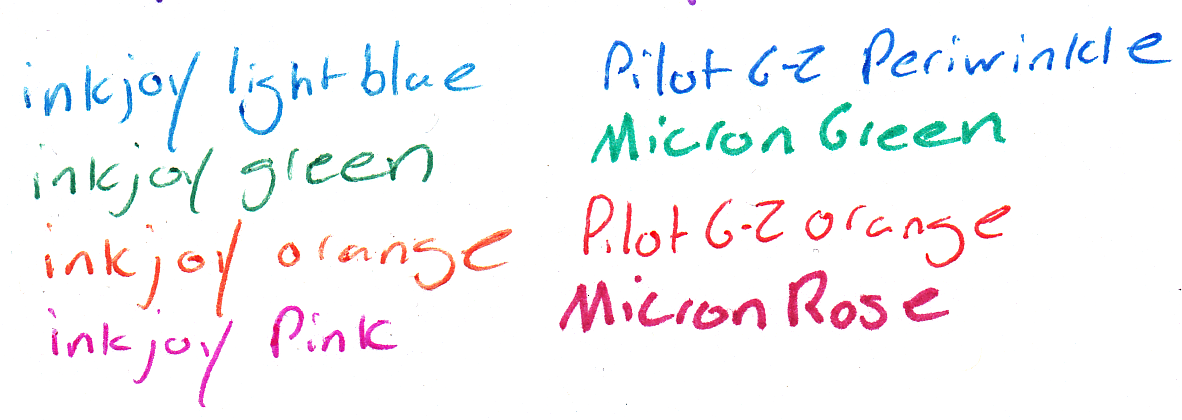
In a previous entry I looked at the more standard Papermate Inkjoy colors, now it’s time for the less standard colors, like light blue, pink, orange, and green.

inkjoy tests 2

The light blue is a sky-colored blue. It is the hardest to read of any of the Inkjoy colors, though it is still fairly visible when not cluttered. It has a very natural feel and is very sky-like. It is very neutral anyway. It doesn’t look like a color that takes a stance, if that makes any sense. It’d make a nice color for both drawing and work.

Next pink, which thankfully isn’t a very aggressive pink. It’s definitely not hot, it’s more of a magenta color, but not quite. It is not a very natural color, though, as it doesn’t look like a rock or a flower. Might be good for a personal thing, or some corrections or something similar.

Third is orange, which I must say looks almost exactly like Pilot G-2 Orange, which I have previously reviewed. Subtle, but not very useful, perhaps flowers or the fruit, but it could be work-friendly, if you’re in a less formal office setting.

Finally green, which is a quite deep, more forest color. A very natural and neutral color. Again a fine informal office color, and a nice forest or swamp color. Though very limited in its natural colors. One of the least useful, but most usable, colors in the set.

Overall these four colors are unintrusive and subtle, with various office and home applications, but very little artistic applications save a few specific places.

Review – Pilot G2 Colors – Black, Blue, Red, Green, and Purple

I don’t believe I have talked about G2 Pilot gel-pens before, I will do a full review later, but first I want to talk about most of the different colors that they come in. I have collected 15, and will split them into three groups, the first of which is the “normal” colors of black, blue, red, green, and purple.

ink tests

Starting with the black: it’s black, there is literally nothing special about it. It is a bit of a warm black, and it goes on smooth. It doesn’t have any magnificent qualities, it is just an all-around black.

Now for the blue, which is a fairly dark but basically standard blue, very similar to the black. It is probably one of the darkest standard blue pens available, and it is a fairly cool blue, like a deep lake. Again, though, it has nothing particularly special to offer.

The red is a medium red, which is a bit different. Most companies go for either an eye-bleedingly light red, or a deep red that is much more pleasant. As far as reds go this is in the middle, but it certainly isn’t neutral. It has no tint of pink, and is most definitively, starkly, red.

The green is surprisingly dark for a standard green. It’s almost a grassy color, and not the light, lime-ish color most other companies associate with green (it’s like the cherry flavor of pens). It is definitely green, but is unoffensive and pleasant. It sticks out, though, making it seem like one of those “replace red because it hurts people’s feelings on grades” pens (I’m no psychologist, so I know nothing about whether that is good or bad, it’s just what I thought of). I think it’s nice.

And finally the purple, which is the black sheep of the normal colors. It is a light, almost violet or deep rose color. It is warm and goes on a bit less smoothly than the other colors here. I really don’t like it, it’s just far too light, and it doesn’t go with the deep other colors at all. It really won’t stick out on a paper either, so it’s just kind of there, it has no natural color akin to it, so it has limited art utility as well.

Overall these are a very good set of office colors, and if you’re just looking for some smooth-writing different colors that aren’t too wacky, I’d look here first. But they do all have limited art potential, so you may want to delve further to get just the right color in that case.


Review – Sharpie Pen Colors

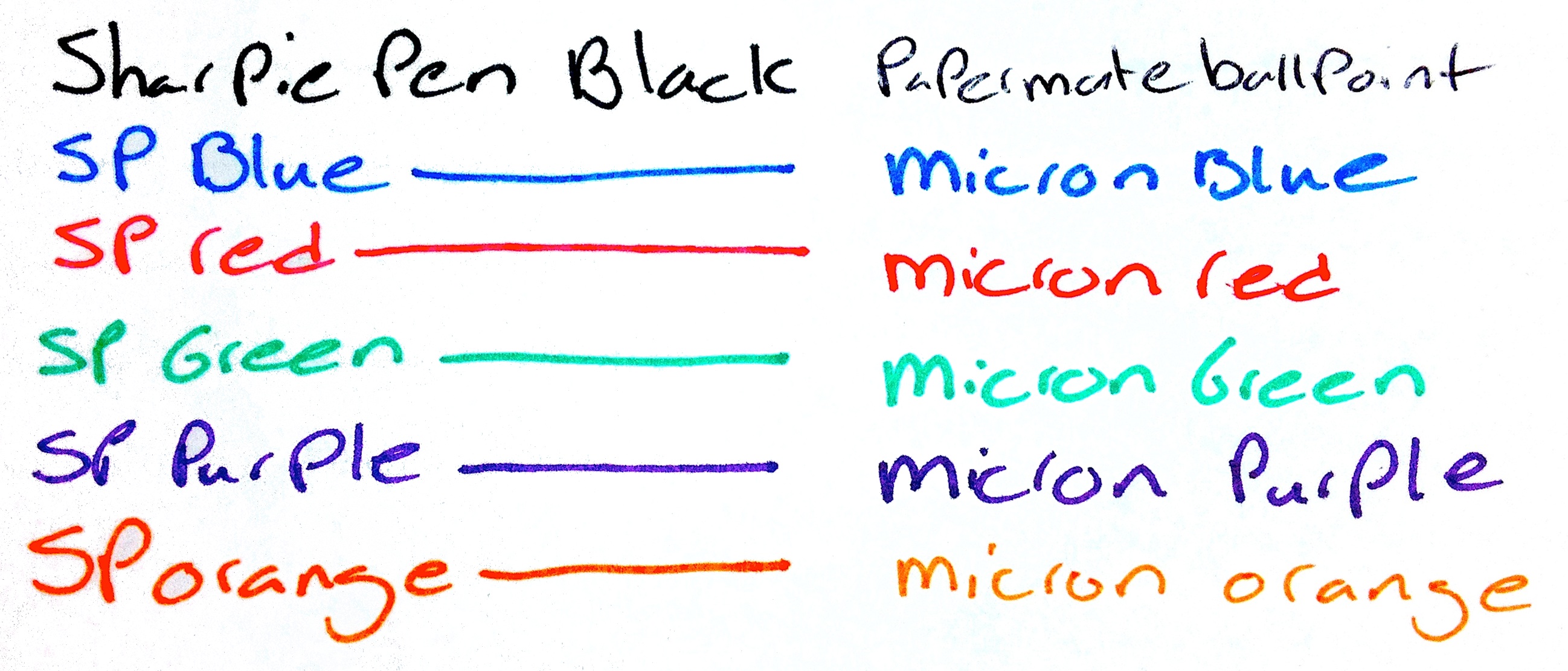
I have reviewed the Sharpie pen before. And the ink in that pen was a bit of a muted black. Now it’s time to look at some more of the Sharpie pen color palette: the blue, red, green, purple, and orange pens.

pen comparison sharpie 2

Colors not exact representations.

Starting off with the blue, which is a typical blue, if a bit washed-out looking. It is a subdued blue that would be appropriate in most work environments. They say that all of the colors are water-proof and smear resistant. I will say that is mostly true unless under extreme circumstances, but don’t expect them to be as all-around useful as their marker cousins. They also dry fairly fast and are supposed to be non-toxic, but I’m not checking that.

Now to the red, which is the most disappointing of the bunch. It is faded and looks almost pinkish. It’s hard to tell it’s really a red and it certainly lacks the intensity most look for in a red ink. That being said, it is subdued and will work better in a work or school environment where one would want a less aggressive color.

The green is, say it with me, subdued. It is undeniably green, and being as laid back as it is almost intensifies it. It’s the hardest to read out of the bunch and is almost eye hurting after a while. Strangely it is almost identical to Micron green.

The purple is flat, but deep. It is easily the darkest and most readable of the bunch. It is also fairly close to a Micron purple and provides a nice, neutral color, that is still quite different.

Now finally the orange. The orange is the only intense color out of the bunch, and even then for orange it is fairly flat. It does jump off the page and provide the kick one would expect from a nice orange. I’d say it’s probably the best color of the bunch.

So there are a few colors. Aside from looking almost identical to Micron colors I’d say they’re good. I haven’t the foggiest as to why that is but it is a bonus in my book. Anyway, if you like Sharpie pens, and want some nice, pleasant colors for work or some such, I’d take a closer look at these. And due to their subtlety they also look much more natural in drawings than standard, intense colors.

Review – Micron Red, Blue, Purple, and Green colors

I have reviewed several Micron pens in the past. But in case you were wondering if they could add a little more color to your life, here are some Micron Colors in .05.

It is an eight-pen set of colors from Micron that I’m looking at. It includes black so that’s out. The first four colors I will look at are what I call the ‘standard’ colors. They are red, blue, green, and purple.

I have already talked about the blue and the red so I’ll cover those quickly first. These pens are larger than the ones I reviewed previously so the ink is a bit more saturated. They aren’t as glaringly red and blue as before, but they are still some of the brightest and most vibrant of their colors on the market, aside from the awful nano-liner. Getting this large also makes them more prone to bleed-through, of which there is a slight hint in the blue.

Next we have the purple, which, in the Micron style, is a very aggressive purple. It is very deep, and in low lighting could be mistaken for black. It is very highly saturated, and changes little to none when applying pressure for some time to just tapping it on the paper. Amazingly at this darkness it isn’t very prone to bleed-through.

Finally the green. This is, surprisingly, a fairly sedate green, falling in the middle of forest and lime. It is unmistakably green, but rather unremarkable. It doesn’t jump like the other inks in this set. It just sits there, making it rather like greens in real life which you have to look closely to appreciate. Again, surprisingly enough this color is the most prone to bleed-through in the entire set, even writing fairly fast it leaves dots on the other side of fairly thin paper.

micron color test 1.1

So overall the ‘standard’ colors in this Micron package are great. They’re not really the best for sketches of nature or the outside world, but for labeling and organizing they are great. For example, different color parts in a schematic. It’s nice to have colored pens around and these hold up the Micron standard. I can definitely find a use for them.