Review – Uni-Ball Kuru Toga Mechanical Pencil

When talking about mechanical pencils, as with many things, it’s hard to get away from the idea that there must be some way to improve upon past designs, and that the standard design we use today has enough flaws in it that seem easily fixable that they should be promptly corrected. The Uni-Ball Kuru Toga is a mechanical pencil that is designed to fix one of the long-standing problems with pencils: unevenness of the tip due to use. Let’s see how it works out.

20141126-005210.jpg

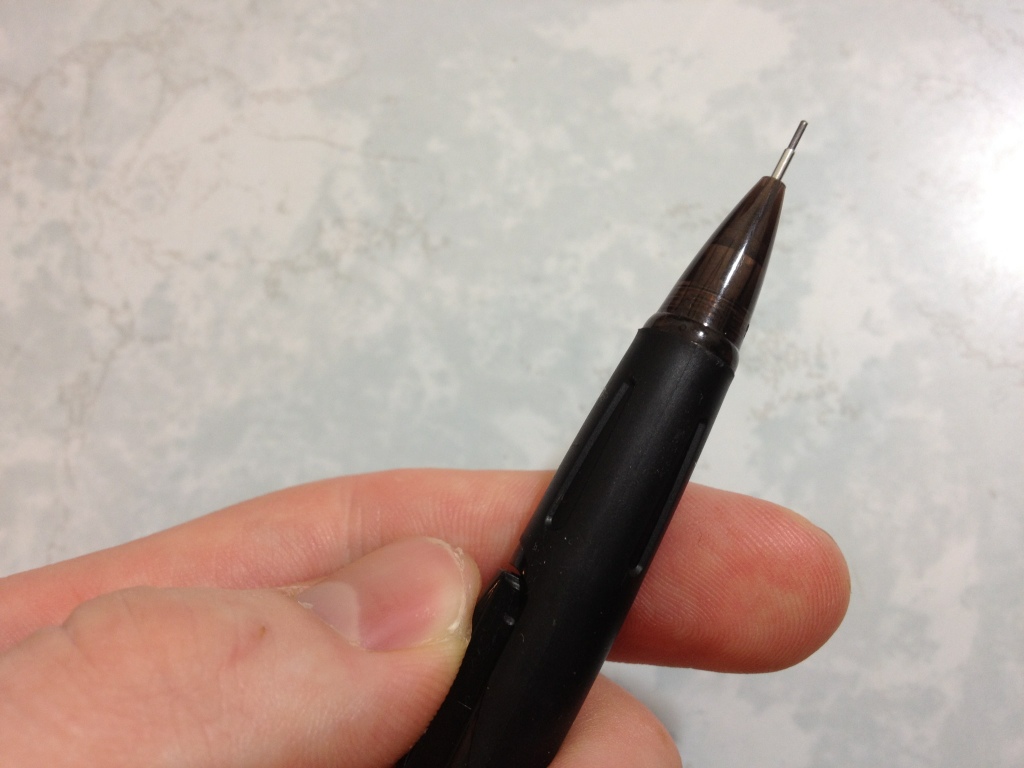
The body of the Kuru Toga is quite simple. The barrel is almost entirely featureless until getting close to the point, where there are a few ridges for “grip”, and then a small metal step-down to the lead point. Interestingly enough, unlike most mechanical pencils, this metal step-down is not integral to the design and the pencil will function fine without it. At the top is a small click-advance system, with a transparent eraser cover that is the accent color. The eraser is small, but works quite well, and most packs come with a few replacements. The cover makes a satisfying clicking noise as it moves into place. The clip has all the info you’ll get about the pencil, which is just enough, though not very much. The clip itself is functional, but not the best. The barrel is semi-transparent with a logo, giving the pencil overall a very interesting look.

20141126-005215.jpg

The lead is HB, and, according to the package, diamond-infused. It is harder than most other HB’s I’ve used, and I haven’t had a lead break on me yet, though that’s more because of the lead advance, which tends to give less instead of more, meaning I have less lead available to break. Overall, the lead is smooth enough and doesn’t write very bold or dark. The real feature of this pencil is the turning point, which acts with the pressure of writing and supposedly turns the lead to prevent breakage and to create a more even tip. I’m not sure if it works, or even if it is working, as I’ve never felt it when using the pencil, but I have also never had the lead break, so there’s that. I wouldn’t say it improves the writing experience by creating a sharper point, but it certainly doesn’t make it worse. Perhaps this feature for me is unnoticed since I naturally rotate the pencil around in my hand willy-nilly. That’s just how I write.

So overall, how well does this pencil do? Pretty good, I guess. I’m not a fan of the overall design, and the lack of any grip on the smooth plastic can make it hard to hold. Like I said, I can’t even tell if the feature is working, but I’ll go ahead and say that, at least through a combination of factors that went into the design of the pencil and lead, it is much less prone to breakage than other models. So if you have a problem with breaking your leads, I’d certainly have a look, but if you value the comfort in hand more than the lead quality, I might look elsewhere.


Review – Pilot Precise Colors, Green and Purple

I’ve taken a look at the Pilot Precise V5 pens before, and they’re pretty good pens in the standard compliment of black, red, and blue colors. But they also have a few other colors available, and in this little review I’ll take a look at the purple and green offerings.

Pilot precise green and purple

First the purple, which is much darker and a much truer purple than most, which are more a fuchsia. The color is deep, but not deep enough to be washed out. It could still conceivably be used in an office setting, but might be pushing it. And while there are rarely truer purples, it doesn’t have a very natural look to it. Perhaps it exists in some deeps shades of flowers, but otherwise it is far too dark. Startup with this color is easy, and while it does fade with water, it is still readable.

And second, the green, which again is much darker and much truer than other greens. It is unmistakably green, but darker than what one would usually think of green as being. It doesn’t get close to a forest or hunter, but certainly is far from a light or lime. I couldn’t think of any office uses, unless you’re a teacher who doesn’t want to use red. It is just light enough to stand out and not look professional. In art, though, it is a wonderfully natural color, and it shades a little bit for interesting effects. It has a bit of a startup problem (or a drying out problem) and is the less water-resistant of the two, but it is still adequate.

Is it worth moving over to Pilot Precise pens just to get these colors? Unlikely, but they are great colors that add to an already nice lineup. I enjoy them, and very similar colors are hard to find in disposable rollerballs or gel pens. They might be worth a look.

Review – Moleskine Volant Notebooks (Tiny)

I’ve talked about Moleskine books in the past. And while they aren’t the greatest of notebooks I find them to be my favorite for a number of reasons. The size and sturdiness of the covers are the main thing I like, but what if both of those things were taken away and I was left with a small and flexible notebook? This time I’ll be looking at the Moleskine Volant Pocket notebooks.

20141028-230947.jpg

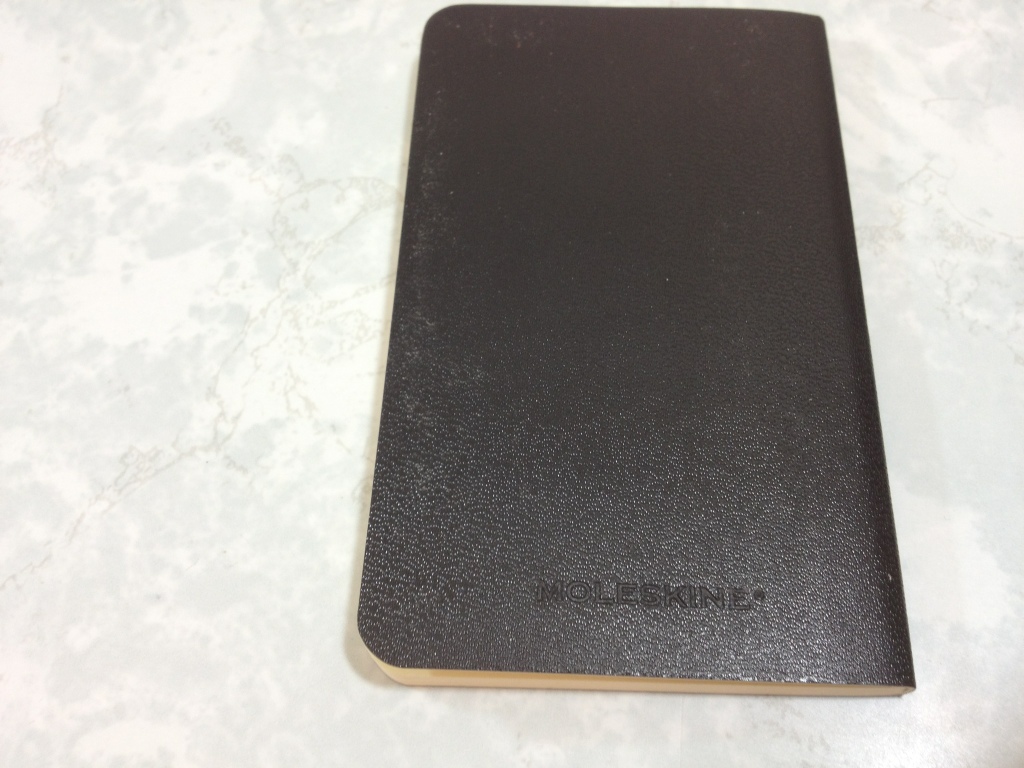
Moleskine Volant books are small, pocket sized books about 2.5×4.125in., which is a very odd size indeed. There are twenty-eight sheets or fifty-six pages. They are all perforated and standard moleskine paper with only a few lines.  There is a page on which a name and address can be written, but no pocket in the back as these books are much too small. Moleskine is imprinted on the back of the books and the cover texture is similar to the regular Moleskines.

20141028-230952.jpg

The spine and cover are quite flexible and the binding is hidden from view. After only moderate use the edges will start to peel and bend, but do hold up very well, and any pocket book is bound to get damaged to this extent. They’re a bit plastic-y, so the amount they hold up isn’t remarkable, but it is good enough to get the job done.

20141028-230957.jpg

The paper is standard Moleskine. It’s thin, and you wouldn’t want to use both sides even with a ballpoint for the bleed/show through. The perforations work quite well and I’ve had no problems with mis-torn sheets. The paper is fairly strong and archival as well as smooth. So the overall experience of writing on it is not bad if one’s pen choice is correct (it’s not a liquid ink type of paper). The ruling is spaced such that not too terribly much can be placed on a page, but at its size, there isn’t much more they could do.

Overall, these notebooks are wonderful for their size. If you have a pocket that would fit one and need to carry around a notebook this is the one I’d recommend. They are a little bit pricy, but I don’t know of another notebook of similar size in a competitors range. So it might be your only option. And it’s a good, even if not the best possible, option.


Review – Q-Pins Pushpins

Pushpins can be a problem. But they are what they are, right? There’s no getting around them. That’s what I would’ve thought until I heard about Q-Pins pushpins, which claim to have updated the pushpin to a more modern and easy-to-use design. How do they hold up?

20141007-225237.jpg

Full disclosure before I begin: I was sent these to review by the company. With that out of the way, let’s look at the features: Q-Pins are designed to deal with the problems one encounters when using regular pushpins. They’re shaped like a capital “Q” and use the tail to hold paper to the board, rather than the pin itself. If one doesn’t use the pin on a regular pushpin, the amount of force required to hold the document up will leave an unappealing mark. I used to get around this by using thumbtacks, which has less grip for your fingers, but more for the document. I’d best describe Q-pins as a cross between the best parts of a pushpin and thumbtack, with a little more ergonomics. The edges of the bowl on the Q are curved inwards, creating a nice grip for the thumb and index finger that is more than enough to get it out.

20141007-225242.jpg

They come in either packs of black and white opaque or a pack of green, blue, purple, and yellow translucent. Personally I wish there were more color sets, but these work well.

Now, it’s kinda hard to talk about what a pushpin does, even though I have done that quite a bit, it looks like. In any case, I decided to try and beat up a q-pin by throwing it across the room and at the floor with a moderate amount of force. The results were not a scratch, and I’ve seen pushpins shatter under similar conditions (though rarely). I tried bending the tail off, and my fingers began to hurt as the plastic started bending. I’m sure they can be broken, but it almost has to be intentional. And for a bit of fun, I grabbed the metal pin itself with pliers and pulled firmly in both directions. The pin and its plastic case are not easily separated.

So, are they better than pushpins? Yes. Are they perfect? No. If one is very careful or hangs up thick documents, the pin can be used to hang an object without a mark. But sometimes even a natural amount of force can lead to a straight indent in the document being hung. This is certainly better than a hole, and in my opinion it’s also better than the circular indent coming from a pushpin or thumbtack used with friction. In this scenario, the Q-Pin also has superior holding capability, though it is quite close. Removing the Q-Pin is also much easier than either of the two other options. It’s a clear winner, but it is a bit more expensive. If you don’t lose things and want a better pushpin, possibly for life, you should try some Q-Pins.

Review – Pentel GraphGear 500 Mechanical Pencil

Now, I’m a cartoonist, and when I am penciling and there is no wood pencil to be found (as there unfortunately often isn’t these days), I do use a mechanical pencil. But which one do I use? There are many “alright” and “good” mechanical pencils out there for very cheap prices. Well, I was looking for one a little better, and I found the Pentel GraphGear 500. Let’s check it out.

20140829-101239.jpg

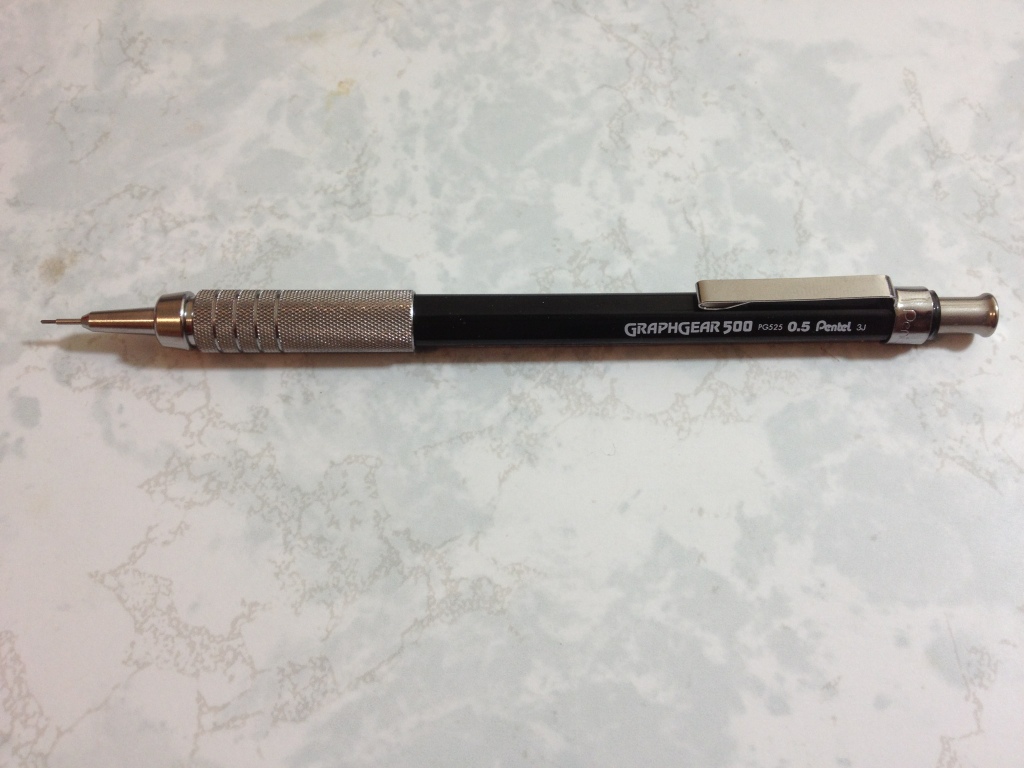
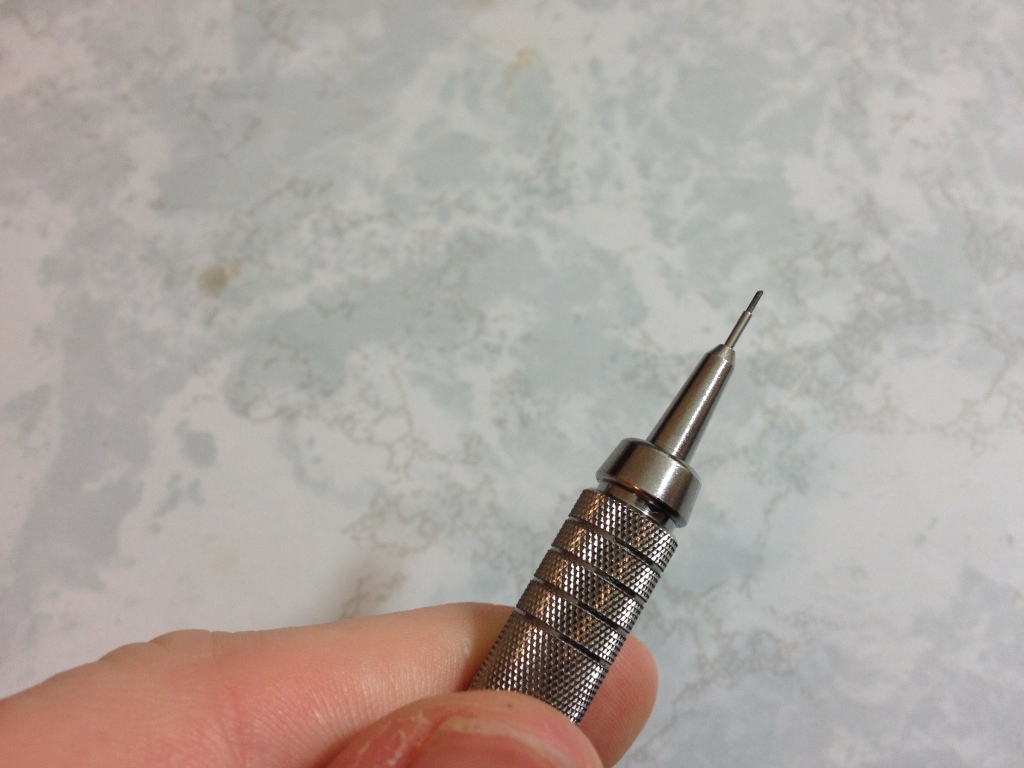
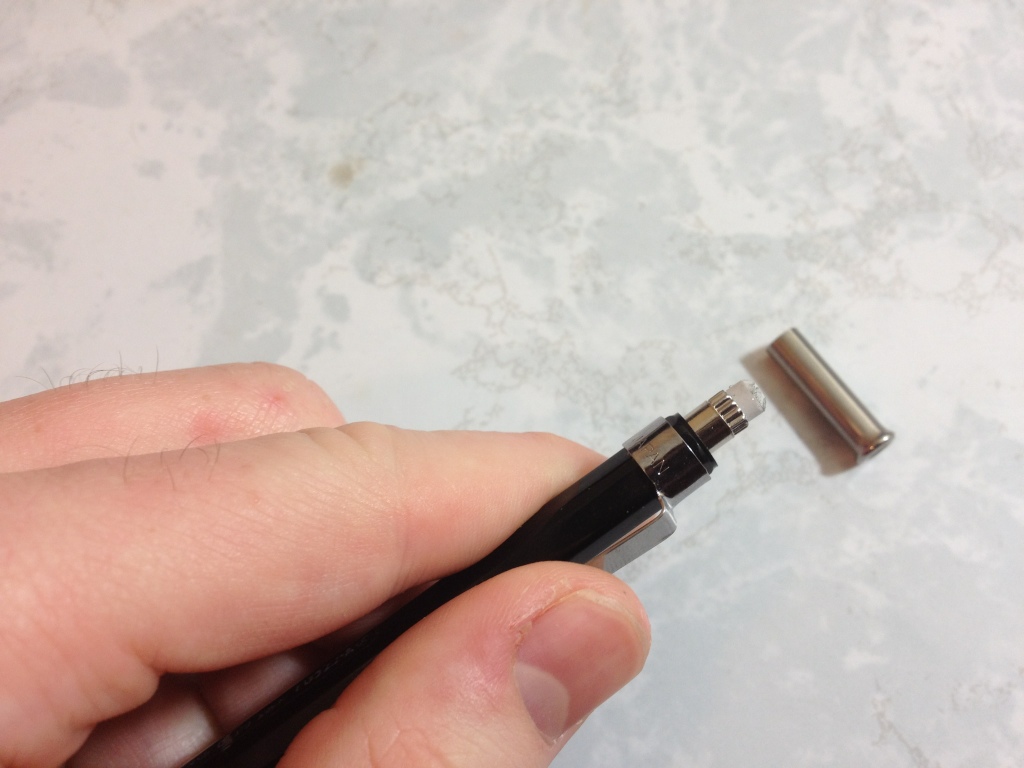
The top of the pencil is rather bland, with a simple metal button and a clipped-on metal clip (interesting). Down from that there is a thin hexagonal black plastic barrel with all necessary information printed on it, and then printed again on a sticker that it will all rub off of. The sticker also has some other, less-necessary info and a barcode, and has the benefit of being removable. The grip section is a very interesting knurled metal that holds quite well in the hand, isn’t sharp, and doesn’t leave one’s fingers smelling like metal as some pen/pencils do. There is then a smooth step-down/tapering tip all the way down to the lead, which in this particular model is 0.5 HB (#2).

20140829-101245.jpg

The lead is standard HB and writes quite smoothly, it feels a bit harder than many other #2’s I’ve used, which may just be a feeling in my hand. The entire thing feels very sturdy in the hand and is great for both technical drawings and sketches. The lead is “hi-polymer”, whatever that means, but it is good, and since there is no shock absorber it has to be good at not breaking, which it also is.

20140829-101250.jpg

There are several packages, and the one that I got has no spare erasers and only one spare piece of lead, ensuring that I have to go back and get more.

Overall the pencil is great. It works very well and is very nice to hold. It’s sturdy and keeps up with minimal wear. It’s easy to hold, easy to write (or draw) with, and stays well in the pocket. It doesn’t have any fancy features, which one could get in the higher end models, but it does cover all of the basic features and does them really well. If you want a good pencil without all the bells and whistles, I’d definitely check out the Pentel GraphGear 500.

Review – Pentel Twist-Erase Click

When looking at all of the options for mechanical pencils, one will inevitably come to the conclusion at some point that there just has to be a more efficient way to do the things mechanical pencils do. Fortunately, Pentel has you covered with the Pentel Twist-Erase click mechanical pencil, which hopefully is a lot more convenient than all of those other pencils you find around.

20140816-002532.jpg

The top of the pencil starts with the eraser, which has a small turning ring around the bottom that can be twisted to extend the eraser as the name implies. The eraser is very long, extending to a least five times its original length. Below that is a tight, functional metal clip that holds well and is held in place by a piece of plastic. On the same lateral space is the information about the pencil, where all necessary information is written in a fairly out-of-the-way manner. Below this is a rather interesting curved breaking point in the pencil which will separate and allow the lead to be inserted. Then we get to the side-mounted click mechanism, which is placed both just above and in place of the rubber grip section.  The button has a few grooves to ease pushing, but is otherwise smooth. The grip section is a thin rubber that does not let ones’ fingers slide but does not give to create something super comfortable. It is functional. Then there is a semi-transparent cone, leading to the thin metal tube that the lead will dispense out of.

20140816-002537.jpg

The two main features of the pencil work well. The eraser twisting is easy if not buttery smooth.  The pencil comes with several additional erasers which are just fine for what they are, though they won’t fully remove a hard pencil line. The side-click mechanism is easy to use, and out of the way enough that it doesn’t affect normal writing. The standard lead is HB and is really nothing special. It writes well, without any flaws that stick out. There is no shock absorption, so the lead is more likely to break than in a pencil with such a feature, but that really isn’t an issue. There are a few pieces of lead already in the pencil and it comes with a replacement container.

20140816-002542.jpg

Really, if one is looking for a different mechanical pencil, or specifically for a longer eraser or a side advance, on a budget, this is easily the best model. There are really no frills or problems, it just functions as advertised. Sure, there are more expensive models that could do better, but one would have to pay a premium for such items. For the sake of convenience I would definitely look into and consider the Pentel Twist-Erase Click.

Review – Kikkerland Retro Ballpoint and Stylus

A while ago, I reviewed the Bic Tech Ballpoint and Stylus pen. That was one of the first pen/stylus combinations I encountered that were actually purchasable for me (I live in the middle of nowhere). Recently another of the same type of pen was given to me: the Kikkerland Retro Ballpoint and Stylus. And I like these types of pens, so let’s see how this one preforms.

20140729-234916.jpg

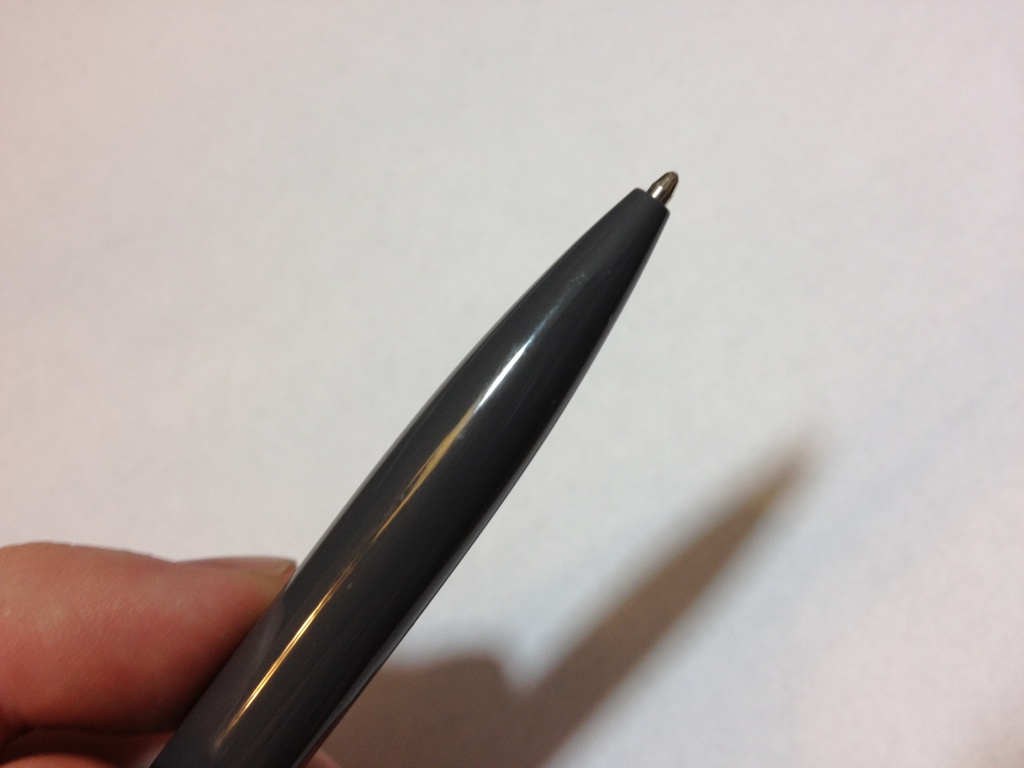
The style of the pen is “retro” and it comes in three color combinations, two of which I wouldn’t consider using, while I think the third, red and grey, looks quite nice. The pen is fairly torpedo shaped, with both ends tapering down and the widest point being in the center, where there is a small center ring that divides the two body colors and metal sections. There is an almost unusably tight clip that says Kikkerland near the top, followed by a small ring with the smallish stylus point on top. Beyond that, there is no information or other markings on the pen. The paint is plain and smooth, slick enough that it almost slides out of the hand at times, but durable.

20140729-234922.jpg

The mechanism is a twist one. It is quite smooth, almost too smooth, as pushing too hard on the pen may reverse the action. The default refill is a Cross type in medium, I’d likely buy Cross refills myself. The pen writes rather smoothly and has little in the way of startup problems, but a bit in the way of blobbing problems. It is good for short notes, but for longer writing likes to smudge and blob. It is, like most ballpoint inks, fairly water resistant.

20140729-234927.jpg

Flipping the pen around gets you to the stylus which is a bit smaller and more precise than the Bic one mentioned earlier. It is still slightly mushy and I think these smaller styluses need work before I will thoroughly enjoy using one, but this is the most responsive one I’ve tried. Again, there are a few problems, but I have no difficulties using this to operate my phone, and carrying it around to jot down ideas in Adobe Ideas.

Overall, the pen is on par and the stylus is slightly above-average. I’d make sure the colors and styles work for you before getting it, and replace the cartridge with a Cross refill. After that, it should easily serve well. The metal in the body is sturdy and the paint resists chipping, though it does chip near the tip. It isn’t the greatest pen ever, and it won’t last forever, but it is certainly better than much of the competition for not a bad price.

Review – Pentel Quicker Clicker 0.5mm Mechanical Pencil

Two weeks ago I reviewed the Pentel Champ mechanical pencil. Maybe that’s great and works for you, but let’s take a look at something a bit upgraded: the Pentel Quicker Clicker mechanical pencils.

20140708-230846.jpg

Starting from the back of the pencil, there is a small piece of plastic with a few breathing holes to cover the eraser, which is a fairly standard, white, mechanical pencil eraser. Following that is the metal clip, which is really clip-y and will make sure this thing stays put without ripping your shirt when you take it out. Engraved at the top of this clip is all the pen’s information. It’s a little less information than I would like, but it is all the necessary stuff. Past that is a slightly smoky tube which is quite thick, and contains all of the remaining leads and has them easily visible. The grip is next, which is a hard-type rubber with small wave-ridges, making quite a comfortable grip. Inlaid in this grip is a small side-advance lever that is made of plastic but feels very solid. The front of the pencil is a small plastic cone that is slightly smoky like the barrel, with a small, thin metal tube the lead will feed through. There is, unfortunately, no method of preventing the lead from breaking.

20140708-230853.jpg

The lead is 0.5mm and comes standard in HB. This hardness is the same as a No. 2 pencil. There really isn’t much to say about it: it is a high quality lead that resists breaking to some degree and goes on the paper smoothly. It is a little bit soft for me, and I feel that the line variations caused by varying pressure on the pencil happen a little too quickly for me to enjoy it as a daily writer, but as a sketcher it is great, depending on what you prefer. It definitely isn’t as soft as some would like, or quite as hard as some others (me) would like, but it gets the job done well.

Overall, the Pentel Quicker Clicker is a nice little mechanical pencil for a low-medium price. The side-advancing feed is great for not accidentally advancing the feed while erasing, and makes it more efficient to advance the lead and write faster. The lead, clip, and eraser are all serviceable, making the slim metal tip that allows lead to be easily broken the only detractor from the overall package.

Review – Sharpie Twin Tip Fine/Ultra Fine

I like permanent markers, and Sharpies are some of the best. But there are many situations where the tip of a fine Sharpie is simply much to broad. Carrying around a second sharpie in extra-fine seems like a hassle, or vise-versa depending on which size one uses more. The people at Sharpie (Sanford (Rubbermaid)) must have figured this out at some point and so they now have multiple point Sharpies. Let’s take a look at the Fine/Ultra Fine version.

20140702-004910.jpg

The body of the pen is quite like a regular fine-point Sharpie. The cap is slick with a flimsily little plastic clip built in. The body is made out of a similar material and has the necessary information printed on it. Where there would usually be a rounded-off end on a normal Sharpie, there is instead a tiny cap that has a set of spines, and is much easier to grip than the other end. Pulling either cap off reveals a slick section that is nearly identical to regular Sharpie Fines and Ultra Fines. These sections are not quite slippery enough to have the pen fall out of one’s hands during normal usage. The larger cap posts very easily on the smaller one, but in a very well-thought-out design choice, the larger cap has several small studs that allow the smaller cap to in effect be posted. This doesn’t hold the cap in the most secure manner possible, but is better than the alternative of nothing.

20140702-004916.jpg

The tips are fairly standard. The Fine is slightly larger than a Micron 08 or about 1mm, the Ultra Fine is about 1/2 mm or about the size of a Micron 05. Both of these are large for standard writing, but for writing on boxes, other large spaces, or some drawing they are superb. The ink is standard Sharpie fare: a cold, deep black (when the marker runs dry it becomes a much warmer color) that covers well, but not the best. It is permanent and run-resistant, it stains clothes and is unpleasant on the skin. It is non-toxic for normal use, but heavily sniffing or eating would be cause for concern. Just be normal with your normal usage.

Is it worth it to get a pen with two tips? Yes, if you find a need for both. I’d suggest going with the fine more often, as the ultra fine tends to dry up faster with its smaller cap. But there is still a good amount of utility there. The thing is easy to use, and works really well. Moving, signing, warehousing, and large art pieces are where these will find their homes. And really, for a nice black permanent marker, there are few that match and none that are better.

Review – Pilot Precise v5 Black, Blue, and Red

Times are tough if one wants to write smoothly and precisely on a budget. Technical pens wear out fast, and fountain pens cost money and time to maintain. I use both, but sometimes I just want to write easily and precisely without all of the maintenance and hassle. This is where the Pilot Precise series of pens come in. Today I’ll be looking at the v5 set in black, red, and blue.

20140603-232945.jpg

The cap and barrel are simple and straight. The cap has nothing on it but a simple metal clip that does its job well but can bend easily. The barrel has the necessary info about the product and an ink window so that if ink starts to run low you can get a general idea. Removing the cap shows a transparent section and feed system, which is more for being cool looking than any sort of functionality regarding ink level. At the end of the section is a series of plastic step downs that lead to a metal rolling ball tip. At the bottom of the section is a small clear plastic window that allows one to easily see if there is little or no ink left in the pen. The transparent section and barrel are both a slick plastic, but provide enough surface area that slipping off or letting go of the pen is not an issue.

20140603-232950.jpg

The tips of the pens write fairly smoothly. Older ones get a bit stiffer, but even on the extra-fine v5 they are never scratchy. The rolling ball delivers a nice “precise” line to the paper. Although it does have more variation than a technical pen in width, it has less than a standard ballpoint does, and it doesn’t blob. Like I said, writing is smooth: almost as smooth as a fountain pen, but not quite there. I’d say they are wonderful for writing (especially if ballpoints cramp one’s hands) but are not as good for drawing. Still better than a ballpoint, though.

20140603-232940.jpg

The three colors I have are Black, Blue, and Red: fairly standard colors with a fairly standard execution. The black is a warm black (this is an older pen, and Pilot may have changed formulas. The other two are brand new.) and noticeably less saturated than the thicker v7. The blue is quite dark, darker than most other Pilot inks, and quite work-appropriate. It’s almost a deep water blue, but not quite as dark as, say, Bic blue. The red is bright, bright to the point of being aggressive. Don’t grade papers with it unless you really want to say they’re wrong. It shows up almost from across the room and is quite a contrast to the deep red body of the pen. I’d say it has the fewest practical applications of the bunch. All of these inks are liquid-based and soak into the paper, meaning that they take a bit of moisture to run, but when they do they never stop. The red is the worst in this case.

In the end I’d say simply that these pens are great for writing, and all right for drawing. They aren’t the best but are great and ubiquitous for what they are.