Review – Tombow Dual Brush Pens Grayscale Set

Ink-washing is a great way to improve the look of ink drawing, but diluting India ink and using traditional brushes can be messy and a hassle at times. Gray brush pens certainly do help and the Tombow Dual pens have both a brush and marker tip to make using grays easy.

20150615-082919.jpg

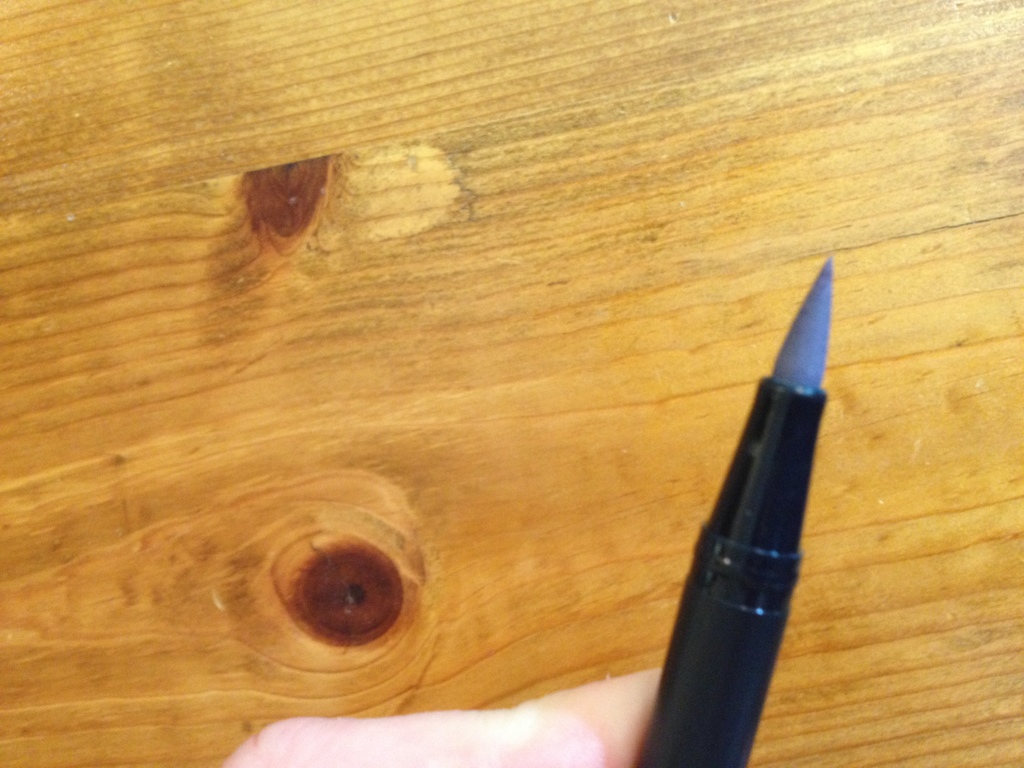
On either end of the marker there is a cap. One is quite a bit larger than the other, in both length and circumference. Both have ridges for easy removal, and small inner caps to prevent what they’re covering from drying out. The larger cap also has a fin to prevent it from rolling too far on a desk. The caps are made in such a way the that larger cap can “post” over the smaller one, and the smaller one can post into the larger one. They’re both sturdy and work well. The section for the larger brush side is nice and tapering. It’s long and easy to hold. However, the one for the marker side is quite stubby and holding on the body is almost necessary. The body itself is plain: a cylinder with text, Necessary information is there and it works.
20150615-082925.jpg

The pack I have is a pack of five grays and a black. The black is fairly understandable and a bit warm. The other grays purport to be “cool” but do vary from cool to warm, in my opinion. Several of them are also far too dark to really be distinguishable, but that also is just my opinion. The N95 and N60 are the most distinctive. Being very light and easy to work with, and very warm, turning to green after a while, respectively. The 45 and 55 are barely distinguishable and the 65 is about halfway between true white and true black, but all three get very dark very quickly and none of the five easily make a smooth edge, they are too varied in color to do so. The colors are all acid free, making them archival quality. And while they are water-based and claim to be blendable, I find that once they absorb into paper or card they are almost immovable. They go on smooth, the brush has quite a bit of variance but can be fragile (it is a sponge-like and not a bristle brush) and the marker is quite consistent and rigid. They can be used for several large projects or quite a few little ones, but can’t be expected to last longer than any other felt-based markers.

20150615-082930.jpg

In the end, they are great for someone who is just trying to get a feel for the grayscale washed look but is frustrated with, intimidated by, or doesn’t have to time for mixing up one’s own wash. Some other supplemental brush pens might be needed to get the full effect out of the shading, but these are a good start and the double-ended aspect makes them more useful than similar pens.
Review – PaperMate Flair Colors – Black, Blue, Red, Green, Purple, and Yellow

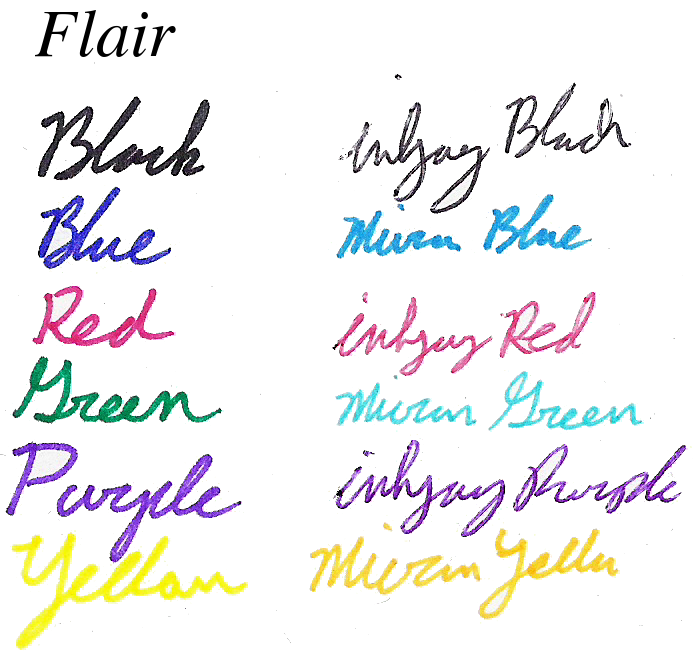
The Papermate Flair is a good porous-point pen; I’ve looked at both the black and red versions in the past. But they do come in a host of colors. I got the largest pack I could find, which seems to be exclusive to Sam’s Club, with 20 colors. And it’s so exclusive that I can’t find official color names for 4 of them. Those 4 will be in the last part of this series, the first 3 being Standard, Warm, then Cool. And now onto the colors.

Papermate flair colors part 1

Black – The black is a fairly standard black (most are): it’s deep and cool. It’s office-appropriate and moderately smear-resistant. While it does smear, it is readable after most spills.

Blue – A dark, office-type blue that is not a very natural color, but a pleasant one. It is legible and unintrusive. It lightens considerably and smudges when wet, but doesn’t erase.

Red – A dull (but still punchy) red, nice to look at, but a bit pinkish. It’s less glaring and hard on the eyes for grading and warnings than comparable pen reds, but similar to most marker reds. Is fairly smear resistant, but does lighten.

Green – A dark green, slightly darker than, say, a crayon green. It’s a deep, grassy, natural color. Noticeably different from the other, more common colors, but nothing that’ll jump out from across the room. It could be used in a liberal office. It smears and lightens quite a bit, though.

Purple – One of the more usual, pops-off-the-page purples. It is noticeable as a purple and isn’t the most natural-looking color. It stands out from dark blues, but could get lost in a page of dark inks. Almost no smudging on this one, though it does feather a lot when wet. It could be used in a similar office to the green one.

Yellow – A super-bright, stereotypical yellow. It’s almost illegible on white paper. It’s the most water-resistant after red and purple, but it all but disappears anyway. It hurts they eyes to look at for a long time (I’m not sure if it’s the brightness or the fact it’s hard to read) and isn’t a very natural-looking color. I wouldn’t recommend this one unless you’re coloring in books.

And that’s part 1 of my look at the 20 Papermate Flair colors. A good general assortment here, but nothing groundbreaking. Next week I’ll take a look at 5 of the more Warm colors in the set.

Review – Uni-ball Jetstream Bold

Some people search for the best of something. I never really looked at my collecting in that way. I just like using a variety of things, and for me I know that there’s no one perfect thing. But that doesn’t stop me from liking sites like TheWireCutter.com, which finds the best product in a given category for the average consumer. I was recently featured in their article about the best mechanical pencil (along with several other, well-known reviewers), and while I was talking to them, I thought I’d try out their recommendation for best ballpoint pen: the Uni-Ball Jetstream. If you read their mechanical pencil article, and my review of their pick the Uni Kuru Toga, this might seem familiar. I do understand why people like the pen, but I don’t like it so much, and here’s what I think of it.

20150311-220545.jpg

My particular Jetstream is the bold 1.0, and starting at the top it has a nice, beefy, chrome click button that is very satisfying to use. Down from that is the logo, size, and a solid clip that does its job. The majority of the barrel is rubberized, with the Jetstream logo in the top half in a hard-to-read, reflective plastic. There are slight divots on the section for grip, which actually flares out, instead of tapering in, making it quite large in the hand, and then an interesting-looking chrome cone that leads to the point. This cone does screw off and the pen is easily refillable.

20150311-220550.jpg

The ink itself is a nice, cool black that slides onto the page easily. There is an ever-so-slight amount of dry time, after which the ink is quite waterproof. While the ball does roll nicely and the ink flows smoothly, I still get blobs and stuttering, blobs being less frequent than with comparable pens, and stuttering much more frequent. This slight stuttering is hardly noticeable when writing, but is virtually the only feedback the pen gives. It is most definitely the smoothest ballpoint I’ve ever written with but I don’t feel like I’m in control of it when I’m writing. The stuttering is easy enough to overlook when the writing is done, though.

Overall it’s a well-designed, sturdy pen that I don’t want to write with. The point slides out from under me, and the thick grip cramps my hand after a while. It’s also extremely light, which makes me want to hold it tighter so as to not lose it. Still, the fit and finish are great, it’s very satisfying to hold, and if you want an “inexpensive” smooth ballpoint, it really can’t be beaten

Review – Hot Concepts Illumix 4 in 1 Stylus

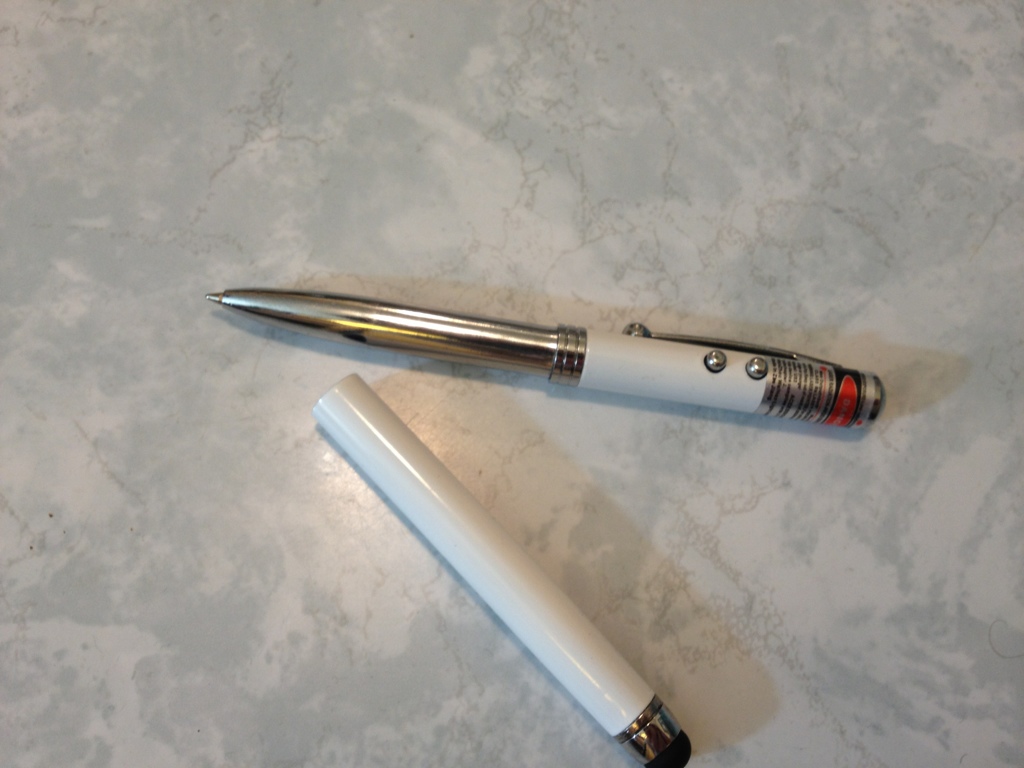
Every once in a while you run into a gimmicky, cheap product that’s still a bit of fun. For instance, I wanted a laser pointer (for me and my cat) and was in Walmart one day. On that day I found the “Hot Concepts Illumix 4 in 1 Stylus”. It’s a funky little pen with a light, laser, and touch-screen stylus. And it’s only a couple bucks! Let’s see how it works:

20150224-232410.jpg
The light is really just a white LED that’s stuck in the end of the pen. There’s no focus, so it dissipates rather quickly. You could get an idea about the shape of a small room, find a key, or perhaps locate something stuck behind some furniture, but that’s about it. Nothing far away can be seen, and nothing in great detail. But it still works alright. Interestingly enough, both the light and laser can be turned on at the same time. The laser is dimmed significantly by this, but the light seems unaffected.

20150224-232415.jpg

The laser pointer works fine. It’s one of the standard cheap ones that can be found almost anywhere. It will hurt your eyes, but isn’t very bright on anything else. It isn’t very well focused and will spread out over long distances. But inside a regular sized room, it is very functional as both a people and cat toy.

20150224-232420.jpg

The stylus works with modern touch screens, and it’s fine. It’s so easy to make a stylus that works with these screens now it’s unremarkable. It’s a bit cheaper than the norm and seems like it might wear out, but I’d say the worst thing about it is that you have to watch out and not hit the buttons and blind yourself when using it.

Finally, the pen part. It works, actually quite well. The tip is very fine, but despite that, it writes quite smoothly with little pressure. The inks a standard, almost-black ballpoint ink that’s water-resistant. The cartridge can’t be replaced as far as I can tell, though the batteries can be. So when you run out of ink you’re out and just left with the other features. That would seem to indicate the pen is not a primary function. The sleeve with the stylus has to be removed to access the pen, and this is not held on very well. It slips and can come off with a bit of a shake. There’s also nowhere to put the sleeve when using the pen, meaning it’s a two-handed operation.

A couple of other things: the clip works well, there’s a warning under the laser but otherwise no information printed on the pen, and the white smooth color with “chrome” trim looks nice, but not very professional, and it’s quite slippery.

Overall, every action it performs is done passably, but not well. It’s a fun device to mess around with or have if you want any or all of the 4 uses, but won’t use any of them that much. The batteries don’t last that long, the ink cartridge is small and not replaceable, and the overall tolerances aren’t very tight. The metal construction is nice, but the product seems to be made with disposability in mind. It’s fun, and good for the money. Just don’t expect much out of it.

Review – Monteverde Ceramic Gel Refill

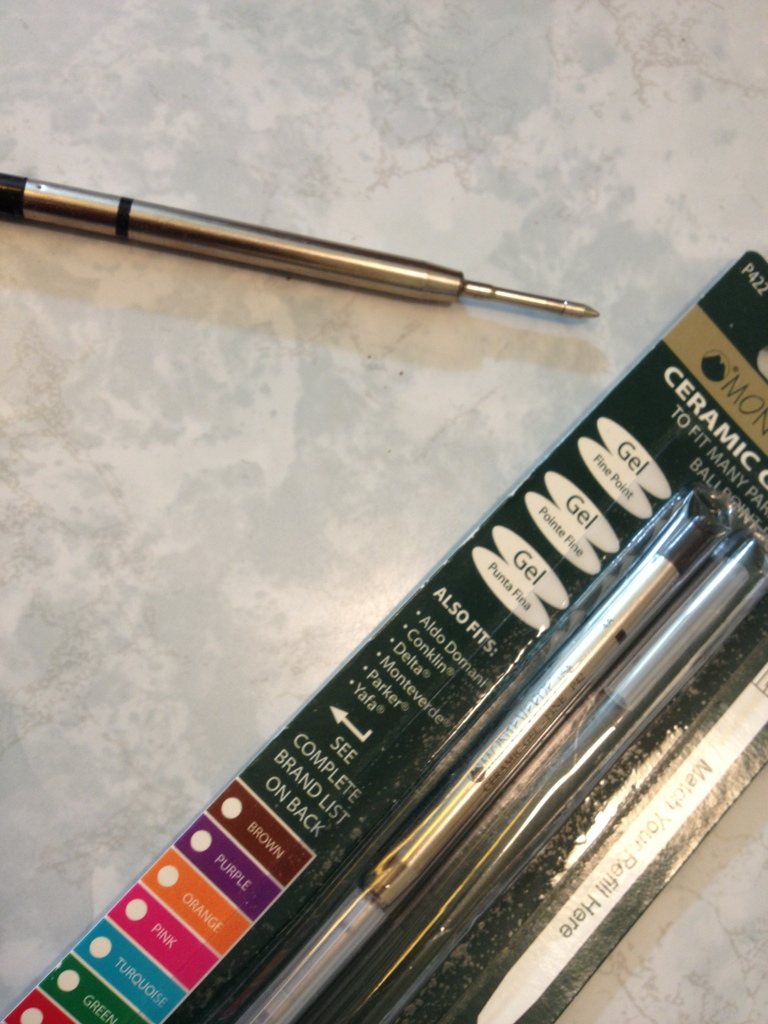
Some companies are iconic. Some companies have existed for years and have made a lasting impact on all of the products in their market today. Parker is one of these companies. And when my Parker Jotter ran out of ink, and I was trying to find a refill, this became apparent. Because while there aren’t many Parker brand click pen refills to be found in the world (it can be done, and much easier than some other things, but still…) it is quite easy to find a refill that will fit into a Parker pen. In fact, it’s more common to find pens that fit such refills than it is to find a genuine Parker pen now. Monteverde is one such company that makes both refills and pens of the Parker type, and I’ll be looking at the Ceramic Gel refill from them today.

20150210-235432.jpg

The body of the refill itself fits perfectly into any Parker-type pen with ease. Printed on the cartridge is enough information to help you buy another and then some.

The ink is a jet black. It takes some time to dry completely, though, and even when it is dry enough to turn the page the ink isn’t completely dry. It sparkles for some time until it fades to a nice black with little to no shading, which I like in a black.

When dry the ink is very water-resistant, with only minimal feathering. Writing is quite smooth, though I chose the fine-tipped version, which is very finicky about the angle at which it is held and will skip if it is even slightly out of alignment. The tip can also upon occasion require a stroke before the ink flows. After this, there are no flow problems to mention.

It’s just a good refill that does what one would expect it to. It performs well, and its smoothness is quite nice. Really, though, the feel is so close to many other gel pen refills that it comes down to a matter of trying most of them and selecting a favorite.

Review – Poquitos Part 2 – Monteverde Ballpoint/Stylus and Fountain Pen

I had the regular Yafa brand Poquitos for quite some time before ever even hearing about the brand Monteverde, which is one of the many brands of “inexpensive” luxury pens that Yafa owns. Monteverde mainly has their own line of pens that could be completely separated from Yafa, but recently I discovered Monteverde was releasing a set of pens under the same name and similarly styled to the Yafa Poquito. This, of course, confused me, until I found out the companies’ relationship. The two Monteverde Poquitos have both similarities and differences when compared to the regular Yafa versions. Let’s take a look.

20150121-234835.jpg

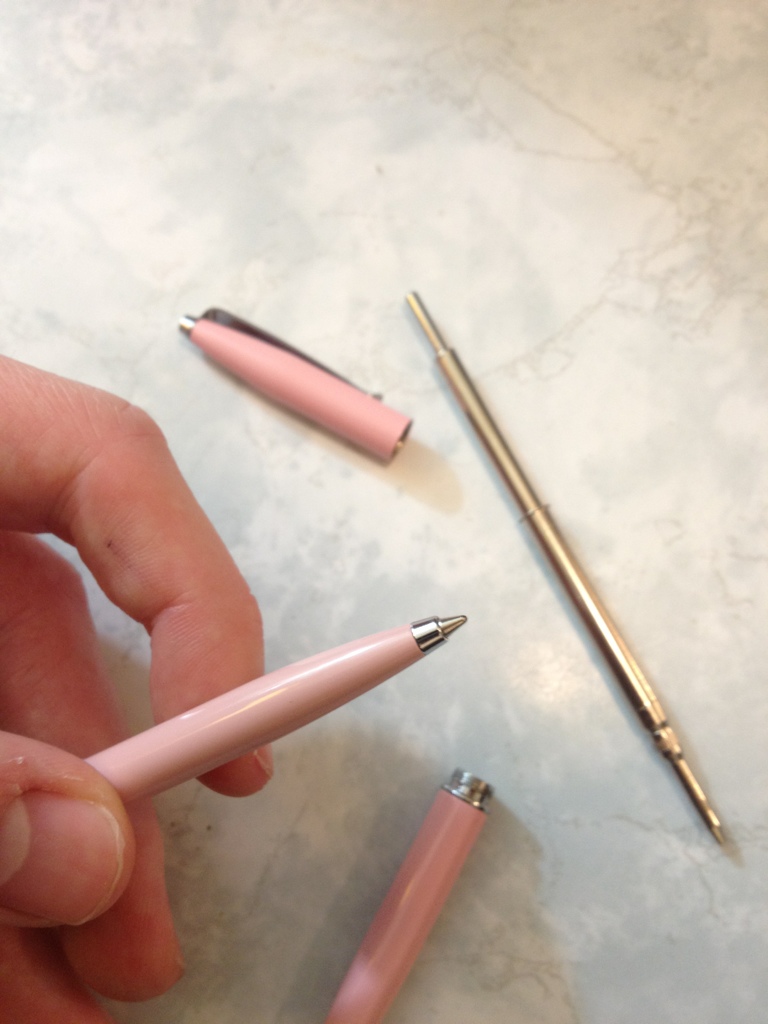
First up is the fountain pen, which is styled very similarly to the original Poquito, but because it is a fountain pen, it is slightly larger, a little longer, and about twice as thick. The tip of the cap has the same “stylus” as on the smaller pens, and the clip is almost identical. The pen is also made of brass, but seems to be painted better, and Poquito is written right on the cap.

Being a fountain pen, it accepts cartridges (of the standard international variety), but there are no converters designed for it. Some small converters can be finagled into working, but none are advertised as doing so. The nib (which is only available in medium) and feed are relatively dry, but that is the case with many pens with similar nib and feed types (plastic, iridium point, German made) and many inks are designed to work well with this type of pen. The section is stainless steel (I think) and gets slick upon prolonged use. And the pen is too short to hold comfortably without posting. But the pen is still super small, and is absolutely ideal for taking quick notes provided one finds an ink that works well with it.

20150121-234842.jpg

In addition to their release of the fountain pen, Monteverde also released a new version of the regular ballpoint Poquito, called the Poquito Stylus (and funnily enough, they also released the Poquito Stylus XL which is almost the size of the Largo). The pen has the same writing and mechanism end as the Yafa Poquito (which is the only part that the Poquitos share). But on the other end, a touch-screen stylus of average size replaces the old hard “stylus” point, which was really useless. This new stylus works quite well, though it can be a bit broad at times. The clip design has also changed. It works just as well, and looks a little nicer, in my opinion, but is more likely to damage the item it is clipped onto. The ballpoint itself is identical to the older pen, with refills being the same.

Overall, the Monteverde versions of the Poquito pens are quite small, and quite functional. They haven’t really fixed any of the problems with the standard Yafa versions, but the added benefits of a fountain pen and stylus (for the people that like to use them) are great. All of the Poquitos are hardy little pens that serve well, and can go almost anywhere. The Monteverde versions just add a little more style and a little more usage variation.


Review – Poquitos Part 1 – Yafa Ballpoint and Pencil

Some things are better small, and the Yafa Poquito, being one of the first pens I got, proved that to me. It was exceptional for my small hands at the time. But how does the set compare now?

20150113-225904.jpg

The Yafa Poquito pens have metal bodies that come in various colors. The top of the pen is a bit of a rounded-off cone, and the top of the pencil has a small steel button. The clips are tight and almost identical, with the pen’s being pointed, and the pencil’s being round. The bodies of both utensils taper from the middle to each end, with the center band being separate in the pen and attached to the mechanism in the pencil. The metal tip of the pencil is also part of the mechanism, whereas in the pen it is part of the body. The bodies are quite solid, but the paint will wear off with time and a bit of use. Consider getting a silver or brass one to fix that if you mind.

20150113-225910.jpg

The pencil takes .7mm lead, and what it comes with it fairly standard, sometimes broken in transit. The mechanism is easy to use and quite sturdy. It would stand up to a bit of abuse. There is no play once the lead has been extruded, it doesn’t have “shocks” as it were, but the mechanism is separate from the pen body, and this creates a squeak now and then.

The pen is a smooth-writing fine cartridge. It is a ballpoint so there are occasional globs and hard starts. If left out for some time, the pen will be quite hard to start, but in this case a while is so long a time that one would expect it to. When it does flow, it is very smooth, and has almost no issues. It is not quite black, and waterproof, as most ballpoint blacks are.

The Poquitos pack quite a bit of punch for their size, being less than 4 inches long (and they still manage to fit relatively comfortably in the hand). And while they do have some flaws, they are far from from deal-breaking for having a pen or pencil there when you really need it. They serve best as backups and are miles ahead of small pens that don’t allow one to comfortably hold them or have very little ink. I’d say that in that category, Poquitos are at least worth a look.

Review – Pilot BP-S Medium

For quite some time, pen companies have been trying to come out with the “superior” ink. And many succeed in varying ways. Every ink has its benefits and faults. The Pilot BP-S (which I can only assume stands for “better pen” as it uses the “better” refill) claims to have a “revolutionary” ink (perhaps when it was first made) that is very smooth and writes the first time. But all my quotation marks just make me a skeptic. Let’s look at the pen.

20141224-010739.jpg

The body of the pen looks like a hyped-up Bic Cristal. It’s got a similar hexagonal shape, with a black end cap that screws off for easy refilling (with the Pilot better refills). The body is clear with a minor amount of information physically molded into it. It’s enough to tell you what you’re using. The grip is series of tiny ridges that lead all the way to the metal cone tip, and are surprisingly grippy compared to the rest of the pen. The refill in this model is medium, and it comes out a ways beyond the cone. The cap is nothing to write home about, though it does have a flat surface for easy removal, which is nice.

20141224-010745.jpg

On to the writing. I can tell you for a fact that no pen that isn’t liquid ink will write the first time every time, but this one comes close. It does take some pressure to start, usually, and a more constant pressure to continue writing than a regular ballpoint, but the overall experience is smoother. With the right amount of pressure, the ink comes out in a consistent line, and with a little let up, a serviceable one with a few gaps. Neither of these options are more strain on the hand than a regular ballpoint. The ink is black, most of the time. Sometimes it’s more of a cool dark grey. And that’s fine for any office setting, though not really for art. It is also smudge-resistant and water-resistant, like most ballpoints, so it will survive a spill as long as the paper does.

Overall it’s a good pen. Perhaps it was better comparatively when it was first introduced. It is nothing terribly special, but it is superior to standard ballpoint offerings from most major companies. Again, just slightly. If a ballpoint is the perfect writing or art utensil for you, but it just isn’t quite smooth enough, these are probably worth a look. They certainly don’t cross over into the realm of feeling or acting like another type of pen, which unfortunately tends to happen with these “smooth” inks.

Review – Zig Millennium 005 Technical Pen

There are a lot of technical pens out there, and I’ve only looked at a few. Today I’m going to try and remedy that a little bit by doing a review of the Zig Millennium technical pen, specifically the black 005 version.

20141216-235803.jpg

The pen body is a bit odd. The bottom is a small, rounded piece of plastic. The barrel is silver and covered in writing. All necessary information is printed in several languages. The cap is nothing really special either: the top is flat with the tip size on what looks like a black plastic cutaway; the clip is simple, with a rounded end similar to a Pilot Precise or Uni-ball Vision. Interestingly enough, it says to keep the pen horizontal, but gives one a pocket clip. It’s the section of the pen that’s strange: it’s very small and nubby, it rounds off quite quickly and the ridges used to keep the cap in place are quite noticeable. It terminates rather abruptly into a metal end that leads to the tip. I’m not sure if one is supposed to hold the slightly uncomfortable section when writing or move back on the pen and place the fingers over the written portions of the pen, which I can feel the ink is raised up on, and will likely rub off quickly.

20141216-235811.jpg

On to the tip. It produces a very thin line, around the same width, but perhaps a bit wider than other brands of the same size, though that may just be the paper being used. The ink is archival quality (haven’t tested) and waterproof (have tested, is quite!) though that is to be expected from a pigmented ink. The black is quite black, and a cool black, which is nice, as many blacks tend to be warm. Writing is smooth and there are no skips or bumps with a good tip, though it will wear out after some time.

Overall it’s a good little pen, and quite comparable to the other technical pens in terms of both quality and price. I can’t speak for whether or not the rest of the line is wider than its counterparts from other brands, but that might be something to consider when purchasing. Otherwise, I’d say it’s almost entirely an æsthetic and comfort choice for the user.

Review – Pilot Precise Colors, Green and Purple

I’ve taken a look at the Pilot Precise V5 pens before, and they’re pretty good pens in the standard compliment of black, red, and blue colors. But they also have a few other colors available, and in this little review I’ll take a look at the purple and green offerings.

Pilot precise green and purple

First the purple, which is much darker and a much truer purple than most, which are more a fuchsia. The color is deep, but not deep enough to be washed out. It could still conceivably be used in an office setting, but might be pushing it. And while there are rarely truer purples, it doesn’t have a very natural look to it. Perhaps it exists in some deeps shades of flowers, but otherwise it is far too dark. Startup with this color is easy, and while it does fade with water, it is still readable.

And second, the green, which again is much darker and much truer than other greens. It is unmistakably green, but darker than what one would usually think of green as being. It doesn’t get close to a forest or hunter, but certainly is far from a light or lime. I couldn’t think of any office uses, unless you’re a teacher who doesn’t want to use red. It is just light enough to stand out and not look professional. In art, though, it is a wonderfully natural color, and it shades a little bit for interesting effects. It has a bit of a startup problem (or a drying out problem) and is the less water-resistant of the two, but it is still adequate.

Is it worth moving over to Pilot Precise pens just to get these colors? Unlikely, but they are great colors that add to an already nice lineup. I enjoy them, and very similar colors are hard to find in disposable rollerballs or gel pens. They might be worth a look.