Review – Paper:Mate Design Mechanical Pencil 0.7mm

t’s always nice to try new mechanical pencils, and I’ve been looking at a few recently. One that is around what might be considered “medium territory” is the Paper:Mate Design pencil (7mm #2), which has a few nice features that make it nicer than some others I’ve looked at.

20140909-224744.jpg

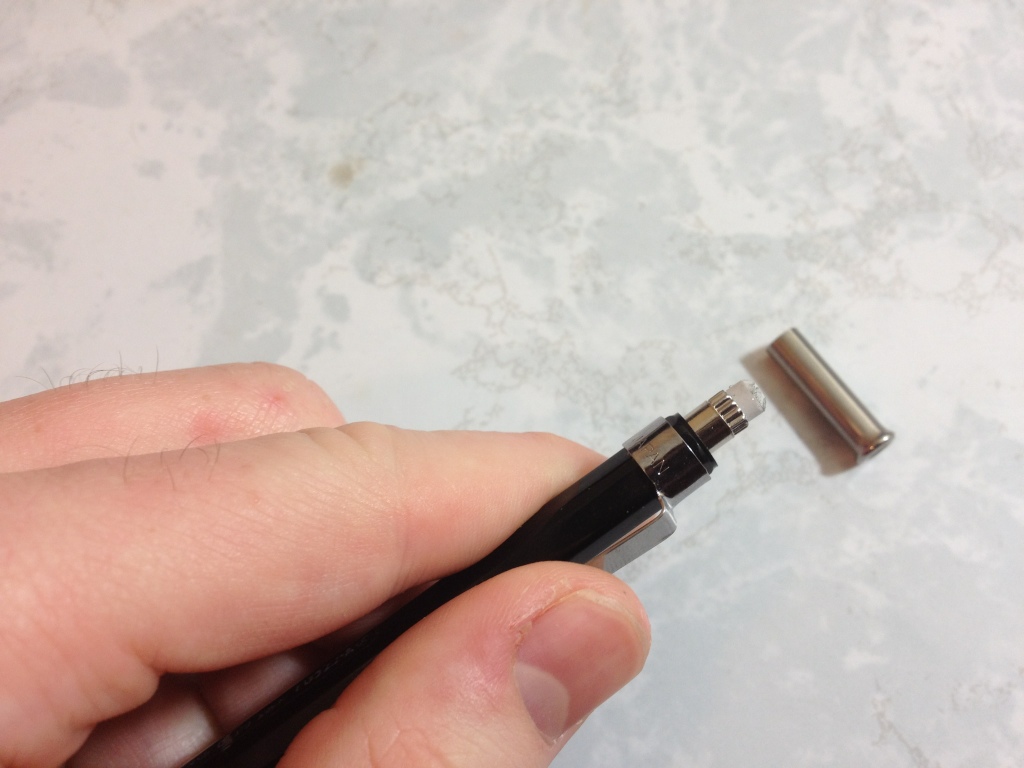
Starting at the mechanism, the button is quite small and has a slight angle to the top so that one’s fingers will just slide off that much easier. That being said, it works quite well. I haven’t had any issues with it, and the click is both minimal and satisfying. Removing the metal sheath reveals the eraser, which does its job. Removing the eraser gives one access to the lead, and removing the eraser holder allows one to disassemble the pencil, which is handy (one would need to unscrew the front to do that). Down from that is a clip with the Paper:Mate logo. It needs some finesse to clip on, but both holds well and is fairly easy to detach. The barrel is a medium-sized metal tube with a nice finish that simply says Paper:Mate (personally I’d’ve liked more info, but that is literally only me). The grip is a fairly hard rubber with several lines running parallel that don’t seem to do anything to improve grip. It is a bit slippery, but not to a degree that it will distract you unless you’ve used a ton of pens and pencils. There is a metal cone that leads to a smaller, retractable metal cone tip the lead flows out of. This retractable tip means that the pencil will not scratch the inside of a pocket or something, which is quite nice.

20140909-224750.jpg

The lead is alright. It is standard HB but feels a bit smoother and more break-prone than other brands of HB I’ve used. That being said, it’s broken about the same amount. I was at first apprehensive when using this pencil. It has no shock-absorbing spring and when one pushes down just after clicking, the lead retracts and makes a distracting clicking sound. This is a major problem in pens for me, and hearing the sound again and again drives me crazy, but fortunately this pencil holds the lead tight enough that I only ever hear the sound at the start of a writing session. What it does mean that is annoying, though, is that if the lead is only advanced a slight amount, a problem this pencil tends to have, then one can easily push the lead back into the pencil and be unable to write. This is actually not as major a problems as it sounds, but I feel it should be mentioned.

20140909-224755.jpg

Overall, this pencil exceeds my expectations. The retracting point and stainless steel barrel are nice features. And aside from a few minor things, everything else does its job well enough. The pencil really feels solid and good in the hand without being too heavy, and the writing experience is quite smooth. If you’re looking for a tough mechanical pencil for some mid-length writing sessions, I’d seek one out, though if you’re in an extremely demanding location or are writing for a long time (the grip is poor) you might look elsewhere.
Review – Pentel GraphGear 500 Mechanical Pencil

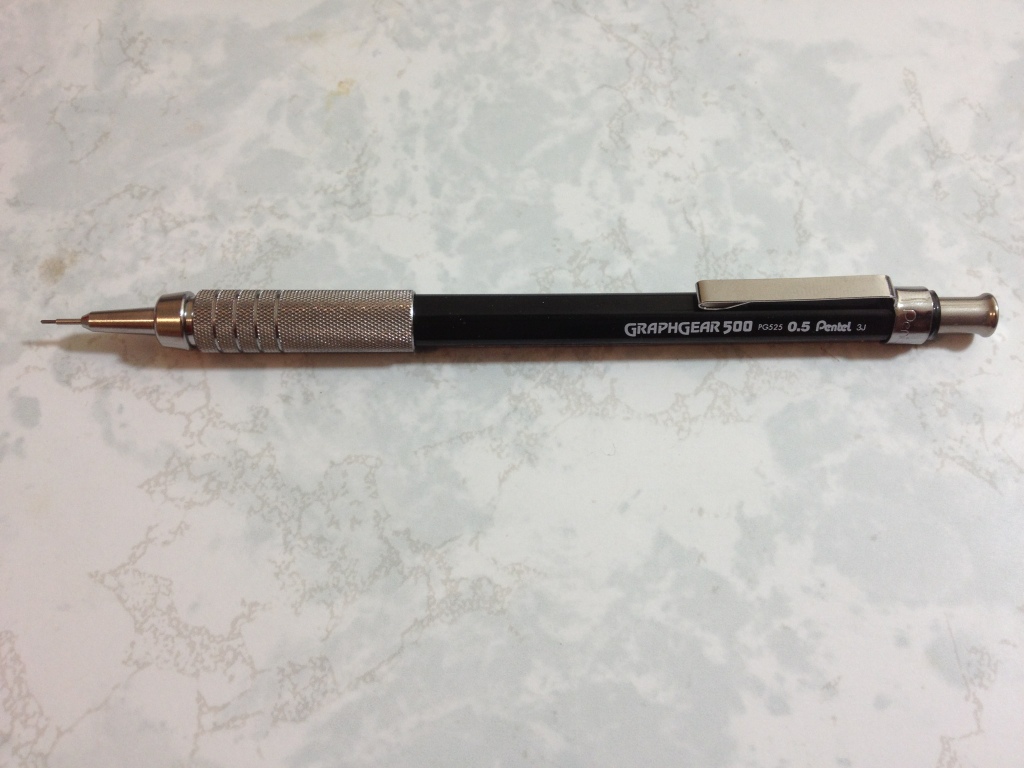
Now, I’m a cartoonist, and when I am penciling and there is no wood pencil to be found (as there unfortunately often isn’t these days), I do use a mechanical pencil. But which one do I use? There are many “alright” and “good” mechanical pencils out there for very cheap prices. Well, I was looking for one a little better, and I found the Pentel GraphGear 500. Let’s check it out.

20140829-101239.jpg

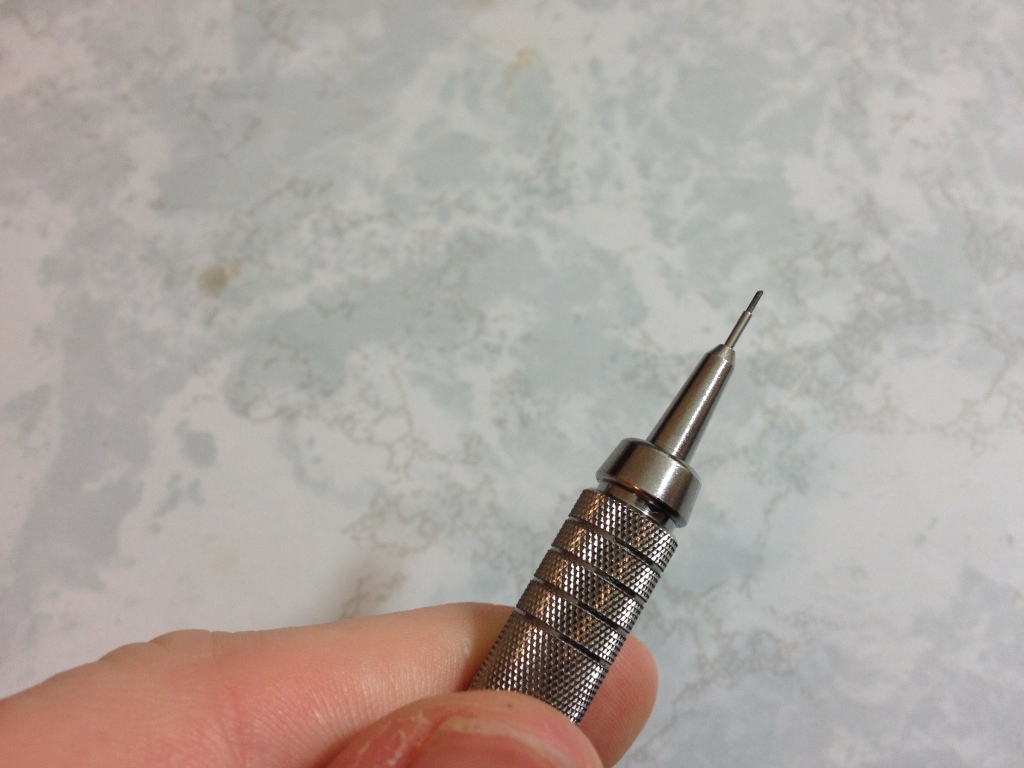
The top of the pencil is rather bland, with a simple metal button and a clipped-on metal clip (interesting). Down from that there is a thin hexagonal black plastic barrel with all necessary information printed on it, and then printed again on a sticker that it will all rub off of. The sticker also has some other, less-necessary info and a barcode, and has the benefit of being removable. The grip section is a very interesting knurled metal that holds quite well in the hand, isn’t sharp, and doesn’t leave one’s fingers smelling like metal as some pen/pencils do. There is then a smooth step-down/tapering tip all the way down to the lead, which in this particular model is 0.5 HB (#2).

20140829-101245.jpg

The lead is standard HB and writes quite smoothly, it feels a bit harder than many other #2’s I’ve used, which may just be a feeling in my hand. The entire thing feels very sturdy in the hand and is great for both technical drawings and sketches. The lead is “hi-polymer”, whatever that means, but it is good, and since there is no shock absorber it has to be good at not breaking, which it also is.

20140829-101250.jpg

There are several packages, and the one that I got has no spare erasers and only one spare piece of lead, ensuring that I have to go back and get more.

Overall the pencil is great. It works very well and is very nice to hold. It’s sturdy and keeps up with minimal wear. It’s easy to hold, easy to write (or draw) with, and stays well in the pocket. It doesn’t have any fancy features, which one could get in the higher end models, but it does cover all of the basic features and does them really well. If you want a good pencil without all the bells and whistles, I’d definitely check out the Pentel GraphGear 500.

Review – Pentel Twist-Erase Click

When looking at all of the options for mechanical pencils, one will inevitably come to the conclusion at some point that there just has to be a more efficient way to do the things mechanical pencils do. Fortunately, Pentel has you covered with the Pentel Twist-Erase click mechanical pencil, which hopefully is a lot more convenient than all of those other pencils you find around.

20140816-002532.jpg

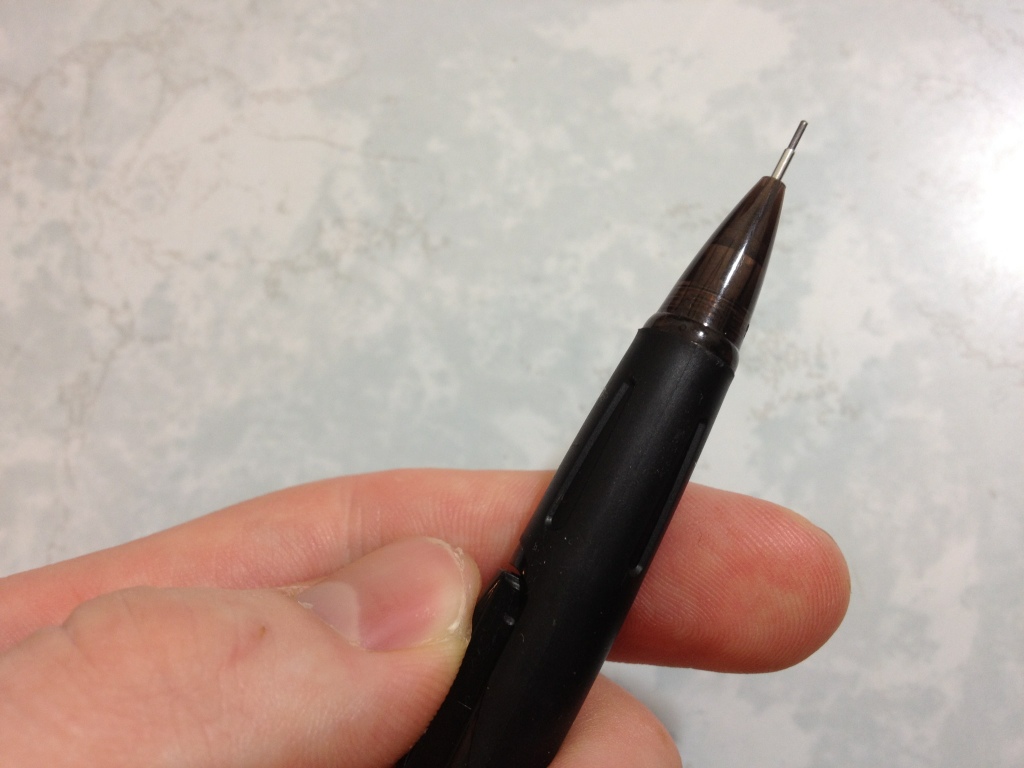
The top of the pencil starts with the eraser, which has a small turning ring around the bottom that can be twisted to extend the eraser as the name implies. The eraser is very long, extending to a least five times its original length. Below that is a tight, functional metal clip that holds well and is held in place by a piece of plastic. On the same lateral space is the information about the pencil, where all necessary information is written in a fairly out-of-the-way manner. Below this is a rather interesting curved breaking point in the pencil which will separate and allow the lead to be inserted. Then we get to the side-mounted click mechanism, which is placed both just above and in place of the rubber grip section.  The button has a few grooves to ease pushing, but is otherwise smooth. The grip section is a thin rubber that does not let ones’ fingers slide but does not give to create something super comfortable. It is functional. Then there is a semi-transparent cone, leading to the thin metal tube that the lead will dispense out of.

20140816-002537.jpg

The two main features of the pencil work well. The eraser twisting is easy if not buttery smooth.  The pencil comes with several additional erasers which are just fine for what they are, though they won’t fully remove a hard pencil line. The side-click mechanism is easy to use, and out of the way enough that it doesn’t affect normal writing. The standard lead is HB and is really nothing special. It writes well, without any flaws that stick out. There is no shock absorption, so the lead is more likely to break than in a pencil with such a feature, but that really isn’t an issue. There are a few pieces of lead already in the pencil and it comes with a replacement container.

20140816-002542.jpg

Really, if one is looking for a different mechanical pencil, or specifically for a longer eraser or a side advance, on a budget, this is easily the best model. There are really no frills or problems, it just functions as advertised. Sure, there are more expensive models that could do better, but one would have to pay a premium for such items. For the sake of convenience I would definitely look into and consider the Pentel Twist-Erase Click.

Review – Ticonderoga Sensematic

Have you ever been using a mechanical pencil and thought it was too much of a hassle to push the button before writing more? If so (Dixon) Ticonderoga claims to have you covered, with the Ticonderoga Sensematic self-advancing pencil.

20140716-000810.jpg

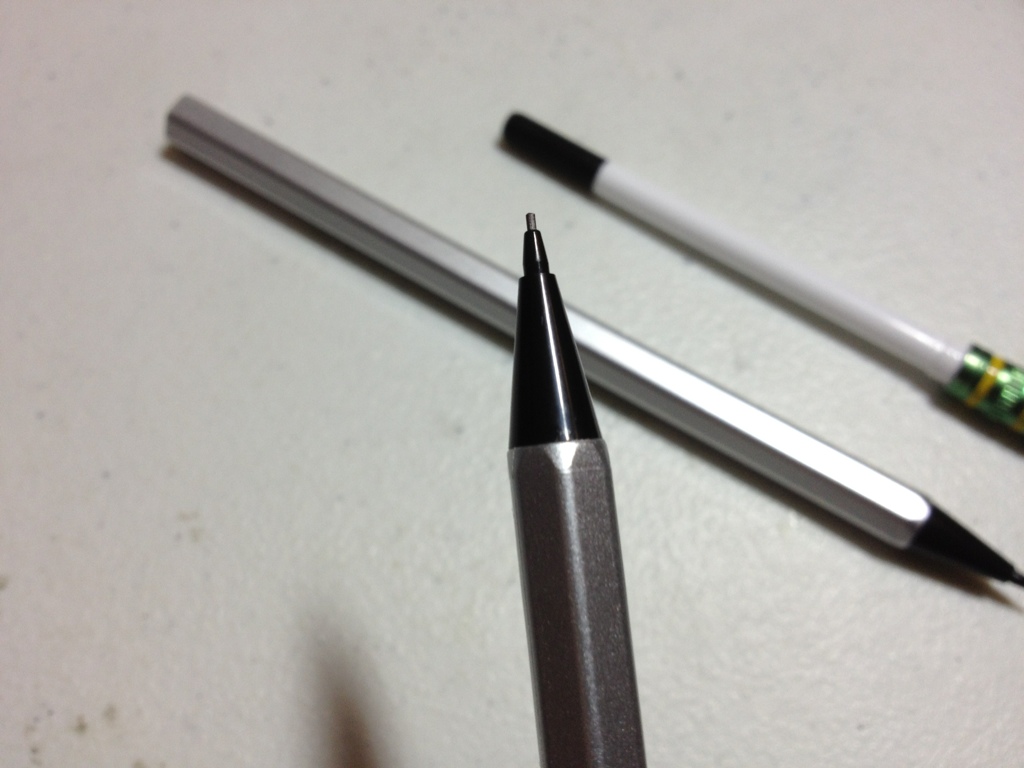
The body of the pencil looks like a standard pencil, but is a bit shorter. It has hexagonal sides, and a standard eraser with a metal attachment point, which screws out and contains extra lead to refill the pencil with. The tip is conical, and contains the self-advancing mechanism, from which the lead sticks out a bit.

20140716-000815.jpg

The lead is a standard HB (#2) and is nothing really special, so I won’t say much more other than it works. The real thing to talk about is the mechanism, which the box says one can simply “just write” with and the lead will advance automatically. And, in my experience so far, this is true. I haven’t had to change anything in my writing to make it work: it just does, making it quite a handy little thing. Now it doesn’t have a very long advance, so there isn’t much lead to work with, but for writing and some sketching that isn’t a problem at all. The mechanism works by having what is essentially a click-advance near the top of the exposed lead, and when it is pushed back more lead is exposed and then locked into place. This means that there could be instances where writing stops, but this could be easily solved by rotating the pencil.

Overall, this is a great idea with good execution. I quite like it but since the erasers aren’t replaceable and the mechanism feels a bit plastic-y I’d say they won’t last forever. But they will last at least as long as a regular pencil, with much less of a hassle, so I’d say it’s a win.

Review – Bic Atlantis Ballpoint and 0.7mm Pencil

Bic is one of the most prominent manufacturers of cheap pens and pencils (and other necessary cheap plastic things). They have several lines of pens and pencils, some as expensive as a dime and some a bit more. The Bic Atlantis is a set of pencils and pens in various colors, which happen to be called the same thing. Today I’ll be taking a look at the Blue ballpoint and the 0.7mm mechanical pencil.

20140716-000746.jpg

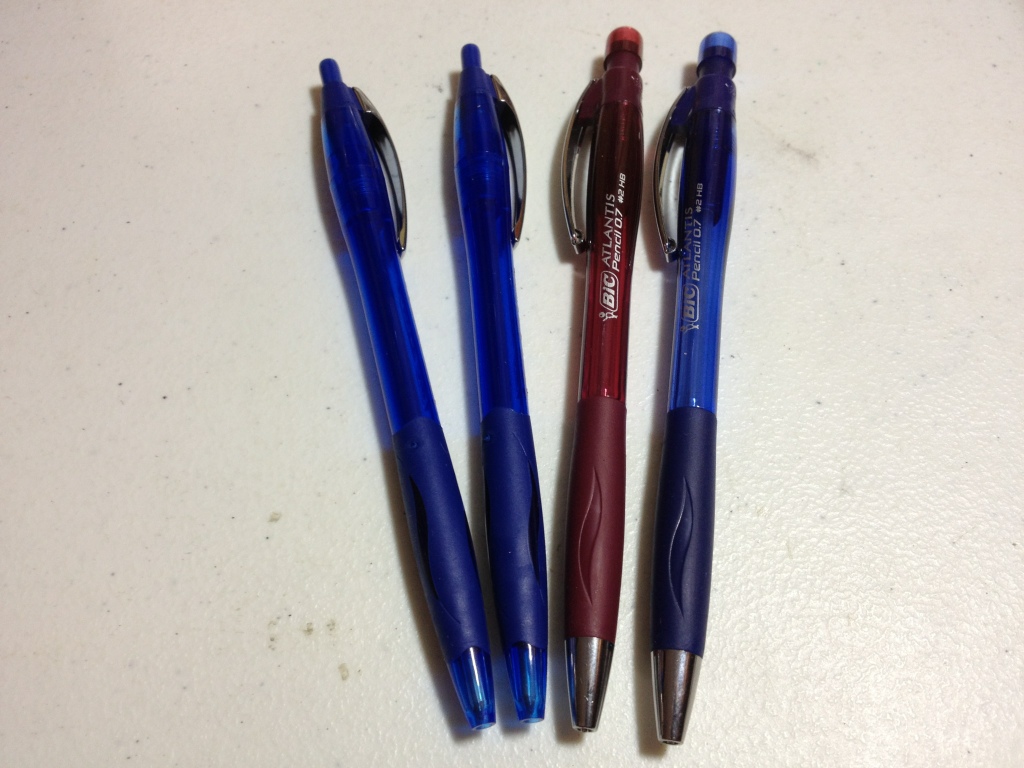
Despite sharing a name, the pen and pencil don’t share bodies. They do have similar styling that can be described in the same way, with the pencil being slightly thicker and a bit longer. Starting from the tip, there is a small cone, metal on the pencil, plastic on the pen. This is followed by a thin, hard rubber grip which is all right, but might as well not be there, in my opinion. Within the grip it is a clear plastic wave in the pen, while the wave is impressed into the grip of the pencil. The barrel is relatively smooth and has all necessary information. Neither have a way to twist open the barrel, but around the clip both can be opened and the insides removed (the pen is glued). Above that is the clip, which is quite different on each. The pen is a very firm, stiff piece of metal, while the pencil is much more loose and is wrapped over into the plastic body. On the top is a clicking mechanism. The pen is surprisingly quiet and unsatisfying. You’d never know it clicked if you closed your eyes, but it works well. The pencil has an eraser and a cap on it, the eraser can be removed to allow the pencil to be refilled, and the clicking works well. So both are quite different, but they are similar enough to be in the same category.

20140716-000752.jpg

The pen gives a very fine line, which is quite smooth. However like most “smooth” ballpoints it tends to blob often and pick up paper fibers. The color is also, like most ballpoints, quite waterproof, meaning it won’t run without being completely and utterly soaked. The pens can technically be refilled, but they aren’t supposed to be. The pencil is standard 0.7 and HB, meaning it is smooth but not too smooth. They also have a retractable metal tip to prevent the inside of pockets and bags from being torn, and there is a spring which prevents the lead from breaking due to excessive pressure. I honestly think that HB (#2) is a bit too soft, but for most writing and sketching purposes it does quite well.

20140716-000800.jpg

Overall the Bic Atlantis set is very lopsided. The pen is standard fare and not really worth much. It doesn’t do anything better than anything else in the price range, though they are quite cheap. The pencils are twice as expensive, at least, but are much more worth it. They come with extra lead and erasers, and the spring and cover mechanisms for saving the eraser and lead are almost unique for the price. It’s a great little thing that I quite enjoy using. And it might become a sketching mainstay.

Review – Pentel Champ 0.5mm

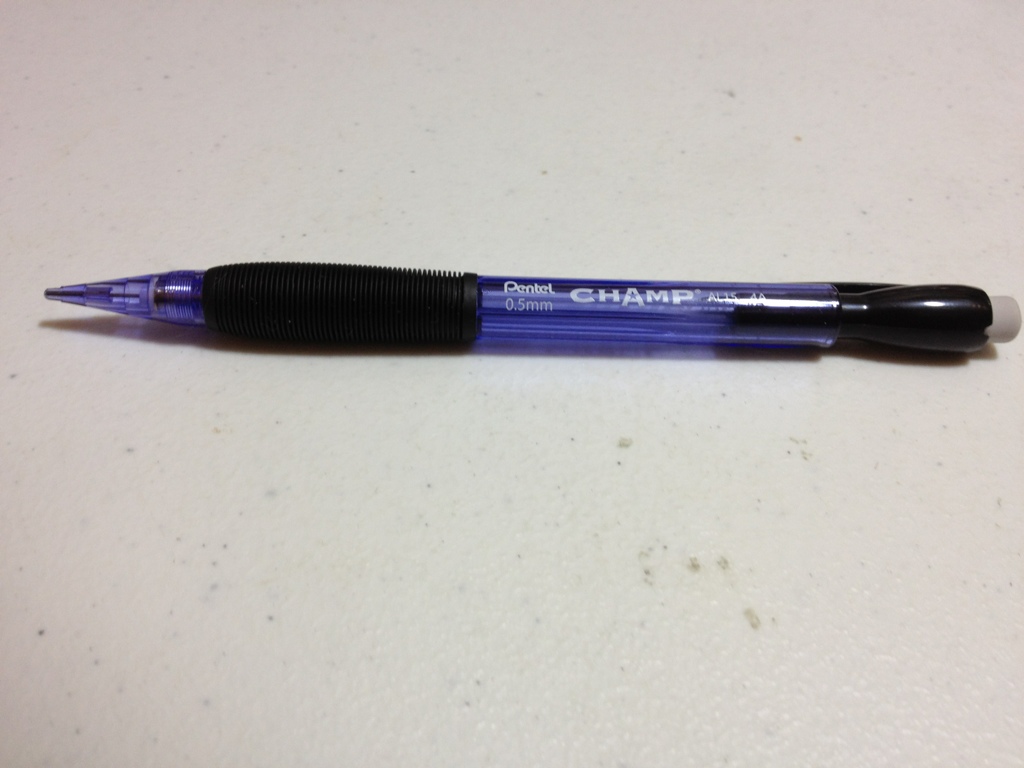
I haven’t touched mechanical pencils much, just because I don’t use them very much. But mechanical pencils can obviously be quite handy, and their very consistent line makes them ideal for several styles of drawing. This time I’ll be looking at one of the cheapest offerings, the Pentel Champ in 0.5mm.

20140624-231744.jpg

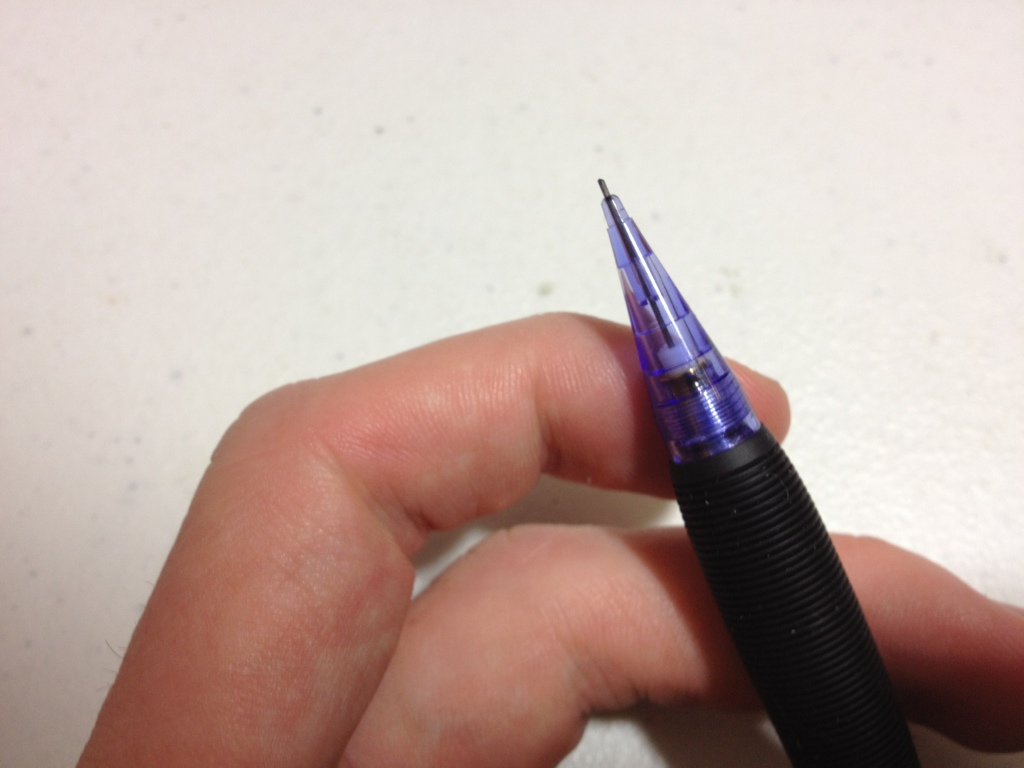
The body of the Champ is a simple, translucent plastic of various colors. It’s cylindrical, save for the cone leading to the point, and a rather large rubber grip. The back is a reversed cone with a clip that’s alright, and an eraser. Obviously, this part clicks down in quite a smooth action, though lead is not dispensed with every stroke: sometimes a few beats are missed. At the very end is an eraser, which works quite well, as much as one would expect. It’s not perfect, but it removes enough lead to be worthwhile to use. On the side of the barrel is all relevant information, though it seems that it would wear off easily. The lengthy grip is noteworthy on some models, like the one I have, in that is is made of many tiny fins, which are much more comfortable and accommodating in my opinion than standard solid rubber grips, and no less grippy. It holds better in the hand than any other gripped utensil I’ve used, but I’m not really a fan of grips anyway.

20140624-231751.jpg


The lead provided is HB, so standard number 2, but it feels a bit soft (my package also came with 24 lead refills). It is still quite hard and writes wonderfully. I like a mid-range pencil, maybe a bit on the hard side, and this delivers. Like I said, it feels a bit softer than I usually deal with, but that might just be the mechanical pencil thing. Writing is smooth with very few hiccups or scratches. The lead isn’t too prone to breaking but breaking is unavoidable in this type of pencil. And, as previously mentioned, sometimes the mechanism doesn’t want to function.

Overall, the Pentel Champ is quite a champ for what it is: a tiny mechanical pencil more suited for school and office work. But it performs quite well in all situations. A good starting pencil in both 0.5 and 0.7mm, though I prefer 0.5mm.

Review – Palomino Blackwing Pencil

So I’ve reviewed some pencils, and I believe it is time in my pencil-reviewing career to take a look at the reproduction of the “greatest” pencil of all time: The Palomino Blackwing.

20140507-013813.jpg

The body of the pencil is unique, which really is something to say about a pencil. The main body is a fairly standard hexagon shape, but painted in a nice, less-standard matte black. The Palomino Blackwing name and logo is printed in gold, with a gold band around the back. No indication of hardness is presented. The eraser holder starts off normal, but flares out into a rectangular shape with a metal insert that holds the eraser and makes it replaceable. This eraser holder is fairly smoothly finished, which is also unconventional. The erasers themselves are fine, they get the job done but they aren’t perfect, especially if they have to deal with the amount of lead this pencil puts on the paper.

20140507-013820.jpg

Now to what really matters: the lead of the pencil. It is fairly soft, but not the softest. From what I can gather it’s about a 3 or 4B (a few bits softer than a no.1 or no. 2 pencil) and boy does it glide. It’s likely one of the best flowing pencils I’ve ever used. Even for this hardness it is noticeably smoother than others in the same area. But it does sacrifice its point for this. The pencil just never stays sharp, and it can go from a fine (almost) line to a very broad line very fast. The softness also makes sharpening harder as the end never gets quite as sharp as I’d like it to be as it keeps breaking off. I suspect that the Blacking will be reduced to a stump in short order because of this, and the eraser likely never be used to its fullest.

20140507-013829.jpg

Overall I’d say that the Blackwing is a superb pencil, but just not my type. It is well constructed, has convenient ideas and is super smooth. But I prefer more precision in my writing and drawing and need a finer point for that. I’m also no a fan of the darkness that softer pencils provide. I like being a little more in control and a little bit lighter. That said, the shading is amazing and the tonal range is phenomenal. It wouldn’t be my greatest pencil of all time, but I can see how it would easily be someone’s.

Review – General’s Woodless Graphite Pencil Comparison with Cretacolor Monolith

So, last week I reviewed the Cretacolor Monolith all-graphite pencil. This week I was going to review the General’s Woodless pencil, but I realized how similar they are, so I will simply be talking about the differences in the two.

20140430-033722.jpg

The General’s pencil had (I have an older one) an inferior set of markings on the side that wore off quickly and easily. If the newer versions have a similar ink I’d say this is a downside as you can’t see what you’re using. The outer coating is a darker color, which has no real effect except aesthetics. And the back end is a bit more flat.

Is the quality the same? I can’t tell for sure, as they both seem the same, but if I must hazard a guess I’d say that the General’s pencil is a bit more fragile. But for all I know they could be made by the same company.

All in all I’d have to say that if you were going to pick between the two it might not even matter. Whether or not your local store (or where you shop most) carries them, and the color are the two biggest factors I can think of. Really it’s just a toss up. (But don’t actually do that: the pencils might break!)

Review – Cretacolor Monolith 9B All Graphite Pencil

There are always new things to be done with old inventions. They could just be a novelty, or improve the invention quite a bit. And when searching around for pencils, one may come across the all-graphite pencils that have been around. Today I’ll be looking at one type of these, the Cretacolor Monolith.

20140423-011236.jpg

Well, the body of that pencil is nothing to talk about, really. It is all graphite with a thin finish and white text giving standard supply information. There is also a bar code. Really, there is nothing to talk about as all of the pencil is the same material.

20140423-011242.jpg

It isn’t particularly fair to say that I’m just reviewing the pencil in this case, as the pencils will vary highly based on the grade of graphite used. I believe they all have the same hard graphite and finished outer shell. But my particular pencil here is a 9B which is very very soft indeed and means that this particular pencil has trouble keeping a point and wears down very quickly. On the other hand, it can be used to create a magnificent array of shading effects. I have had no problems with snapping, even with the points, but I wouldn’t expect to drop it and have a complete pencil come out of it. They do feel quite fragile. There is also the waste factor from sharpening the pencil, especially when it has been well used, will lose a lot of graphite (I’m not sure what this means when compared to all of the wood lost in standard pencils but I thought it worth mentioning) This can be avoided by sharpening the pencil by using it on its side as a shader. Using the pencil in this way also creates a marking area that is larger than almost any other art supply until one gets to brushes.

Overall a graphite pencil has its special uses, most notably with coverage, but is also fragile and not entirely unique. It’s like a charcoal stick that is much more well-behaved. So I would say it is worth a shot to try one and see if you like it. If you’re prone to using only the point of a very sharp pencil this might not be for you. But if you want flexibility in line width and color (especially with a softer pencil), then this might do some amazing things for you.

Review – Faber Castell Black Velvet Pencil

If you’re at a second hand place, or a garage sale, etc, and looking for art supplies, you might wonder wether or not a discontinued item you find is a good thing to pick up or not. This might be the case with the Faber Castell Velvet pencils, of which I am covering the black ones here.

20140418-021135.jpg

The body of the pencil is nice and round. Its a fairly solid piece of wood with a wonderful grippy, but unintrusive coating. There is a simple eraser on the end, which, if it has been stored poorly or even suboptimally, will quickly become useless. The size of the body is slightly thicker than many other pencils, making it easier to handle and more comfortable to write with. On the side, over the black all information is stamped into the side, with some covered in gold.

20140418-021140.jpg

The lead itself is a soft number 2. It shades well, and writes smoothly. Really, it is a very middle-of-the-road lead. It has nothing particularly special. It is of average diameter and isn’t prone to breaking. It is quite good for sketching, but might require several other supplemental pencils.

Overall I’d say that if you’re looking for a decent all-around pencil and can find these cheaply, they’ll do the trick. They aren’t up to the super-high-quality standards of modern Faber Castell products but they do work very well. They are more comfortable than most other inexpensive, school-like pencils and can do just a little bit more. Check them out if they seem reasonable.