Review – Zebra Sarasa Colors Black, Blue, Red, Navy, Mahogany

I’ve talked about the Zebra Sarasa before, and it’s an alright gel pen. The saving grace of many gel pens is that most come in a variety of colors at least partially unique to them, and the Sarasa is no exception there. Let’s take a look at a few of the colors.

The colors are always a bit off in the digital space

The colors are always a bit off in the digital space

First, Black. It’s a cool black that covers well. It works in an office setting and generally doesn’t get lighter even with minimal pressure. I’d say it’s black almost as soon as it gets on the page. The drying time is moderate and it’s water smudge-able.

Next, Blue.  The blue is quite dark, darker than most office-type blue colors. This makes it easier to read and more professional. It’s also natural looking, more like a deep sea-blue than an in-between blue that doesn’t really exist in nature. It’s the least smudge-prone of the bunch, but that won’t entirely stop it from lifting off the page.

Third, Red. It is a bland red, with no real pop to it. Though it is brighter than some of the competition, it isn’t really eye hurting. It’s quite noticeable and quite red but has no character — and no real flaws, either. It’s the color that fades the most when exposed to water.

Now, Navy.  Navy is a very deep, dark blue. It’s really almost black. You’d need a good light on to tell which one is which, though you could tell that black and navy are different colors with minimal light. It’s a wonderful dark color that is almost soothing and quite free flowing.

Finally (for this set), Mahogany.  It is really more like maroon. It’s a slightly purplish red which is also very dark and quite nice. It is much more noticeable than the navy, and still quite natural, giving an almost brown appearance from far away. It’s probably my favorite of the five, though the one with the fewest applications, and while you might get away with it at the office, it could be a hard sell. Unless you work for Texas A&M University.

That’s the five colors for this week. Next time I’ll be looking at the other five colors in the standard ten color pack.

Review – Q-Pins Pushpins

Pushpins can be a problem. But they are what they are, right? There’s no getting around them. That’s what I would’ve thought until I heard about Q-Pins pushpins, which claim to have updated the pushpin to a more modern and easy-to-use design. How do they hold up?

20141007-225237.jpg

Full disclosure before I begin: I was sent these to review by the company. With that out of the way, let’s look at the features: Q-Pins are designed to deal with the problems one encounters when using regular pushpins. They’re shaped like a capital “Q” and use the tail to hold paper to the board, rather than the pin itself. If one doesn’t use the pin on a regular pushpin, the amount of force required to hold the document up will leave an unappealing mark. I used to get around this by using thumbtacks, which has less grip for your fingers, but more for the document. I’d best describe Q-pins as a cross between the best parts of a pushpin and thumbtack, with a little more ergonomics. The edges of the bowl on the Q are curved inwards, creating a nice grip for the thumb and index finger that is more than enough to get it out.

20141007-225242.jpg

They come in either packs of black and white opaque or a pack of green, blue, purple, and yellow translucent. Personally I wish there were more color sets, but these work well.

Now, it’s kinda hard to talk about what a pushpin does, even though I have done that quite a bit, it looks like. In any case, I decided to try and beat up a q-pin by throwing it across the room and at the floor with a moderate amount of force. The results were not a scratch, and I’ve seen pushpins shatter under similar conditions (though rarely). I tried bending the tail off, and my fingers began to hurt as the plastic started bending. I’m sure they can be broken, but it almost has to be intentional. And for a bit of fun, I grabbed the metal pin itself with pliers and pulled firmly in both directions. The pin and its plastic case are not easily separated.

So, are they better than pushpins? Yes. Are they perfect? No. If one is very careful or hangs up thick documents, the pin can be used to hang an object without a mark. But sometimes even a natural amount of force can lead to a straight indent in the document being hung. This is certainly better than a hole, and in my opinion it’s also better than the circular indent coming from a pushpin or thumbtack used with friction. In this scenario, the Q-Pin also has superior holding capability, though it is quite close. Removing the Q-Pin is also much easier than either of the two other options. It’s a clear winner, but it is a bit more expensive. If you don’t lose things and want a better pushpin, possibly for life, you should try some Q-Pins.

Review – Pilot G-2 and G-2 Mini

There are some pens that everyone knows about, standby pens that we all recognize and know the performance of. These are pens that even pen snobs would use in a pinch. The Pilot G-2 and G-2 Mini perhaps are such pens. But do they really hold up to their reputation? Let’s take a look.

20140930-230411.jpg

I’m not sure I really need to describe one of the most well-known pens ever, but I’ll start at the click button. It is simple and elongated, and there is nothing really special about it. Below it is a small section of colored plastic where the clip attaches. The clip has the basic pen info on it, though not much. It does its job well. It might be a bit loose, though the absence of a catch on it makes replacing it in and retrieving it from a pocket much easier. Down from this is a smooth, transparent, circular barrel. There is nothing exciting here, but I should note that the only differences between the regular and the mini are the cartridge size and the length of this barrel here. All other aspects of the pens are identical, which means the mini is a bit thick for its size. After the barrel comes a fairly distinctive grip with a small recessed and grooved area where ones fingers go. The grip style is good but the rubber is slick, so the net effect for me is that the grip is unnecessary. Below that there is a small plastic cone that leads to the retractable point on the pen.

20140930-230416.jpg

Now, I’ve talked about as many Pilot G-2 ink colors as I could get my hands on in the past, so I’m not going to cover that here, but I will go over the overall writing experience. The pens are gel pens and are quite a bit smoother that standard ball points, though the smoothest of ballpoints will almost rival the cheaper gel pens like the G-2. The G-2 has quite a bit of feedback, which is something I do like when writing. Sometimes, though, it doesn’t feel like you’re putting down any ink and instead just scratching the paper. There are generally no blobs unless you’re looking at the more outlandish colors, but on cheaper paper the ink absorbs very fast and will quickly create dots anywhere you decided to stop. Really, there are very few problems if one just sticks to standard black. All other colors do tend to have unique effects to them. Long drying time is a problem with all of them, I’m afraid.

20140930-230421.jpg

Overall I’d say the pen is still quite a good regular pen. Despite the many little flaws that it may have, it works, and it does the job of being a pen well. It isn’t the best pen, but it’s not very expensive and it’s far from the worst. It’s a pen everyone can use, but if you’re not a satisfied pen user and you’re looking for the best for you personally, you might want to try somewhere else.

Review – Bic Stic Colors Pink, Purple, Lime, and Light Blue

The Bic Round Stic is an iconic pen. Not so much as the Bic Cristal, but still quite well known. It is a fairly robust pen, but usually one of few colors. The pen usually comes in the four standard colors: black and RGB. With some hunting, though, one can find more exotic colors, like the ones I will be talking about today: the pink, lime, purple, and sky blue colors.

20140924-022123.jpg

First up is the pink, which is a nice color. It certainly isn’t hot pink, which I despise. It covers well and writes smoothly. It’s fairly dark but still quite pink, though not a very natural pink. It’s the kind that could really only be seen from an ink like this and not anywhere else.

Next is the light (sky) blue, which writes smoothly, but has many little imperfections in the line. It just doesn’t cover well. The color is fantastic, though. It can be a bit hard to see at times but it’s quite pleasant to look at and not particularly eye straining. It is most like the colors at the edges of a clear body of water or the sky closer to the sun, so rare, but not unheard of in nature.

A bit altered in editing

A bit altered in editing, but a good representation

On to the lime, which is by far the hardest to read of the group. And it has some startup and writing problems, though when you get it working it does write smoothly. On the paper, the green is so light as to be unreadable in many cases and can cause eye strain. Though I call it lime, it really is much lighter and closer to… well, nothing that I can think of.

And finally, the purple, which is the best in terms of pen quality. It has no startup issues, writes smoothly, and covers well. It is darker than the blue but not by much, and still would require a second glance to read from far away. That being said, it is a very pleasant color to look at and is great for use when a more standard office color is not necessary. The color would be a rare one to find in the wild, though.

Overall, for writing these pens are hit and miss, and for art they are also hit and miss. The purple and blue are the best. I wouldn’t even try to use the lime. If you’re looking for some way to make your writing more unique, there are other Bic sets out there for that (like an entire box of the purple) and the same goes for any type of art that you might be making, unless it requires some very specific colors

Review – Prismacolor Kneaded Rubber Eraser

Recently, my erasers started running out of eraser juice, and I started having trouble with them. So I went to the art supply store looking for a replacement. I found almost my exact eraser, and one that was a bit cheaper, so I decided to try the cheaper one, the Prismacolor Kneaded Rubber eraser, out.

20140917-043500.jpg

Kneaded rubber erasers are cool. They can stretch and bend to get into small, difficult spots as well as wider spots. They can “clean” themselves, and generally don’t leave any eraser shavings. And while this is a good eraser, it isn’t as good as the ones I have used previously. It just doesn’t erase quite as well. Pencil is harder to remove, and stays bolder in indented lines. The eraser also rubs off quite a bit. There are still fewer shavings than one would get with a solid eraser, but more shavings than one should get with a rubber one.

So, if you’re just looking for an eraser that is better than standard or even high-quality solid erasers, I would recommend this one. It’s definitely good and gets the job done. But it certainly isn’t the best rubber eraser out there.

Review – Paper:Mate Design Mechanical Pencil 0.7mm

t’s always nice to try new mechanical pencils, and I’ve been looking at a few recently. One that is around what might be considered “medium territory” is the Paper:Mate Design pencil (7mm #2), which has a few nice features that make it nicer than some others I’ve looked at.

20140909-224744.jpg

Starting at the mechanism, the button is quite small and has a slight angle to the top so that one’s fingers will just slide off that much easier. That being said, it works quite well. I haven’t had any issues with it, and the click is both minimal and satisfying. Removing the metal sheath reveals the eraser, which does its job. Removing the eraser gives one access to the lead, and removing the eraser holder allows one to disassemble the pencil, which is handy (one would need to unscrew the front to do that). Down from that is a clip with the Paper:Mate logo. It needs some finesse to clip on, but both holds well and is fairly easy to detach. The barrel is a medium-sized metal tube with a nice finish that simply says Paper:Mate (personally I’d’ve liked more info, but that is literally only me). The grip is a fairly hard rubber with several lines running parallel that don’t seem to do anything to improve grip. It is a bit slippery, but not to a degree that it will distract you unless you’ve used a ton of pens and pencils. There is a metal cone that leads to a smaller, retractable metal cone tip the lead flows out of. This retractable tip means that the pencil will not scratch the inside of a pocket or something, which is quite nice.

20140909-224750.jpg

The lead is alright. It is standard HB but feels a bit smoother and more break-prone than other brands of HB I’ve used. That being said, it’s broken about the same amount. I was at first apprehensive when using this pencil. It has no shock-absorbing spring and when one pushes down just after clicking, the lead retracts and makes a distracting clicking sound. This is a major problem in pens for me, and hearing the sound again and again drives me crazy, but fortunately this pencil holds the lead tight enough that I only ever hear the sound at the start of a writing session. What it does mean that is annoying, though, is that if the lead is only advanced a slight amount, a problem this pencil tends to have, then one can easily push the lead back into the pencil and be unable to write. This is actually not as major a problems as it sounds, but I feel it should be mentioned.

20140909-224755.jpg

Overall, this pencil exceeds my expectations. The retracting point and stainless steel barrel are nice features. And aside from a few minor things, everything else does its job well enough. The pencil really feels solid and good in the hand without being too heavy, and the writing experience is quite smooth. If you’re looking for a tough mechanical pencil for some mid-length writing sessions, I’d seek one out, though if you’re in an extremely demanding location or are writing for a long time (the grip is poor) you might look elsewhere.

Review – Pentel EnerGel X Retractable Gel Pen 0.5 Red

Some brands can have very confusing product lines. And in the world of writing instruments, Pentel is great with product and poor with names. Today I’ll be taking a look at the Pentel EnerGel X 0.5 Retractable pen in Red. This is not to be confused with any other pen in the EnerGel line, because they all have completely different bodies, though you’d likely be able to expect the same performance.

20140903-000555.jpg

There really isn’t much to say about the body of the pen: it’s a transparent cylinder. The grip kinda works, but it isn’t the best. It’s much more slippery than some other grips. The clip is a bit plastic-y but does its job, although I wouldn’t trust it too much. The click mechanism is nice, solid and loud, nothing wimpy about it. And, strangely enough, the pen unscrews from the top to refill and not around the section.

20140903-000600.jpg

The tip of the pen is quite thin. There is a cone, but it stops a ways from the actual point. Writing is quite smooth. Occasionally there is a skip but there are no burps or blobs. The line is quite consistent as well. The red color is quite bright, but manages to not be an eyesore. It isn’t really useful for anything but marking errors or as a distinguishing color, but it does look nice. It is water-resistant, but does smear (though it’s still readable) and I suspect that it would wash almost entirely off after major water exposure.

All in all, I’d say that this is a decent pen. They cost a bit more than similar gel pens, and the writing is a bit better. I’d say it’s definitely a step up writing-wise from a Pilot G-2 but a step down in ergonomics. It’s consistent and smooth line makes it a joy, and if that’s what you want I’d say give it a shot.

Review – Pentel GraphGear 500 Mechanical Pencil

Now, I’m a cartoonist, and when I am penciling and there is no wood pencil to be found (as there unfortunately often isn’t these days), I do use a mechanical pencil. But which one do I use? There are many “alright” and “good” mechanical pencils out there for very cheap prices. Well, I was looking for one a little better, and I found the Pentel GraphGear 500. Let’s check it out.

20140829-101239.jpg

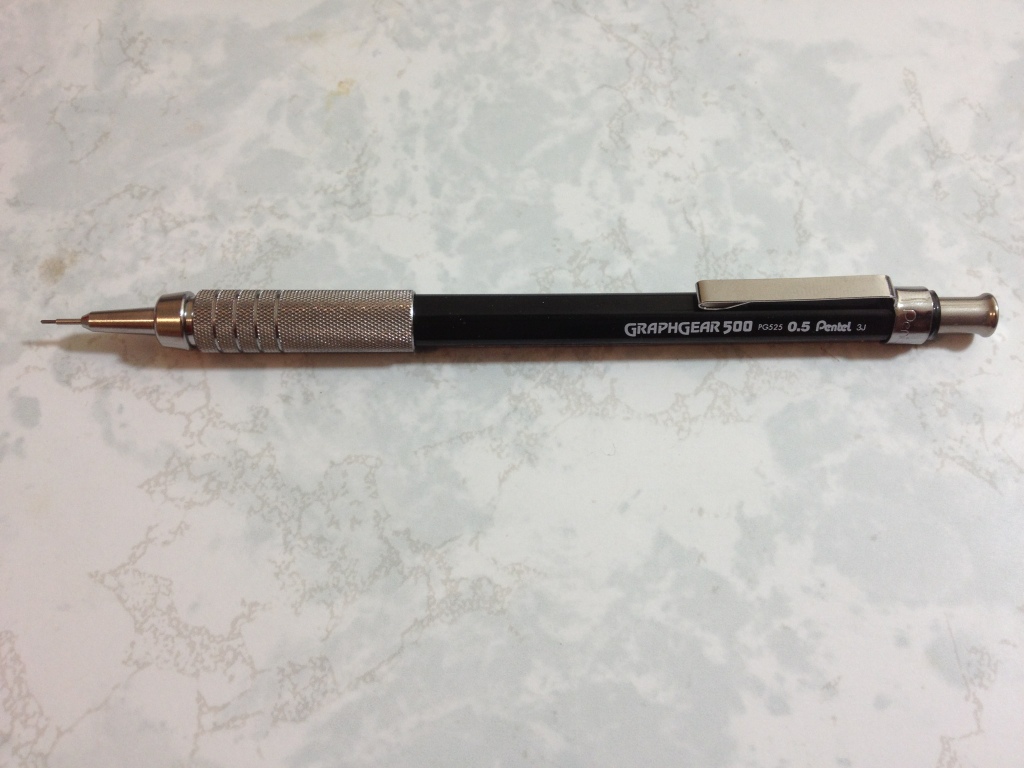
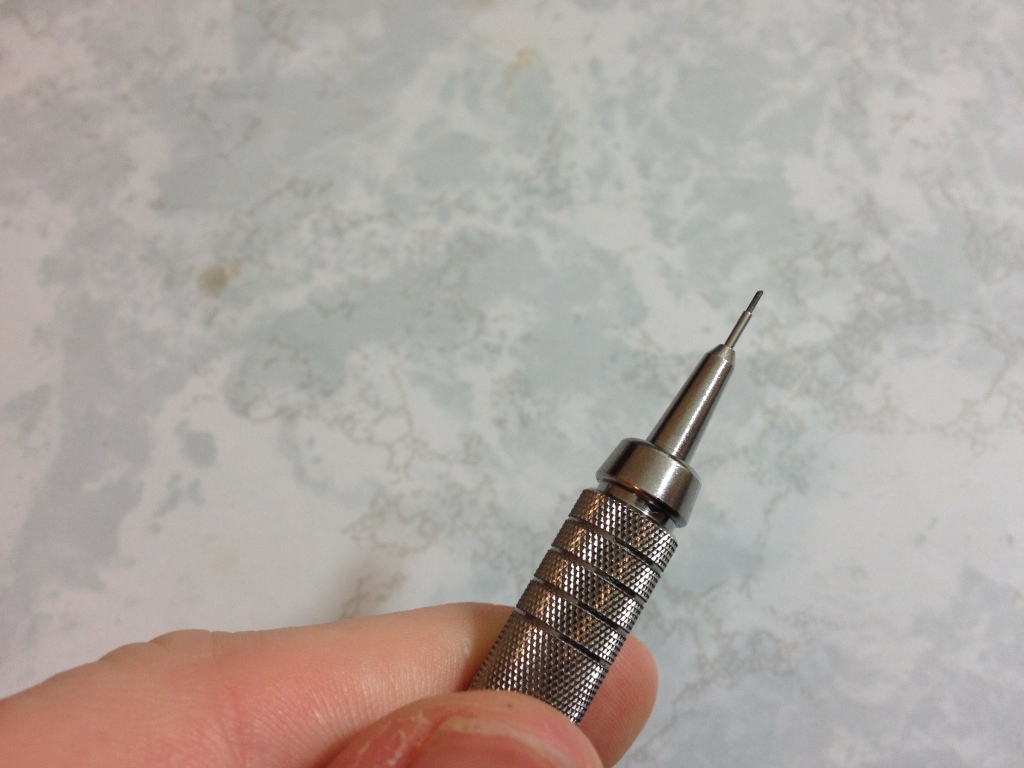
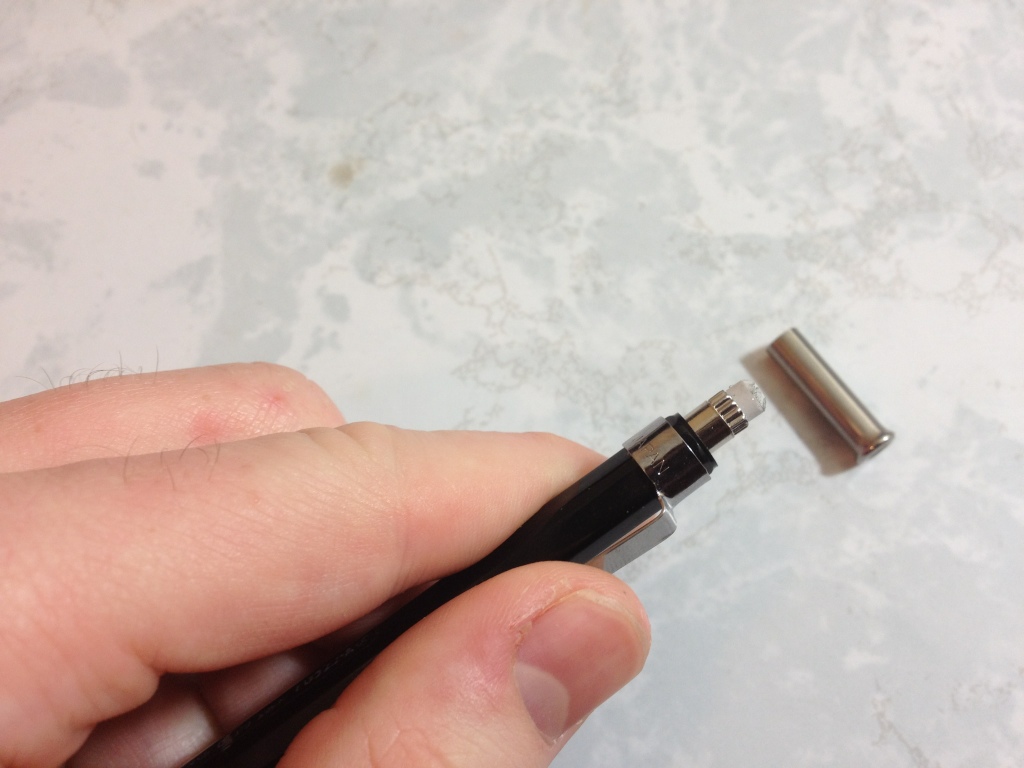
The top of the pencil is rather bland, with a simple metal button and a clipped-on metal clip (interesting). Down from that there is a thin hexagonal black plastic barrel with all necessary information printed on it, and then printed again on a sticker that it will all rub off of. The sticker also has some other, less-necessary info and a barcode, and has the benefit of being removable. The grip section is a very interesting knurled metal that holds quite well in the hand, isn’t sharp, and doesn’t leave one’s fingers smelling like metal as some pen/pencils do. There is then a smooth step-down/tapering tip all the way down to the lead, which in this particular model is 0.5 HB (#2).

20140829-101245.jpg

The lead is standard HB and writes quite smoothly, it feels a bit harder than many other #2’s I’ve used, which may just be a feeling in my hand. The entire thing feels very sturdy in the hand and is great for both technical drawings and sketches. The lead is “hi-polymer”, whatever that means, but it is good, and since there is no shock absorber it has to be good at not breaking, which it also is.

20140829-101250.jpg

There are several packages, and the one that I got has no spare erasers and only one spare piece of lead, ensuring that I have to go back and get more.

Overall the pencil is great. It works very well and is very nice to hold. It’s sturdy and keeps up with minimal wear. It’s easy to hold, easy to write (or draw) with, and stays well in the pocket. It doesn’t have any fancy features, which one could get in the higher end models, but it does cover all of the basic features and does them really well. If you want a good pencil without all the bells and whistles, I’d definitely check out the Pentel GraphGear 500.

Review – Zebra Sarasa Gel Pen

Every pen brand has its own main gel pen model, and Zebra is no exception. The Zebra Sarasa is Zebra’s main gel pen, and likely their most-recognized pen behind their steel line. How do they hold up? Let’s see.

20140820-004547.jpg

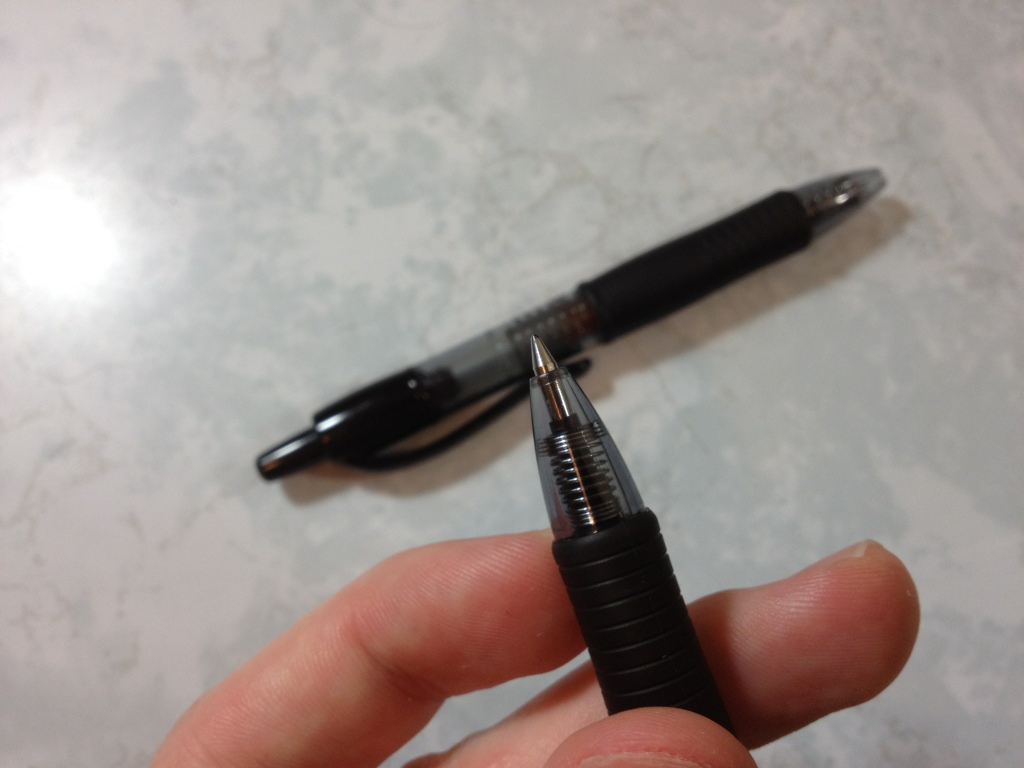
The Sarasa starts with a very classic push button. Below that is a unique clip that holds tightly but is easy enough to get out of your pocket without a problem. Some information about the pen is printed on the clip, and nowhere else on the pen. The barrel is clear and round, down to the grip. The grip section is rubber and hard. It has a slight hourglass taper so that your fingers want to rest in the middle, and it’s harder for them to slip off. It also has several quite annoying stripes that don’t aid your grip, but instead simply make your fingers feel uncomfortable. After that is a transparent cone leading the the metal tip of the roller-ball. It’s a fairly simple and standard design, but effective.

20140820-004554.jpg

The ink goes on the paper nicely and smoothly. It is not particularly quick to dry and can smudge easily. It is advertised as archival quality and acid-free, which I believe but haven’t tested. And while it certainly isn’t water-proof, it is water resistant. The line is medium (0.7) and the black color is quite black, and a cold black, very nice. It does absorb a bit more into cheaper paper making it harder to write in a way that looks nice, but it does preform well.

Overall, the Zebra Sarasa is an alright pen. It works well, but not as well as some other brands. If you really don’t like the grip on the Pilot G-2, or the expense of some better gel pens, then you might want to try this one out. The pocket clip is notably better, but not so much better that it’s worth getting the rest of the pen. Fortunately, it does come in a variety of colors that some other brands might not have and may come in handy.

Review – Pentel Twist-Erase Click

When looking at all of the options for mechanical pencils, one will inevitably come to the conclusion at some point that there just has to be a more efficient way to do the things mechanical pencils do. Fortunately, Pentel has you covered with the Pentel Twist-Erase click mechanical pencil, which hopefully is a lot more convenient than all of those other pencils you find around.

20140816-002532.jpg

The top of the pencil starts with the eraser, which has a small turning ring around the bottom that can be twisted to extend the eraser as the name implies. The eraser is very long, extending to a least five times its original length. Below that is a tight, functional metal clip that holds well and is held in place by a piece of plastic. On the same lateral space is the information about the pencil, where all necessary information is written in a fairly out-of-the-way manner. Below this is a rather interesting curved breaking point in the pencil which will separate and allow the lead to be inserted. Then we get to the side-mounted click mechanism, which is placed both just above and in place of the rubber grip section.  The button has a few grooves to ease pushing, but is otherwise smooth. The grip section is a thin rubber that does not let ones’ fingers slide but does not give to create something super comfortable. It is functional. Then there is a semi-transparent cone, leading to the thin metal tube that the lead will dispense out of.

20140816-002537.jpg

The two main features of the pencil work well. The eraser twisting is easy if not buttery smooth.  The pencil comes with several additional erasers which are just fine for what they are, though they won’t fully remove a hard pencil line. The side-click mechanism is easy to use, and out of the way enough that it doesn’t affect normal writing. The standard lead is HB and is really nothing special. It writes well, without any flaws that stick out. There is no shock absorption, so the lead is more likely to break than in a pencil with such a feature, but that really isn’t an issue. There are a few pieces of lead already in the pencil and it comes with a replacement container.

20140816-002542.jpg

Really, if one is looking for a different mechanical pencil, or specifically for a longer eraser or a side advance, on a budget, this is easily the best model. There are really no frills or problems, it just functions as advertised. Sure, there are more expensive models that could do better, but one would have to pay a premium for such items. For the sake of convenience I would definitely look into and consider the Pentel Twist-Erase Click.