Review – Pentel Twist-Erase Click

When looking at all of the options for mechanical pencils, one will inevitably come to the conclusion at some point that there just has to be a more efficient way to do the things mechanical pencils do. Fortunately, Pentel has you covered with the Pentel Twist-Erase click mechanical pencil, which hopefully is a lot more convenient than all of those other pencils you find around.

20140816-002532.jpg

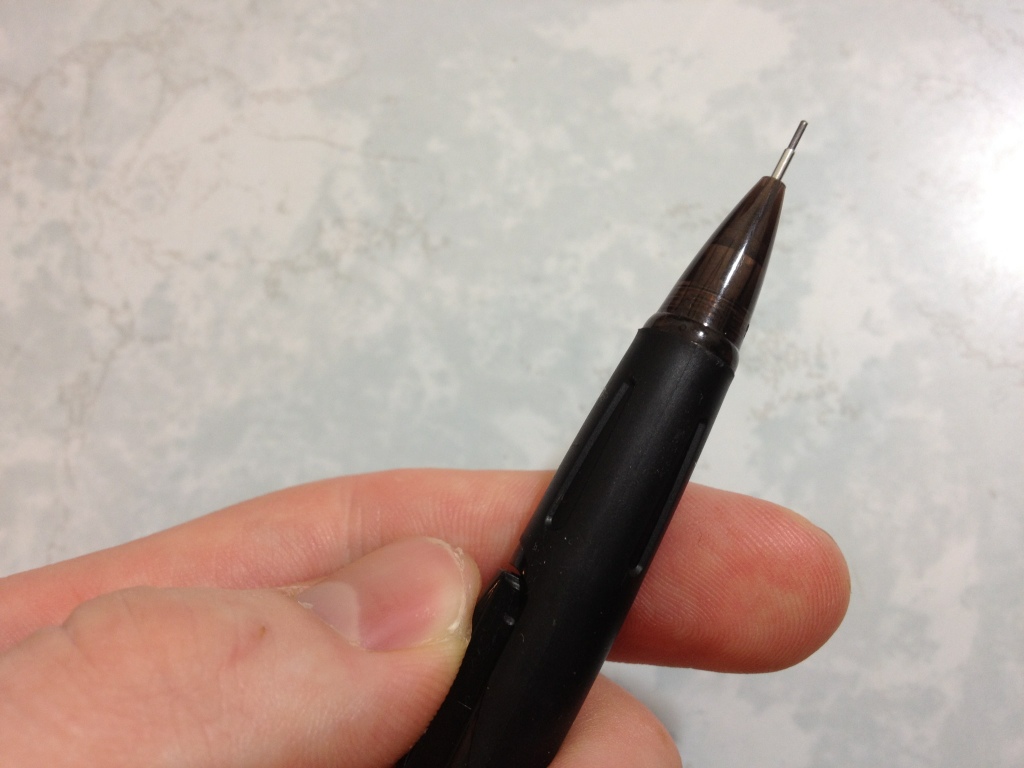
The top of the pencil starts with the eraser, which has a small turning ring around the bottom that can be twisted to extend the eraser as the name implies. The eraser is very long, extending to a least five times its original length. Below that is a tight, functional metal clip that holds well and is held in place by a piece of plastic. On the same lateral space is the information about the pencil, where all necessary information is written in a fairly out-of-the-way manner. Below this is a rather interesting curved breaking point in the pencil which will separate and allow the lead to be inserted. Then we get to the side-mounted click mechanism, which is placed both just above and in place of the rubber grip section.  The button has a few grooves to ease pushing, but is otherwise smooth. The grip section is a thin rubber that does not let ones’ fingers slide but does not give to create something super comfortable. It is functional. Then there is a semi-transparent cone, leading to the thin metal tube that the lead will dispense out of.
20140816-002537.jpg

The two main features of the pencil work well. The eraser twisting is easy if not buttery smooth.  The pencil comes with several additional erasers which are just fine for what they are, though they won’t fully remove a hard pencil line. The side-click mechanism is easy to use, and out of the way enough that it doesn’t affect normal writing. The standard lead is HB and is really nothing special. It writes well, without any flaws that stick out. There is no shock absorption, so the lead is more likely to break than in a pencil with such a feature, but that really isn’t an issue. There are a few pieces of lead already in the pencil and it comes with a replacement container.

20140816-002542.jpg

Really, if one is looking for a different mechanical pencil, or specifically for a longer eraser or a side advance, on a budget, this is easily the best model. There are really no frills or problems, it just functions as advertised. Sure, there are more expensive models that could do better, but one would have to pay a premium for such items. For the sake of convenience I would definitely look into and consider the Pentel Twist-Erase Click.

Review – Kikkerland Retro Ballpoint and Stylus

A while ago, I reviewed the Bic Tech Ballpoint and Stylus pen. That was one of the first pen/stylus combinations I encountered that were actually purchasable for me (I live in the middle of nowhere). Recently another of the same type of pen was given to me: the Kikkerland Retro Ballpoint and Stylus. And I like these types of pens, so let’s see how this one preforms.

20140729-234916.jpg

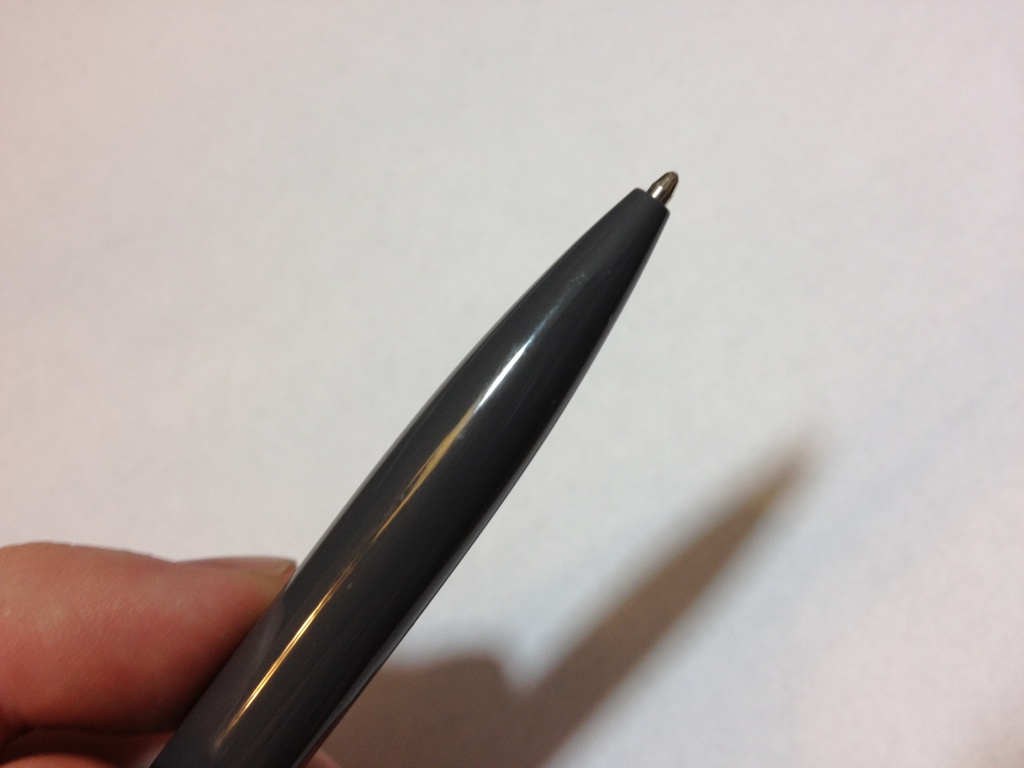
The style of the pen is “retro” and it comes in three color combinations, two of which I wouldn’t consider using, while I think the third, red and grey, looks quite nice. The pen is fairly torpedo shaped, with both ends tapering down and the widest point being in the center, where there is a small center ring that divides the two body colors and metal sections. There is an almost unusably tight clip that says Kikkerland near the top, followed by a small ring with the smallish stylus point on top. Beyond that, there is no information or other markings on the pen. The paint is plain and smooth, slick enough that it almost slides out of the hand at times, but durable.

20140729-234922.jpg

The mechanism is a twist one. It is quite smooth, almost too smooth, as pushing too hard on the pen may reverse the action. The default refill is a Cross type in medium, I’d likely buy Cross refills myself. The pen writes rather smoothly and has little in the way of startup problems, but a bit in the way of blobbing problems. It is good for short notes, but for longer writing likes to smudge and blob. It is, like most ballpoint inks, fairly water resistant.

20140729-234927.jpg

Flipping the pen around gets you to the stylus which is a bit smaller and more precise than the Bic one mentioned earlier. It is still slightly mushy and I think these smaller styluses need work before I will thoroughly enjoy using one, but this is the most responsive one I’ve tried. Again, there are a few problems, but I have no difficulties using this to operate my phone, and carrying it around to jot down ideas in Adobe Ideas.

Overall, the pen is on par and the stylus is slightly above-average. I’d make sure the colors and styles work for you before getting it, and replace the cartridge with a Cross refill. After that, it should easily serve well. The metal in the body is sturdy and the paint resists chipping, though it does chip near the tip. It isn’t the greatest pen ever, and it won’t last forever, but it is certainly better than much of the competition for not a bad price.

Review – Pentel Quicker Clicker 0.5mm Mechanical Pencil

Two weeks ago I reviewed the Pentel Champ mechanical pencil. Maybe that’s great and works for you, but let’s take a look at something a bit upgraded: the Pentel Quicker Clicker mechanical pencils.

20140708-230846.jpg

Starting from the back of the pencil, there is a small piece of plastic with a few breathing holes to cover the eraser, which is a fairly standard, white, mechanical pencil eraser. Following that is the metal clip, which is really clip-y and will make sure this thing stays put without ripping your shirt when you take it out. Engraved at the top of this clip is all the pen’s information. It’s a little less information than I would like, but it is all the necessary stuff. Past that is a slightly smoky tube which is quite thick, and contains all of the remaining leads and has them easily visible. The grip is next, which is a hard-type rubber with small wave-ridges, making quite a comfortable grip. Inlaid in this grip is a small side-advance lever that is made of plastic but feels very solid. The front of the pencil is a small plastic cone that is slightly smoky like the barrel, with a small, thin metal tube the lead will feed through. There is, unfortunately, no method of preventing the lead from breaking.

20140708-230853.jpg

The lead is 0.5mm and comes standard in HB. This hardness is the same as a No. 2 pencil. There really isn’t much to say about it: it is a high quality lead that resists breaking to some degree and goes on the paper smoothly. It is a little bit soft for me, and I feel that the line variations caused by varying pressure on the pencil happen a little too quickly for me to enjoy it as a daily writer, but as a sketcher it is great, depending on what you prefer. It definitely isn’t as soft as some would like, or quite as hard as some others (me) would like, but it gets the job done well.

Overall, the Pentel Quicker Clicker is a nice little mechanical pencil for a low-medium price. The side-advancing feed is great for not accidentally advancing the feed while erasing, and makes it more efficient to advance the lead and write faster. The lead, clip, and eraser are all serviceable, making the slim metal tip that allows lead to be easily broken the only detractor from the overall package.

Review – Sharpie Twin Tip Fine/Ultra Fine

I like permanent markers, and Sharpies are some of the best. But there are many situations where the tip of a fine Sharpie is simply much to broad. Carrying around a second sharpie in extra-fine seems like a hassle, or vise-versa depending on which size one uses more. The people at Sharpie (Sanford (Rubbermaid)) must have figured this out at some point and so they now have multiple point Sharpies. Let’s take a look at the Fine/Ultra Fine version.

20140702-004910.jpg

The body of the pen is quite like a regular fine-point Sharpie. The cap is slick with a flimsily little plastic clip built in. The body is made out of a similar material and has the necessary information printed on it. Where there would usually be a rounded-off end on a normal Sharpie, there is instead a tiny cap that has a set of spines, and is much easier to grip than the other end. Pulling either cap off reveals a slick section that is nearly identical to regular Sharpie Fines and Ultra Fines. These sections are not quite slippery enough to have the pen fall out of one’s hands during normal usage. The larger cap posts very easily on the smaller one, but in a very well-thought-out design choice, the larger cap has several small studs that allow the smaller cap to in effect be posted. This doesn’t hold the cap in the most secure manner possible, but is better than the alternative of nothing.

20140702-004916.jpg

The tips are fairly standard. The Fine is slightly larger than a Micron 08 or about 1mm, the Ultra Fine is about 1/2 mm or about the size of a Micron 05. Both of these are large for standard writing, but for writing on boxes, other large spaces, or some drawing they are superb. The ink is standard Sharpie fare: a cold, deep black (when the marker runs dry it becomes a much warmer color) that covers well, but not the best. It is permanent and run-resistant, it stains clothes and is unpleasant on the skin. It is non-toxic for normal use, but heavily sniffing or eating would be cause for concern. Just be normal with your normal usage.

Is it worth it to get a pen with two tips? Yes, if you find a need for both. I’d suggest going with the fine more often, as the ultra fine tends to dry up faster with its smaller cap. But there is still a good amount of utility there. The thing is easy to use, and works really well. Moving, signing, warehousing, and large art pieces are where these will find their homes. And really, for a nice black permanent marker, there are few that match and none that are better.

Review – Pilot Precise v5 Black, Blue, and Red

Times are tough if one wants to write smoothly and precisely on a budget. Technical pens wear out fast, and fountain pens cost money and time to maintain. I use both, but sometimes I just want to write easily and precisely without all of the maintenance and hassle. This is where the Pilot Precise series of pens come in. Today I’ll be looking at the v5 set in black, red, and blue.

20140603-232945.jpg

The cap and barrel are simple and straight. The cap has nothing on it but a simple metal clip that does its job well but can bend easily. The barrel has the necessary info about the product and an ink window so that if ink starts to run low you can get a general idea. Removing the cap shows a transparent section and feed system, which is more for being cool looking than any sort of functionality regarding ink level. At the end of the section is a series of plastic step downs that lead to a metal rolling ball tip. At the bottom of the section is a small clear plastic window that allows one to easily see if there is little or no ink left in the pen. The transparent section and barrel are both a slick plastic, but provide enough surface area that slipping off or letting go of the pen is not an issue.

20140603-232950.jpg

The tips of the pens write fairly smoothly. Older ones get a bit stiffer, but even on the extra-fine v5 they are never scratchy. The rolling ball delivers a nice “precise” line to the paper. Although it does have more variation than a technical pen in width, it has less than a standard ballpoint does, and it doesn’t blob. Like I said, writing is smooth: almost as smooth as a fountain pen, but not quite there. I’d say they are wonderful for writing (especially if ballpoints cramp one’s hands) but are not as good for drawing. Still better than a ballpoint, though.

20140603-232940.jpg

The three colors I have are Black, Blue, and Red: fairly standard colors with a fairly standard execution. The black is a warm black (this is an older pen, and Pilot may have changed formulas. The other two are brand new.) and noticeably less saturated than the thicker v7. The blue is quite dark, darker than most other Pilot inks, and quite work-appropriate. It’s almost a deep water blue, but not quite as dark as, say, Bic blue. The red is bright, bright to the point of being aggressive. Don’t grade papers with it unless you really want to say they’re wrong. It shows up almost from across the room and is quite a contrast to the deep red body of the pen. I’d say it has the fewest practical applications of the bunch. All of these inks are liquid-based and soak into the paper, meaning that they take a bit of moisture to run, but when they do they never stop. The red is the worst in this case.

In the end I’d say simply that these pens are great for writing, and all right for drawing. They aren’t the best but are great and ubiquitous for what they are.


Review – Papermate Flair Part 2 Red

A while back I reviewed the Papermate Flair pen, and I was going to say that this was a review of the red version of the same pen; but really I intend this as a continuation of the last review after some more use, and as a review of the red color for the pen.

20140402-022340.jpg


I can confirm that the inner cap will keep the tip dry for extended periods of time. The clip is very difficult to use and is easy to get bent out of shape. And while the black pen has a problem with the color rubbing off, the red has no such problem.

The red color itself is more of a pinkish, and it’s kinda washed out. The line for the medium is spread out enough that it is very noticeable as a not-quite red. It isn’t very aggressive, so if one was grading papers and such and wanting to use something that didn’t offend the viewer, this would work. However, as far as I can see there are no other practical applications. Perhaps marking on technical drawings, but again there are easier and better solutions. Using the pen on a very absorbent paper will make a much deeper color, so that is an option.

Overall the Flair is still a great pen, but I wouldn’t recommend the red color as it is not a very strong red, or a good covering color.


Review – Pilot P-500 Rollerball Pen

When I was a kid I loved the stationery section, and office supply stores were like candy stores to me. One day at one of these stores (Office Depot?) my parents bought me a pack of pilot P-700s which I loved and used for almost all of middle school and some of high school until they all got lost or dried up. I liked them so much I only did personal work with them and not any regular school work. Recently I found a P-500 (one size smaller) in a store and decided to see of they were really as good as I remembered.

20140326-015133.jpg

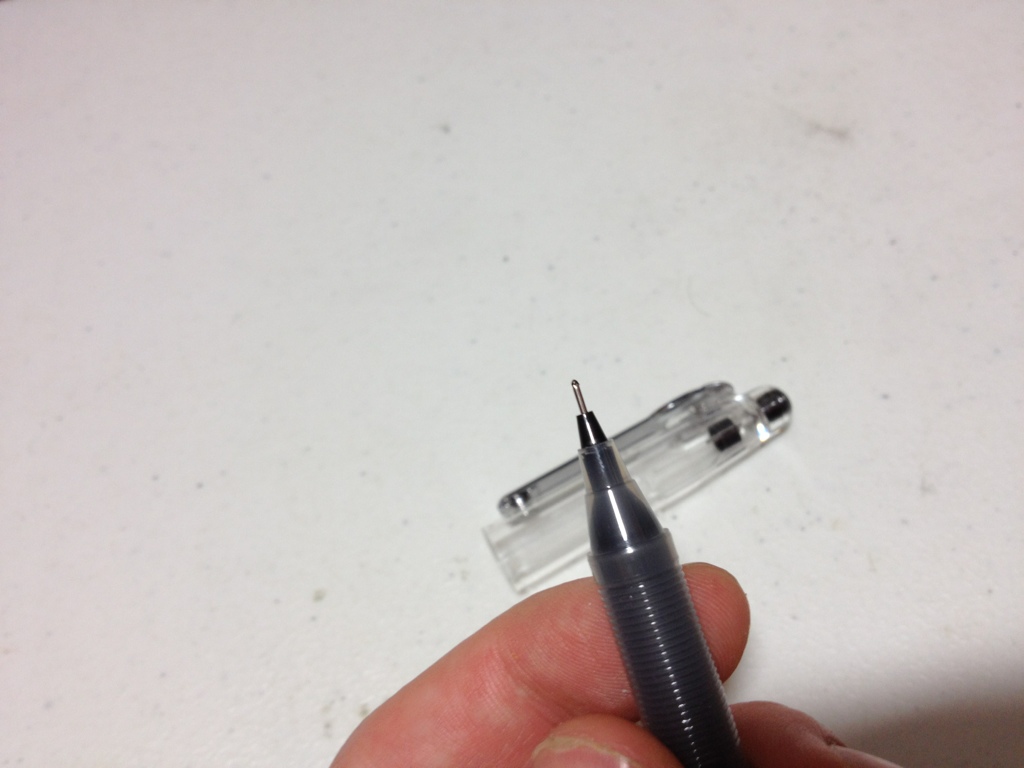
The cap of the pen is clear, with a little black bit in the top.There is a visible small black bit inside to keep it dry. The clip is metal and very tight, it’s got a ball on the end and very easy to slip into a pocket. It has a 0.5 printed on it to denote the size. The barrel has all necessary information printed on it (extra fine). There is a granite texture covering it with a clear end ball. The grip section is ribbed and very grippy for how slick the plastic is. There is a gradual slope to a very thin metal rollerball point. The section is clear making the ink supply visible.

20140326-015140.jpg

The line is an extra fine (0.5mm I’m guessing) and is advertised as being precise, which I have a hard time believing with any gel ink pen. Maybe it’s just my hand, but when writing or drawing with a gel or liquid ink pen everything just slides all over the place. This pen is no exception, though I will say that it puts ink where you tell it to put ink and nowhere else, and does it very consistently.

The inks color is black, almost the same as the pilot G2 black but a little warmer and a little lighter. It is a very good black for almost all writing and drawing purposes. It doesn’t cover well, but who uses an extra fine pen to cover anyway? The ink is very consistent and really nothing special in any of its properties otherwise. It flows as well or better than one would expect from a pen of this price-point.

Overall, these are great pens, both for writing and drawing, but they are not technical pens and cannot replace them for a finished product. They are comfortable to hold and smooth writing. Just better enough than other pens to justify their price. They are a good in-between or starting pen, but not to be used for a finished product.


Review – Manuscript Calligraphy Scroll 4 Nib

So this week I’ll be doing a quick review of the Scroll 4 calligraphy nib by the Manuscript Pen Company.

20140314-094350.jpg

The scroll nib concept is simple enough: it splits a regular italic nib with a second slit and a notch out of the middle, thus creating two lines when applied to the paper. The Manuscript scroll 4 has this simple design, with “No.4 Scroll England” stamped into it as well.

Writing is much easier than with a standard calligraphy fountain pen nib. The feed seems designed to keep up very well with all kinds of calligraphy nibs. Very little pressure is required to write and may even hinder performance at times. Each line is about a millimeter wide with one being slightly smaller than the other. To write with this nib, one must adjust their calligraphy a little bit but not very much, it is a very easy nib to use, though even with gentle use the small tines get misaligned every now and then, causing them to pop and either momentarily spit a small glob of ink or skip.

Overall this is a fairly nice nib that is well suited to its purpose of calligraphy, and while it doesn’t have many other (if any other) uses, it is still quite fun to play around with sometime, and this particular one doesn’t cost much.

Review – Sheaffer Maxi Kit Viewpoint Pen Body

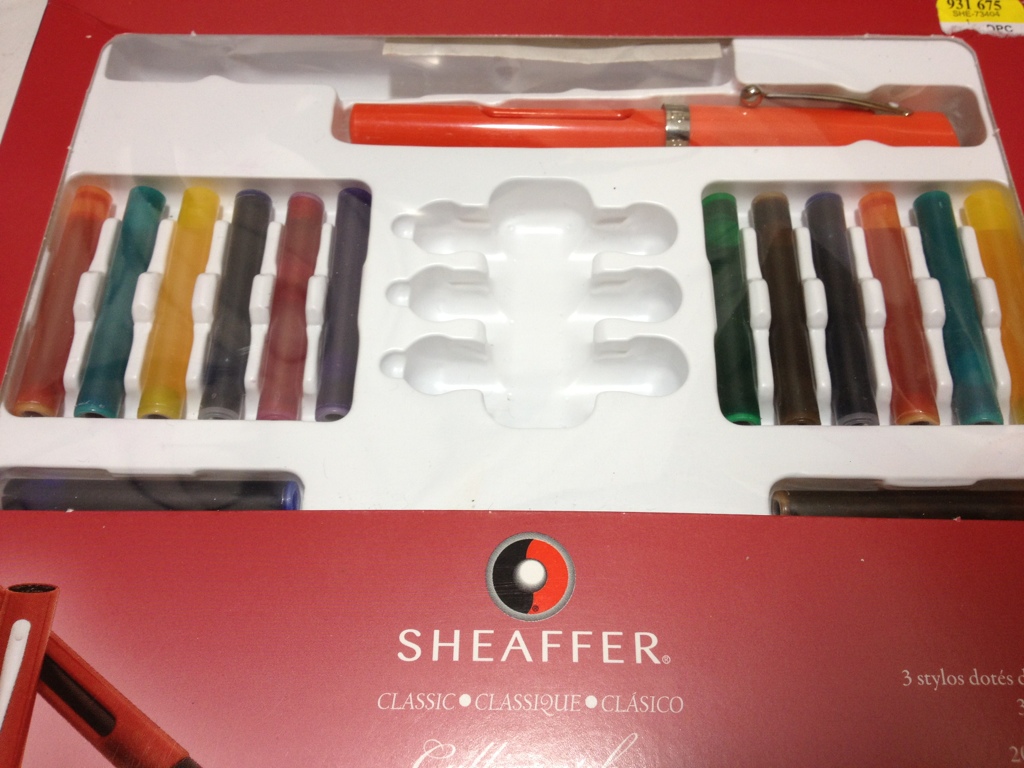
I have talked a lot about specialty pens and the like. Now it’s time to talk about another one, this one specifically for calligraphy. In this several part review I’ll be talking about the Sheaffer Calligraphy Maxi-kit. In this first part I’ll talk about the included pens, the Sheaffer Viewpoint.

20140122-004518.jpg

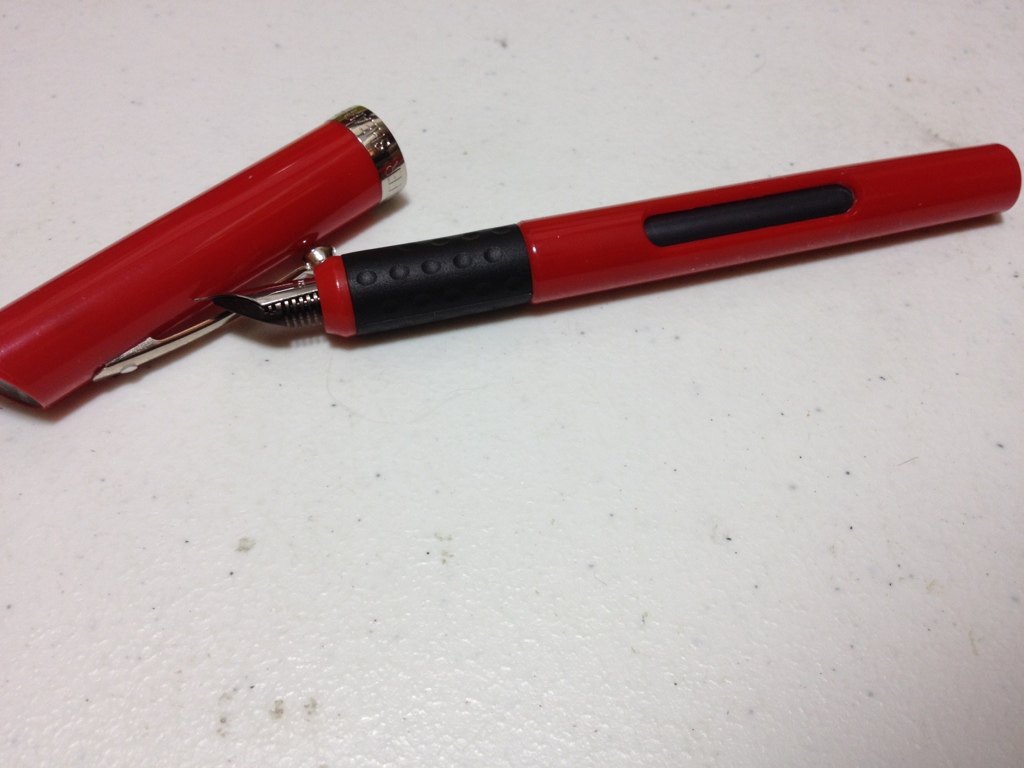
The cap of the Viewpoint is a cylinder with a slanted top. This slant has Sheaffer written on it as well as the size of the nib meant to go with the pen (in this kit at least). The bottom of the cap has a chrome band with Sheaffer written on it. The clip is simple, but functional, having a small ball at the end, up near the top is also the white dot that signifies a lifetime Sheaffer warranty (possibly).

20140122-004528.jpg

The barrel of the pen is also a simple cylinder, except it has a rather large hole cut in two sides to create a viewing area for the cartridge or converter (get it). The barrel’s end is also rounded so it won’t stand up.

The (grip) section is made of dimpled rubber and is sufficiently grippy and un-intrusive. Just after the grip is a small piece of plastic (color matching the barrel) and then the nib directly. There is a rather steep step to nib from the section, making the nib look perhaps a bit small. The feed is well hidden and works fine for the purpose, but on some pens can be finicky.

Overall the Sheaffer Viewpoint body is a sturdy, and functional design, even if it’s not the most comfortable. Its real purpose is to get a nib to the paper and it does the job quite well. Though it is a bit weaker than previous Sheaffer models due to the hole.

Review – Pentel Sign Pen

A felt tip marker can be a useful art supply. If you want to use a high quality marker pen from a well established brand, and don’t need a particularly thick line, the Pentel Sign Pen may be the thing you’re looking for.

20131018-003651.jpg

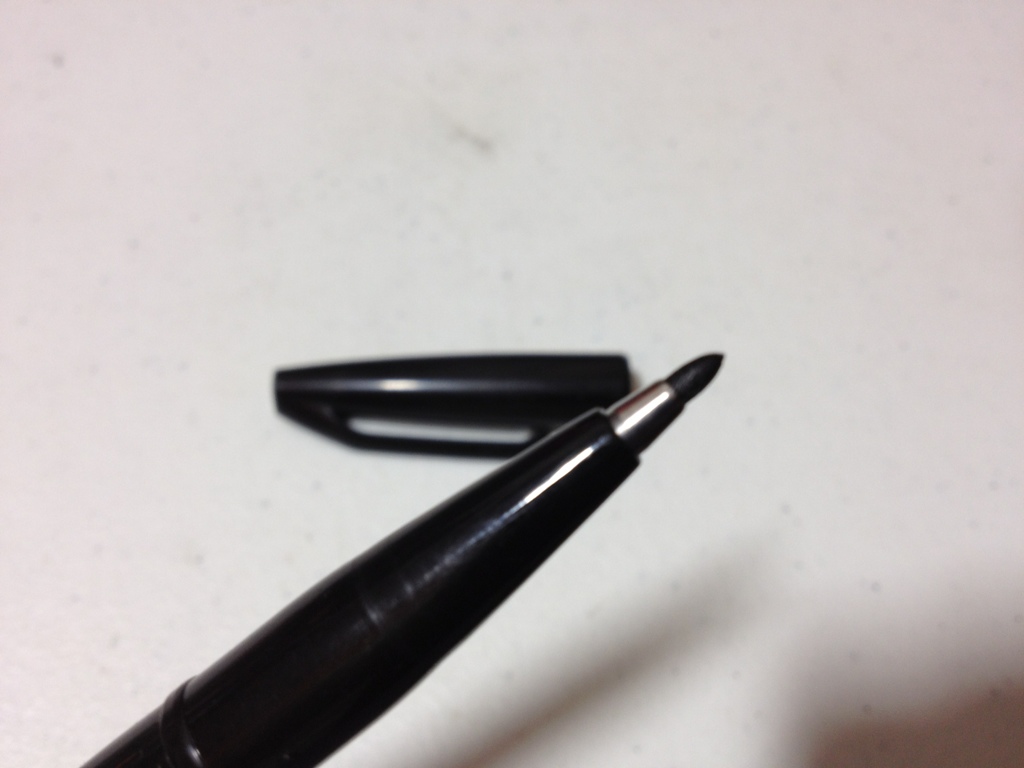
The pen itself is black, fairly flat, combining the worst of matte and shiny blacks. The base has a small tan disk. It’s got a slightly hexagonal design, and both ends taper down to a cylinder. The cap is in the same design. The clip is a long piece of plastic, and it ends in a slightly sharp, shirt tearing, tip. The grip section tapers down to a metal holder and a thin felt tip.

20131018-003657.jpg

The ink is a nice black, and it is very black. The tip doesn’t seem to have much line variation. It looks about the same no matter the pressure. Using enough pressure to give variation would damage the tip. Tilting the tip can cause some variation. The ink is mildly waterproof. It does turn grey and does smudge heavily, though it doesn’t fully disappear and can in most cases be read.

So if you need a fine-to-medium point, water-resistant black marker, which sounds specific but really isn’t, this could be the pen for you. In my opinion it is more comfortable than a sharpie, and is a bit smaller, which is nice. It is a very good pen for line art especially on larger works.