Review – Black Sharpie Pen


I like Sharpies. They’re good makers and some of the most permanent I’ve ever used. They’re useful in tons of situations, from signing to just getting something bold out there. The only problem is sometimes they just aren’t small enough. If somethings need to be both permanent and small you seem to be out of luck. Until you find Sharpie pens, that is.

20130130-000819.jpg


The body of the pen is similar to most other pens, it is slim and long. It has a label containing all necessary information about the pen and helping decrease the slickness of the body. The cap has the interesting aesthetic of not being larger than the body, making the pen look slightly odd, but this makes no performance difference. Attached to the cap is a flexible clip that does its job nicely and is not prone to breaking. At the bottom of the pen is also a place to slip the cap on so that it does not get lost while one is using the pen.


The line produced by the pen is thin, but still thicker than common cheap ballpoints. It comes out exactly where you put it and in that deep black color one expects from a Sharpie. Pressure makes very little variation, the ink is always black, and only slightly lighter if one tries to achieve that effect. It flows smoothly over most surfaces and sticks everywhere you expect Sharpie to stick. Although it does in the end feel more like a pen than a Sharpie.

20130130-000827.jpg


I stated in the beginning the main reason one would get this pen. It’s a nice small, permanent, bold pen. It’s serviceable at most pen and Sharpie duties. It would even replace fine-point Sharpies for me. But of course it has the problem of not having a specific use. So it would really be up to you whether or not you have a use for this pen.

Review – Fine Point EXPO Markers

So, are markers art supplies? By markers, I of course mean dry-erase. Is the whiteboard the canvas of the classroom? I don’t know, but I would count dry-erase markers as art supplies so I’ll talk about them briefly.

20130124-152020.jpg


I’m going to focus on the pen-type variety of the EXPO marker. They are small, pen-size. They fit in the hand nicely and don’t slip despite the glossy finish.The cap holds well, but it has no clip so it won’t stay in one’s pocket.


The ink of this particular one is black, it goes on smooth, dries fast and is nice and bold. It stays well and looks nice and sharp. It obviously doesn’t have much line variation but the point is fine enough that one can achieve most of what they would want to. When one is done the ink comes of easily with an eraser. The smell has also been reduced (though not eliminated) and the ink is thankfully non-toxic.

20130124-152026.jpg

There’s a reason EXPO has become synonymous with dry-erase markers, they are simply one of the best, and for dry-erase needs one usually can’t go wrong with EXPO. As long as its large. (they also work just like a regular marker on paper.)

Review – Staples Medium Ballpoint Pen

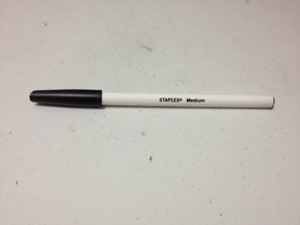
Pens, they’re necessary things. If not for art, then for simple, day to day life. You won’t believe how may people I’ve run into that need pens and don’t carry them around. Okay, maybe you wouldn’t, but I’m still going to quickly talk about a cheap way to get your pen fix so you can jot down notes and stuff (as in peoples’ numbers): the Staples Medium Ballpoint pen.

20130118-001440.jpg


The pens are simple: a small plastic tube, containing a smaller plastic tube filled with ink. The tube is slick, but not slick enough to have the pen slip out of your hands while writing. It has the logo and name on the side in plain lettering that isn’t prone to rubbing off. The cap also fits on nicely and allows the pen to be loosely held in a pocket. Overall, the body does its job.


But what about the point? The tip is a ballpoint which produces a medium weight line with a very universal width. It will take a little bit of skill to get variation from this pen. But what one would want out of a pen like this is reliability, and that is given to one by the constant line. The pen, however, does at times need to be coaxed into writing and will dry up beyond usability if neglected for too long.

20130118-001448.jpg


It’s a nice cheap pen. It’s nothing spectacular, but for the price, nothing is. It is great for jotting notes, getting ideas down, writing drafts and piling around the house so you’re never pen-less.

Review – Limn Books

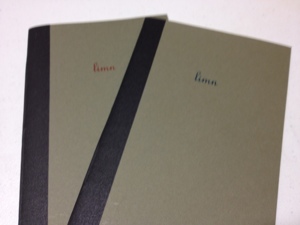
I am always on the lookout for new sketch/notebooks. I have hundreds already, but am hopelessly obsessed with paper. I have loads of different styles of notebooks. And when I found these fairly unique notebooks I had to have a look at them. (Disclaimer – They are made by my brother so I may be a little biased.)

20121207-001113.jpg

Limn Books come from Austin Texas. At the moment they come in two flavors of 5.5x 8.5. The flavors really only mean that one has red lettering and the other has blue. The only lettering is Limn on the cover and a contact email on the back. They contain 20 sheets of plain paper (no lines) covered by green cover stock. They are hand-sewn, single signature bound then covered with a binding strip.

20121207-001119.jpg

The covers are quite nice at protecting the books and looking nice, but they are not stiff enough to write on, so writing will require a table. The paper is almost butter, smooth but with enough grit to hold ink on the page well. Ink bleed is not much of a problem, especially if one is just writing and not drawing. They are comparable to Moleskine books in both paper and cover quality, but lack the elastic and are quite bit cheaper.20121207-001124.jpg

They are nice, inexpensive little books. They write well, are extremely portable, and are generally handy. They are good books for keeping notes, lists, and ideas. They have no real specific purpose in my mind, and are good at anything one wants to do in them, but are not necessarily the best at anything.

Review – Pentel Pocket Brush Pen

So I do a lot of non-drafting type drawing, which I will admit is most of drawing. But in that type of drawing, lines are not the same length, they waver, get thicker and thinner and such. If you need to get a similar effect, Pentel has a pen for you.20121205-010917.jpg


The Pentel Pocket Brush Pen is quite a nice instrument with a very uninspired name (which is good for tracking it down). The body of the pen is medium length, slick and black. At the bottom of the cap in silver is an asian character that I don’t know the origin of and the word Pentel. They are both slightly engraved and hinder nothing. They are the only adornments on the pen. There is also a clip on the pen that serves its purpose well.

The brush itself is very nice, it is easy to keep at a point and is very responsive to pressure. The pen requires no squeezing or other methods to keep ink flowing so one always gets a nice full line.

20121205-010922.jpg


The ink itself is black but thin. It takes multiple coats to create a true black, otherwise one gets streaks, but these are only visible on close inspection and may be what you’re going for. The cartridges are also replaceable and fairly easy to find. The pen comes with two and one can buy packs of four.

In short the Pentel Pocket Brush Pen is just that, a pocket brush pen, and a very nice one at that. It does its job well and painlessly. It is one of the finer and cheaper brush pens I have encountered.

Review – Pigma Brush

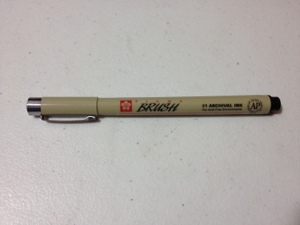
Do you like the flowing lines and moderation of a brush, but want the simplicity of a pen? The makers of Micron have a solution. The Pigma brush.

20121102-235927.jpg


The ink is the same as the Micron ink. It is a very deep black that applies smoothly to the page and rarely bleeds. It is waterproof and fadeproof archival ink. It marks just as well or better than any pen around.


The body of the brush is the same as the Micron’s, as well. It is slick and glossy, but fortunately easy to hold, and never once felt like it was slipping in my hand. The cap locks in place firmly and snaps haphazardly onto the back. The clip attached to the cap works das designed. The writing on the body is easy to read and rub resistant, and the identification on the cap is easy to read.

20121102-235932.jpg


But now for what this item is about: the brush. The brush is fairly short, no longer than the nib of the regular Microns or most other pens. The brush at its finest is super thin, and goes up to an above average pen thickness. The line range is roughly equivalent to the Micron 005 to 05 and everywhere in between. The application is buttery smooth and never splutters or splatters. Even when the brush begins running out of ink you will only begin to get a grey line instead of a patchy one. And it takes a long time to get it to run out.20121102-235937.jpg


For fine detail work this item is perfect, it is a perfect addition to the Pigma family and suits the audience it was created for perfectly. But it is for a specific audience. Very large or multimedia projects will find the product ill suited to create most desired effects. But that does not diminish the fact that it is a very good pen.

Review – Higgins Fountain Pen India Ink

Higgins non-waterproof fountain pen India ink. I don’t really have more of an introduction than that. This’ll be pretty short because there isn’t much to say about ink. But there is still enough that it is warranted.

First off this ink is black, I mean really black, even when it is diluted by water it is still a solid grey, it doesn’t turn into a deep green or blue. It is not true India ink because it does wash off with water, but you’ll have to do some scrubbing. It is fairly thin because it is used for fountain pens, making it less suitable for most other uses. Applied over a large area it causes the paper to wrinkle, but not too severely. But because of this it is very smooth, and any line problems will stem from the pen. It shows through most papers and stains a lot of items. So one must be careful while using it.

20121024-000449.jpg


Over all the ink is nice, it works well for fountain pens and is okay for other tasks. It is water soluble so it can be cleaned up (if not easily) which is a huge bonus. But most importantly it is a true black.

Review – Testors Plastic Cement

Do you need to glue plastic pieces? Are you making models, collages, or sculptures? (Why do I always begin these with a question?) Then lets check out Testors plastic model cement.

20121017-204751.jpg


This review shall be short as glue is glue. It does what it says it does, binding most plastics, but it has problems with gloss and such as most glues do. It does not bond metal or most other substances, it is purely for plastic-to-plastic gluing. Although it will stick your fingers and paper with it, so be careful when using it. It takes several hours to fully set but hardens in about half a minute. The only real problem with using it is its terrible odor, but that is common to all plastic glues.

In short it is a very good glue, and that is why Testors is one of the most well-known brands in this line. There are better glues, and this is obviously not suited for every use, but that does not change how well it performs for the price. Just don’t get it on any paper products unless you want them to turn to very thin, stiff boards.

Review – Bienfang NoteSketch Book

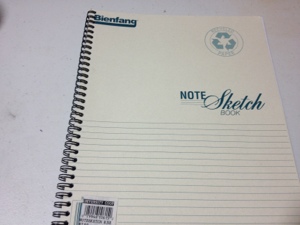
One of the worst things about different types of notebooks is that they vary in the page setup. Some have lines, some graphs, others are blank. Even the lined ones vary in the ruling between the lines. And what if you want to make a note on a sketch? Sure, you can just write it somewhere on the page, but it never really looks right, does it? Likewise with drawing on lined paper. Or what if you want to draw a diagram with a description. It will never go in any space you have left on the page, especially if it’s a long one.

20121007-000204.jpg

Well, Bienfang appears to have those people covered with the NoteSketch Book (all in different fonts so you remember it better). But we have to start with the covers first. The front cover is a nice card stock, heavy and not likely to rip out. It can take a mild beating, regular use is easily handled, but abuse isn’t. The back is cardboard and quite nice. It is light but strong, and will support drawing on ones lap or holding it in front of a subject. The paper inside is a little over half blank with the rest being roughly college ruled lines. It’s nice, but as thin as printer paper. It will only take pencil or technical pens before bleeding and wrinkling. Of course, for its intended use this is no problem. This also helps keep the book slim and it easily fits into most bags. They come in a variety of page sizes but those are all virtually identical, with the page size you like being the only deciding factor.

20121007-000211.jpg

Personally I can’t go anywhere without one of these. I don’t use them much at home, but on the road or just outside they are perfect. I don’t know about anyone else, but I only bring a pencil and a pen when I’m out, so any drawbacks from thin paper are negligible. And the ability to write notes and have space for it fits what I do. I love having a set aside space to put my thoughts or the story behind a drawing. If thats what you like to do, or you like to draft or draw diagrams that require explanation, this is the book for you. If thats not your thing, then this may just not interest you.

Review – Bienfang 12 Watercolor Brush Pens

If water color trays aren’t your style, there are of course other options. Like the Bienfang watercolor brush pens for example.

20121001-174311.jpg

The pens come in a dozen colors and with a blending pen. The colors are roughly two of the standard assortment: two greens, two yellows, two reds, two blues, an orange, a brown, a black and a purple. They vary in shades enough to make them unique from the standard assortment of bright crayola colors, but they still aren’t the most natural of colors.

20121001-174317.jpg

They come with the color separated from the brush like most brush pens. One must remove a ring to expose more thread that the cap can screw into to connect the two. The design is one of the best I’ve seen but leaves no room for more color. Once a pen is used fully there is no option but to discard it. The color must also drain into the brush before use and the body of the pen must be constantly squeezed to keep fresh color in the brush. But this is common on many cheaper brush pens and is no real problem.

20121001-174323.jpg

The brushes themselves are nice and tend to keep a point (once they are full of color). They do have a tendency to have a problem with the cap but that may just be me having a problem putting them back on. The color is applied in nice, smooth strokes if the brush is full and does layer and blend as expected. They are rather muted, though, and are hardly distinguishable from similar colors in the set until multiple coats are applied. Even then it is hard to tell the two reds or yellows apart. The color is also not true water color and is resistant when dry and stains clothes, so one should be careful when using it.

If one likes the watercolor esthetic but does not want the hassle of the tubes or trays, I’d say this is a good replacement. It does not, however, have all of the benefits of full water color. It is pleasant looking and nice to use but simply cannot capture the full water color appeal. I personally have found very little use for full water color and only a little more for this. I am not a fan of using either, but if you find that you are in need of a watercolor look, I would recommend a look.