Review – Noodler’s Nib Creeper Flex Pen

Fountain pens don’t particularly lend themselves to art. That’s more in the realm of brush and dip pens. But for the more artistically inclined fountain pen users, there are flex pens. Though most examples are ludicrously expensive, Noodler’s Ink brand has several flex pens at a reasonable price. Let’s see how the Noodler’s Nib Creeper Flex holds up to scrutiny.
20130704-232129.jpg

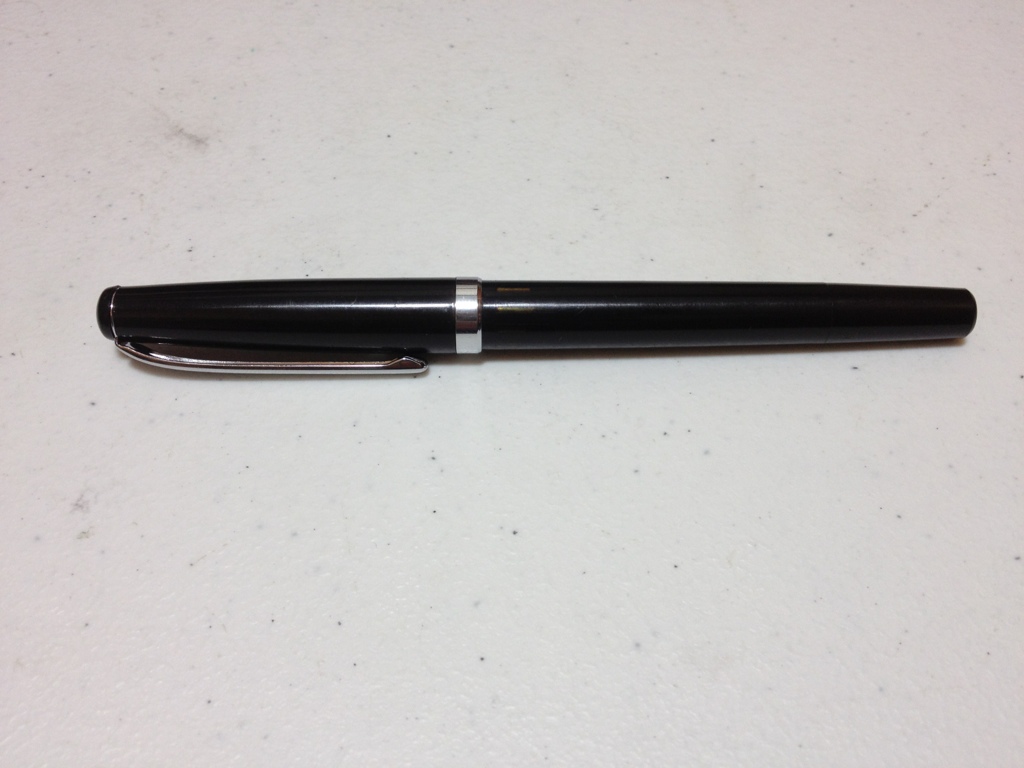
The one I personally have at hand is a plain black one. They come in all sorts of wonderful colors and you should really look into them if you’re thinking about buying one. The black itself is quite nice, though shiny enough that scratches are noticeable. The trim is a nice metal, not sure on the specifics but also shiny. The clip says “Noodler’s Ink” and rotates on the cap; it also does a very good job of holding the pen in a pocket. In the middle of the pen there are a few semi-transparent windows with which you can view your ink volume, though they are not the most accurate things. The cap unscrews to reveal more of the same design to the nib. Both the body and the cap are made of a nice plastic, which feels a little too light and smells a bit. But it is quite sturdy and the smell does subside.

The pen fills nicely by twisting the back all the way out and then down several times (to eliminate as much air as possible) while the nib is immersed in ink. The plunger mechanism unfortunately doesn’t come out like several other Noodler’s pens, or at least not easily. But the nib and feed can be removed simply by gripping them in the mid-section and pulling them out as they are friction fit into the pen. This allows for easy customization of the ink flow. It also allows for easier cleaning when changing inks.

Now to the nib and the actual writing. On paper the nib is wonderfully smooth. Not as smooth as a nice Cross or something similar, but up there. It flexes when pushed down, though not very easily. It does require some force, and at times feels like it may have problems, though these have never materialized for me. The thickness of the line varies depending on the nib and feed configuration. I would say it goes from about a Micron 01 (005 if you go really, really light) to just over a Micron 08 or about the size of the Micron Brush. After that it starts to railroad (split into two lines) even in the wettest of configurations. It also tends to write fairly dry, having a faster ink drying time and less bleed-though than other pens. But this is only minimal.

20130704-232148.jpg

Overall this is a very nice pen. If you’re looking for a sturdy brush replacement or just something to add some variation to drawings it may be the thing for you. For me it strains my had a little, and I prefer less variation in my line, which limits my use for it. But it is still a superb little pen, and a very good value. It can also double as a fancy signing pen, and a note pen. Just something to carry around. It’s great, and if you’re looking for a flex pen it’s definitely the place to start.


Review – large Blank Moleskine

A little while ago I reviewed the Moleskine blank pocket book. Now in the same notebook direction I’ll take a quick look at the Moleskine blank large book. Will the classic renowned Moleskine hold up to closer scrutiny? We’ll see.

20130430-230325.jpg

The cover is cardboard wrapped in faux-leather. It’s fairly sturdy, though it does begin to wear at the corners with continuous use. Though if you find a notebook that doesn’t I’ll be amazed. The binding is rounded, flexible and lies flat. It does have a tendency to crease when opened for too long. It also tears eventually, and if the book is really old it even begins to split down the back. This only happens toward the end of the book’s life (the last twenty pages or so). Around the cover is an elastic band which does a good job holding everything together but will eventually bend the cover in.

The pages are super thin. There are 240 of them in this half-inch book. They are of okay stock. Anything heavier than a ballpoint pen bleeds through but not usually onto the next page, it can just be seen through the page. The paper is smooth and writes well, the fine texture is just enough to prevent slips of the hand.

20130430-230332.jpg

The first and last pages are attached to the binding, rendering them mostly useless. In the back is the standard pocket, which contains the story of Moleskine (and a quality control number which is actually quite useful). In the front is a ‘who owns this’ page with a reward blank. I don’t find those particularly useful but they are there.

So are they worth it? Like all notebooks it depends on what you’re looking for (unless they just fall apart, those are useless no matter what). They are great for free range writing with sketches to enhance the look. As a sketchbook they work best with pencil as most anything else will bleed through. They are very solid in construction, the front cover especially can take a severe beating. They have very few organizational features, which some may find liberating and some infuriating. Like I said, best as a free range writing/sketch book. Alright as a travel log or such. They’re decent, and the ones I use all the time.

Review – Faber Castell 24 Colour Pencils

Colored pencils have been around for a long time. And now most of them are very cheap and often associated with kids or school. However, if one does want to look into the more expensive world of colored pencils there are plenty to choose from. Let’s take a look at the Faber-Castell box of 24 Colour pencils.

closed

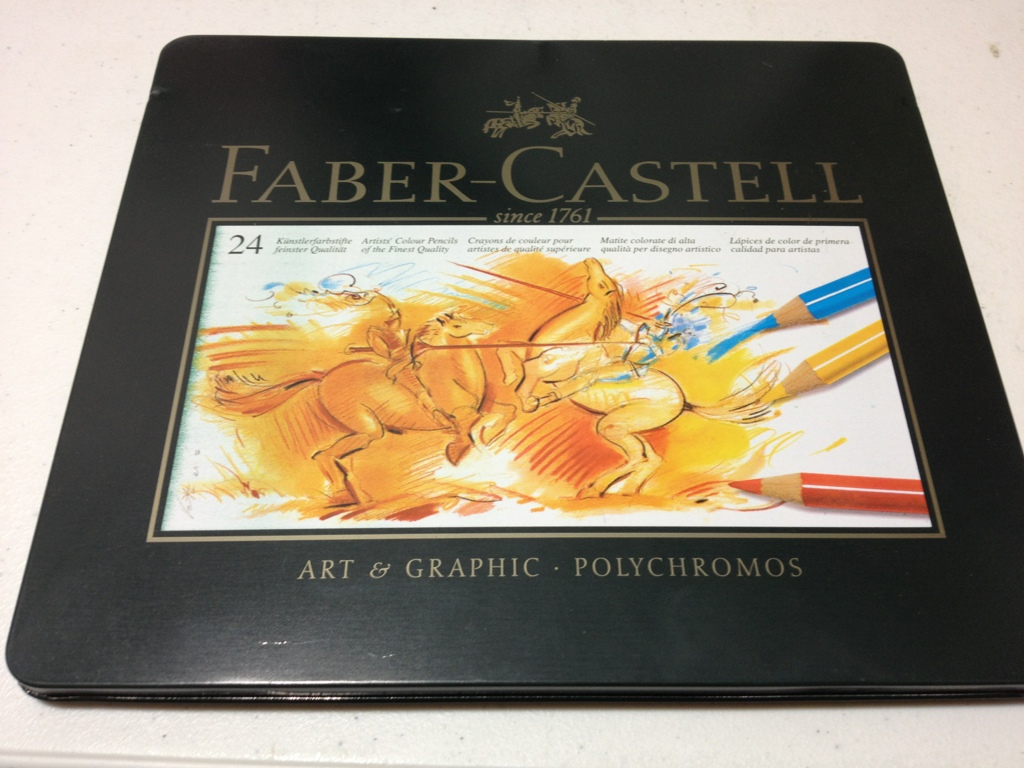
The pencils come in a nice, if easily dent-able metal case. Inside the case the pencils are stored in a row on a plastic tray. The pencils themselves are thicker than most pencils and nicely circular. They will sharpen in standard pencil sharpeners but be wary of the lead. On the side is a hard-to-read but nice logo and color information section. They are not slick and have a very matte finish that holds well in the hand. The color of this finish matches the color of the lead fairly well if not exactly.

The lead itself is hard and brittle. The colors are not nearly as vibrant as those of Crayola or other such colored pencils, giving them a much more realistic tone. The full range of colors is wonderful, with some very subtly different colors and some nice earth tones. The lead comes off well on paper and is quite opaque as most colored pencils are; they do not want to bleed or mix which is another reason why the full compliment of colors is nice. When drawing, it is best to watch how hard you push, as too hard can easily break the lead and not enough will lead to unsatisfactory coverage.

open

These colors are a huge upgrade from the standard “map colors” and such. Though they may be a bit pricy, they are great drawing implements. They seem to carry a certain prestige that transfers onto the paper (or other mediums). If you are will to spend the money I would certainly recommend these pencils. They are quite superb

Review – Staples Medium Ballpoint Pen

Pens, they’re necessary things. If not for art, then for simple, day to day life. You won’t believe how may people I’ve run into that need pens and don’t carry them around. Okay, maybe you wouldn’t, but I’m still going to quickly talk about a cheap way to get your pen fix so you can jot down notes and stuff (as in peoples’ numbers): the Staples Medium Ballpoint pen.

20130118-001440.jpg


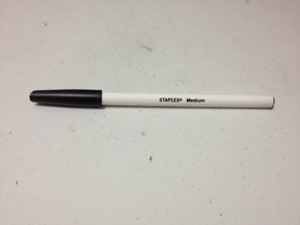
The pens are simple: a small plastic tube, containing a smaller plastic tube filled with ink. The tube is slick, but not slick enough to have the pen slip out of your hands while writing. It has the logo and name on the side in plain lettering that isn’t prone to rubbing off. The cap also fits on nicely and allows the pen to be loosely held in a pocket. Overall, the body does its job.


But what about the point? The tip is a ballpoint which produces a medium weight line with a very universal width. It will take a little bit of skill to get variation from this pen. But what one would want out of a pen like this is reliability, and that is given to one by the constant line. The pen, however, does at times need to be coaxed into writing and will dry up beyond usability if neglected for too long.

20130118-001448.jpg


It’s a nice cheap pen. It’s nothing spectacular, but for the price, nothing is. It is great for jotting notes, getting ideas down, writing drafts and piling around the house so you’re never pen-less.

Review – Testors Plastic Cement

Do you need to glue plastic pieces? Are you making models, collages, or sculptures? (Why do I always begin these with a question?) Then lets check out Testors plastic model cement.

20121017-204751.jpg


This review shall be short as glue is glue. It does what it says it does, binding most plastics, but it has problems with gloss and such as most glues do. It does not bond metal or most other substances, it is purely for plastic-to-plastic gluing. Although it will stick your fingers and paper with it, so be careful when using it. It takes several hours to fully set but hardens in about half a minute. The only real problem with using it is its terrible odor, but that is common to all plastic glues.

In short it is a very good glue, and that is why Testors is one of the most well-known brands in this line. There are better glues, and this is obviously not suited for every use, but that does not change how well it performs for the price. Just don’t get it on any paper products unless you want them to turn to very thin, stiff boards.