Review – Clairefontaine Staple Bound Pocket 3.5″ x 5.5″

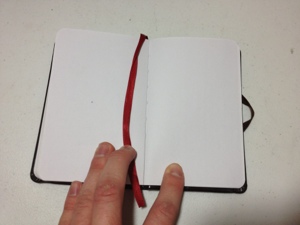
There is a new contender in the pocket notebook category. Well, not new, but new to me. The Clairefontaine staple bound 9 X 14 cm pocket book. This is not really very comparable to the other two pocket books I’ve reviewed as it is much thicker, but it is still around the same size, so here we go. The book is twice as thick as a Field Notes book and about a millimeter wider, and the rounding on the corners is about the same.

20130709-235523.jpg

The cover is a fairly thick but flimsy card stock. There is a website URL, paper weight, dimensions, and page count listed on the back cover, and no other information save the logo. The inside cover is a simple white, while the outside is the standard Clairefontaine cover, which I consider to be fairly ugly. The cover also has a blank space which I assume is a subject line or a name space.

20130709-235529.jpg

Inside is 48 sheets of 90 gram Clairefontaine paper, which is superb. This is one of the few notebooks where the page count, rather than the sheet count, matters, as you can write on both sides, even with a fountain pen. The paper is lined with a 7mm ruling, a small margin at the top, and an infinitesimal margin at the bottom. The lines are a very pale purple and not at all intrusive. As far as I know they only come in a lined version at this size. Writing-wise, the paper is buttery smooth. Very easy to write on, but ink resistant enough to have little to no bleed through, except for the nano-liner which can bleed through tables it seems. The paper is also heavy, it takes effort to bend it along the spine to write with it, and once you have bent it, it stays there.

20130709-235534.jpg

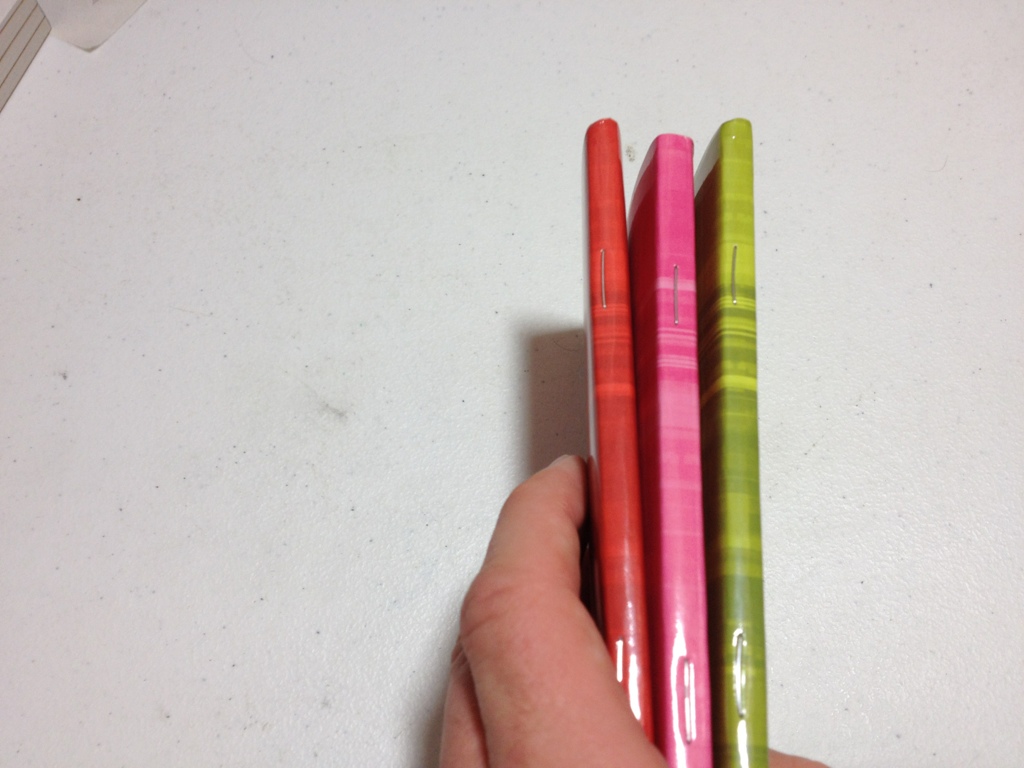
Finally the binding: it’s bent over and squared with two staples each about a quarter of the way in. It seems far from the sturdiest binding, but it can take a fair amount of flex before buckling. Though with no support at the edges they do tend to get a little banged up. Because of its interesting folding style and large page count, the binding does seem a bit weak, in mine the staples aren’t even fully stapled, so pulling this book apart intentionally would be easy. But unintentionally it seems to hold up fine, more due to the paper than the binding. It will buckle and get bunged up at the edges, though. I’m skeptical about it’s ability to take some hard wear and tear for all 96 of its pages to be used.
20130709-235539.jpg

Overall this is a great little pocket book. I personally won’t use them as much as some other books because of the terrible, intrusive cover designs and its thickness. But for writing or drawing with fountain pens, dip pens, or ink brushes, this thing can’t be beat. It’s a great, sturdy little notebook with especially good paper.


Review – Pilot B2P Ballpoint Pen

I’ve come across quite a few interesting or novel pens. I’ve tested out most pens I can get my hands on and have determined my taste accordingly. But a pen caught my eye recently with a gimmick I’d never seen before. It was a Pilot B2P pen, made out of recycled bottles. I’d seen pencils made out of recycled denim, but never a recycled pen. I don’t usually pick up Pilot pens but I decided to give this one a try, if only for the novelty.

20130619-000122.jpg

I’ll start with the writing performance, because on this pen that’s less interesting. It’s a ballpoint, and for a ballpoint it writes amazingly smooth, even smoother than most Gel pens I’ve used. The ink is black and fairly dark. The line is thin, well, at least thinner than most ballpoints. It usually writes on the first go with no skipping, a problem I usually have with Gel pens. It’s fairly impressive, though I think it may run out of ink rather quickly.

20130619-000142.jpg

Onto the body, which is a fairly pleasing blue color. It’s got a fairly useless grippy-grip near the tip and a mid-way between sturdy and flimsy pocket clip on the back. The blue is dark but transparent on the back, mimicking a bottle, and to further the effect it has ridges and troughs to look and feel like a crumpled up bottle, making it feel quite nice in the hand in my opinion. There is an easily worn off label around the center of the pen that contains all useful information, though the more pertinent information is also on the clip.

The retractable mechanism works quite well and doesn’t seem break-prone, it’s nice and solid (though if they hadn’t perfected this tech by now they never would). It also disassembles easily and well into parts for replacement and refilling, though I doubt you’ll ever do either of those.

20130619-000133.jpg

So yes, it’s a nice ballpoint, not the nicest ballpoint, but a nice one. For the price it’s good and novel. And the feel is quite nice. Its uses are that of all ball pens and this one doesn’t stand out terribly. But it is good, and a very interesting idea. And it’s a better conversation starter than the standard click-y ballpoint.

Mini Composition Showdown

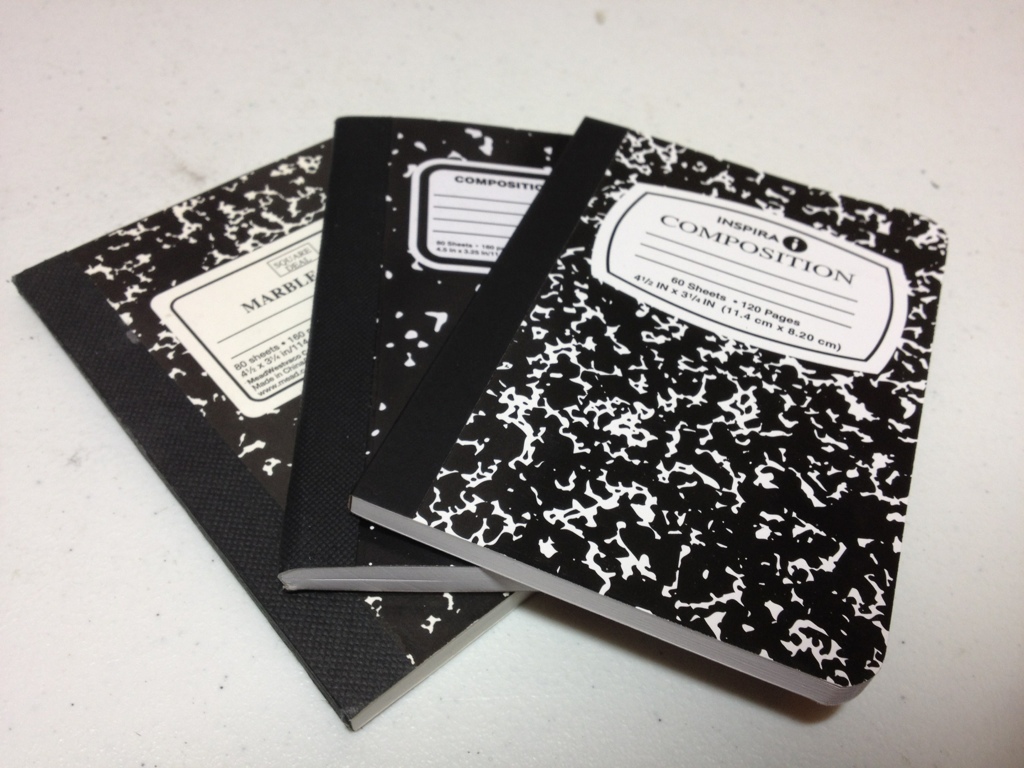
A while back I reviewed the Dolgen Inspira mini composition book. I have quite a few books like this and instead of reviewing them all I decided to just compare them all together. So here’s the mini composition showdown. Mead vs. Inspira vs. Top Flight.

First off, covers and binding. All the covers are the standard composition marble pattern, with the Inspira being the most crowded followed by the Mead and then the Top Flight. The binding on the Top Flight is a sturdy fold stitch with eight signatures, while the Mead and Inspira are weak, simple glue binding. All notebooks lie flay fairly well, though the Top Flight takes more breaking in. Cover durability again goes to the Top Flight with the other two tied. The cover corners are straight on some of the Mead, clipped on the Top Flight, and rounded on the Inspira, meaning the Mead with the square corners will most likely tear up quickest. Other Mead notebooks have rounded corners.  If you want color the Mead and the Top Flight are the way to go.

20130614-235313.jpg

Their dimensions are about the same, with Inspira being slightly taller and Mead being slightly wider. The Mead and Top Flight both have eighty pages, while the thinner Inspira has sixty. The smoothest paper belongs to the Mead, the roughest to the Inspira, and the Top Flight is very akin to newsprint, unfortunately, not very high quality. All are not archival quality paper and fade rather quickly on the shelf, though they are bright white out of the package. None are very good at holding ink, but the Inspira is best without bleeding, followed by Mead and Top Flight.

What will really make or break these books, though, is their large price difference. The Inspira are three for one dollar (U.S.) the Top Flight are five for three dollars, and the Mead are one to two apiece.

So if you can organize all that and determine the best for you you’ll end up with a very nice pocket book. Each one is suited subtly to a different task so the main challenge is finding out what is best for you. They are certainly not the best memo books by any means, but they’ll certainly work, especially in a pinch.

Review – Uni Paint Pen

So you want to paint, but you’re better at drawing. Or you want to mark on some surface unsuitable for Sharpie or other permanent markers. Well, the Uni Paint PX-21 by Sanford may be for you.

This pen is oil-based and needs to be shaken up like a spray can before use. It has a “fine” point, which means a medium or even broad point if you compare it to anything that is a not a paint pen. The line it writes is solid and about as thick as a large Crayola marker. This particular version is the black version which is especially solid, though it is fairly shiny, somewhere between a Sharpie and a matte black spray in terms of marking on plastic. It does mark on literally anything, though some shiner plastics and polished metals have it wear off easily.

20130512-001155.jpg

The body of the pen is metal and feels solid in the hand. A shiny label has all the necessary information printed on it, including warnings and such. This label makes the pen slightly slippery in the hand so tight gripping is necessary.

The cap matches the color of the paint. It has ridges that are sharp and cut into the skin. It also fits very snugly onto the end, meaning it is quite difficult to remove, which is both a hindrance and a benefit.

20130512-001204.jpg

Also be warned that since it is an oil-based pen it stinks mightily and will give you a headache after a few minutes of constant exposure. The label even tells you to put the cap on immediately after use, though this is most likely also to not let the paint dry out.

Overall this is a great little painting device. It is especially handy for touchups on plastic and metal painting. Or, if you’re like my relatives and have a shop were regular markers and price tags have a hard time sticking to the stock. It’s not really a home item, or one that will be useful to canvas painters, but it certainly will have its place with sculptors and model builders.

Review – Dolgen Mini Composition Book

Okay, this is kind of a cheat. But little notebooks are art supplies to someone. Even with the small price, should you get these small Dolgen composition books? Are they worth it?

20130427-234558.jpg

These little books contain about 60 pages of narrow lined paper. The stock is thin, and bleeds easily, but it is still about the same as average copy paper. They’re about 3½ X 2¼ inches, so they fit nicely into a pocket. They aren’t that great for drawing, but they excel at little notes and ideas.

The binding is fairly poor. I get the impression that it will fall apart quickly, but not as quickly as it takes to finish the book.

20130427-234604.jpg

These things are small, easy to carry, and really handy. They’re great for jotting down notes and the like. While they obviously aren’t made for drawing, a quick sketch or two definitely won’t hurt them, one just has the lines to contend with. At the three for a dollar price I paid for them, they are superb little notebooks.

Review – Faber Castell 24 Colour Pencils

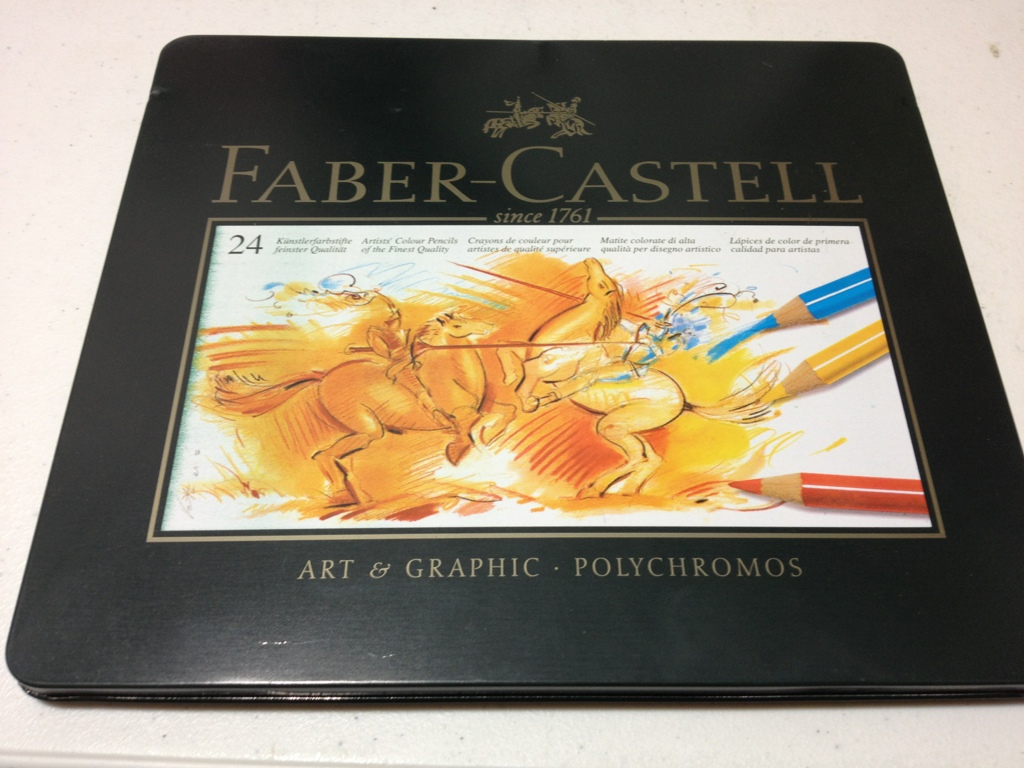
Colored pencils have been around for a long time. And now most of them are very cheap and often associated with kids or school. However, if one does want to look into the more expensive world of colored pencils there are plenty to choose from. Let’s take a look at the Faber-Castell box of 24 Colour pencils.

closed

The pencils come in a nice, if easily dent-able metal case. Inside the case the pencils are stored in a row on a plastic tray. The pencils themselves are thicker than most pencils and nicely circular. They will sharpen in standard pencil sharpeners but be wary of the lead. On the side is a hard-to-read but nice logo and color information section. They are not slick and have a very matte finish that holds well in the hand. The color of this finish matches the color of the lead fairly well if not exactly.

The lead itself is hard and brittle. The colors are not nearly as vibrant as those of Crayola or other such colored pencils, giving them a much more realistic tone. The full range of colors is wonderful, with some very subtly different colors and some nice earth tones. The lead comes off well on paper and is quite opaque as most colored pencils are; they do not want to bleed or mix which is another reason why the full compliment of colors is nice. When drawing, it is best to watch how hard you push, as too hard can easily break the lead and not enough will lead to unsatisfactory coverage.

open

These colors are a huge upgrade from the standard “map colors” and such. Though they may be a bit pricy, they are great drawing implements. They seem to carry a certain prestige that transfers onto the paper (or other mediums). If you are will to spend the money I would certainly recommend these pencils. They are quite superb

Review – Toison D’or 1900 Pencil

This is another pencil review. So I’m gonna skip all the introduction and get right into talking about the Toison D’or 1900 2B pencil.

20130301-000103.jpg

It’s a nice pencil, about the size of a regular No.2 pencil. It’s black with gold, easy to read lettering. It has the mildly uncomfortable hexagonal body but with rounded corners.  The end is also rounded, making it a bit slippery. It sharpens well and is high-quality wood. It writes like a regular 2B but slips in the hand sometimes.

20130301-000111.jpg

It’s just a pencil. The only really deciding factor here is the black color and whether or not you mind a mildly slippery pencil. It is a remarkably average pencil in every other way.


Review – Escalada 3.5 x 5.75 Pocket Journal

So, you’re out and about, you’ve just finished your last pocket notebook and are looking for a new one. You happen across one. It’s got 80 sheets of thick sketch paper and is only a couple bucks. It even looks kinda nice in its faux-leather binding. Is this small Escalada journal a good buy? Let’s see.

20130221-225351.jpg

We’ll start with the binding. It’s surprisingly good, it flexes well and doesn’t break under standard usage conditions. The binding, as well as the cover is of course cardboard covered in faux-leather with a slightly unattractive sheen. This layer holds up alright, though it does start to peel and rub off at the corners which is very unsightly. It also gets gummy in high temperatures and begins to take the shape of whatever is next to it, so where the elastic band is there will be a permanent set of grooves. But it hasn’t melted or gotten sticky in the time I’ve used it and I live in the middle of the desert.

20130221-225415.jpg

The paper is 80 sheets of 74 lb drawing paper. It’s thick but flimsy, it feels as if it’s falling apart sometimes and ink bleeds through and can be easily seen on the other side in some cases. Yet I have had no instances of marking on the next page. It has an easily visible grain and does at times warp ones drawings, mostly pencil though and not very much. The roughness is a bit unsightly to me but that’s just personal preference. Despite the flimsy feeling of the pages they are very stout and remain ridged most of the time. They resist bending, however I feel that if they did bend they would soon fall apart.

It’s an alright pocket sketchbook. It’s cheap, both in price and manufacturing, but it does do its job well enough. Just carrying it in a bag or a case won’t do much harm to it, especially since it only has eighty pages and can be run through fairly quickly. However, if your life is a bit more rough and tumble than most this is not for you, it will look ugly shortly and fall apart not long after. It does best if you’re looking for a notebook to store in your bag or somewhere on the cheap and don’t have too much preference as to the quality of the content you put in it.

Review – 3M Post-It Notes

When one is being an artist, one must get ideas. But sometimes one can’t get them to the drawing board immediately: they may be working on a project, or about to fall asleep (like that ever stops artists), or have and actual job to do, or just be out and about. During these situations sticky notes come in handy. Now, sticky notes are one of the rare instances where to entire set of products aren’t just called the name of the largest brand (Kleenex for tissues, Oreos for stuffed cookies etc…). Sticky notes are everywhere, you can find them at almost any store for fairly low prices. So is it worth paying a little more to get brand-name 3M Post-It Notes?

20130208-002121.jpg


I would say yes. First, for the obvious reason that they are more adhesive than most other brands. I know that sticky notes are made to be easy to peel on and off, but I still want them to stay where I put them (I’m convinced that the T.V. shows use glue to hold their sticky notes on those boards). Second, they’re a great size. I hate those thin, flimsy sticky notes, and the ones that come in different shapes are annoying to place and serve no purpose. Any bigger and they would be cumbersome, any smaller and one couldn’t write on them. Now I do realize that other companies make their sticky notes in the same size, but the quality is lacking, which is the third reason I like 3M Post-Its. The quality of the paper is unmatched in any other sticky notes to my knowledge. You might not think it matters how good the paper is on a sticky note. But being able to simply write something and stick it somewhere without having to worry about the paper or your message being damaged is a great thing.

20130208-002127.jpg


So yes, 3M Post-Its are worth it. They are better than the competition in every way one would want a sticky note to be better (and they make awesome bookmarks). They stick, write, and place well and are a must have for any office and artist.

Review – Black Sharpie Pen


I like Sharpies. They’re good makers and some of the most permanent I’ve ever used. They’re useful in tons of situations, from signing to just getting something bold out there. The only problem is sometimes they just aren’t small enough. If somethings need to be both permanent and small you seem to be out of luck. Until you find Sharpie pens, that is.

20130130-000819.jpg


The body of the pen is similar to most other pens, it is slim and long. It has a label containing all necessary information about the pen and helping decrease the slickness of the body. The cap has the interesting aesthetic of not being larger than the body, making the pen look slightly odd, but this makes no performance difference. Attached to the cap is a flexible clip that does its job nicely and is not prone to breaking. At the bottom of the pen is also a place to slip the cap on so that it does not get lost while one is using the pen.


The line produced by the pen is thin, but still thicker than common cheap ballpoints. It comes out exactly where you put it and in that deep black color one expects from a Sharpie. Pressure makes very little variation, the ink is always black, and only slightly lighter if one tries to achieve that effect. It flows smoothly over most surfaces and sticks everywhere you expect Sharpie to stick. Although it does in the end feel more like a pen than a Sharpie.

20130130-000827.jpg


I stated in the beginning the main reason one would get this pen. It’s a nice small, permanent, bold pen. It’s serviceable at most pen and Sharpie duties. It would even replace fine-point Sharpies for me. But of course it has the problem of not having a specific use. So it would really be up to you whether or not you have a use for this pen.