Review – PaperMate Flair Colors – Olive, Lilac, Navy, Plum, and Turquoise

And now for part 3 of my look at the 20 colors of Papermate Flair pens. This time I’ll be looking at five of the cooler colors in the lineup. I’ll just get started.

Papermate flair colors part 3

Olive – Olive is a nice green, forest-y color that looks quite natural and is very pleasant. It is quite conservative and laid back. One might be able to get away with using it at an office, but it’s unlikely. In poor lighting it almost blends in with dark blues and blacks, though. On the smearing side it’s one of the worst, easily smearing and becoming unreadable with contact with water.

Lilac – It’s a light purplish color that is smooth and quite easy to look at. It wouldn’t be appropriate in most offices, but in many a field of flowers there are similar colors. The color looks almost washed out before water is applied, but it smears and feathers probably the least out of the entire set.

Navy – Navy is a very dark, office-appropriate blue that goes well in most places. Artistically, it would be most at home in the dark, but there may be other applications. It does smear, but very little, and it is often readable afterwards. The main problem when water is applied is that there is so much pigment that it covers a wide area with a bluish tinge.

Plum – A bit off from most of the fruit I’ve seen, this plum is a dark, red-ish, purple color. It could pass for a plum still, just not one from a supermarket. It could also make its home in an office for a bit of fun, but not for everything. It bleeds, feathers, and smears pretty badly, but does stay mostly readable.

Turquoise – Turquoise is a nice color at points, but it shades quite a bit, and the color variation can at times be unpleasant. It’s a good sky, but doesn’t look like the stone, and going over it multiple times will turn it into more of an aquamarine. If your work doesn’t have a problem with blue, it should still work. With a wipe from water nothing changes, but if left for a few moments the color dissolves completely and is unreadable.

And that’s it for part 3. These colors are some of my favorites in the set, and much more usable than their warm counterparts. Next time I’ll be taking a look at the remaining 4 pens, which aren’t officially named anywhere I can find.

Review – PaperMate Flair Colors – Orange, Lime, Magenta, Marigold, and Pink

Now it’s time for part two of my look at the 20 colors of the Papermate Flair. This section of five is the “Warm” colors section. Mostly some normal colors here, but a few out-liars. Nothing too crazy.

Papermate flair colors part 2

This scan didn’t work the best


Orange – The orange is a deep, red-ish orange that is surprisingly natural looking. It’s very subdued, but noticeable, good for organization, but not for documents. It’s dark enough that it can be read at a glance. It fades significantly, but doesn’t really smear when wet.

Lime – The lime likely has the most variance in color, when written with fast it is a surprisingly standard bright lime color, but when taken slowly it is rather dark and subdued. It wouldn’t make a great office color but it is less harsh than a normal lime green, and the variances in tone make it good for art. Another plus is water hardly affects it.

Magenta – I find magenta colors had to classify, this one is pretty, nice to look at, and readable. It wouldn’t suit the office well but it does look like I could see it out my window. Heavy bleeding and smearing when wet with this one.

Marigold – At first glance this pen looks like another yellow, which it is, but much less harsh and more readable. It has a tinge of orange that is very pleasant and flower-like. There’s a lot of smearing, but almost no fading when exposed to water. Perhaps it could be used as an alternative to red to use when marking something important. Just as noticeable, but less aggressive.

Pink – I don’t like this color, it’s a hot-ish pink, not blinding, but not pleasant. It’s standard all things considered, it barely moves when wet and is inappropriate for anything but personal organizing. I’m not judging you if you like it, but I won’t be using if for anything.

And that’s part two. I like the warm colors, but I struggle to find uses for them. Next time I’ll take a look at five more, but this time “Cool” colors.

Review – PaperMate Flair Colors – Black, Blue, Red, Green, Purple, and Yellow

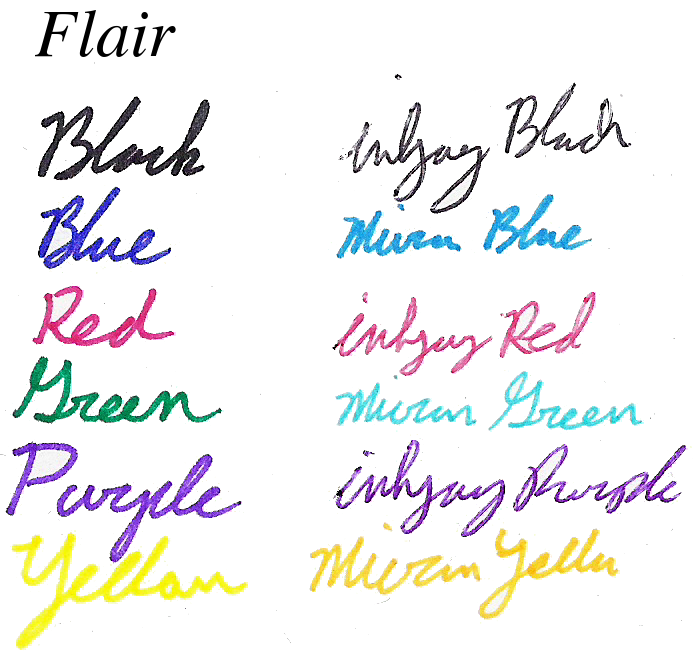
The Papermate Flair is a good porous-point pen; I’ve looked at both the black and red versions in the past. But they do come in a host of colors. I got the largest pack I could find, which seems to be exclusive to Sam’s Club, with 20 colors. And it’s so exclusive that I can’t find official color names for 4 of them. Those 4 will be in the last part of this series, the first 3 being Standard, Warm, then Cool. And now onto the colors.

Papermate flair colors part 1

Black – The black is a fairly standard black (most are): it’s deep and cool. It’s office-appropriate and moderately smear-resistant. While it does smear, it is readable after most spills.

Blue – A dark, office-type blue that is not a very natural color, but a pleasant one. It is legible and unintrusive. It lightens considerably and smudges when wet, but doesn’t erase.

Red – A dull (but still punchy) red, nice to look at, but a bit pinkish. It’s less glaring and hard on the eyes for grading and warnings than comparable pen reds, but similar to most marker reds. Is fairly smear resistant, but does lighten.

Green – A dark green, slightly darker than, say, a crayon green. It’s a deep, grassy, natural color. Noticeably different from the other, more common colors, but nothing that’ll jump out from across the room. It could be used in a liberal office. It smears and lightens quite a bit, though.

Purple – One of the more usual, pops-off-the-page purples. It is noticeable as a purple and isn’t the most natural-looking color. It stands out from dark blues, but could get lost in a page of dark inks. Almost no smudging on this one, though it does feather a lot when wet. It could be used in a similar office to the green one.

Yellow – A super-bright, stereotypical yellow. It’s almost illegible on white paper. It’s the most water-resistant after red and purple, but it all but disappears anyway. It hurts they eyes to look at for a long time (I’m not sure if it’s the brightness or the fact it’s hard to read) and isn’t a very natural-looking color. I wouldn’t recommend this one unless you’re coloring in books.

And that’s part 1 of my look at the 20 Papermate Flair colors. A good general assortment here, but nothing groundbreaking. Next week I’ll take a look at 5 of the more Warm colors in the set.

Review – Uni-ball Jetstream Bold

Some people search for the best of something. I never really looked at my collecting in that way. I just like using a variety of things, and for me I know that there’s no one perfect thing. But that doesn’t stop me from liking sites like TheWireCutter.com, which finds the best product in a given category for the average consumer. I was recently featured in their article about the best mechanical pencil (along with several other, well-known reviewers), and while I was talking to them, I thought I’d try out their recommendation for best ballpoint pen: the Uni-Ball Jetstream. If you read their mechanical pencil article, and my review of their pick the Uni Kuru Toga, this might seem familiar. I do understand why people like the pen, but I don’t like it so much, and here’s what I think of it.

20150311-220545.jpg

My particular Jetstream is the bold 1.0, and starting at the top it has a nice, beefy, chrome click button that is very satisfying to use. Down from that is the logo, size, and a solid clip that does its job. The majority of the barrel is rubberized, with the Jetstream logo in the top half in a hard-to-read, reflective plastic. There are slight divots on the section for grip, which actually flares out, instead of tapering in, making it quite large in the hand, and then an interesting-looking chrome cone that leads to the point. This cone does screw off and the pen is easily refillable.

20150311-220550.jpg

The ink itself is a nice, cool black that slides onto the page easily. There is an ever-so-slight amount of dry time, after which the ink is quite waterproof. While the ball does roll nicely and the ink flows smoothly, I still get blobs and stuttering, blobs being less frequent than with comparable pens, and stuttering much more frequent. This slight stuttering is hardly noticeable when writing, but is virtually the only feedback the pen gives. It is most definitely the smoothest ballpoint I’ve ever written with but I don’t feel like I’m in control of it when I’m writing. The stuttering is easy enough to overlook when the writing is done, though.

Overall it’s a well-designed, sturdy pen that I don’t want to write with. The point slides out from under me, and the thick grip cramps my hand after a while. It’s also extremely light, which makes me want to hold it tighter so as to not lose it. Still, the fit and finish are great, it’s very satisfying to hold, and if you want an “inexpensive” smooth ballpoint, it really can’t be beaten

Review – Masterpiece Odorless Paint Thinner

When looking for something as simple as paint thinner (mineral spirits), it can be tempting to go for the cheapest option in a given item’s range. And for odorless mineral spirits at my local store, Masterpiece was the cheapest brand there. Should I have gone with the more expensive option? Let’s see.

20150304-104550.jpg

The container is fairly standard for a quart size bottle. The front label doesn’t have much art but gives enough information, and the back label gives enough “if you destroy property or yourself with this it isn’t our fault” warnings that you get the point. I’m not here to give safety advice but it should be said this stuff is very flammable and could do damage to you if used in a non-ventilated area.

There is a handle on the container for east carry that works fine. The only problem I have with it is the seal and handle conspire to make pouring difficult. It tends to “glug” which is something I’d be wary of.

The thinner itself works very well. When used on colored pencils (a trick I just found out about recently), it dissolves the wax and allows for easy blending. When used with paint, it does indeed thin oil-based paint quickly and is good for cleaning brushes and facilitating mixing. In regards to it being odorless it is, basically, though you will be able to tell if you’re in a room with an open container of the stuff, which is good to prevent too much inhalation.

Overall, it works, and I don’t regret going with the least-expensive option. I like it, and it’s far superior to turpentine (which is the stuff of the devil). It might not be the purest form of mineral spirits, and some are likely better. But for a beginner it certainly is effective at what it is advertised to do.

Review – Hot Concepts Illumix 4 in 1 Stylus

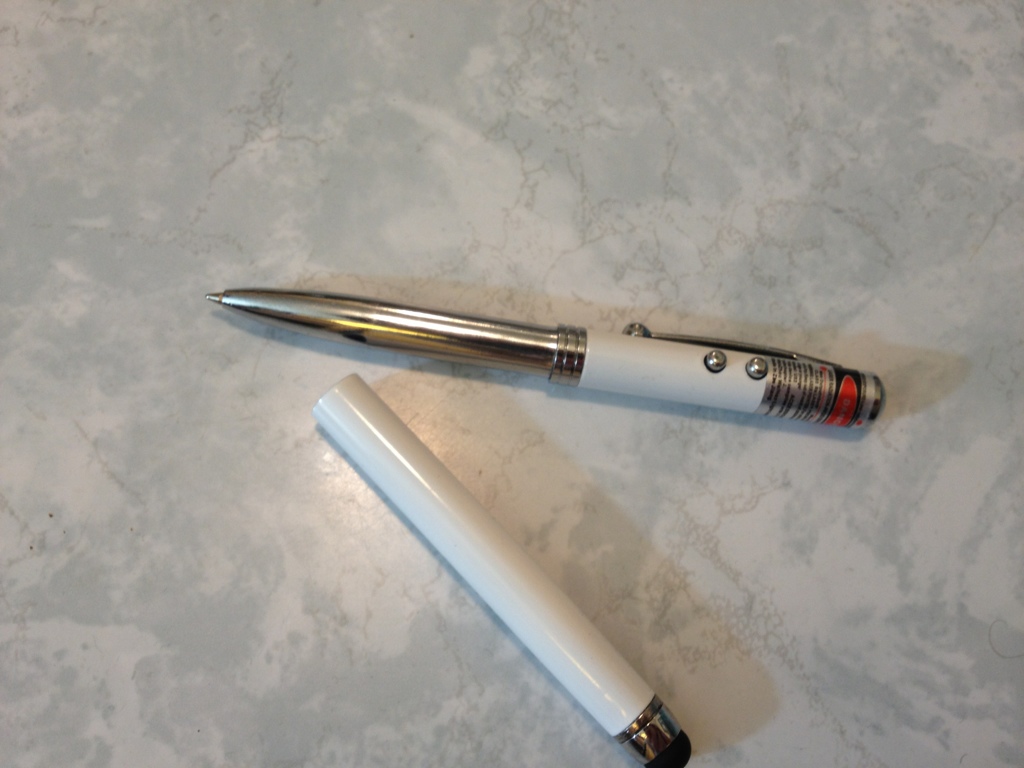
Every once in a while you run into a gimmicky, cheap product that’s still a bit of fun. For instance, I wanted a laser pointer (for me and my cat) and was in Walmart one day. On that day I found the “Hot Concepts Illumix 4 in 1 Stylus”. It’s a funky little pen with a light, laser, and touch-screen stylus. And it’s only a couple bucks! Let’s see how it works:

20150224-232410.jpg
The light is really just a white LED that’s stuck in the end of the pen. There’s no focus, so it dissipates rather quickly. You could get an idea about the shape of a small room, find a key, or perhaps locate something stuck behind some furniture, but that’s about it. Nothing far away can be seen, and nothing in great detail. But it still works alright. Interestingly enough, both the light and laser can be turned on at the same time. The laser is dimmed significantly by this, but the light seems unaffected.

20150224-232415.jpg

The laser pointer works fine. It’s one of the standard cheap ones that can be found almost anywhere. It will hurt your eyes, but isn’t very bright on anything else. It isn’t very well focused and will spread out over long distances. But inside a regular sized room, it is very functional as both a people and cat toy.

20150224-232420.jpg

The stylus works with modern touch screens, and it’s fine. It’s so easy to make a stylus that works with these screens now it’s unremarkable. It’s a bit cheaper than the norm and seems like it might wear out, but I’d say the worst thing about it is that you have to watch out and not hit the buttons and blind yourself when using it.

Finally, the pen part. It works, actually quite well. The tip is very fine, but despite that, it writes quite smoothly with little pressure. The inks a standard, almost-black ballpoint ink that’s water-resistant. The cartridge can’t be replaced as far as I can tell, though the batteries can be. So when you run out of ink you’re out and just left with the other features. That would seem to indicate the pen is not a primary function. The sleeve with the stylus has to be removed to access the pen, and this is not held on very well. It slips and can come off with a bit of a shake. There’s also nowhere to put the sleeve when using the pen, meaning it’s a two-handed operation.

A couple of other things: the clip works well, there’s a warning under the laser but otherwise no information printed on the pen, and the white smooth color with “chrome” trim looks nice, but not very professional, and it’s quite slippery.

Overall, every action it performs is done passably, but not well. It’s a fun device to mess around with or have if you want any or all of the 4 uses, but won’t use any of them that much. The batteries don’t last that long, the ink cartridge is small and not replaceable, and the overall tolerances aren’t very tight. The metal construction is nice, but the product seems to be made with disposability in mind. It’s fun, and good for the money. Just don’t expect much out of it.

Review – Papermate Eagle

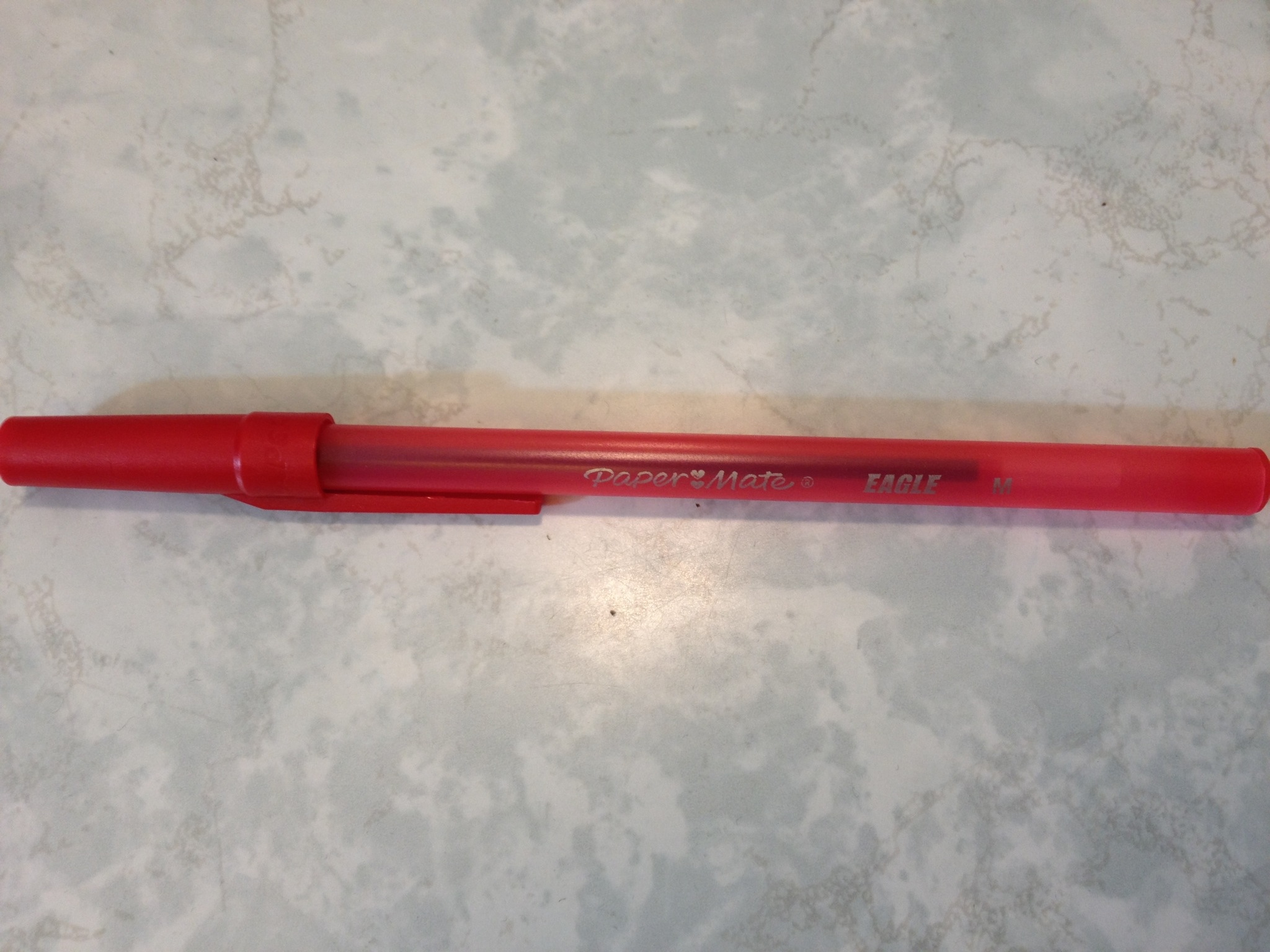
All pen companies have a simple, cheap round pen. Bic has the round Stic, Staples has its… pen, and Paper:mate has its Eagle. And it’s the Eagle I’ll be looking at today.

20150218-000755.jpg

The body of the Eagle is nothing spectacular.  It’s simply a semi-transparent cylinder which tapers down slightly just after the section to a tip/refill insert that can technically be removed, but which shouldn’t be because replacing it would be as expensive as replacing the pen. The cap is a standard friction fitting affair, which covers the tip so ink doesn’t get everywhere, and has a clip that’ll keep it in your pocket for a little bit, though I wouldn’t trust it. The information printed on the side of the barrel is minimal but works.

20150218-000802.jpg

The writing is surprisingly smooth for a ballpoint, at least for the red one I’m using. I guess they’re just getting better over the years. The ink is the same color as in the Paper:mate Write Bros pens. It’s fairly dark and unaggressive as far as reds go. And it’s waterproof almost instantly, though I wouldn’t wager on it being fade resistant. Writing comfort is minimal, as one still has to push down a considerable amount when compared to liquid or gel pens, and there is no grip other than the plastic of the barrel. But it’s still quite tolerable and causes no excess discomfort when writing.

Overall it’s a fine office pen.  It works, and it’s cheap. It’s sturdy and fairly reliable. Is it great? No. But they’re fine for what they are, and virtually indistinguishable from similar Bic pens. If you lose a lot of pens, or need to get some for students or coworkers, these should do just fine.

Review – Monteverde Ceramic Gel Refill

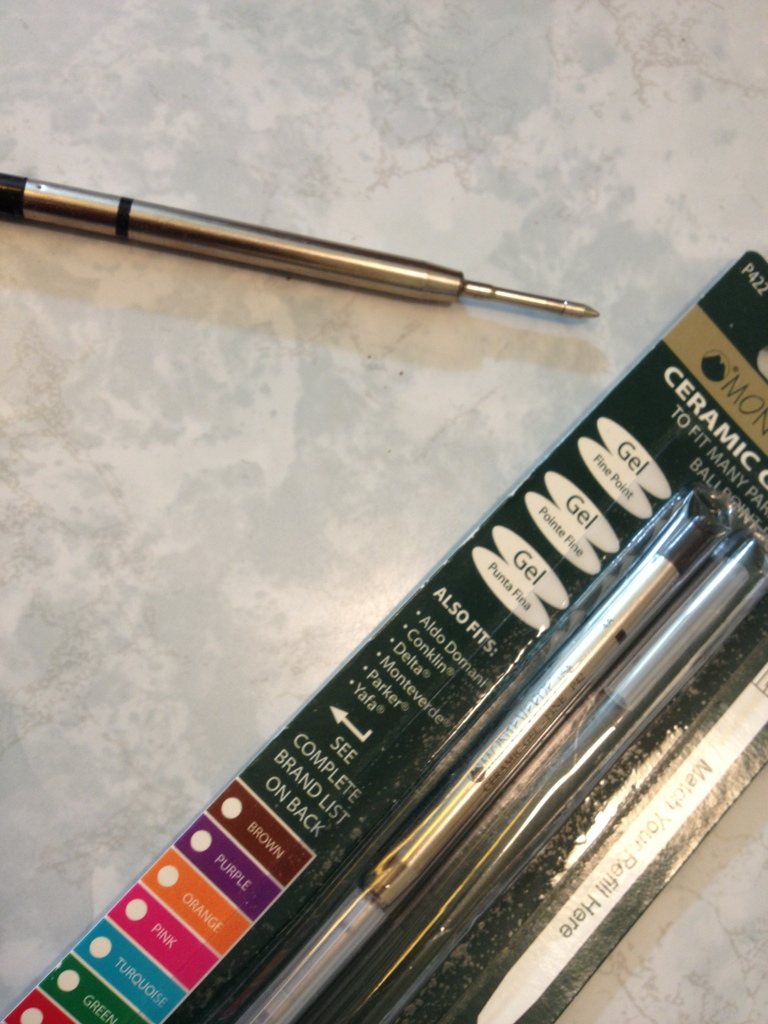
Some companies are iconic. Some companies have existed for years and have made a lasting impact on all of the products in their market today. Parker is one of these companies. And when my Parker Jotter ran out of ink, and I was trying to find a refill, this became apparent. Because while there aren’t many Parker brand click pen refills to be found in the world (it can be done, and much easier than some other things, but still…) it is quite easy to find a refill that will fit into a Parker pen. In fact, it’s more common to find pens that fit such refills than it is to find a genuine Parker pen now. Monteverde is one such company that makes both refills and pens of the Parker type, and I’ll be looking at the Ceramic Gel refill from them today.

20150210-235432.jpg

The body of the refill itself fits perfectly into any Parker-type pen with ease. Printed on the cartridge is enough information to help you buy another and then some.

The ink is a jet black. It takes some time to dry completely, though, and even when it is dry enough to turn the page the ink isn’t completely dry. It sparkles for some time until it fades to a nice black with little to no shading, which I like in a black.

When dry the ink is very water-resistant, with only minimal feathering. Writing is quite smooth, though I chose the fine-tipped version, which is very finicky about the angle at which it is held and will skip if it is even slightly out of alignment. The tip can also upon occasion require a stroke before the ink flows. After this, there are no flow problems to mention.

It’s just a good refill that does what one would expect it to. It performs well, and its smoothness is quite nice. Really, though, the feel is so close to many other gel pen refills that it comes down to a matter of trying most of them and selecting a favorite.

Review – Rhodia 3×4.75(5) Staple Bound Pocket Notebook

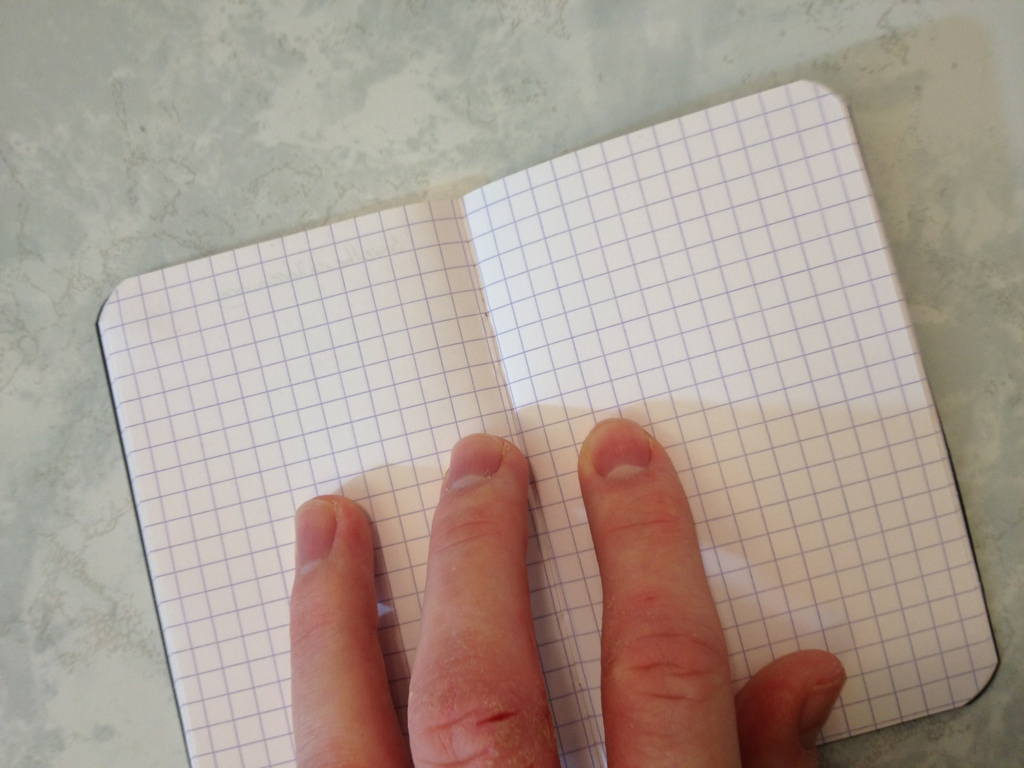
Pocket notebooks are something that, it seems to me, are becoming more of a “thing” again. Whether or not it was just me being unable to find them early in the 2000s, or them not existing in large quantities at the time, I don’t know. Still, I seem to find newer, and possibly better, pocket notebooks all the time, like the Rhodia 3×5 48-page 80g notebook I stumbled across at my local bookstore.

20150203-231111.jpg

The color of my notebook is black (it can be orange), with orange lettering printed on, making it look like the Rhodia premium pads, but it contains regular, stark white, 80g Rhodia paper. My particular book is a graph ruling in a light purple that is customary for the brand. I quite like it, but prefer a light blue for graphs. The 3×5″ size makes the book small and convenient to put in any pocket. Being a half-inch shorter on either side to a field notes book, I was surprised at the places this book could go that the latter couldn’t. The 48 pages are quite sufficient for making lists, a few sketches, or even a few stories, and about the right length to prevent the destruction of the book by the time it is completed.

20150203-231121.jpg

The cover quality is nice. It is thicker than the paper without being cumbersome, and seems tear- and crease-resistant, though I wouldn’t push it. The ink used to print the logo and info on the back is much more heavy-duty than what is used on the pads and holds up without smearing, chipping, or fading for quite some time. The staple binding is a weakness in some cases, being a bending point, but overall causes little damage since the size is so small. And the paper is typical wonderful Rhodia. It is thick and smooth, taking everything from pencils to fountain pens with no problem. It is an absolute pleasure to write on, though with some liquid inks taking time to dry, one has to be careful. If they are looking for speed, a non-liquid pen should be looked into, but even ballpoints feel great on the paper. Bleed-through and feathering are minimal. Show-through is unfortunately common, and tearing is unlikely but possible if the book is going out on an adventure.

Overall, these little notebooks are a great addition to the pocket notebook collection. They are heavy lifters for their size, and the black ones are fairly covert and classic looking. And, of course, they all but disappear in a pocket. A great little book to look into especially if you think Field Notes are just slightly too large.

Review – Scripto Oops

Sometimes, when going through life, you find some amazing idea that you can’t believe has been discontinued. I mean, how could they not be making money on that? Of course, there are many reasons for something to disappear, and in the case of what I’m reviewing today, the Scripto Oops, there are plenty of long erasers to take its place. But this one was the first I ran across, and I think it deserves at least a short review.

20150127-223939.jpg

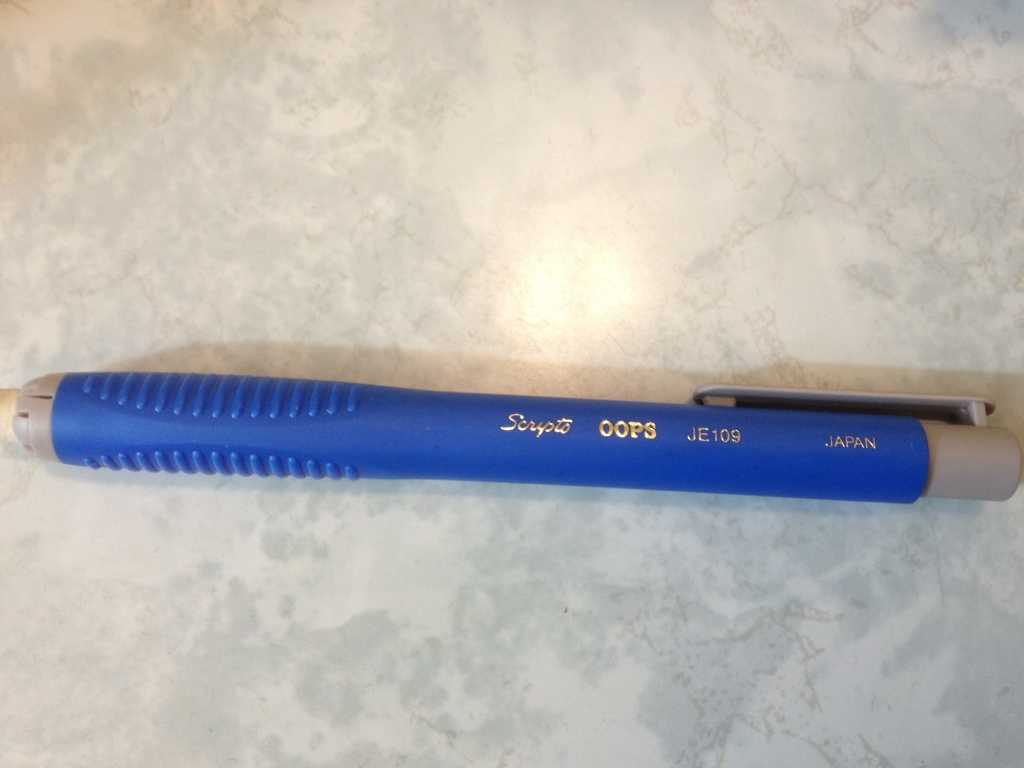
The Oops is a pen-like item, with an uncapped cylinder as a push button on the back, and a functional, but not very useful, clip. One the side of the eraser is printed the relevant information for the company and item being used. At the section, the eraser becomes more “triangular” and ridges are added for grip in the facets.
Pushing the button moves plastic claws at the front of the eraser that push forward and then lock in the main eraser part. This mechanism is fairly sturdy, but does break over time. The eraser itself is better than a standard pink eraser, but not as good as gum erasers. In general, it falls well into the white eraser category.

20150127-223934.jpg

Overall, I love the thing, and use it when I remember it’s around (and not lost in my pen cup). For art, I do tend to use higher-quality erasers, but for everyday use this is a great one and it fills all the roles needed with minimal streaking and removes enough pencil. It’s just a shame they don’t make them anymore.