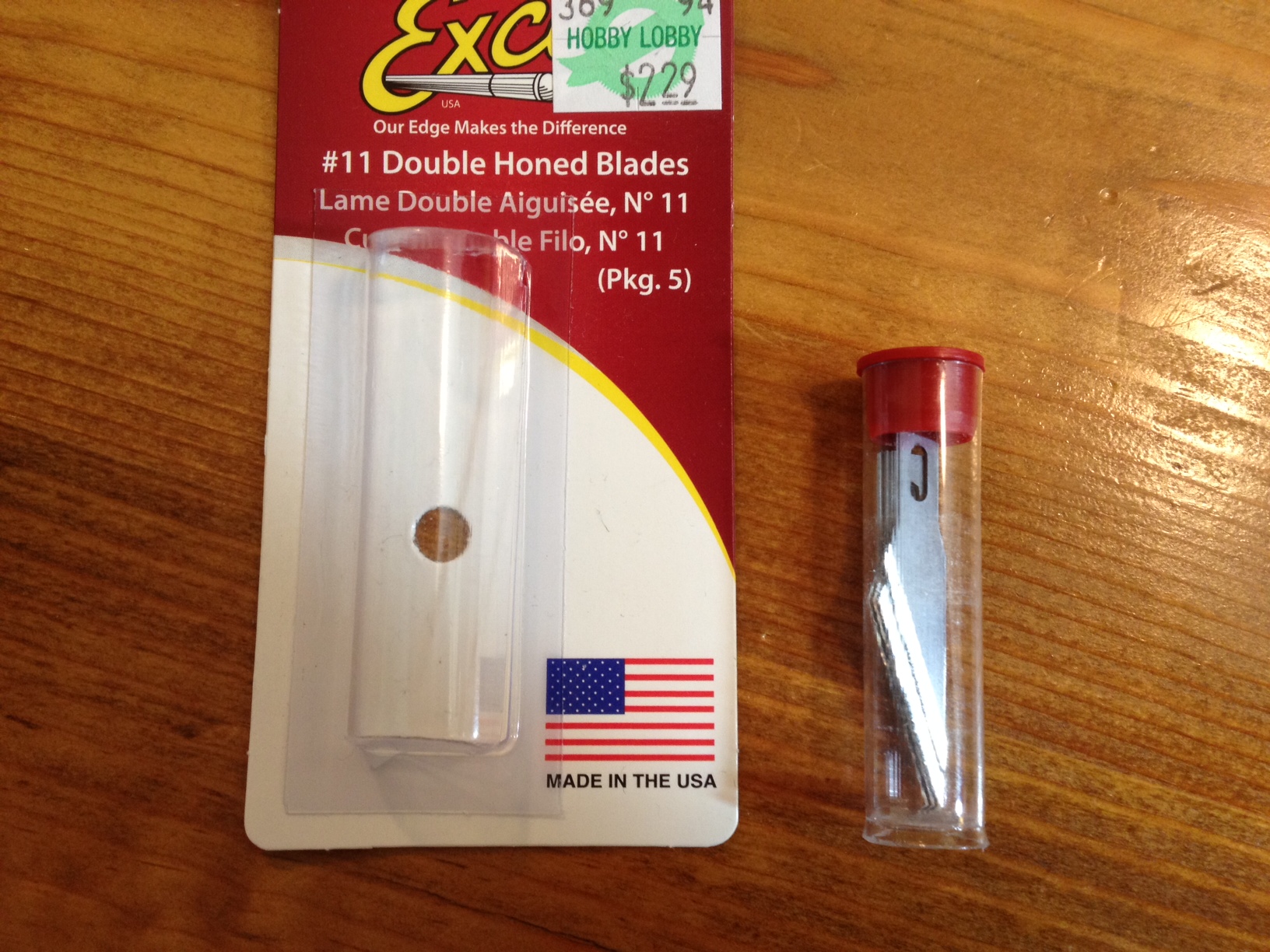
Review – Excel #11 Hobby Knife Blades

X-Acto knives with #11 blades are an art, crafting, and modeling staple. But is the brand name worth it? Will a pack of Excel blades do just as well, or should you just buy the no-name brand from eBay if you want to save money?

photo-40

To start off with, the Excel brand 5-pack that you buy in hobby stores has a tube to store the blades in. It’s nothing special, but it gets the job done, is clear so you can see your supply, and is flexible so it doesn’t shatter.

photo-41

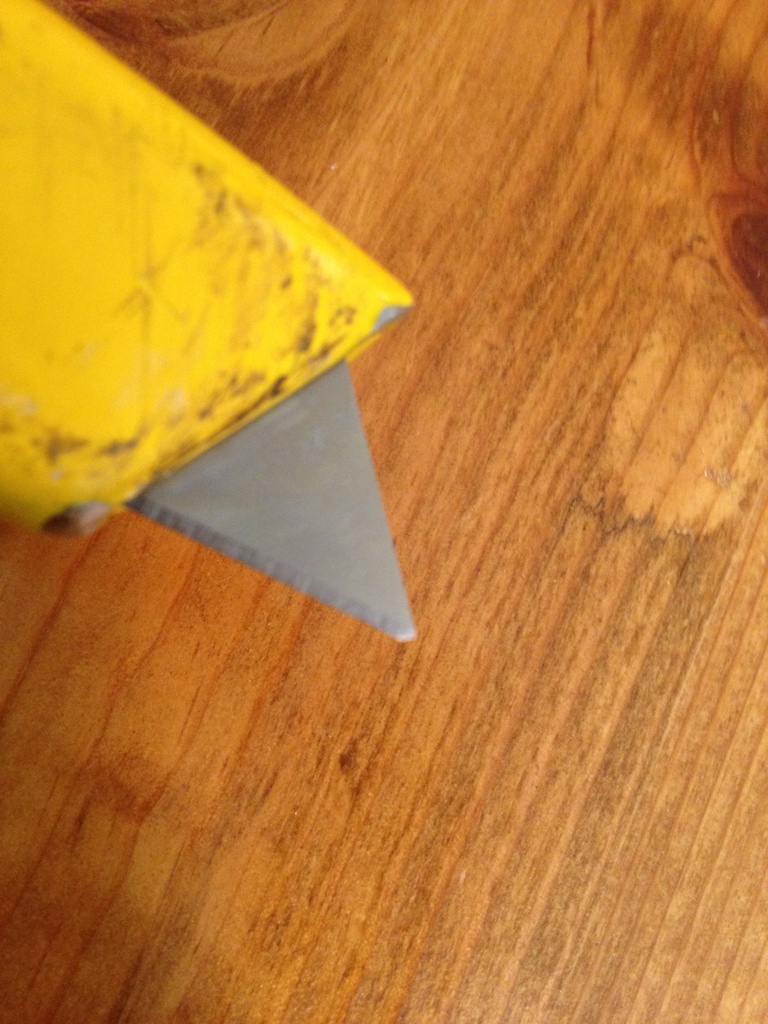
The blades fit securely in all hobby knife and scalpel handles that I tested, and should fit in all (unless there’s a proprietary system I don’t know about). The blades come sharp enough to cut paper, and hold their edge through cutting plastic. They dull and bend at about the same rate as X-Acto blades and can easily make it through several projects before dulling or being nicked. I’ve had no rusting yet (they come oiled), but I do keep them fairly moisture-free. The tip is “flexible” in that it doesn’t shatter and has some play (bouncing back when bent), but the point and the blade are hard enough that a single blade could take weeks of daily use (depending on the use, as plastic and metal are obviously harder than paper and cardstock).

Overall, these blades are less expensive and at least as good, if not better, than the name brand competition. They cut well, hold an edge, and resist breaking. They’re a reliable blade that is at least worth a look.


Review – Dollar General Utility Knife Blades

Utility knives are an almost ubiquitous tool. They are inexpensive and easy to use cutting tools that are good on the job, at home, and for crafting and artistic tasks. And for most people they are used for jobs that scissors just can’t do. Even people who carry pocket knives can use a cardboard cutter now and then. But there’s a reason the blades come in 100 packs at 10¢-30¢ apiece. This set from Dollar General is about 20¢ apiece. How do they work?

20150524-234739.jpg

To start, the packaging says they fit most utility knives, which I’ll believe. Their shape is similar to most other blades I’ve seen, and they fit my knife just fine. They lock into place with about as much precision as one would expect, which is to say not much. There’s play in the blade when installed, but it’s workable. They come sharp enough to cut paper, and strong enough to cut household plastics, which are both really things that are a bit out of the general use of the blade. They don’t dull immediately, either. That being said they don’t last for very long and the blade itself can be dinged rather easily. They are also pretty fragile. When I was testing one on plastic the very tip of the blade broke almost immediately. They’ll last about a hard day (or 2-3 give or take) cutting cardboard, longer in the house, shorter if you’re cutting more or heavier things (like they won’t last literally all day just cutting), and for as cheap as they are I wouldn’t expect much more. And if cutting cardboard cleanly isn’t a necessity they can last longer. Finally, they are smothered in grease in the package to prevent rusting, and while I haven’t left mine out I have no doubt that they would rust really fast.

20150524-234744.jpg

So are they great? No. But no utility knife blades are great.  They do about as well as expected, and are at least safe for their main function of cutting cardboard, rubber and the like. If you need the blades right now, or don’t need to buy many blades, these will work, but larger packs or ones with slightly higher quality would be recommended.

Review – Piccadilly Sketch Book

There are quite a few sketchbooks out there, and it can be hard to choose. If one isn’t the “pick one and stick with it forever”, or the “grab the nearest one off the shelf when a new one is needed” type of person, it can be overwhelming. Which ones on the shelf are worth it? Piccadilly is a brand of notebooks that has been making inexpensive Moleskine-type books for some time. Are their sketchbooks any good?

photo-36

The books have a super-plain brown cardboard cover with only the word sketch thinly lettered on the front. This cover is more of a wrapping, as it’s only attached at one point on the back, wrapping around and folding in the front like a dust jacket would. The binding is a series of small, sewn signatures glued together on the spine. It’s similar to most other binding methods; the spine cover just isn’t glued to the actual spine. At 120 sheets it’s a nice length, and isn’t too bulky or heavy. The construction, while sturdy, wouldn’t, I suspect, hold up to more than its complete page count if heavily used, and the cover-cover might even fall off or be rendered unusable before then. For a non-spiral it’s good, but it won’t last forever.

photo-37

The paper is blank 100gsm, textured and acid-free. It’s quite thick, almost seeming like card stock, but this provides a stable writing service even deep into the book. The texture isn’t great, in my opinion, but isn’t intrusive either. It holds graphite and pigmented ink well. If one is using wet, dye-based inks, though, feathering can be quite severe. The thickness leads to very little bleed-through (although it couldn’t stand, say, sharpies) and almost no show-through in most cases. It’s very well behaved and makes writing and drawing a pleasure, especially with pencil.

photo-38

It’s a good sketchbook, quite a good one, if you’re not going to put it in extreme conditions. It’s on the lower price side of average sketchbooks and does the part. Most people won’t have a problem with it and I certainly haven’t. If you’re looking for something to beat up, a different book might be needed. But if you’re looking for a minimal, handsome medium-use sketchbook, I’d have a look.

Review – Bic Velocity Mechanical Pencil

Bic makes a lot of writing products, and sometimes it’s hard for me to keep them straight. I’ve never really been sure what one is supposed to do over the other. Nevertheless, the Bic Velocity is a solid mechanical pencil and I’ll be looking at it today.

20150510-220506.jpg

The back of the pencil is unremarkable; a clear plastic cap covers a small, white, barely functional eraser (it works about as well as most mechanical pencil erasers). This assembly can be pushed down to activate the lead advance mechanism. Just down from this is a plastic clip, functionally all right, with the pencil’s information written on it. Down from there, the body is clear and straight until it get to the rubberized grip section where it bulges then hourglasses, creating a nice place to rest your fingers. The little cap cone after this is clear, and has the metal tip floating inside so that is retracts when the lead is retracted, preventing the tip from getting caught on anything.

20150510-220540.jpg

Writing is fine. The lead is standard. It doesn’t break much, goes on smoothly enough and dark enough for school or office work. There is no advanced shock absorber or lead turning to prevent any damage, though, but at the price, that’s teetering on the edge of reason. The grip is comfortable enough to get one through writing or drawing without too much trouble. It doesn’t slip and isn’t too narrow. The overall construction is solid, and it feels like it won’t break in your hand.

Overall, the Velocity is fine. It isn’t the best mechanical pencil ever, and it has no real features, but it’s solidly and relatively comfortably built. It is fairly inexpensive and comes with enough refills of erasers and lead to last the user for some time. As far as inexpensive options go for mechanical pencils, it’s a good one, but there’s nothing special about it.

Review – Paper:Mate Sharpwriter

Papermate has been making pencils for a long time, and one of the simplest and least expensive mechanical pencils available is one that they make. These pencils are some of the cheapest on the market from a name brand, and always come in packages containing a large number. They are almost universally recognized as one of the lousiest pencils to use, but is that reputation deserved?

20150503-225627.jpg

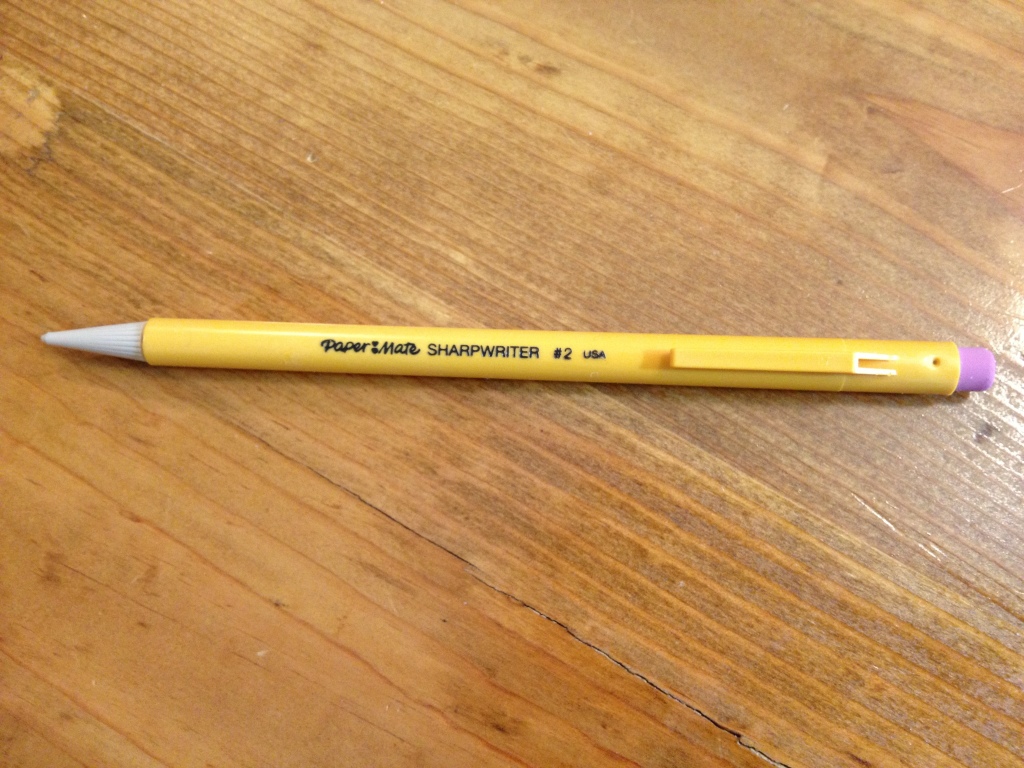
Starting at the back, it’s got a small, pink eraser that does indeed erase (quite well, actually,) but, like most erasers at the back of pencils, it won’t last very long. Moving down from that, we have a basically straight and plain body, with a terrible “clip” near the eraser (it doesn’t actually clip on most things the thickness of shirt pockets). The basic information about the pencil is physically molded in the side, with no other features on the barrel. It looks slightly slippery but does grip with no problems.

20150503-225632.jpg

At the front of the pencil is the lead-advancing mechanism, which one must twist both to extend and retract the lead. This is inconvenient, but not more so than a top click. This twist mechanism is flimsy and easy to break if one goes too far, but not too noticeable when writing. The lead is technically refillable, but the pencil is almost treated as disposable, so it isn’t worth it.  The lead that comes with the pencil is fine: it’s a #2 and it works fine for most purposes, even erasing well with the eraser. There is also a “shock absorber” in the pencil (I believe it isn’t a special thing but inherent in the design) and it works!  You can press down quite hard and the lead will simply retract a few mm instead of breaking, but writing like this would be fatiguing and still cause the lead to break, since the spring is only absorbing force in one direction.

Is it a great pencil? No. Is it a bad pencil that will explode when you take it out? No. It works.  It’s a bit finicky at times, and I feel like I could break it with my bare hands and minimal effort, but under normal use conditions this isn’t a problem. The clip is the worst part, and if you need a good one I’d steer clear of the Sharpwriter. If you’re looking for the one pencil to have forever this is also far removed. But it is quite versatile and quite inexpensive. (Adam Savage of Mythbusters likes them: https://youtu.be/uN6vptYpo5I?t=2m15s) And if you lose pencils often, or are getting them for an office, I’d at least consider it.


May Update

ART SUPPLY CRITIC

New reviews will now be going up on Monday rather than Wednesday. I’m reorganizing my entire posting schedule to make it more even.

TUMBLR

Hello followers (mostly Tumblr followers, since this post is more directed at you/them.) You might have noticed I’ve dropped off of posting my comics to Tumblr recently. This is for a few reasons, the main one being that the method I have to use is a very large hassle to do and is affecting how much I can do during the day, I’ve been working on integrating things better, but it hasn’t worked out and is taking up even more time. So, at the moment, I’m going to stop posting comics every day on Tumblr, and replacing that with a weekly post that rounds up some of the best comics from the week with links. This may also include a text post or two. Eventually, this also may become an email list that people can subscribe to (it won’t leave Tumblr, though). Thank you for being patient with me.

DRAGON FUNNIES

The Dragon Funnies is no longer sharing to Tumblr, and while the site isn’t going anywhere, I’d appreciate it if more people followed my main site (www.dragoncompany.org) instead of this one.

POSTING SCHEDULE

Art supply reviews will be posted on Monday now.

Articles will now be posted on Friday.

Videos will be posted on Monday and Thursday.

A weekly recap will be posted on Saturday.

Other written things, like book reviews and such, will hopefully be posted on Wednesday.


Review – Uni Kuru Toga Roulette

I’ve previously looked at one of the most liked (and according the to the Wirecutter the best) recent mechanical pencils, the UniBall Kuru Toga; I was under whelmed. Recently I was able to get a hold of the upgraded version, the Roulette. Is it worth the upgrade? Should you skip the regular model and get this one? Let’s take a look.

20150428-233220.jpg

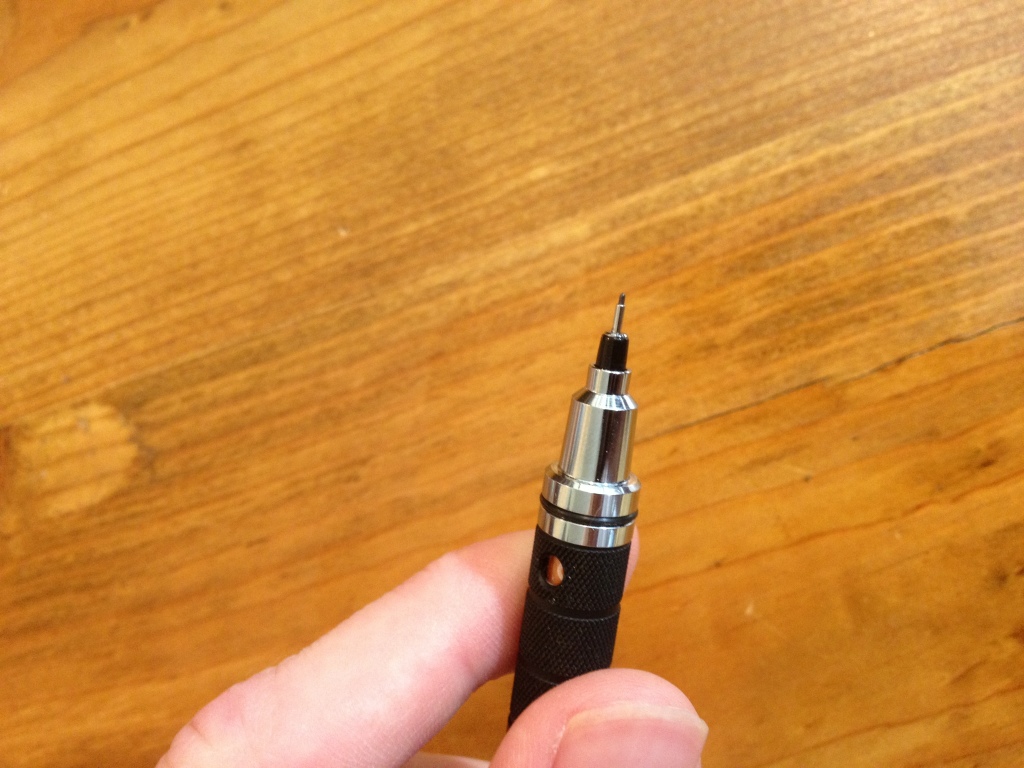
The back end of the pencil is a plastic and metal lead advancer; it works and doesn’t dig into the skin. There is a rubberized ring around it for reasons I don’t quite understand. Removing the advancer reveals a super tiny eraser that won’t last long but does indeed erase. Below that is a clip, which is fit onto the barrel in a way that would allow removal, but with difficulty. Japan is stamped into the side of the clip, and the name and size of the pencil is written on the barrel just beneath the clip. The barrel is plain until one gets to the section, which is metal and extended, the bottom half is knurled, but not aggressively so; it provides a good grip. There is a small hole in the grip that allows one to see the fact that the pencils mechanism is turning (but no the mechanism itself). Down from that is a tip very similar to the regular Kuru Toga, but extended is some ways. On this model this oddly designed step down cap is still not necessary, but covers up an otherwise ugly portion.

20150428-233226.jpg

Now on to the part everybody loves, the mechanism. I mentioned that I was under-whelmed by this previously, and I still am, but I know why now. The window in the grip section allowed me to see clearly when the mechanism was turning and when it wasn’t. And while it was possible to do this in the cheaper versions I was a bit harder to see. The mechanism itself by the way, as far as I can tell, is identical in both pencils, but there is no way to open them and find out exactly without possibly rendering them inoperable. But the answer to when the mechanism was turning when I was writing with the pencil was… never. I tested it, the mechanism works, it just never moves when “I” write with it. My writing, and drawing, are much too light to get it to rotate the lead, and thus I never see the affects. The packaging (for the inexpensive one, my roulette came in all Japanese packaging) says that the mechanism helps with the point of the pencil, and to prevent breakage. I really have never had a problem with either of these things, partly because I flail the pencil around compulsively when writing and drawing, and that rotates it such that my lead is always at a point. Now I guess I know that I write far too lightly to have a problem with breakage. But man, if I write lightly, some people must really press down on the things. So yes, it works flawlessly, but if you write like I do it isn’t really a selling point. And finally I wouldn’t worry about the mechanism wearing out, it is extremely well made and there have been no complaints about such a thing occurring, so if it does by that time you’d be able to just get a new one, it’s popularity means it likely isn’t going anywhere.

So, it is a good pencil? Yes. Is it worth the money for the upgraded version? Yes, even without the mechanism. The pencil is solid, well made, and solves the comfort issues I had with the less expensive version. The weight is good, the feel is good, the metal gives one a good grip and the writing is nice and fine. And if one does press hard enough to activate the mechanism I’ve heard nothing but good things. I wouldn’t take it over my Graphgear, but that’s just personal preference. I like the thinner body a little better on that one. So if you write with a lot of pressure, the Kuru Toga is the pencil for you, if you don’t you have other equally good options within the price range in my opinion. Even then it’s definitely worth a look.
Review – Daler Rowney 11×14″ Canvas Panels

Painting is fun, but stretching one’s own canvas can be difficult without experience, and even pre-stretched canvases can take up more space than wanted if one is simply practicing. Or, maybe you’re using mixed media or just drawing, and a stretched canvas isn’t right for you. Canvas panels are a good, sturdy alternative in these cases, and I’ll be taking a look at some fairly inexpensive ones by Daler Rowney.

20150421-221920.jpg

There are three canvases in the package. All are functionally identical. They’re 11×14” almost on the nose, and very sturdy, both in binding and in strength. The have a bit of flex, and have a slight bend if left unattended, but would be very hard to snap or fold. They’re essentially primed and can be painted on directly, but one might want to go ahead and prime them beforehand. The cotton canvas is acid-free to prevent decay, and the grain is not large enough to be intrusive. Paint, pencil, glue, etc. all stick well without any major problems. I’ve had one painting not like to dry on the stuff, but since all of my others have, I’d be willing to say the problem was with the old paint I was using.

20150421-221926.jpg

In short, the panels are quite good and inexpensive. They won’t replace a full canvas, but they won’t hinder the painter (artist). The slight warp they have is an easily corrected downside, and the only major one I can see.

Review – Master’s Touch Palette Knife

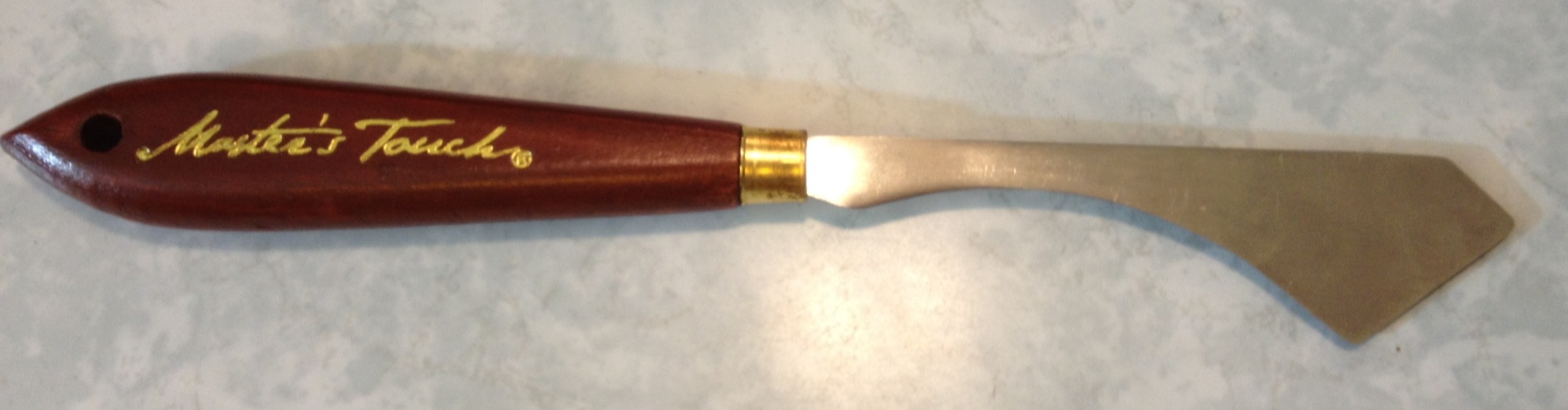
I’ve been painting recently, and have a new appreciation for palette knives (foolishly I never used them before), both for controlling paint on a palette, and for painting. Unfortunately I’ve found no real resource that says if there are consistent sizes and shapes for palette knives, and I don’t believe there really is. So instead of this being a review of a specific size or shape of knife, this will be a general look at the quality of the Master’s Touch brand of inexpensive and easily accessible palette knives.

20150414-225713.jpg

The particular knife style here is slightly unconventional, and appears in the least amount of photos I see online, though it is the shape used by Bob Ross, so it’s got that going for it. The handle is a light, okay finished wood with a lanyard hole and the Master’s Touch logo imprinted on it. It’s sturdy enough and it works. Following that is what appears to be a “brass” “section” ring that is dented and losing its finish. It holds the blade in place, fairly sturdily, but also not centered. The blade is stainless steel, quite flexible and tapers down to a very usable edge. It is finished well enough, and doesn’t get thin enough to cut easily, but I suppose if one really tried they could make it dangerous. In some places the brushed finish isn’t nearly as well done, but these places don’t really matter in the scheme of things.

Overall it’s a nice introductory tool. It obviously has some quality control issues, but they aren’t major and don’t prevent the tool from functioning or make it dangerous. It’s inexpensive, and I would recommend it to anyone who isn’t sure if they really want to paint and are just trying to get into it, upgrading in the future is always possible and still isn’t a lot of money. And even if one doesn’t this tool will likely be able to last a painting lifetime.

Review – PaperMate Flair Colors – Maroon, Brown, Caramel, and Grey

And now it is time for the final part of my look at the 20 colors of the Papermate Flair pen. This section only has 4 pens, and it’s special because I couldn’t find names for these colors from any official source. So the 4 names presented here are just what I think most represent the colors. Let’s get started and wrap this up.

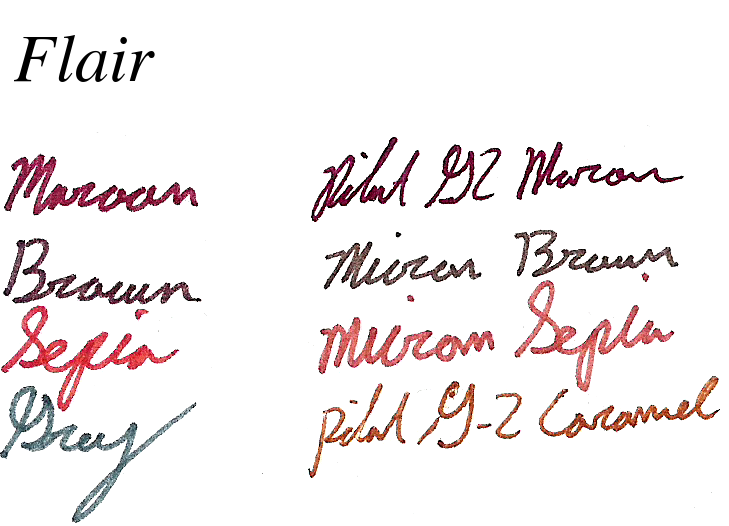
Papermate flair colors part 4

Maroon – I love a good maroon shade, and this one does not disappoint. It’s easy enough to tell, even amongst other dark colors, what it is, and the tone is nice to look at. It might not be the most natural maroon I’ve seen, but it’s quite good, and sometimes it may even be work compliant. It doesn’t smear much but it’s not the best at resisting water, either.

Brown – The brown is a nice dark, UPS, brown. It doesn’t quite look like dirt, more like bark, and it barely smears. It’s easy on the eyes, blends in with dark colors, and could work in some office settings.

Caramel (error in image where this is labeled as Sepia and Micron Colors are switched) – Caramel is the color I’ve had the hardest time naming. I just don’t really get this light brown. It looks fairly standards, but it’s a bit off from the browns in Micron, Crayola, Pilot, and other such brands. It looks all right, but not the most natural, and most workspaces wouldn’t appreciate it. Although smearing is next to none.

Grey – And the final color is also one of the most boring. Grey is a color I love that isn’t featured in many color sets. And that’s because there isn’t much use for it. In nature I can only think of fog, and in an office only if you convince them it’s just your black pen running out. That being said, it’s a nice dark, even grey with very minimal smudging and feathering.

And there we are, the 20 current colors of the Papermate Flair. I do like them, and even some of the more garish colors are better in these sets than others. There’s a good mix of water resistance, workspace appropriateness, and personality in there. And I would recommend the set if you like tones of colors and like the Flair. But it’s a bit expensive and maybe one should consider the smaller sets if they want specific colors.