Review – Sharpie Black Retractable Pen

So you want to ink a drawing you did, but you can’t find Microns, or any other technical pen. You certainly don’t want to use a ballpoint. What do you do? Well, the Sharpie retractable pen may be an answer. The black version, to be precise.

20130808-234009.jpg

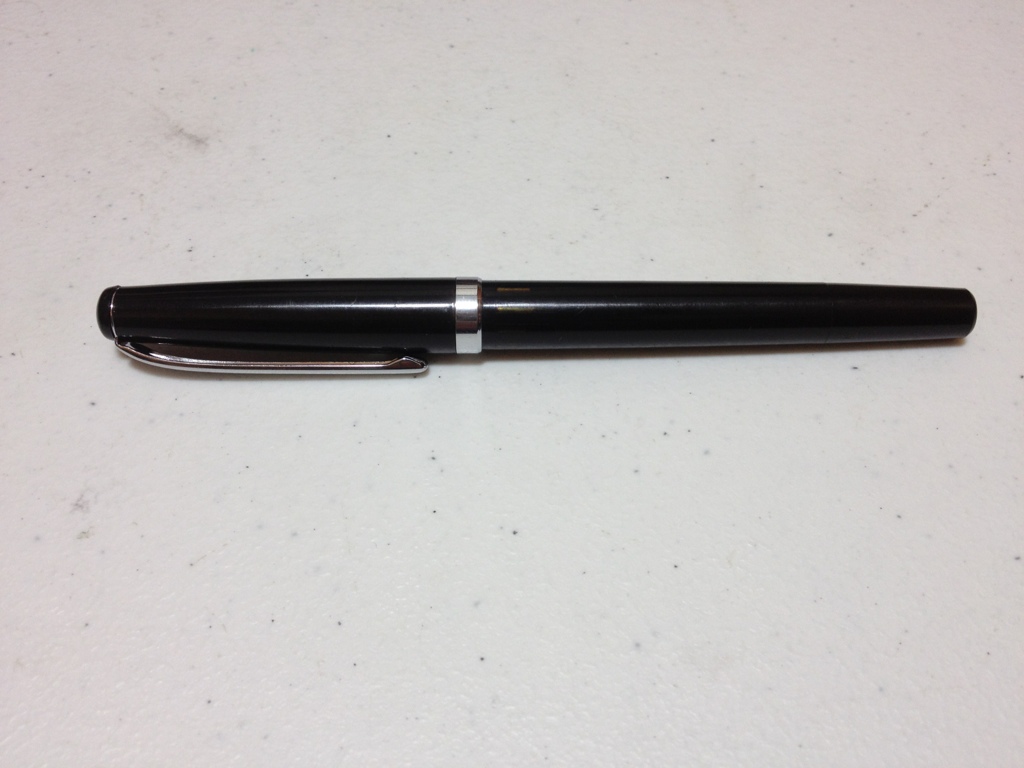
The pen itself is a shiny black that gets finger prints on it constantly, though it cleans easily. The body of the pen starts out wide and tapers toward the rear of the pen. Near the front is a rubberized grip section with some grippiness to it. Sharpie pen is written on the back near the clip in silver. The pen looks like it can be taken apart in several places, but it can’t.

20130808-234019.jpg

The clip is metal, it’s rather stiff and doesn’t easily go into or out of a shirt pocket. The click mechanism in the back for retracting the pen feels solid, but the plunger is loose and feels a little flimsy.

20130808-234014.jpg

As for the most important part: the tip. It’s a fine tip, with the standard very black Sharpie color. It puts down a fairly smooth line. I would compare it to a Micron 01 or that range, but it’s really slightly smaller. The tipping material is very stiff and doesn’t like to bend, which leads to less line variation but a longer usable life. It’s not a permanent pen, or at least permanent like the markers. It writes and sticks on most surfaces, but not on all, but it is very black on everything.

Overall is it going to replace a good technical pen? No, but it is very good for inking in a pinch or if you want a less-used line width in your art. It writes well, it looks good. The main problems for me stem from the fatness of the pen and the cheap-feeling mechanisms. Is it for you? Maybe. I’d recommend trying it out and maybe keeping a few around just in case.

Review – Micron Rose, Brown, and Sepia Colors

So now we get to the final group of the Micron colors that came in the 8 pack of Micron colors. These are the weird or non-standard colors, in my opinion.

The first is Rose, which is a pink: they just call it Rose to make it fancy. It’s a very deep, pleasant, pink color, not like the very vibrant, in-your-face pinks that dominate what is considered pink these days. It doesn’t really approach purple, but it is darker than most roses I’ve ever seen. It’s surprisingly nature-y for a pink, though. It does have some problems with bleed-through on thin paper, but not a lot.

Next we have Brown, which I would call light brown. I would say it’s sort of a fertile, soft, earth color. Again, for a light color it’s fairly subdued, not like a Crayola pencil or anything. Again, it’s surprisingly real looking. It has no problems with bleed-through at all really, and goes well in a landscape.

Finally we have Sepia, which I call dark brown. It’s very mud-like. Another deep, saturated color. It can get very saturated though, and end up looking like black in the final product, so it does take careful application. It also tends to pool, resulting in spots of darker color. Some skill is required to get it to look right. Surprisingly, though, it has very little bleed-through even on thin paper.

micron color test 2.0

These ‘non-standard’ colors are very nice overall. If one is looking to do nature sketches, landscapes, etc. these are quite nice. They are very subdued and blend in nicely. I find them much more pleasant than the bright reds and blues of the other Microns. If you just want standard colors for organizing or technical things, these are not the pens you need.  However, if you’re drawing a lot of the outside, or in cool colors, these are fantastic.

Review – Clairefontaine Staple Bound Pocket 3.5″ x 5.5″

There is a new contender in the pocket notebook category. Well, not new, but new to me. The Clairefontaine staple bound 9 X 14 cm pocket book. This is not really very comparable to the other two pocket books I’ve reviewed as it is much thicker, but it is still around the same size, so here we go. The book is twice as thick as a Field Notes book and about a millimeter wider, and the rounding on the corners is about the same.

20130709-235523.jpg

The cover is a fairly thick but flimsy card stock. There is a website URL, paper weight, dimensions, and page count listed on the back cover, and no other information save the logo. The inside cover is a simple white, while the outside is the standard Clairefontaine cover, which I consider to be fairly ugly. The cover also has a blank space which I assume is a subject line or a name space.

20130709-235529.jpg

Inside is 48 sheets of 90 gram Clairefontaine paper, which is superb. This is one of the few notebooks where the page count, rather than the sheet count, matters, as you can write on both sides, even with a fountain pen. The paper is lined with a 7mm ruling, a small margin at the top, and an infinitesimal margin at the bottom. The lines are a very pale purple and not at all intrusive. As far as I know they only come in a lined version at this size. Writing-wise, the paper is buttery smooth. Very easy to write on, but ink resistant enough to have little to no bleed through, except for the nano-liner which can bleed through tables it seems. The paper is also heavy, it takes effort to bend it along the spine to write with it, and once you have bent it, it stays there.

20130709-235534.jpg

Finally the binding: it’s bent over and squared with two staples each about a quarter of the way in. It seems far from the sturdiest binding, but it can take a fair amount of flex before buckling. Though with no support at the edges they do tend to get a little banged up. Because of its interesting folding style and large page count, the binding does seem a bit weak, in mine the staples aren’t even fully stapled, so pulling this book apart intentionally would be easy. But unintentionally it seems to hold up fine, more due to the paper than the binding. It will buckle and get bunged up at the edges, though. I’m skeptical about it’s ability to take some hard wear and tear for all 96 of its pages to be used.

20130709-235539.jpg

Overall this is a great little pocket book. I personally won’t use them as much as some other books because of the terrible, intrusive cover designs and its thickness. But for writing or drawing with fountain pens, dip pens, or ink brushes, this thing can’t be beat. It’s a great, sturdy little notebook with especially good paper.


Review – Noodler’s Nib Creeper Flex Pen

Fountain pens don’t particularly lend themselves to art. That’s more in the realm of brush and dip pens. But for the more artistically inclined fountain pen users, there are flex pens. Though most examples are ludicrously expensive, Noodler’s Ink brand has several flex pens at a reasonable price. Let’s see how the Noodler’s Nib Creeper Flex holds up to scrutiny.

20130704-232129.jpg

The one I personally have at hand is a plain black one. They come in all sorts of wonderful colors and you should really look into them if you’re thinking about buying one. The black itself is quite nice, though shiny enough that scratches are noticeable. The trim is a nice metal, not sure on the specifics but also shiny. The clip says “Noodler’s Ink” and rotates on the cap; it also does a very good job of holding the pen in a pocket. In the middle of the pen there are a few semi-transparent windows with which you can view your ink volume, though they are not the most accurate things. The cap unscrews to reveal more of the same design to the nib. Both the body and the cap are made of a nice plastic, which feels a little too light and smells a bit. But it is quite sturdy and the smell does subside.

The pen fills nicely by twisting the back all the way out and then down several times (to eliminate as much air as possible) while the nib is immersed in ink. The plunger mechanism unfortunately doesn’t come out like several other Noodler’s pens, or at least not easily. But the nib and feed can be removed simply by gripping them in the mid-section and pulling them out as they are friction fit into the pen. This allows for easy customization of the ink flow. It also allows for easier cleaning when changing inks.

Now to the nib and the actual writing. On paper the nib is wonderfully smooth. Not as smooth as a nice Cross or something similar, but up there. It flexes when pushed down, though not very easily. It does require some force, and at times feels like it may have problems, though these have never materialized for me. The thickness of the line varies depending on the nib and feed configuration. I would say it goes from about a Micron 01 (005 if you go really, really light) to just over a Micron 08 or about the size of the Micron Brush. After that it starts to railroad (split into two lines) even in the wettest of configurations. It also tends to write fairly dry, having a faster ink drying time and less bleed-though than other pens. But this is only minimal.

20130704-232148.jpg

Overall this is a very nice pen. If you’re looking for a sturdy brush replacement or just something to add some variation to drawings it may be the thing for you. For me it strains my had a little, and I prefer less variation in my line, which limits my use for it. But it is still a superb little pen, and a very good value. It can also double as a fancy signing pen, and a note pen. Just something to carry around. It’s great, and if you’re looking for a flex pen it’s definitely the place to start.


Review – Pilot B2P Ballpoint Pen

I’ve come across quite a few interesting or novel pens. I’ve tested out most pens I can get my hands on and have determined my taste accordingly. But a pen caught my eye recently with a gimmick I’d never seen before. It was a Pilot B2P pen, made out of recycled bottles. I’d seen pencils made out of recycled denim, but never a recycled pen. I don’t usually pick up Pilot pens but I decided to give this one a try, if only for the novelty.

20130619-000122.jpg

I’ll start with the writing performance, because on this pen that’s less interesting. It’s a ballpoint, and for a ballpoint it writes amazingly smooth, even smoother than most Gel pens I’ve used. The ink is black and fairly dark. The line is thin, well, at least thinner than most ballpoints. It usually writes on the first go with no skipping, a problem I usually have with Gel pens. It’s fairly impressive, though I think it may run out of ink rather quickly.

20130619-000142.jpg

Onto the body, which is a fairly pleasing blue color. It’s got a fairly useless grippy-grip near the tip and a mid-way between sturdy and flimsy pocket clip on the back. The blue is dark but transparent on the back, mimicking a bottle, and to further the effect it has ridges and troughs to look and feel like a crumpled up bottle, making it feel quite nice in the hand in my opinion. There is an easily worn off label around the center of the pen that contains all useful information, though the more pertinent information is also on the clip.

The retractable mechanism works quite well and doesn’t seem break-prone, it’s nice and solid (though if they hadn’t perfected this tech by now they never would). It also disassembles easily and well into parts for replacement and refilling, though I doubt you’ll ever do either of those.

20130619-000133.jpg

So yes, it’s a nice ballpoint, not the nicest ballpoint, but a nice one. For the price it’s good and novel. And the feel is quite nice. Its uses are that of all ball pens and this one doesn’t stand out terribly. But it is good, and a very interesting idea. And it’s a better conversation starter than the standard click-y ballpoint.

Review – Micron 02 Red and Blue Technical Pens

Image

I’ve talked about Microns in the past. They are basically THE technical pen. But those are just the black ones. Are the colors any good? Do they hold up to the standard and more importantly are the colors usable in any real way? How will these red and blue 02s stack up?

20130607-010852.jpg

The bodies are standard Micron bodies. Slick but still grippy. With hard to rub off, easy to read information in convenient places on them and a number on the lid. The color of the base of the pen where the cap clicks in and the ink on the top has been changed to the pen’s color for easy find-ability.

20130607-010919.jpg

The particular pen I’m using here is an 02, so it’s far from both the stiffest and weakest nibs, though it’s closer to the weaker side. It does bend a little while writing. It’s not large enough to provide much variation, either in line weight or color density. The ink is good, standard Pigma ink, archival, stands up to almost anything. It rarely bleeds and the nib seems to give off just the right amount of ink to have a fast dry time.

But on to the color. They are unmistakably blue and red. They are bright and vibrant, even on a fairly off-white paper, such as Moleskine notebooks and the like. It is brighter than any other pen or marker I have used previously. Almost unusably bright, unfortunately, as I can find no drawing scenario where it would be useful. They are good for organization, though, especially on the aforementioned off-white paper where they don’t look so jarring. They can make handy divider writings and are good for color coded text.

20130607-010911.jpg

Overall these are superb pens with little purpose. They work great, are incredibly sturdy and last quite a while, though I can find no way to work them into any drawing. Notes and technical sketches are the best place for these. Or, if you just want to have a nice pen in an interesting color.

Review – Uni Paint Pen

So you want to paint, but you’re better at drawing. Or you want to mark on some surface unsuitable for Sharpie or other permanent markers. Well, the Uni Paint PX-21 by Sanford may be for you.

This pen is oil-based and needs to be shaken up like a spray can before use. It has a “fine” point, which means a medium or even broad point if you compare it to anything that is a not a paint pen. The line it writes is solid and about as thick as a large Crayola marker. This particular version is the black version which is especially solid, though it is fairly shiny, somewhere between a Sharpie and a matte black spray in terms of marking on plastic. It does mark on literally anything, though some shiner plastics and polished metals have it wear off easily.

20130512-001155.jpg

The body of the pen is metal and feels solid in the hand. A shiny label has all the necessary information printed on it, including warnings and such. This label makes the pen slightly slippery in the hand so tight gripping is necessary.

The cap matches the color of the paint. It has ridges that are sharp and cut into the skin. It also fits very snugly onto the end, meaning it is quite difficult to remove, which is both a hindrance and a benefit.

20130512-001204.jpg

Also be warned that since it is an oil-based pen it stinks mightily and will give you a headache after a few minutes of constant exposure. The label even tells you to put the cap on immediately after use, though this is most likely also to not let the paint dry out.

Overall this is a great little painting device. It is especially handy for touchups on plastic and metal painting. Or, if you’re like my relatives and have a shop were regular markers and price tags have a hard time sticking to the stock. It’s not really a home item, or one that will be useful to canvas painters, but it certainly will have its place with sculptors and model builders.

Review – Royal Langnickel Nano-Liner 02 Red Technical Pen

So, you really need a red technical pen. You’ve heard good things about Microns, but you can’t find them in red at your local store. You instead find a red Royal Langnickel Nano-Liner pen. Is it a good substitute for a micron pen? Let’s see.

First off, the body of the pen is not sleek. It is grippy as a result but feels a bit rough on the hand. All necessary information is printed on the side and is fairly hard to rub off, though it can be done more easily than with other pens. The metal clip on the cap does its job well and the number on the top is easily visible and rub-resistant.

20130215-233456.jpg

The ink is a bright red, unmistakeable for any other color. It’s brighter than most other red pens and would most likely have to be diluted to even begin to simulate reality. It is permanent and a bit more liquid than most technical pens. It bleeds through thin paper with ease and pools at starting and stopping positions. With card stock it works just fine, but with a heavy grain paper the line tends to seep out and become wider. Precession drawing is difficult, even with the 02, which would seem to make a line as big as a Micron 05. However, for large sweeping motions this pen seems right at home, just don’t push to hard and destroy the nib.

20130215-233502.jpg

So, is this pen an adequate replacement for a Micron? Certainly not! It does have several good points: large amounts of ink are good for long, and sweeping lines, but less so for the precision drawing it is marketed for. It does do the drawing job better than a standard office pen and is cheaper than a Micron. I think it’s really up to personal preference as with all art supplies, but one should really try a Micron first before checking this pen out.

Review – Black Sharpie Pen


I like Sharpies. They’re good makers and some of the most permanent I’ve ever used. They’re useful in tons of situations, from signing to just getting something bold out there. The only problem is sometimes they just aren’t small enough. If somethings need to be both permanent and small you seem to be out of luck. Until you find Sharpie pens, that is.

20130130-000819.jpg


The body of the pen is similar to most other pens, it is slim and long. It has a label containing all necessary information about the pen and helping decrease the slickness of the body. The cap has the interesting aesthetic of not being larger than the body, making the pen look slightly odd, but this makes no performance difference. Attached to the cap is a flexible clip that does its job nicely and is not prone to breaking. At the bottom of the pen is also a place to slip the cap on so that it does not get lost while one is using the pen.


The line produced by the pen is thin, but still thicker than common cheap ballpoints. It comes out exactly where you put it and in that deep black color one expects from a Sharpie. Pressure makes very little variation, the ink is always black, and only slightly lighter if one tries to achieve that effect. It flows smoothly over most surfaces and sticks everywhere you expect Sharpie to stick. Although it does in the end feel more like a pen than a Sharpie.

20130130-000827.jpg


I stated in the beginning the main reason one would get this pen. It’s a nice small, permanent, bold pen. It’s serviceable at most pen and Sharpie duties. It would even replace fine-point Sharpies for me. But of course it has the problem of not having a specific use. So it would really be up to you whether or not you have a use for this pen.

Review – Staples Medium Ballpoint Pen

Pens, they’re necessary things. If not for art, then for simple, day to day life. You won’t believe how may people I’ve run into that need pens and don’t carry them around. Okay, maybe you wouldn’t, but I’m still going to quickly talk about a cheap way to get your pen fix so you can jot down notes and stuff (as in peoples’ numbers): the Staples Medium Ballpoint pen.

20130118-001440.jpg


The pens are simple: a small plastic tube, containing a smaller plastic tube filled with ink. The tube is slick, but not slick enough to have the pen slip out of your hands while writing. It has the logo and name on the side in plain lettering that isn’t prone to rubbing off. The cap also fits on nicely and allows the pen to be loosely held in a pocket. Overall, the body does its job.


But what about the point? The tip is a ballpoint which produces a medium weight line with a very universal width. It will take a little bit of skill to get variation from this pen. But what one would want out of a pen like this is reliability, and that is given to one by the constant line. The pen, however, does at times need to be coaxed into writing and will dry up beyond usability if neglected for too long.

20130118-001448.jpg


It’s a nice cheap pen. It’s nothing spectacular, but for the price, nothing is. It is great for jotting notes, getting ideas down, writing drafts and piling around the house so you’re never pen-less.