Review – Scotch Transparent Tape

If reviewing Scotch Tape means I’m out of ideas, then call me out of ideas (I do have plenty more things to look at, though). But really, who doesn’t have a use for tape? And when buying that tape, couldn’t shaving off several pennies save quite a bit of money over time? Is the brand name really worth it (It’s pretty generic-sounding, now, isn’t it)? Let’s see.

20141111-234203.jpg

First thing, the container: Scotch Tape comes with a clear plastic, simple, but quite durable dispenser. The roll of tape is clicked into place on the wheel and at the front are several teeth for separating the tape into strips. Is any of this the best quality? No, but it gets the job done, and very cheaply. If one has a tape dispenser that they like, individual rolls can be bought, so I’d say that this works quite well.

Now onto the tape itself, which certainly isn’t “magic” or “invisible”. The stuff I’m looking at is just labeled “transparent”, and that it is. The tape is easy to see through and sufficiently sticky that it will hold most documents together without a problem in either holding or reading. In fact, the tape itself is very strong, and the adhesive is more likely to break than the tape itself (or perhaps what it’s taped to). Given that it does have a certain rigidness to it, though, it isn’t a tape for repairing any item that, like a tool, will be used, or will move. It is surprisingly strong, but really only good for paper products.

Now, is it worth it to buy Scotch Tape and not some other tape? Given how inexpensive Scotch Tape is already, I’d say yes. And if it isn’t right where you’re shopping, I’d even hunt around for it. The two rolls that come in a pack for around a dollar will last for quite some time. And I’ve seen other brands for around the same price that cease to be sticky once they came off the roll. In short, there’s a reason we say “Scotch Tape” and not “transparent adhesive tape”.
Review – Papermate Mirado Black Warrior

There are a lot of pencils out there, and it seems there are even more cheap pencils (that isn’t possible, I realize, but it made sense when I was typing it). How good can some of these pencils be? Today I’ll be taking a look at the Paper:mate Mirado Black Warrior Pencil.

20141105-010555.jpg

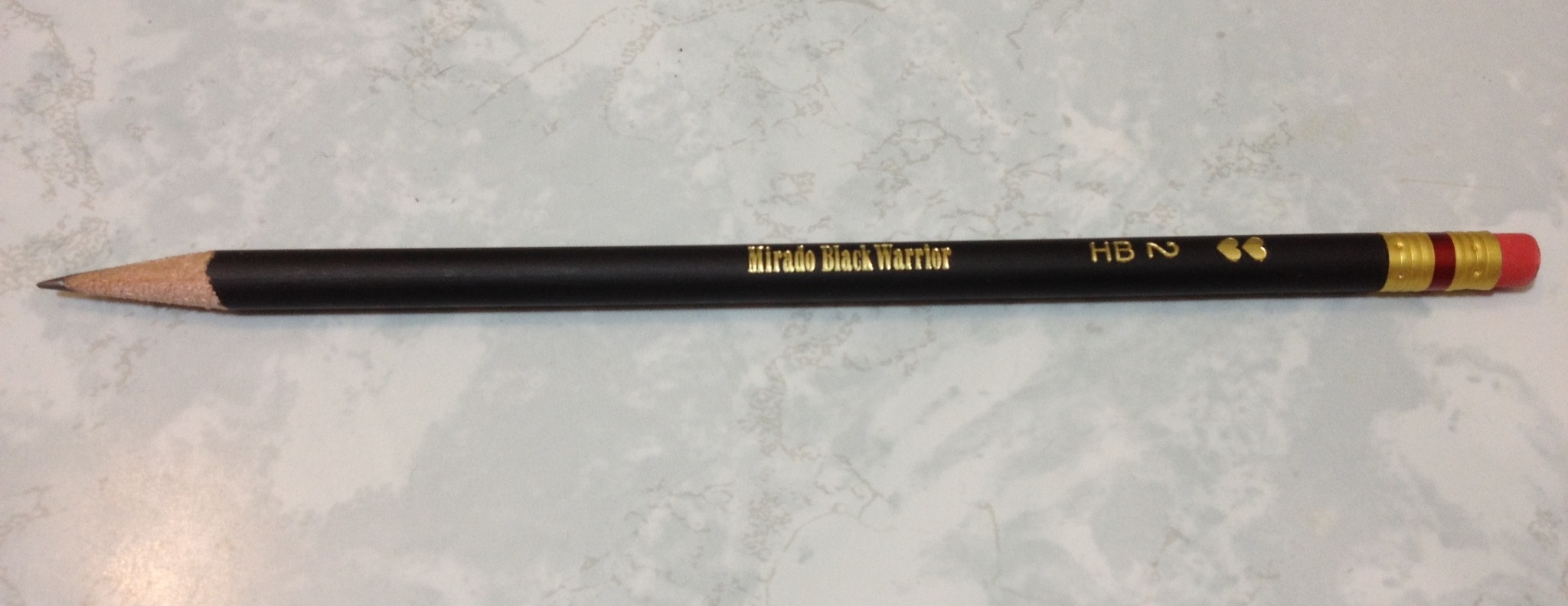
The pencil body is simple and round, which is surprisingly not a standard pencil shape. I always had round pencils at school (a set of leftovers from my father), and people always liked the way they felt when I loaned them out (which is why I lost so many). The shape is quite comfortable, and just that little bit better than a hexagonal pencil. The set of pencils that I received have a satiny finish that make them fairly grippy even with sweaty hands (from what I understand, they used to be more shiny and slippery). The rest of the body is a plain black with “Mirado Black Warrior” in gold on it in a poorly chosen font, as well as HB 2 and the Papermate logo, the hearts of which take away from the “warrior”-ness.

20141105-010601.jpg

The back of the pencil has a standard pink eraser, which does its job and hasn’t dried out in the time I’ve had it. I’d guess it isn’t the best quality and if you always want to erase what you wrote I’d recommend getting a dedicated eraser, but these work fine for most of us. The lead is HB, but feels much softer than most HBs I’ve used. Perhaps that is just me, but I’d say it is at least a little softer and it covers smoothly and well. A good pencil for filling in scantrons or shadows. Because it is so soft it is not too great at holding a point, though.
Is it a good pencil? Definitely, and for the money it’s really just a matter of preference.

There are loads of good pencils in this price range, so if one that is round (make sure your desk isn’t slanted) and has a slightly softer lead sounds good to you; or maybe you just like the “stealth” idea of an all-black pencil, this one is at least worth looking at. And like I said, for the price almost anyone could afford to pick up a box to compare to any other pencil they happen to be using.


Review – Moleskine Volant Notebooks (Tiny)

I’ve talked about Moleskine books in the past. And while they aren’t the greatest of notebooks I find them to be my favorite for a number of reasons. The size and sturdiness of the covers are the main thing I like, but what if both of those things were taken away and I was left with a small and flexible notebook? This time I’ll be looking at the Moleskine Volant Pocket notebooks.

20141028-230947.jpg

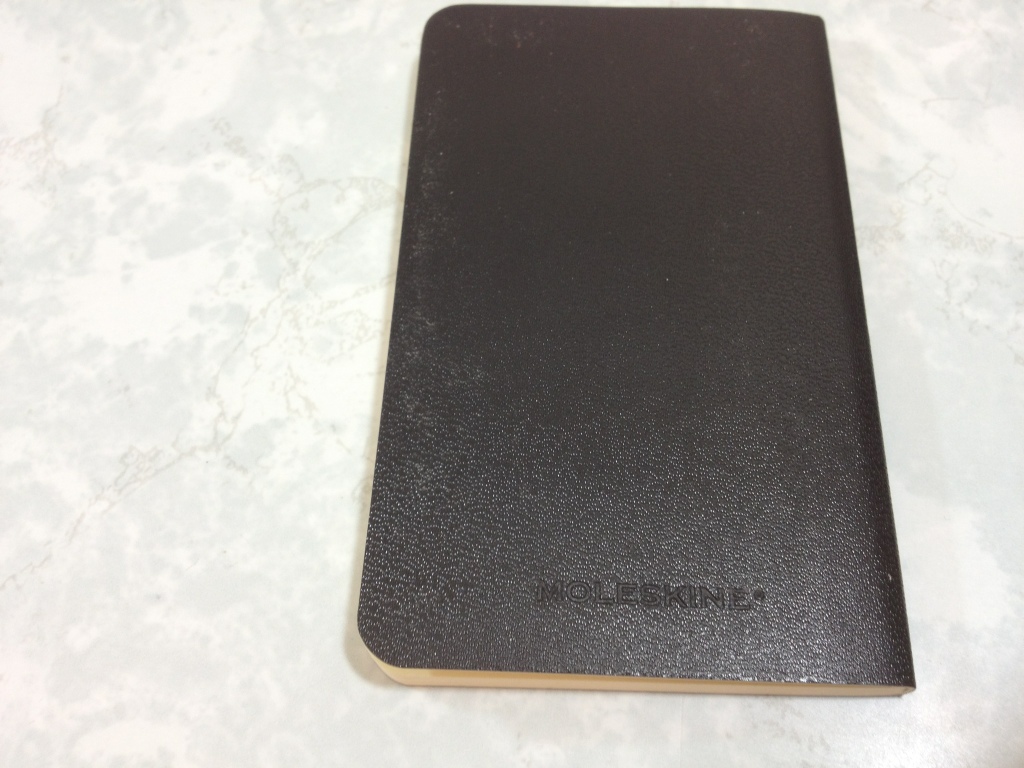
Moleskine Volant books are small, pocket sized books about 2.5×4.125in., which is a very odd size indeed. There are twenty-eight sheets or fifty-six pages. They are all perforated and standard moleskine paper with only a few lines.  There is a page on which a name and address can be written, but no pocket in the back as these books are much too small. Moleskine is imprinted on the back of the books and the cover texture is similar to the regular Moleskines.

20141028-230952.jpg

The spine and cover are quite flexible and the binding is hidden from view. After only moderate use the edges will start to peel and bend, but do hold up very well, and any pocket book is bound to get damaged to this extent. They’re a bit plastic-y, so the amount they hold up isn’t remarkable, but it is good enough to get the job done.

20141028-230957.jpg

The paper is standard Moleskine. It’s thin, and you wouldn’t want to use both sides even with a ballpoint for the bleed/show through. The perforations work quite well and I’ve had no problems with mis-torn sheets. The paper is fairly strong and archival as well as smooth. So the overall experience of writing on it is not bad if one’s pen choice is correct (it’s not a liquid ink type of paper). The ruling is spaced such that not too terribly much can be placed on a page, but at its size, there isn’t much more they could do.

Overall, these notebooks are wonderful for their size. If you have a pocket that would fit one and need to carry around a notebook this is the one I’d recommend. They are a little bit pricy, but I don’t know of another notebook of similar size in a competitors range. So it might be your only option. And it’s a good, even if not the best possible, option.


Review – Zebra Sarasa Colors – Hunter, Fuchsia, Cobalt, Light Green, and Violet

After the first five colors in the ten-color pack of Zebra Sarasa pens, the colors get a bit less conventional and a bit more extreme. Let’s look at the Zebra colors Hunter, Fuchsia, Cobalt, Light Green, and Violet.

zebra sarasa colors 2

First Hunter, which is a dark bluish-green, a bit more blue than usual hunter greens, which seem a bit warmer. The color is very deep, and in some places could easily be work-friendly. It is a very natural color and could easily fit an artist’s needs for a deep green. It lifts the most when exposed to water, but like the rest of the colors here, it doesn’t really budge to smear once it dries.

Next Fuchsia, which I’d call rose, but that’s just me. It sits on the fence for me between a deep pink and a light purple. I can’t really tell which it is. As far as either one goes, though, it is a very appealing color that, unlike other pinks or light purples, doesn’t hurt the eyes. It’s more of a flower color than anything else.

Third is Cobalt, which is a very grey blue, though I’m almost tempted to say it’s the other way around. It’s a dark and dim color that gives off a wintery feeling. Artists could find a use for it in many winter themes and its color is just subdued enough that it would likely be a good office companion and still let you stick out.

Fourth Light Green, which is almost lime. It hurts the eyes a little, but it isn’t terrible. I’ve certainly seen worse. It doesn’t look very natural, and it’s slightly hard to read. It might make a good color for marking mistakes, but otherwise its uses are limited.

And finally, Violet, which is bright and indisputably purple. It’s a flowery purple and that’s the only really natural parallel that I can think of. It also might not be work-appropriate because of its brightness. But it is superb in readability, not dark enough to blend in in low light, and not light enough to disappear on the paper. For casual writing, this one would be a keeper.

And that’s it for the ten pack of Zebra Sarasa Gel pens, I think they’re great little things, with an interesting color set in which some aren’t often seen, let alone this common. They’re nice inks, and I’d go for them if you like the pen.

Review – Zebra Sarasa Colors Black, Blue, Red, Navy, Mahogany

I’ve talked about the Zebra Sarasa before, and it’s an alright gel pen. The saving grace of many gel pens is that most come in a variety of colors at least partially unique to them, and the Sarasa is no exception there. Let’s take a look at a few of the colors.

The colors are always a bit off in the digital space

The colors are always a bit off in the digital space

First, Black. It’s a cool black that covers well. It works in an office setting and generally doesn’t get lighter even with minimal pressure. I’d say it’s black almost as soon as it gets on the page. The drying time is moderate and it’s water smudge-able.

Next, Blue.  The blue is quite dark, darker than most office-type blue colors. This makes it easier to read and more professional. It’s also natural looking, more like a deep sea-blue than an in-between blue that doesn’t really exist in nature. It’s the least smudge-prone of the bunch, but that won’t entirely stop it from lifting off the page.

Third, Red. It is a bland red, with no real pop to it. Though it is brighter than some of the competition, it isn’t really eye hurting. It’s quite noticeable and quite red but has no character — and no real flaws, either. It’s the color that fades the most when exposed to water.

Now, Navy.  Navy is a very deep, dark blue. It’s really almost black. You’d need a good light on to tell which one is which, though you could tell that black and navy are different colors with minimal light. It’s a wonderful dark color that is almost soothing and quite free flowing.

Finally (for this set), Mahogany.  It is really more like maroon. It’s a slightly purplish red which is also very dark and quite nice. It is much more noticeable than the navy, and still quite natural, giving an almost brown appearance from far away. It’s probably my favorite of the five, though the one with the fewest applications, and while you might get away with it at the office, it could be a hard sell. Unless you work for Texas A&M University.

That’s the five colors for this week. Next time I’ll be looking at the other five colors in the standard ten color pack.

Review – Q-Pins Pushpins

Pushpins can be a problem. But they are what they are, right? There’s no getting around them. That’s what I would’ve thought until I heard about Q-Pins pushpins, which claim to have updated the pushpin to a more modern and easy-to-use design. How do they hold up?

20141007-225237.jpg

Full disclosure before I begin: I was sent these to review by the company. With that out of the way, let’s look at the features: Q-Pins are designed to deal with the problems one encounters when using regular pushpins. They’re shaped like a capital “Q” and use the tail to hold paper to the board, rather than the pin itself. If one doesn’t use the pin on a regular pushpin, the amount of force required to hold the document up will leave an unappealing mark. I used to get around this by using thumbtacks, which has less grip for your fingers, but more for the document. I’d best describe Q-pins as a cross between the best parts of a pushpin and thumbtack, with a little more ergonomics. The edges of the bowl on the Q are curved inwards, creating a nice grip for the thumb and index finger that is more than enough to get it out.

20141007-225242.jpg

They come in either packs of black and white opaque or a pack of green, blue, purple, and yellow translucent. Personally I wish there were more color sets, but these work well.

Now, it’s kinda hard to talk about what a pushpin does, even though I have done that quite a bit, it looks like. In any case, I decided to try and beat up a q-pin by throwing it across the room and at the floor with a moderate amount of force. The results were not a scratch, and I’ve seen pushpins shatter under similar conditions (though rarely). I tried bending the tail off, and my fingers began to hurt as the plastic started bending. I’m sure they can be broken, but it almost has to be intentional. And for a bit of fun, I grabbed the metal pin itself with pliers and pulled firmly in both directions. The pin and its plastic case are not easily separated.

So, are they better than pushpins? Yes. Are they perfect? No. If one is very careful or hangs up thick documents, the pin can be used to hang an object without a mark. But sometimes even a natural amount of force can lead to a straight indent in the document being hung. This is certainly better than a hole, and in my opinion it’s also better than the circular indent coming from a pushpin or thumbtack used with friction. In this scenario, the Q-Pin also has superior holding capability, though it is quite close. Removing the Q-Pin is also much easier than either of the two other options. It’s a clear winner, but it is a bit more expensive. If you don’t lose things and want a better pushpin, possibly for life, you should try some Q-Pins.

Review – Pilot G-2 and G-2 Mini

There are some pens that everyone knows about, standby pens that we all recognize and know the performance of. These are pens that even pen snobs would use in a pinch. The Pilot G-2 and G-2 Mini perhaps are such pens. But do they really hold up to their reputation? Let’s take a look.

20140930-230411.jpg

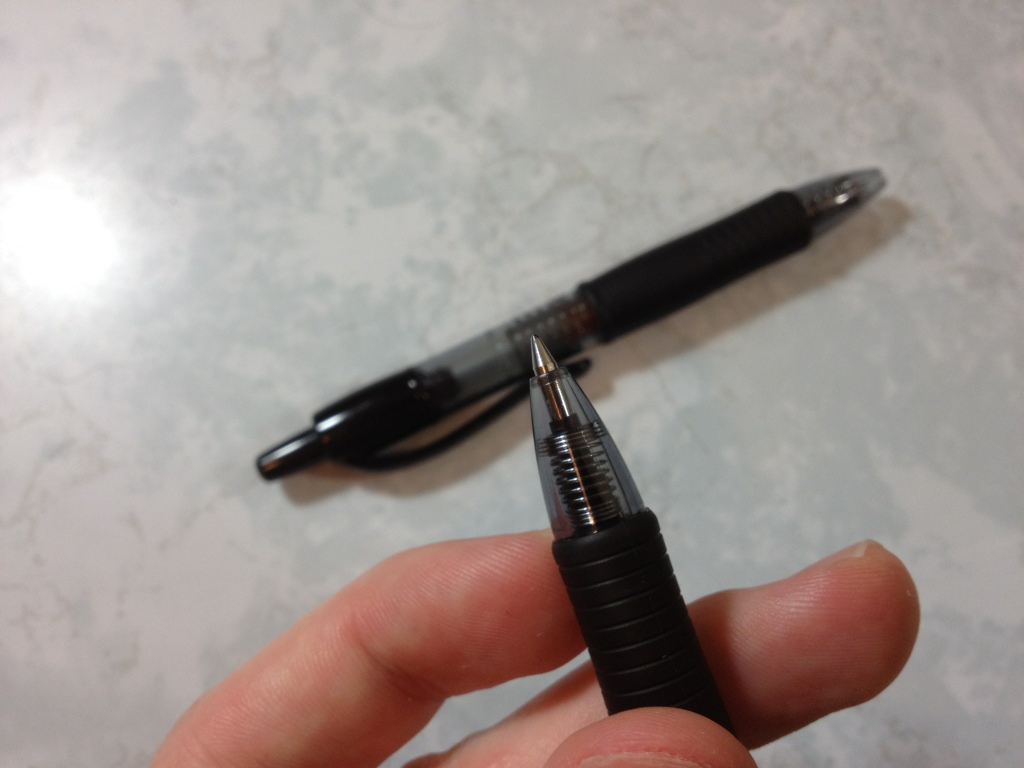
I’m not sure I really need to describe one of the most well-known pens ever, but I’ll start at the click button. It is simple and elongated, and there is nothing really special about it. Below it is a small section of colored plastic where the clip attaches. The clip has the basic pen info on it, though not much. It does its job well. It might be a bit loose, though the absence of a catch on it makes replacing it in and retrieving it from a pocket much easier. Down from this is a smooth, transparent, circular barrel. There is nothing exciting here, but I should note that the only differences between the regular and the mini are the cartridge size and the length of this barrel here. All other aspects of the pens are identical, which means the mini is a bit thick for its size. After the barrel comes a fairly distinctive grip with a small recessed and grooved area where ones fingers go. The grip style is good but the rubber is slick, so the net effect for me is that the grip is unnecessary. Below that there is a small plastic cone that leads to the retractable point on the pen.

20140930-230416.jpg

Now, I’ve talked about as many Pilot G-2 ink colors as I could get my hands on in the past, so I’m not going to cover that here, but I will go over the overall writing experience. The pens are gel pens and are quite a bit smoother that standard ball points, though the smoothest of ballpoints will almost rival the cheaper gel pens like the G-2. The G-2 has quite a bit of feedback, which is something I do like when writing. Sometimes, though, it doesn’t feel like you’re putting down any ink and instead just scratching the paper. There are generally no blobs unless you’re looking at the more outlandish colors, but on cheaper paper the ink absorbs very fast and will quickly create dots anywhere you decided to stop. Really, there are very few problems if one just sticks to standard black. All other colors do tend to have unique effects to them. Long drying time is a problem with all of them, I’m afraid.

20140930-230421.jpg

Overall I’d say the pen is still quite a good regular pen. Despite the many little flaws that it may have, it works, and it does the job of being a pen well. It isn’t the best pen, but it’s not very expensive and it’s far from the worst. It’s a pen everyone can use, but if you’re not a satisfied pen user and you’re looking for the best for you personally, you might want to try somewhere else.

Review – Bic Stic Colors Pink, Purple, Lime, and Light Blue

The Bic Round Stic is an iconic pen. Not so much as the Bic Cristal, but still quite well known. It is a fairly robust pen, but usually one of few colors. The pen usually comes in the four standard colors: black and RGB. With some hunting, though, one can find more exotic colors, like the ones I will be talking about today: the pink, lime, purple, and sky blue colors.

20140924-022123.jpg

First up is the pink, which is a nice color. It certainly isn’t hot pink, which I despise. It covers well and writes smoothly. It’s fairly dark but still quite pink, though not a very natural pink. It’s the kind that could really only be seen from an ink like this and not anywhere else.

Next is the light (sky) blue, which writes smoothly, but has many little imperfections in the line. It just doesn’t cover well. The color is fantastic, though. It can be a bit hard to see at times but it’s quite pleasant to look at and not particularly eye straining. It is most like the colors at the edges of a clear body of water or the sky closer to the sun, so rare, but not unheard of in nature.

A bit altered in editing

A bit altered in editing, but a good representation

On to the lime, which is by far the hardest to read of the group. And it has some startup and writing problems, though when you get it working it does write smoothly. On the paper, the green is so light as to be unreadable in many cases and can cause eye strain. Though I call it lime, it really is much lighter and closer to… well, nothing that I can think of.

And finally, the purple, which is the best in terms of pen quality. It has no startup issues, writes smoothly, and covers well. It is darker than the blue but not by much, and still would require a second glance to read from far away. That being said, it is a very pleasant color to look at and is great for use when a more standard office color is not necessary. The color would be a rare one to find in the wild, though.

Overall, for writing these pens are hit and miss, and for art they are also hit and miss. The purple and blue are the best. I wouldn’t even try to use the lime. If you’re looking for some way to make your writing more unique, there are other Bic sets out there for that (like an entire box of the purple) and the same goes for any type of art that you might be making, unless it requires some very specific colors

Review – Prismacolor Kneaded Rubber Eraser

Recently, my erasers started running out of eraser juice, and I started having trouble with them. So I went to the art supply store looking for a replacement. I found almost my exact eraser, and one that was a bit cheaper, so I decided to try the cheaper one, the Prismacolor Kneaded Rubber eraser, out.

20140917-043500.jpg

Kneaded rubber erasers are cool. They can stretch and bend to get into small, difficult spots as well as wider spots. They can “clean” themselves, and generally don’t leave any eraser shavings. And while this is a good eraser, it isn’t as good as the ones I have used previously. It just doesn’t erase quite as well. Pencil is harder to remove, and stays bolder in indented lines. The eraser also rubs off quite a bit. There are still fewer shavings than one would get with a solid eraser, but more shavings than one should get with a rubber one.

So, if you’re just looking for an eraser that is better than standard or even high-quality solid erasers, I would recommend this one. It’s definitely good and gets the job done. But it certainly isn’t the best rubber eraser out there.

Review – Paper:Mate Design Mechanical Pencil 0.7mm

t’s always nice to try new mechanical pencils, and I’ve been looking at a few recently. One that is around what might be considered “medium territory” is the Paper:Mate Design pencil (7mm #2), which has a few nice features that make it nicer than some others I’ve looked at.

20140909-224744.jpg

Starting at the mechanism, the button is quite small and has a slight angle to the top so that one’s fingers will just slide off that much easier. That being said, it works quite well. I haven’t had any issues with it, and the click is both minimal and satisfying. Removing the metal sheath reveals the eraser, which does its job. Removing the eraser gives one access to the lead, and removing the eraser holder allows one to disassemble the pencil, which is handy (one would need to unscrew the front to do that). Down from that is a clip with the Paper:Mate logo. It needs some finesse to clip on, but both holds well and is fairly easy to detach. The barrel is a medium-sized metal tube with a nice finish that simply says Paper:Mate (personally I’d’ve liked more info, but that is literally only me). The grip is a fairly hard rubber with several lines running parallel that don’t seem to do anything to improve grip. It is a bit slippery, but not to a degree that it will distract you unless you’ve used a ton of pens and pencils. There is a metal cone that leads to a smaller, retractable metal cone tip the lead flows out of. This retractable tip means that the pencil will not scratch the inside of a pocket or something, which is quite nice.

20140909-224750.jpg

The lead is alright. It is standard HB but feels a bit smoother and more break-prone than other brands of HB I’ve used. That being said, it’s broken about the same amount. I was at first apprehensive when using this pencil. It has no shock-absorbing spring and when one pushes down just after clicking, the lead retracts and makes a distracting clicking sound. This is a major problem in pens for me, and hearing the sound again and again drives me crazy, but fortunately this pencil holds the lead tight enough that I only ever hear the sound at the start of a writing session. What it does mean that is annoying, though, is that if the lead is only advanced a slight amount, a problem this pencil tends to have, then one can easily push the lead back into the pencil and be unable to write. This is actually not as major a problems as it sounds, but I feel it should be mentioned.

20140909-224755.jpg

Overall, this pencil exceeds my expectations. The retracting point and stainless steel barrel are nice features. And aside from a few minor things, everything else does its job well enough. The pencil really feels solid and good in the hand without being too heavy, and the writing experience is quite smooth. If you’re looking for a tough mechanical pencil for some mid-length writing sessions, I’d seek one out, though if you’re in an extremely demanding location or are writing for a long time (the grip is poor) you might look elsewhere.