Notebook Showdown – Moleskine Cahier Vs Field Notes

So another notebook competition today, huh? This time I’ll be comparing the higher end of the pocket book spectrum. It’s time for Field Notes to go head to head with Moleskine Cahiers.

20130628-000028.jpg

Starting with the covers the Moleskine is a very heavy, single color, piece of cardboard with an imprinted logo on the back. It’s got a flap on the back that folds in and serves as the famous Moleskine pocket. This pocket is not very well secured by the glue and tears out easily, it also causes the back to be prone to creasing rather than flexing. The Field Notes book has a thin “packing brown wrap” cover with a logo on the front and some identifiers. It also has a little on the back, but on the inside is where it really shines. It’s got name, coordinents, date, and return to blanks right in the front, and the back contains may useful reference items, including a list of uses, and all the materials used in the book. It’s still fairly flimsy, though, and when it bends it stays bent rather than easily popping back into place.

20130628-000040.jpg

Size-wise, both books are almost identical, despite the Moleskine having 12 more sheets. The rounding on the corners is also a bit less on the Moleskine. The paper inside the Moleskine is the standard archival quality, but fairly weak, off-white paper the comes with all Moleskines. In the Field Notes is a smooth, bright white paper. The actual type of paper is listed both on the website and in the book for easy reference. Both books come in: blank, ruled, and squared or graphed paper. But some special edition Field Notes have all sorts of different rulings. There is little variation in the ruling size wise, the only major ones being the Field Notes have a wide top margin and slightly lighter lines for the ruling. They’re brownish compared to Moleskine’s grey. One feature of the Moleskine that the Field Notes lack is that the latter half of the pages are perforated for easy removal, meaning you can tear them out without destroying the binding.

20130628-000049.jpg

Speaking of the binding, that’s where the really major difference between these books kicks in. The Field Notes are saddle stitched with three staples. The Moleskines however are stitched with 21 signatures. I believe they are also hand bound though I could be wrong on that. The Moleskine binding and cover makes it (like other Moleskines) like a rock. It is much harder to bend, but bends and creases terribly when it does so. The Field notes is a bit more lenient, bending more, but the staples provide great pivot points for bending and creasing as well. The Field Notes binding, while sturdy, can have the book come apart on it, though this rarely happens because of their limited page count. The binding on the Moleskine is much more likely to come undone itself and leave the book behind, though again this rarely happens.

20130628-000106.jpg

Really it all depends on what you want. They’re both about the same price so do you want: a better cover, more pages, perforation, and a pocket, or: better paper, better binding, and some useful information? In the end that’s what it comes done to. Also the looks a little bit. Personally I prefer the look of the Moleskine, but the quality of the Field Notes, so I use both. Try ’em and find out for yourself, it’s only like twenty dollars for three of each (at the time of writing).

Review – Pilot B2P Ballpoint Pen

I’ve come across quite a few interesting or novel pens. I’ve tested out most pens I can get my hands on and have determined my taste accordingly. But a pen caught my eye recently with a gimmick I’d never seen before. It was a Pilot B2P pen, made out of recycled bottles. I’d seen pencils made out of recycled denim, but never a recycled pen. I don’t usually pick up Pilot pens but I decided to give this one a try, if only for the novelty.

20130619-000122.jpg

I’ll start with the writing performance, because on this pen that’s less interesting. It’s a ballpoint, and for a ballpoint it writes amazingly smooth, even smoother than most Gel pens I’ve used. The ink is black and fairly dark. The line is thin, well, at least thinner than most ballpoints. It usually writes on the first go with no skipping, a problem I usually have with Gel pens. It’s fairly impressive, though I think it may run out of ink rather quickly.

20130619-000142.jpg

Onto the body, which is a fairly pleasing blue color. It’s got a fairly useless grippy-grip near the tip and a mid-way between sturdy and flimsy pocket clip on the back. The blue is dark but transparent on the back, mimicking a bottle, and to further the effect it has ridges and troughs to look and feel like a crumpled up bottle, making it feel quite nice in the hand in my opinion. There is an easily worn off label around the center of the pen that contains all useful information, though the more pertinent information is also on the clip.

The retractable mechanism works quite well and doesn’t seem break-prone, it’s nice and solid (though if they hadn’t perfected this tech by now they never would). It also disassembles easily and well into parts for replacement and refilling, though I doubt you’ll ever do either of those.

20130619-000133.jpg

So yes, it’s a nice ballpoint, not the nicest ballpoint, but a nice one. For the price it’s good and novel. And the feel is quite nice. Its uses are that of all ball pens and this one doesn’t stand out terribly. But it is good, and a very interesting idea. And it’s a better conversation starter than the standard click-y ballpoint.

Mini Composition Showdown

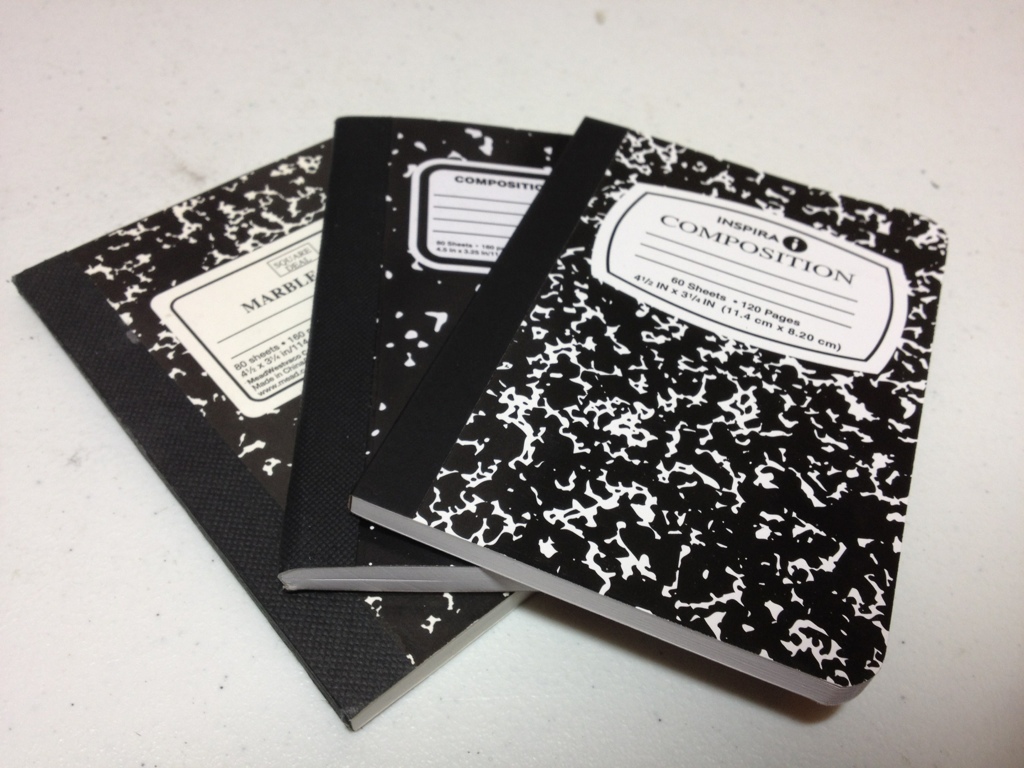
A while back I reviewed the Dolgen Inspira mini composition book. I have quite a few books like this and instead of reviewing them all I decided to just compare them all together. So here’s the mini composition showdown. Mead vs. Inspira vs. Top Flight.

First off, covers and binding. All the covers are the standard composition marble pattern, with the Inspira being the most crowded followed by the Mead and then the Top Flight. The binding on the Top Flight is a sturdy fold stitch with eight signatures, while the Mead and Inspira are weak, simple glue binding. All notebooks lie flay fairly well, though the Top Flight takes more breaking in. Cover durability again goes to the Top Flight with the other two tied. The cover corners are straight on some of the Mead, clipped on the Top Flight, and rounded on the Inspira, meaning the Mead with the square corners will most likely tear up quickest. Other Mead notebooks have rounded corners.  If you want color the Mead and the Top Flight are the way to go.

20130614-235313.jpg

Their dimensions are about the same, with Inspira being slightly taller and Mead being slightly wider. The Mead and Top Flight both have eighty pages, while the thinner Inspira has sixty. The smoothest paper belongs to the Mead, the roughest to the Inspira, and the Top Flight is very akin to newsprint, unfortunately, not very high quality. All are not archival quality paper and fade rather quickly on the shelf, though they are bright white out of the package. None are very good at holding ink, but the Inspira is best without bleeding, followed by Mead and Top Flight.

What will really make or break these books, though, is their large price difference. The Inspira are three for one dollar (U.S.) the Top Flight are five for three dollars, and the Mead are one to two apiece.

So if you can organize all that and determine the best for you you’ll end up with a very nice pocket book. Each one is suited subtly to a different task so the main challenge is finding out what is best for you. They are certainly not the best memo books by any means, but they’ll certainly work, especially in a pinch.

Review – Micron 02 Red and Blue Technical Pens

Image

I’ve talked about Microns in the past. They are basically THE technical pen. But those are just the black ones. Are the colors any good? Do they hold up to the standard and more importantly are the colors usable in any real way? How will these red and blue 02s stack up?

20130607-010852.jpg

The bodies are standard Micron bodies. Slick but still grippy. With hard to rub off, easy to read information in convenient places on them and a number on the lid. The color of the base of the pen where the cap clicks in and the ink on the top has been changed to the pen’s color for easy find-ability.

20130607-010919.jpg

The particular pen I’m using here is an 02, so it’s far from both the stiffest and weakest nibs, though it’s closer to the weaker side. It does bend a little while writing. It’s not large enough to provide much variation, either in line weight or color density. The ink is good, standard Pigma ink, archival, stands up to almost anything. It rarely bleeds and the nib seems to give off just the right amount of ink to have a fast dry time.

But on to the color. They are unmistakably blue and red. They are bright and vibrant, even on a fairly off-white paper, such as Moleskine notebooks and the like. It is brighter than any other pen or marker I have used previously. Almost unusably bright, unfortunately, as I can find no drawing scenario where it would be useful. They are good for organization, though, especially on the aforementioned off-white paper where they don’t look so jarring. They can make handy divider writings and are good for color coded text.

20130607-010911.jpg

Overall these are superb pens with little purpose. They work great, are incredibly sturdy and last quite a while, though I can find no way to work them into any drawing. Notes and technical sketches are the best place for these. Or, if you just want to have a nice pen in an interesting color.

Review – Helix Architects Triangular Scale

Rulers. Well, we all need them at some point. Whether you need to draw a straight line or know the distance between two points, they come in real handy. But sometime the information you need is just not on your ordinary ruler. So you get an architect’s triangular scale. But which one? Let’s look at one of the cheapest: the Helix Architects Triangular Scale.

20130521-102106.jpg

First off, the plastic this thing is made out of is very brittle and sharp. Little burrs and notches line the sides. There are no rounded corners, and you can easily stab yourself on the triangle points. However, there seems to be no fear of shattering or snapping in the piece, it is quite sturdy.

The information is printed in a nice, readable black over the very-slightly off-white plastic. From what I can tell (truth be told I’m not entirely sure about what all the sides are for) they are accurate. I have compared them with several other units I have. The ink used is resilient, but also raised and will rub off with prolonged use as will most rulers and the like.

20130521-102112.jpg

Overall, for it being fairly cheap, it is a nice piece. It does its job well and will probably serve for several years before needing replacement with proper care, though there are many more comfortable or longer lasting alternatives out there.

Review – X-ACTO 3-hole binder Punch

Sometimes you need to do stuff with your art that isn’t art stuff. Sometimes you need to file it away, or keep it safe in a cover, or organize it in a binder. If you’re looking to do the last one, then you might need the X-ACTO 3-hole binder punch.

20130521-101541.jpg

This semi-sturdy piece of transparent plastic is designed to fit in a binder and easily punch holes through a few sheets of paper. I stress a few because on the box it says the limit is three. And yes, even three sheets is very stressful to this thing, and after that it just starts tearing the paper.

I said it was plastic earlier, but the punching apparatus is actually a nice metal piece on a hinge. It is easily as sturdy as any other hole punch I’ve used. The hinge, though, is so close to the paper that it is what you have to use to get a nice clean straight punch line and because it is a hinge this is very difficult.

Off to the bottom there is a guide that you can place your paper on and it works well. There is also a flimsy piece of loose-fitting plastic that I assume is supposed to act as a guide so the paper stays down, though it will hardly do this job well and seems as if it will snap at any moment. It also jiggles unnecessarily. On the front is a 10-inch ruler, which would be nicer if it was ruled correctly, as it is, it is about a quarter of an inch short.

20130521-102051.jpg

And finally on the back are a pair of fold-out binder loops that will allow you to stick this thing in any 3-hole binder you desire, though they will make a horrible grating sound and the plastic they’re screwed into looks like it can break in a hurry. They will never break off the binder rings on their own though.

Really this is just a cheap hole punch. The actual punch is quite nice, but its housing is lacking. If you only need to punch a few sheets every once in a while this is alright. Any more hole punching and this thing will be useless. It will certainly break within a year or two but it is quite cheap. So if that is what you want or need from your hole punch, go right ahead, otherwise try something further up the ladder.

Review – Clairefontaine Spiral Classic wire bound French Ruled Notebook

Do you have trouble with making your handwriting look good? Do you feel that many of the lined notebooks are ruled just to small for you? Then the Clairefontaine Classic Wire Bound French Ruled Notebook may be for you.

20130516-124453.jpg

The notebook’s size is about 6¾” X 8½”. It comes with 60 sheets of 90 gram paper. The paper is a nice, crisp white. And it really is white, it’s brighter than the white in a composition notebook, and is a very stark contrast to most of the higher quality off-white, moleskine-type notebooks.

The quality of the paper is superb. It is buttery smooth and provides a great writing surface. There is no feedback to speak of; so if you like feed back you should be looking elsewhere. The thickness and smoothness of the paper means it handles ink very well. Pencils, ballpoint pens, technical pens, and even fountain pens are handled with ease; though there is a prolonged drying time. Some very wet writing implements, like heavier fountain pens or the Nano-liner, do ghost and occasionally bleed through, but for the most part you can use both sides of the sheet if you so desire.

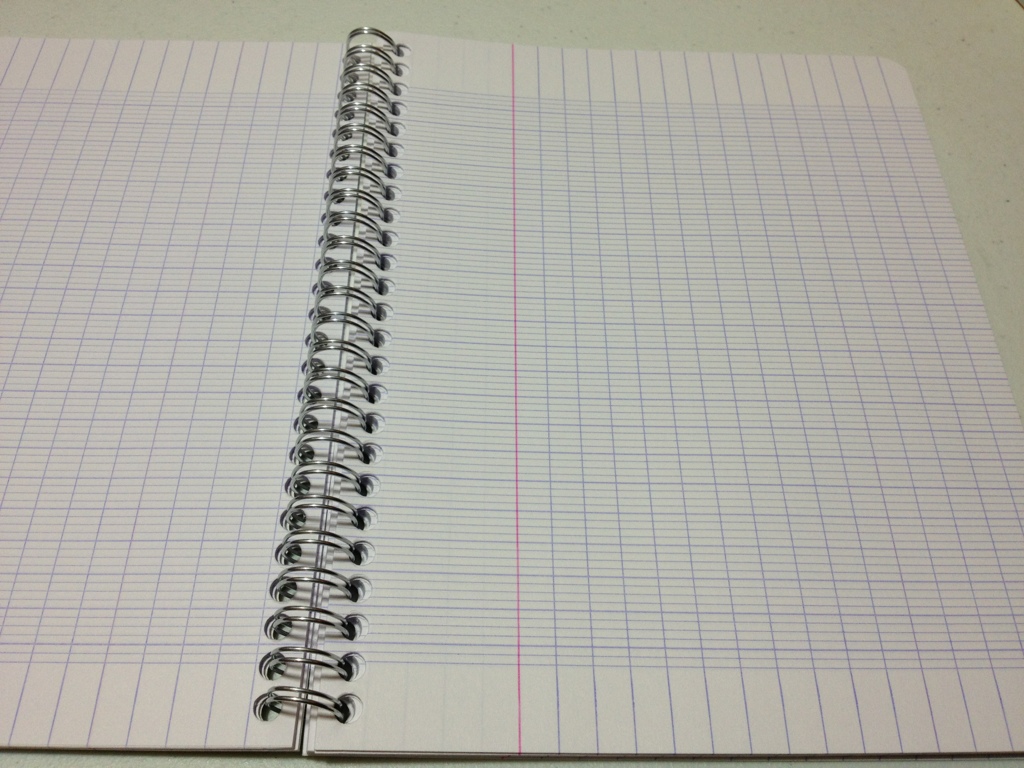
The ruling on the particular book I have is French ruling, or Seyès if you will. It is designed to make one’s handwriting better. It has five thin lines between each pair of thick lines, which allows for the various heights of minuscule and majuscule letters (upper and lower case). It also has lines running vertically that act as indentation guides for paragraphs and the like. It is great for practicing handwriting or for easy spacing of lines, though it can seem overwhelming at times.

20130516-124504.jpg

The binding is a simple spiral that is heavy duty and will allow the book to lie flat easily. The cover is a simple piece of card stock that has nothing special about it. It is covered in a design that I frankly find ugly, but then again I like plain black books so what do I know? It serves its purpose well.

Over all this is a superb book. The paper is incredible, both to write on and to look at. The French ruling is very helpful in writing and can also serve as a general (stress that) guide while drawing little sketches and the like. The binding is nice and simple, doing its job well. It’s not particularly an art book, but it’s a very good writing/note book.

Review – Uni Paint Pen

So you want to paint, but you’re better at drawing. Or you want to mark on some surface unsuitable for Sharpie or other permanent markers. Well, the Uni Paint PX-21 by Sanford may be for you.

This pen is oil-based and needs to be shaken up like a spray can before use. It has a “fine” point, which means a medium or even broad point if you compare it to anything that is a not a paint pen. The line it writes is solid and about as thick as a large Crayola marker. This particular version is the black version which is especially solid, though it is fairly shiny, somewhere between a Sharpie and a matte black spray in terms of marking on plastic. It does mark on literally anything, though some shiner plastics and polished metals have it wear off easily.

20130512-001155.jpg

The body of the pen is metal and feels solid in the hand. A shiny label has all the necessary information printed on it, including warnings and such. This label makes the pen slightly slippery in the hand so tight gripping is necessary.

The cap matches the color of the paint. It has ridges that are sharp and cut into the skin. It also fits very snugly onto the end, meaning it is quite difficult to remove, which is both a hindrance and a benefit.

20130512-001204.jpg

Also be warned that since it is an oil-based pen it stinks mightily and will give you a headache after a few minutes of constant exposure. The label even tells you to put the cap on immediately after use, though this is most likely also to not let the paint dry out.

Overall this is a great little painting device. It is especially handy for touchups on plastic and metal painting. Or, if you’re like my relatives and have a shop were regular markers and price tags have a hard time sticking to the stock. It’s not really a home item, or one that will be useful to canvas painters, but it certainly will have its place with sculptors and model builders.

Review – large Blank Moleskine

A little while ago I reviewed the Moleskine blank pocket book. Now in the same notebook direction I’ll take a quick look at the Moleskine blank large book. Will the classic renowned Moleskine hold up to closer scrutiny? We’ll see.

20130430-230325.jpg

The cover is cardboard wrapped in faux-leather. It’s fairly sturdy, though it does begin to wear at the corners with continuous use. Though if you find a notebook that doesn’t I’ll be amazed. The binding is rounded, flexible and lies flat. It does have a tendency to crease when opened for too long. It also tears eventually, and if the book is really old it even begins to split down the back. This only happens toward the end of the book’s life (the last twenty pages or so). Around the cover is an elastic band which does a good job holding everything together but will eventually bend the cover in.

The pages are super thin. There are 240 of them in this half-inch book. They are of okay stock. Anything heavier than a ballpoint pen bleeds through but not usually onto the next page, it can just be seen through the page. The paper is smooth and writes well, the fine texture is just enough to prevent slips of the hand.

20130430-230332.jpg

The first and last pages are attached to the binding, rendering them mostly useless. In the back is the standard pocket, which contains the story of Moleskine (and a quality control number which is actually quite useful). In the front is a ‘who owns this’ page with a reward blank. I don’t find those particularly useful but they are there.

So are they worth it? Like all notebooks it depends on what you’re looking for (unless they just fall apart, those are useless no matter what). They are great for free range writing with sketches to enhance the look. As a sketchbook they work best with pencil as most anything else will bleed through. They are very solid in construction, the front cover especially can take a severe beating. They have very few organizational features, which some may find liberating and some infuriating. Like I said, best as a free range writing/sketch book. Alright as a travel log or such. They’re decent, and the ones I use all the time.

Review – Dolgen Mini Composition Book

Okay, this is kind of a cheat. But little notebooks are art supplies to someone. Even with the small price, should you get these small Dolgen composition books? Are they worth it?

20130427-234558.jpg

These little books contain about 60 pages of narrow lined paper. The stock is thin, and bleeds easily, but it is still about the same as average copy paper. They’re about 3½ X 2¼ inches, so they fit nicely into a pocket. They aren’t that great for drawing, but they excel at little notes and ideas.

The binding is fairly poor. I get the impression that it will fall apart quickly, but not as quickly as it takes to finish the book.

20130427-234604.jpg

These things are small, easy to carry, and really handy. They’re great for jotting down notes and the like. While they obviously aren’t made for drawing, a quick sketch or two definitely won’t hurt them, one just has the lines to contend with. At the three for a dollar price I paid for them, they are superb little notebooks.