Review – Master Mechanic Carton Cutter

With so many options, one carton cutter review just wasn’t enough, and I am now back to review one that has a higher price. But does that make it better quality?

photo-127

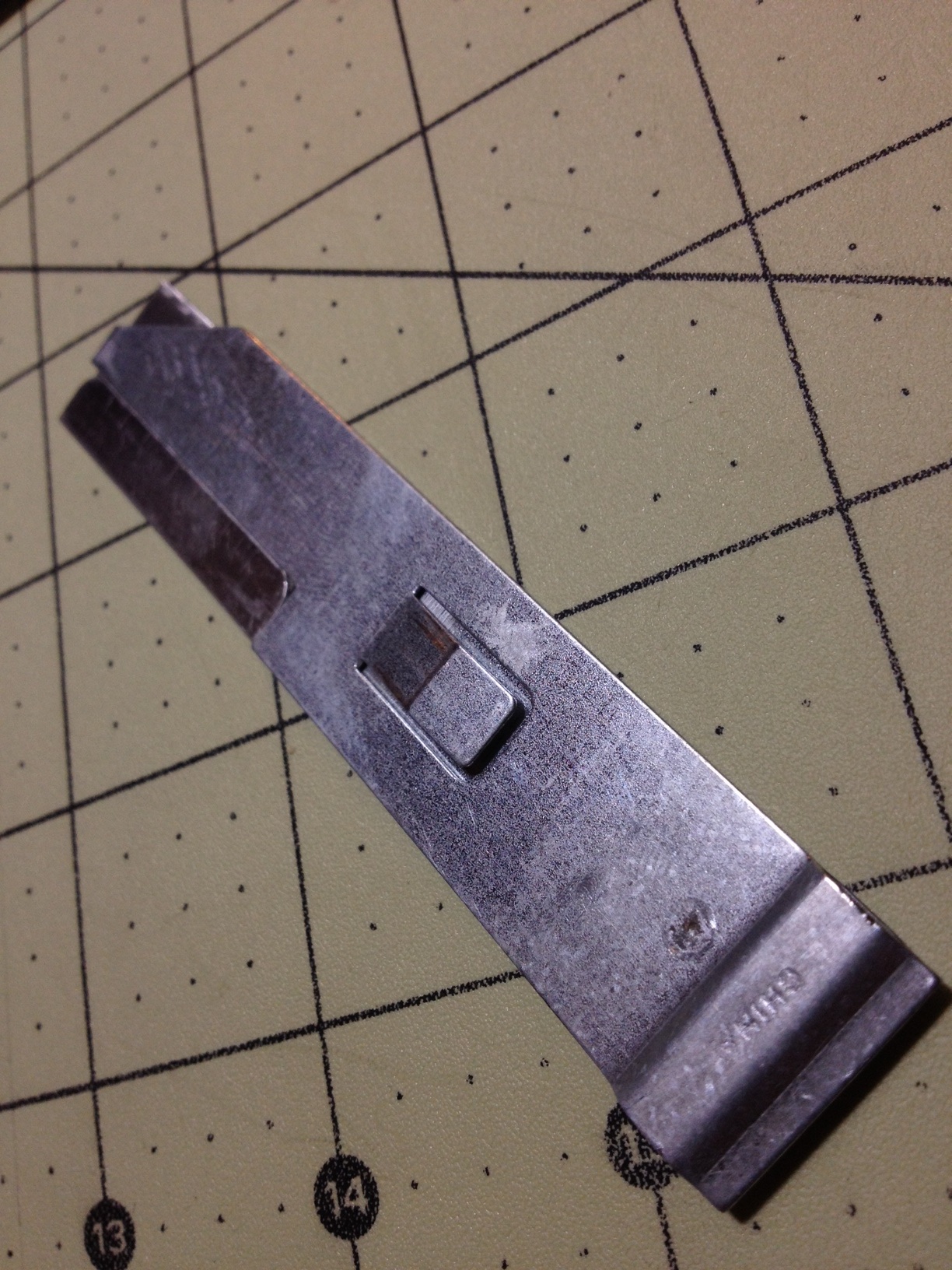
The short answer is yes: it is better quality, but I’ll just go over a few things. The cutter has a bent and nicely shaped/joined sleeve made out of an unknown metal (probably steel), with an insert that is a folded piece of metal that will hold a razor blade. It also has a cutout “spring” that creates the tension instead of the body doing that, making it more pleasant to use. The sleeve also has a nice, easy-to-hold white paint applied, which makes it easier to see. The Master Mechanic logo that is printed on top of this looks nice but wears off easily and looks unsightly when it does.

photo-128

Use is easy and smooth, tapping (a hard surface) both to deploy and retract the blade-holding mechanism (placing the back on a hard surface and pushing firmly will deploy the blade, and doing the reverse with the blunt part of the front will retract it), but it does have a way it “likes” to go in and works better that way. The razor blades that are included are also slightly better than the cheaper knife, but in general one won’t get much use out of single-edge razor blades, which are sharp but cheap and prone to snapping or deforming.

photo-129

Is it worth it to buy a better version of such simple product? Probably not for most people. While this is a better carton cutter than cheaper ones, it isn’t really less dangerous or easier to use per-se. The fit and finish are as good as one could reasonably expect on a product this cheap; the amount of friction on deployment is constant; and the device will likely last for a long time. Still, a carton cutter isn’t a tool most people will be worrying about, and the less expensive ones would be easier to replace if they were misplaced or damaged.

Review – Office Depot Ballpoint Pens

Most stores have generic in-store brands or store branded products for various merchandise. That is the case here, with these Office Depot branded ballpoint pens. I don’t know what they cost originally, but they were marked down twice to 50 cents and then 3 packages for $1. Which means I picked up 30 for a $1. There are very few things I wouldn’t say are a good value for that price (I’d probably say stale gum was worth 30 pieces for $1) so it would be hard for these things to let me down. So let’s see how they perform.

photo-114

The bodies of the pens are super simple. They are round and straight with a cap on the end to hold the ink cartridge in on the back, and a slight bump (to hold the cap on) followed by a taper and then the point of the front. The cap is fairly generic with an integrated clip that works but isn’t great. They are all made of translucent plastic that matches the ink and have “Office Depot” printed on the side.

photo-115

Writing is surprisingly smooth, especially for mediums (they’re a bit broader than normal mediums I would say) and at times they can write with minimal pressure. The packages say “No skip guarantee” which isn’t true, but it wouldn’t be for any pen. It blobs after a certain amount of writing time but I don’t know a pen that wouldn’t, and it’s less than expected. They do tend to have (sometimes severe) startup issues though, especially the longer they are left capped, as do most cheap ballpoint pens.

photo-116

The colors are fairly standard office colors, nothing at all natural looking. The black is just off-black and slightly warm. The red is deep and doesn’t shade much, but still very noticeable. And the blue is quite dark, but still differentiate-able from the black except in the lowest of lights. All are essentially waterproof and dry quickly.

Overall, I’d say the pens are probably worth it. They have no frills, and likely a high margin of error. Any problems, though, and the pen can simply be tossed. They do come with wax-sealed tips, meaning they will last longer in storage, but after that they need to be used fast before they dry up. The bodies are sufficiently hardy to last easily for the life expectancy of a pen like this. The cap seals, the clip holds, and the tip writes. Everything’s functional and unspectacular. If you’re running a business where pens are needed frequently by customers or employees, or you’re just forgetful and lose your pen, these are cheap and they work until they disappear. But they won’t be impressing anyone.

Review – Expo Ultra Fine Red, Green, and Blue

Last week I looked at the Ultra-Fine Expo markers as a whole, and the black color specifically. This week I’ll look at the more common colors in most dry-erase ranges in this size and brand, and see how they work.

photo-52

Red- The color red is a problem with many pens, and dry-erase markers are no exception. The red goes on smoothly enough, and is one of the thinner “sticking” inks. The lines it makes are solid, but the shading and their thin-ness is more pronounced. The color is also quite washed out and pink, which I’m not really a fan of, but seems to be a theme in reds.

Green- The green is one of the thicker and smoother colors. The lines are bold and solid. But the color, while pleasant, is also washed out. While it is definitely in the green spectrum, it’s more of a sea-green or something similar.

Blue- And finally the blue. In writing characteristics, it’s more of a mixture between the other two. The lines aren’t as bold or thick, and it’s not quite as smooth as green, but more so than red. The color is the most true and least shading of the bunch. It goes well with the black, and is easy to read even from far away, though it isn’t too dark.

The first set of colors is standard, and while lackluster, they get the job done. I can’t really complain as they weren’t created with art in mind, but rather for ease of use and low odor, which they have. Next week I’ll take a look at some of the less-standard colors available in the lineup.

Review – Fiskars Cutting Mat (12×18)

If one is cutting things for hobby purposes for much time and one doesn’t have a table which would deal well with sharp objects, a cutting mat is really a no-brainer. But how well do the more common ones really work?

20150608-034547.jpg

Fiskars cutting mats are easy to find in many places. The particular one I use is 12×18 inches, but has a border of about a half-inch, extending the dimensions to about 13×19 but with rounded corners. Each edge is marked with a ruler that is accurate and the mat is divided into inch squares.  A couple of angles are also laid out in one corner. Most of the information on the mat is printed on a sticker on one of the sides (it’s double sided).

Being made of a fairly slick plastic, the mat can clean up easily after things like paint and plaster, but it has a texture that prevents the items being cut from sliding around. The mat is self-healing, but that really only applies to small nicks, anything larger might get a bit better, but will obviously never go away. Most things of this nature don’t inhibit the use of the mat. And it can take quite some beating from blades. If one is using this for hobby projects it will easily hold up to almost anything that is thrown at it (or rather cut on it). Obviously it has an upper limit, as it was cut into shape in the first place, but for normal personal (not industrial) use, it’ll work for a long time.

It does its job, I don’t know what else to say. Placing this on top of a table before cutting something for hobby, personal, or artistic use will almost ensure the safety of the tabletop. It works, and you can buy them from Wal-Mart.


Review – Excel #11 Hobby Knife Blades

X-Acto knives with #11 blades are an art, crafting, and modeling staple. But is the brand name worth it? Will a pack of Excel blades do just as well, or should you just buy the no-name brand from eBay if you want to save money?

photo-40

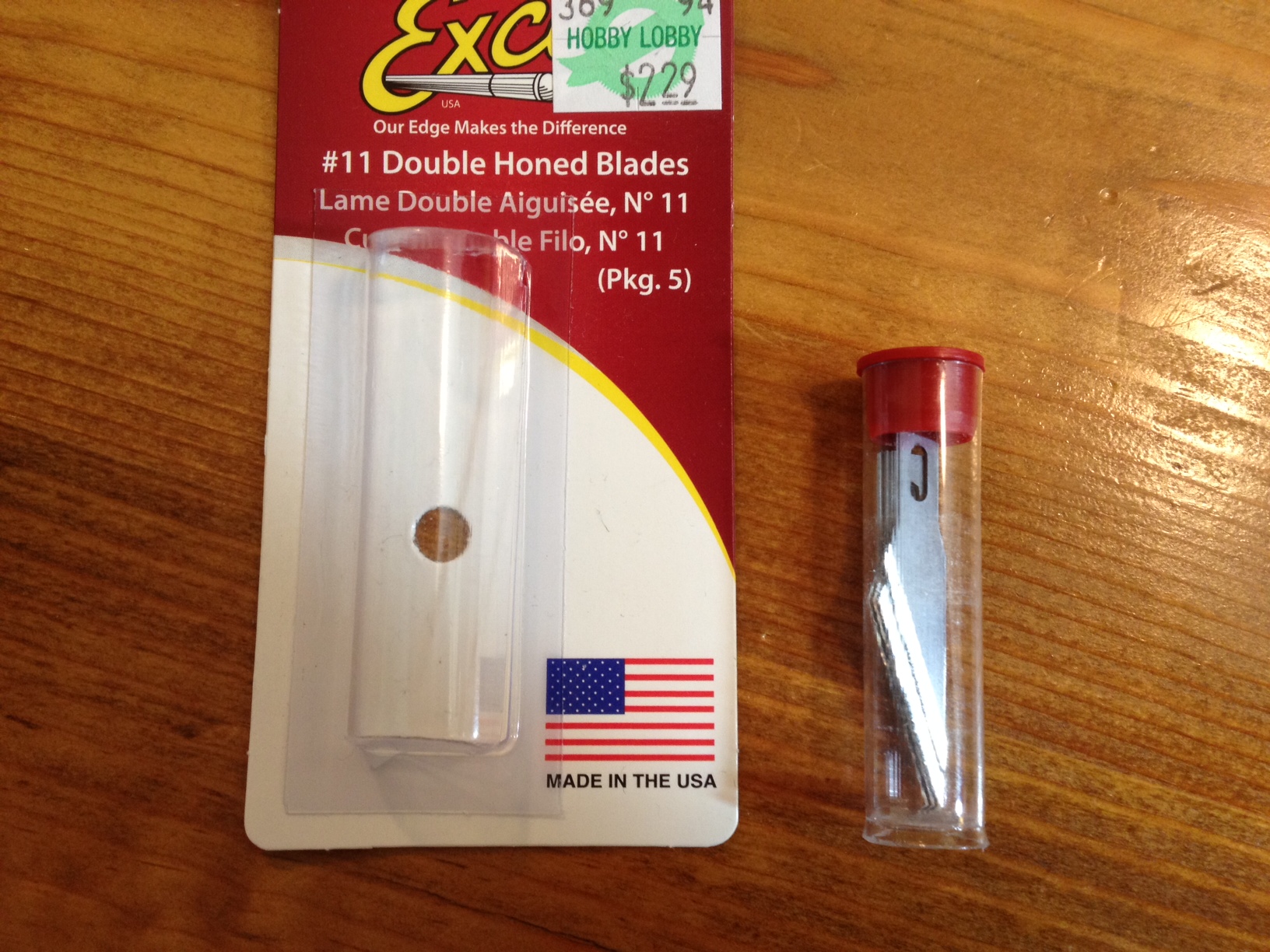
To start off with, the Excel brand 5-pack that you buy in hobby stores has a tube to store the blades in. It’s nothing special, but it gets the job done, is clear so you can see your supply, and is flexible so it doesn’t shatter.

photo-41

The blades fit securely in all hobby knife and scalpel handles that I tested, and should fit in all (unless there’s a proprietary system I don’t know about). The blades come sharp enough to cut paper, and hold their edge through cutting plastic. They dull and bend at about the same rate as X-Acto blades and can easily make it through several projects before dulling or being nicked. I’ve had no rusting yet (they come oiled), but I do keep them fairly moisture-free. The tip is “flexible” in that it doesn’t shatter and has some play (bouncing back when bent), but the point and the blade are hard enough that a single blade could take weeks of daily use (depending on the use, as plastic and metal are obviously harder than paper and cardstock).

Overall, these blades are less expensive and at least as good, if not better, than the name brand competition. They cut well, hold an edge, and resist breaking. They’re a reliable blade that is at least worth a look.


Review – Piccadilly Sketch Book

There are quite a few sketchbooks out there, and it can be hard to choose. If one isn’t the “pick one and stick with it forever”, or the “grab the nearest one off the shelf when a new one is needed” type of person, it can be overwhelming. Which ones on the shelf are worth it? Piccadilly is a brand of notebooks that has been making inexpensive Moleskine-type books for some time. Are their sketchbooks any good?

photo-36

The books have a super-plain brown cardboard cover with only the word sketch thinly lettered on the front. This cover is more of a wrapping, as it’s only attached at one point on the back, wrapping around and folding in the front like a dust jacket would. The binding is a series of small, sewn signatures glued together on the spine. It’s similar to most other binding methods; the spine cover just isn’t glued to the actual spine. At 120 sheets it’s a nice length, and isn’t too bulky or heavy. The construction, while sturdy, wouldn’t, I suspect, hold up to more than its complete page count if heavily used, and the cover-cover might even fall off or be rendered unusable before then. For a non-spiral it’s good, but it won’t last forever.

photo-37

The paper is blank 100gsm, textured and acid-free. It’s quite thick, almost seeming like card stock, but this provides a stable writing service even deep into the book. The texture isn’t great, in my opinion, but isn’t intrusive either. It holds graphite and pigmented ink well. If one is using wet, dye-based inks, though, feathering can be quite severe. The thickness leads to very little bleed-through (although it couldn’t stand, say, sharpies) and almost no show-through in most cases. It’s very well behaved and makes writing and drawing a pleasure, especially with pencil.

photo-38

It’s a good sketchbook, quite a good one, if you’re not going to put it in extreme conditions. It’s on the lower price side of average sketchbooks and does the part. Most people won’t have a problem with it and I certainly haven’t. If you’re looking for something to beat up, a different book might be needed. But if you’re looking for a minimal, handsome medium-use sketchbook, I’d have a look.

Review – Paper:Mate Sharpwriter

Papermate has been making pencils for a long time, and one of the simplest and least expensive mechanical pencils available is one that they make. These pencils are some of the cheapest on the market from a name brand, and always come in packages containing a large number. They are almost universally recognized as one of the lousiest pencils to use, but is that reputation deserved?

20150503-225627.jpg

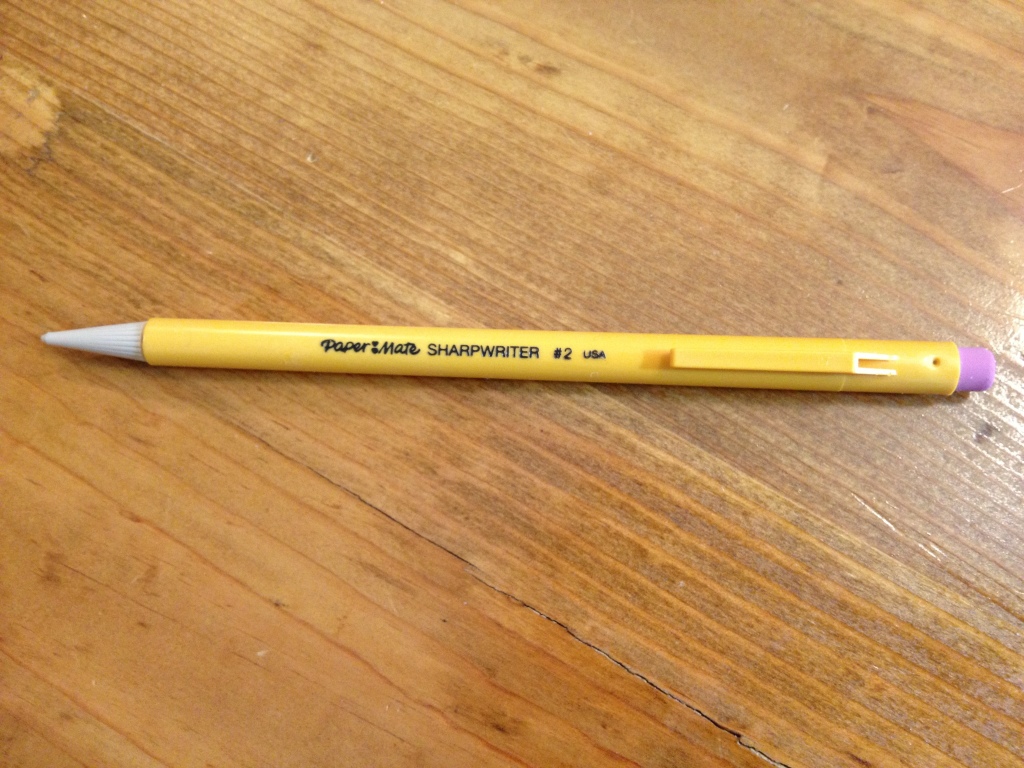
Starting at the back, it’s got a small, pink eraser that does indeed erase (quite well, actually,) but, like most erasers at the back of pencils, it won’t last very long. Moving down from that, we have a basically straight and plain body, with a terrible “clip” near the eraser (it doesn’t actually clip on most things the thickness of shirt pockets). The basic information about the pencil is physically molded in the side, with no other features on the barrel. It looks slightly slippery but does grip with no problems.

20150503-225632.jpg

At the front of the pencil is the lead-advancing mechanism, which one must twist both to extend and retract the lead. This is inconvenient, but not more so than a top click. This twist mechanism is flimsy and easy to break if one goes too far, but not too noticeable when writing. The lead is technically refillable, but the pencil is almost treated as disposable, so it isn’t worth it.  The lead that comes with the pencil is fine: it’s a #2 and it works fine for most purposes, even erasing well with the eraser. There is also a “shock absorber” in the pencil (I believe it isn’t a special thing but inherent in the design) and it works!  You can press down quite hard and the lead will simply retract a few mm instead of breaking, but writing like this would be fatiguing and still cause the lead to break, since the spring is only absorbing force in one direction.

Is it a great pencil? No. Is it a bad pencil that will explode when you take it out? No. It works.  It’s a bit finicky at times, and I feel like I could break it with my bare hands and minimal effort, but under normal use conditions this isn’t a problem. The clip is the worst part, and if you need a good one I’d steer clear of the Sharpwriter. If you’re looking for the one pencil to have forever this is also far removed. But it is quite versatile and quite inexpensive. (Adam Savage of Mythbusters likes them: https://youtu.be/uN6vptYpo5I?t=2m15s) And if you lose pencils often, or are getting them for an office, I’d at least consider it.


Review – Uni Kuru Toga Roulette

I’ve previously looked at one of the most liked (and according the to the Wirecutter the best) recent mechanical pencils, the UniBall Kuru Toga; I was under whelmed. Recently I was able to get a hold of the upgraded version, the Roulette. Is it worth the upgrade? Should you skip the regular model and get this one? Let’s take a look.

20150428-233220.jpg

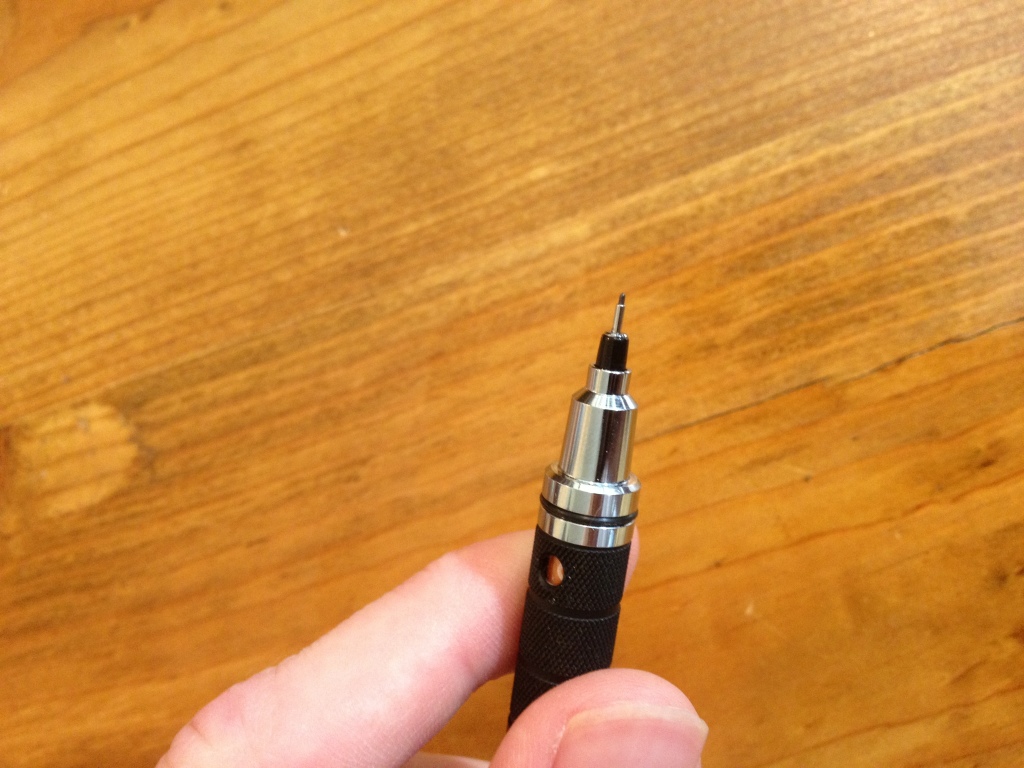
The back end of the pencil is a plastic and metal lead advancer; it works and doesn’t dig into the skin. There is a rubberized ring around it for reasons I don’t quite understand. Removing the advancer reveals a super tiny eraser that won’t last long but does indeed erase. Below that is a clip, which is fit onto the barrel in a way that would allow removal, but with difficulty. Japan is stamped into the side of the clip, and the name and size of the pencil is written on the barrel just beneath the clip. The barrel is plain until one gets to the section, which is metal and extended, the bottom half is knurled, but not aggressively so; it provides a good grip. There is a small hole in the grip that allows one to see the fact that the pencils mechanism is turning (but no the mechanism itself). Down from that is a tip very similar to the regular Kuru Toga, but extended is some ways. On this model this oddly designed step down cap is still not necessary, but covers up an otherwise ugly portion.

20150428-233226.jpg

Now on to the part everybody loves, the mechanism. I mentioned that I was under-whelmed by this previously, and I still am, but I know why now. The window in the grip section allowed me to see clearly when the mechanism was turning and when it wasn’t. And while it was possible to do this in the cheaper versions I was a bit harder to see. The mechanism itself by the way, as far as I can tell, is identical in both pencils, but there is no way to open them and find out exactly without possibly rendering them inoperable. But the answer to when the mechanism was turning when I was writing with the pencil was… never. I tested it, the mechanism works, it just never moves when “I” write with it. My writing, and drawing, are much too light to get it to rotate the lead, and thus I never see the affects. The packaging (for the inexpensive one, my roulette came in all Japanese packaging) says that the mechanism helps with the point of the pencil, and to prevent breakage. I really have never had a problem with either of these things, partly because I flail the pencil around compulsively when writing and drawing, and that rotates it such that my lead is always at a point. Now I guess I know that I write far too lightly to have a problem with breakage. But man, if I write lightly, some people must really press down on the things. So yes, it works flawlessly, but if you write like I do it isn’t really a selling point. And finally I wouldn’t worry about the mechanism wearing out, it is extremely well made and there have been no complaints about such a thing occurring, so if it does by that time you’d be able to just get a new one, it’s popularity means it likely isn’t going anywhere.

So, it is a good pencil? Yes. Is it worth the money for the upgraded version? Yes, even without the mechanism. The pencil is solid, well made, and solves the comfort issues I had with the less expensive version. The weight is good, the feel is good, the metal gives one a good grip and the writing is nice and fine. And if one does press hard enough to activate the mechanism I’ve heard nothing but good things. I wouldn’t take it over my Graphgear, but that’s just personal preference. I like the thinner body a little better on that one. So if you write with a lot of pressure, the Kuru Toga is the pencil for you, if you don’t you have other equally good options within the price range in my opinion. Even then it’s definitely worth a look.
Review – Scripto Oops

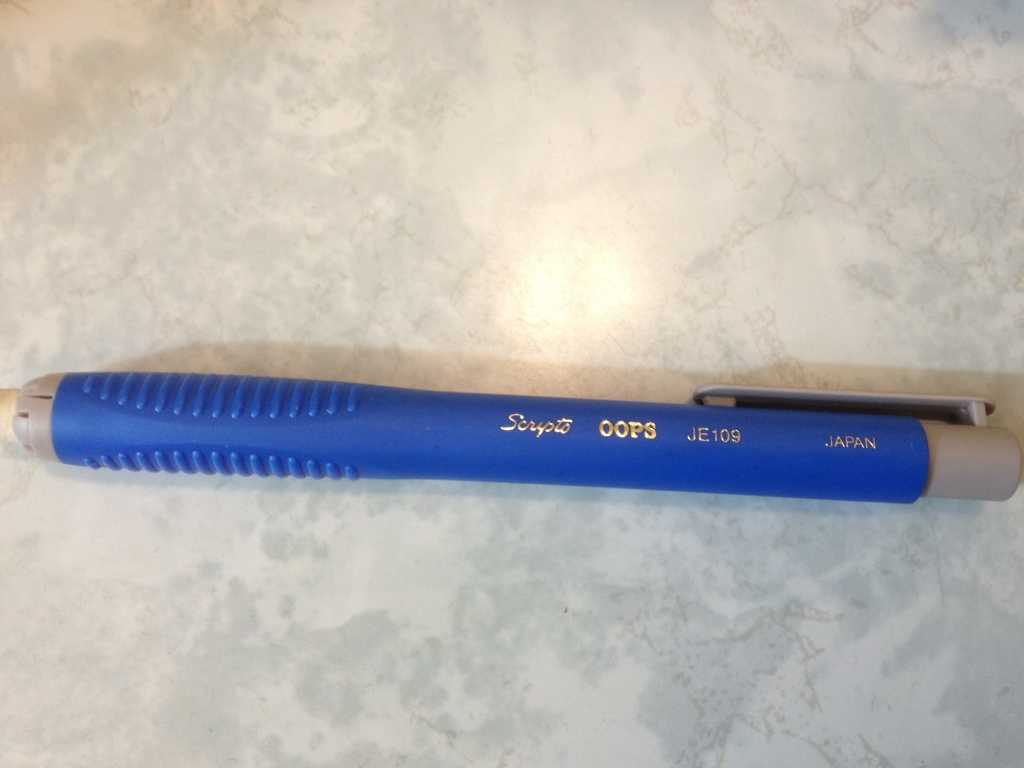
Sometimes, when going through life, you find some amazing idea that you can’t believe has been discontinued. I mean, how could they not be making money on that? Of course, there are many reasons for something to disappear, and in the case of what I’m reviewing today, the Scripto Oops, there are plenty of long erasers to take its place. But this one was the first I ran across, and I think it deserves at least a short review.

20150127-223939.jpg

The Oops is a pen-like item, with an uncapped cylinder as a push button on the back, and a functional, but not very useful, clip. One the side of the eraser is printed the relevant information for the company and item being used. At the section, the eraser becomes more “triangular” and ridges are added for grip in the facets.
Pushing the button moves plastic claws at the front of the eraser that push forward and then lock in the main eraser part. This mechanism is fairly sturdy, but does break over time. The eraser itself is better than a standard pink eraser, but not as good as gum erasers. In general, it falls well into the white eraser category.

20150127-223934.jpg

Overall, I love the thing, and use it when I remember it’s around (and not lost in my pen cup). For art, I do tend to use higher-quality erasers, but for everyday use this is a great one and it fills all the roles needed with minimal streaking and removes enough pencil. It’s just a shame they don’t make them anymore.


Review – Poquitos Part 1 – Yafa Ballpoint and Pencil

Some things are better small, and the Yafa Poquito, being one of the first pens I got, proved that to me. It was exceptional for my small hands at the time. But how does the set compare now?

20150113-225904.jpg

The Yafa Poquito pens have metal bodies that come in various colors. The top of the pen is a bit of a rounded-off cone, and the top of the pencil has a small steel button. The clips are tight and almost identical, with the pen’s being pointed, and the pencil’s being round. The bodies of both utensils taper from the middle to each end, with the center band being separate in the pen and attached to the mechanism in the pencil. The metal tip of the pencil is also part of the mechanism, whereas in the pen it is part of the body. The bodies are quite solid, but the paint will wear off with time and a bit of use. Consider getting a silver or brass one to fix that if you mind.

20150113-225910.jpg

The pencil takes .7mm lead, and what it comes with it fairly standard, sometimes broken in transit. The mechanism is easy to use and quite sturdy. It would stand up to a bit of abuse. There is no play once the lead has been extruded, it doesn’t have “shocks” as it were, but the mechanism is separate from the pen body, and this creates a squeak now and then.

The pen is a smooth-writing fine cartridge. It is a ballpoint so there are occasional globs and hard starts. If left out for some time, the pen will be quite hard to start, but in this case a while is so long a time that one would expect it to. When it does flow, it is very smooth, and has almost no issues. It is not quite black, and waterproof, as most ballpoint blacks are.

The Poquitos pack quite a bit of punch for their size, being less than 4 inches long (and they still manage to fit relatively comfortably in the hand). And while they do have some flaws, they are far from from deal-breaking for having a pen or pencil there when you really need it. They serve best as backups and are miles ahead of small pens that don’t allow one to comfortably hold them or have very little ink. I’d say that in that category, Poquitos are at least worth a look.