Review – INC Soft Scripts Mechanical Pencils

Pencils for the office, school, or just someone who loses their pencils a lot can get pricey, fortunately there are a lot of inexpensive options out there. But are they even worth it to try? Sure, there are a lot of inexpensive pencils, but if they don’t “pencil” there is no reason to even consider them. INC Soft Scripts are one such pencil on the less expensive side of the aisle. How well do they work?

photo-252

The design here is pretty stereotypical, with the barrel being a thin, featureless tube of black plastic that tapers at one end to a plastic lead pipe. Near this end is a rubber grip in one of a few (5 in my case) colors that is narrower in the middle and has ridges toward the end, both ostensibly to help with grip, and they succeed in being barely noticeable. On the back end is a colored plastic push-advance mechanism (that matches the grip) with integrated pocket clip and eraser holder. This bit can be removed to expose the lead-holding tube that contains 2 extra leads (for a total of 3 per pencil). The clip is nothing spectacular, with most of the necessary information on it, and fairly brittle. But I feel the entire end piece would fling off before it broke.

photo-253

Performance is what one would expect. The HB lead is middle-of-the-road, leaning toward soft, but there’s nothing particularly off about it. I personally don’t use a .7mm size but it is a fairly standard size and makes breaking less of a problem. The eraser is one of the little white ones that will get the erasing done pretty well, but will seem to disappear almost immediately. The clip is serviceable but I wouldn’t recommend using it. And, finally, the mechanism is quite solid and workable; pushing lead out and holding it in place when commanded to do so.

photo-254

They’re easily usable, but far from spectacular, pencils, with their main benefits being the rubber grip (if you happen to like those) and the fact that they are the ones at the store (if indeed they are the ones at the store). There’s nothing really there to recommend them on, but no reason to tell you to stay away, either. They will perform fine for office, school, car, or other tasks where pencils should be inexpensive because of the frequency with which they are broken or lost. In comparison to others at a similar, price it would really come down to personal preference.

Review – Western Family Mechanical Pencils

If you are ever in dire need of a mechanical pencil, and somehow find yourself at a shop that doesn’t sell Paper:Mate Sharpwriters at the price of whatever change you have in your pocket, or even at all, the Western Family mechanical pencils may be a cheaper, and click-advanceable, alternative. But are they actually useable?

photo-234photo-236

The body of the pencils is very simple; a smooth cylinder for the barrel with a tapering and fluted (for grip) cone leading to a plastic nub (lead pipe) at the front (this part is free spinning but doesn’t appear to detach). At the back is a nothing-special click mechanism with an integrated plastic clip (that does indeed clip to things and hold it in place, but is pretty flimsy) and a small white eraser on the back. Removing the eraser (which actually fits down inside almost all of the click mechanism) reveals the inner lead-holding tube, which comes stocked with one extra lead per pencil. The entire click mechanism can also be removed for more direct access.

photo-235

The performance is nothing to write home about. The HB 7mm lead is, as one would expect, fairly soft but not too soft, and a bit wide for people like me (I prefer 5mm, but I can live with 7). The eraser does indeed erase: it gets rid of most regular graphite marks but can be used up very quickly. The barrel of the pencil feels sturdy, but the ends are flimsy and plastic-y with tolerances that aren’t very tight.

photo-237

Overall the package is fairly bare-bones, but functional. I wouldn’t use them as my main pencils, but they’d work in a pinch. For only a few dollars you get 10 pencils (in 5 terribly boring colors) with 2 leads each and a body and eraser that will hold up probably no longer than it takes to use those 2 leads (the clip being the weakest link there). There is nothing particularly appealing aesthetically about them and no information (like lead size) other than “Western Family” printed on them. They’ll work for scattering about for use if you can’t find your normal pencil or for loaning to people who don’t care about the pencil (like at the office, or playing D&D) but I can’t recommend them for any other reason.

Review – Sterling Studio 4-Piece Synthetic Brush Set SS-117

One of the problems with painting miniatures (doll houses, dioramas, war game pieces, etc…) is that it’s difficult to find brushes in the right sizes, and even then, brushes can be expensive. But if you’re not going to be doing a whole lot of work with them, how well would an inexpensive brush set like the Sterling Studio SS-117 work? Let’s take a look.

photo-165

Just a bit of a disclaimer, I’m not sure if this set is available anymore or even where one would get it. I got it at an outlet store at a considerable discount and waited to use it a few times before making this review.

photo-164

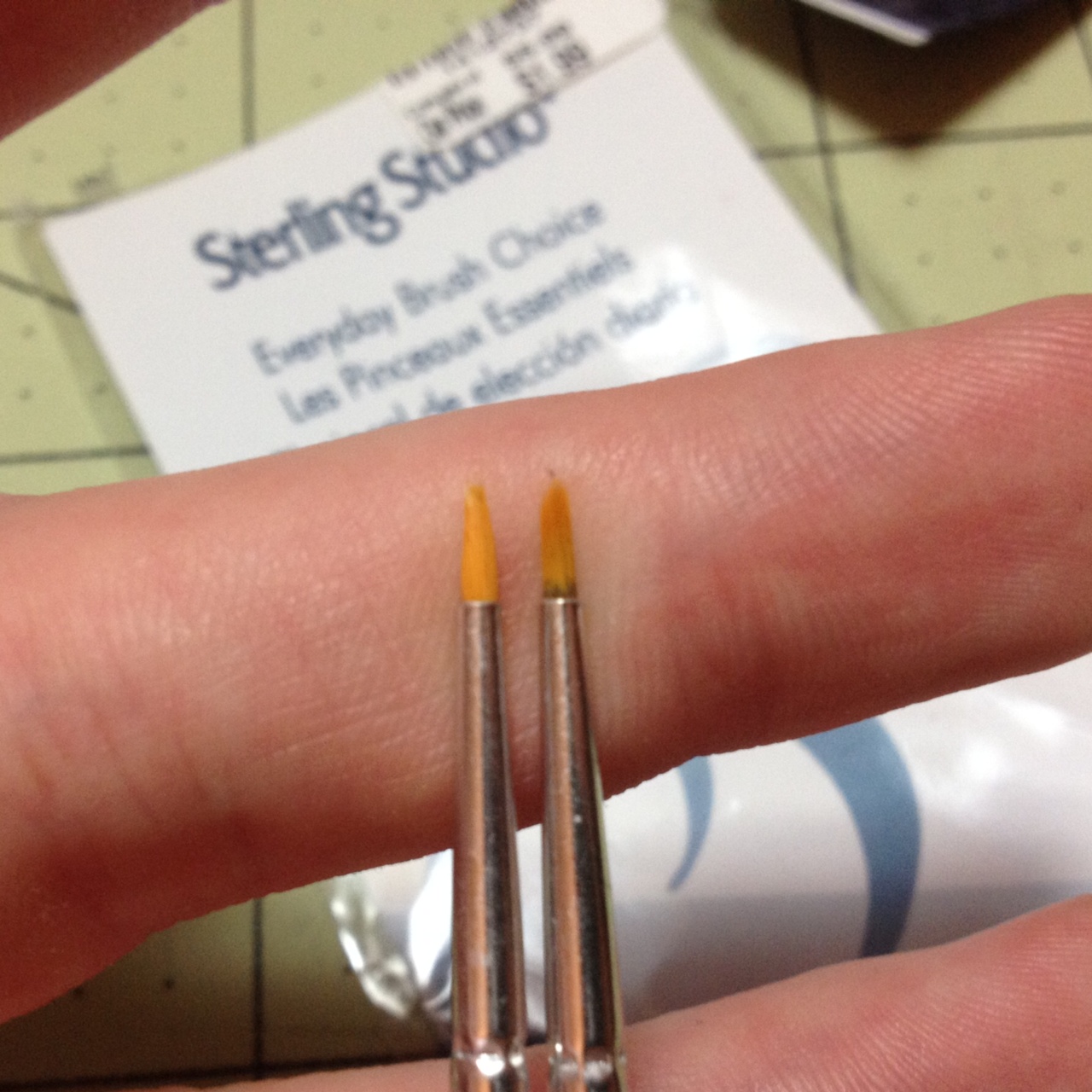
The bodies of the brushes are quite simple. They are a thin piece of wood painted a dark blue with “Sterling Studio” and the brush size written on the side in white. This is followed by a very cheap piece of crimped silver metal, which holds the orange synthetic bristles. The set include a round, two brights, and a spotter. The brights being flat-ish and semi-rectangular while the other two are rounder and pointier. The differences in the round and spotter are very little save one feels a bit stiffer, but I don’t know if that’s from other factors.

photo-167

The sizes are quite small, 10/0 (0000000000) and 2/0 (00) {Side note: paint brush sizing is weird sometimes} but they aren’t massively different. While the double zero (2/0) is noticeably larger I’m not sure how much of a difference it will make. The bristles are a pretty cheap synthetic material that is quite springy (which I hear is a bad thing, but my painting skill is not fine enough to really notice) save for one which is very stiff. They seem to wear quickly, but they are quite a small surface area so it stands to reason they wouldn’t take much abuse. I know they aren’t the best quality but I’d say they’re about medium seeing as I’ve used much worst brushes. Since they are so small they don’t hold a lot of paint, but they do work well for very fine detail or fine highlighting. I believe the common wisdom among mini painters is use the largest brush you can get away with, and these in most cases aren’t. And while I have used them, I can’t imagine too many scenarios where I would need to.

photo-166

They are quite a cheap set, the wood is weightless, the finish is far from perfect (though fortunately the crimping is not loose), and the brushes will wear out quick. But for the amount of times a brush of these sizes would be applicable (unless you were doing 6mm minis, all of the detail in an already small scale doll house, or all of the detail in an N scale train set) they will do just fine. I can’t say I’d recommend them, but if you might need to paint some fine detail every once in a while, I’d say pick them up if you run across them.

Review – Faber-Castell 033 Ballpoint Pen

I recently received a box of things my brother got for me on his trip to Peru. Inside were several pens that seemed to be commonly available there. Indeed, they are more common there than in the US, because all of the information I could find on them was in Spanish, or Russian (Ukrainian? Cyrillic of some sort). And they do say “Product of Peru” in Spanish. So let’s get to it and look at the first type I received, the Faber-Castell 033 ballpoint in black.

photo-156

The pen has a very classic octagonal design, and it’s made with a plastic that feels much like the plastic that older pens and mechanical pencils were made out of, except it is much lighter and feels more brittle and thinner as a result. The faceted barrel is capped on the back by a step-down plug of a light grey color that allows the pen to be neatly posted, and the cap on the front is a very simple, if unsightly, ribbed design. The clip is molded in and works, but is quite filmsy, and I wouldn’t trust it. The cap does fit securely over the section, which is a simple taper in the barrel to a larger-than-normal metal cone, at the end of which is the ball. As far as I can tell, this tip is not removable, and thus the pen is not refillable. Stamped in gold on the side is just enough information to identify it, but not much more.

photo-157

Writing is surprisingly smooth for a ballpoint, but it does have occasional startup issues and more blobbing than I can get past. The ink is comparable to inexpensive Bic ink. It’s suitably dark and black, but it’s got a bit of a red sheen, and upon close inspection under a bright light it looks like a very dark purple. It’s still on the warmer side of things, though. It dries fast (except for the blobs), but with certain types of paper I wouldn’t try it left-handed. And its blobbing might cause it to smear for left-handers anyway. It is suitably waterproof like most ballpoint inks. I haven’t tested lightfastness, but in general even cheap black inks do well, but it isn’t archival quality.

Overall it’s a well-working, inexpensive pen. As far as super cheap pens go it isn’t the best, but it’s far from the worst. It writes well, but not perfectly. The body is simple with no frills and holds together despite being cheaply made. And there isn’t much more to it than that. I wouldn’t be going out to import them, but I would (and will) use them if I ended up with them (which I obviously did).

Review – Office Depot Ballpoint Pens

Most stores have generic in-store brands or store branded products for various merchandise. That is the case here, with these Office Depot branded ballpoint pens. I don’t know what they cost originally, but they were marked down twice to 50 cents and then 3 packages for $1. Which means I picked up 30 for a $1. There are very few things I wouldn’t say are a good value for that price (I’d probably say stale gum was worth 30 pieces for $1) so it would be hard for these things to let me down. So let’s see how they perform.

photo-114

The bodies of the pens are super simple. They are round and straight with a cap on the end to hold the ink cartridge in on the back, and a slight bump (to hold the cap on) followed by a taper and then the point of the front. The cap is fairly generic with an integrated clip that works but isn’t great. They are all made of translucent plastic that matches the ink and have “Office Depot” printed on the side.

photo-115

Writing is surprisingly smooth, especially for mediums (they’re a bit broader than normal mediums I would say) and at times they can write with minimal pressure. The packages say “No skip guarantee” which isn’t true, but it wouldn’t be for any pen. It blobs after a certain amount of writing time but I don’t know a pen that wouldn’t, and it’s less than expected. They do tend to have (sometimes severe) startup issues though, especially the longer they are left capped, as do most cheap ballpoint pens.

photo-116

The colors are fairly standard office colors, nothing at all natural looking. The black is just off-black and slightly warm. The red is deep and doesn’t shade much, but still very noticeable. And the blue is quite dark, but still differentiate-able from the black except in the lowest of lights. All are essentially waterproof and dry quickly.

Overall, I’d say the pens are probably worth it. They have no frills, and likely a high margin of error. Any problems, though, and the pen can simply be tossed. They do come with wax-sealed tips, meaning they will last longer in storage, but after that they need to be used fast before they dry up. The bodies are sufficiently hardy to last easily for the life expectancy of a pen like this. The cap seals, the clip holds, and the tip writes. Everything’s functional and unspectacular. If you’re running a business where pens are needed frequently by customers or employees, or you’re just forgetful and lose your pen, these are cheap and they work until they disappear. But they won’t be impressing anyone.

Review – Dollar General Utility Knife Blades

Utility knives are an almost ubiquitous tool. They are inexpensive and easy to use cutting tools that are good on the job, at home, and for crafting and artistic tasks. And for most people they are used for jobs that scissors just can’t do. Even people who carry pocket knives can use a cardboard cutter now and then. But there’s a reason the blades come in 100 packs at 10¢-30¢ apiece. This set from Dollar General is about 20¢ apiece. How do they work?

20150524-234739.jpg

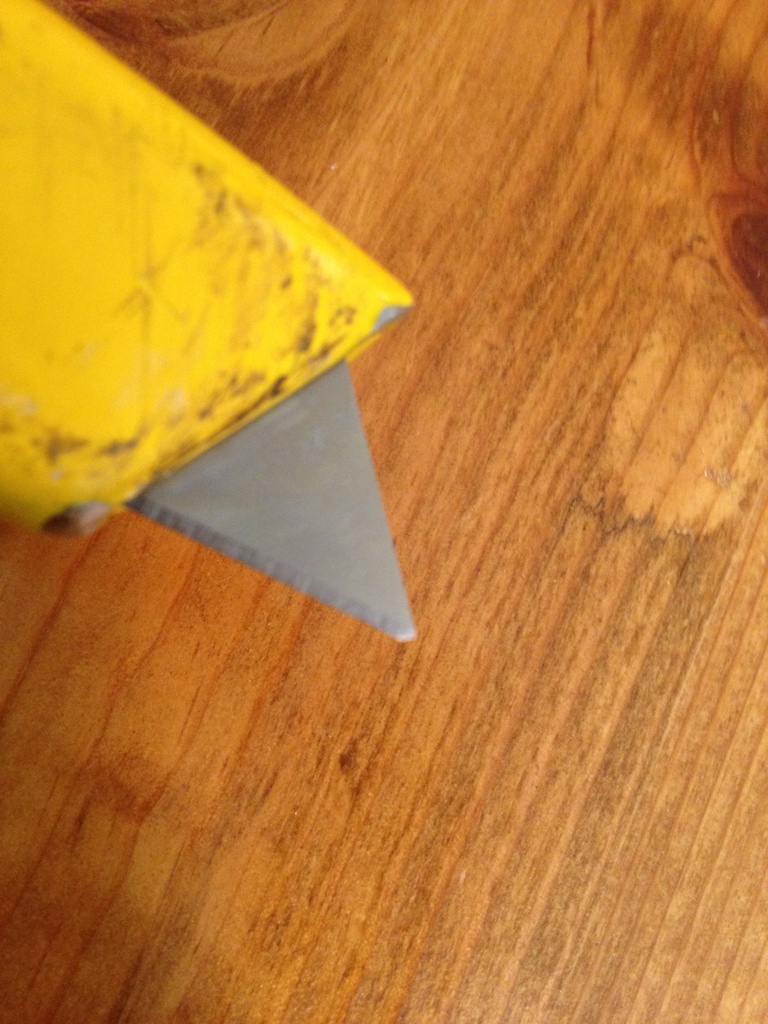
To start, the packaging says they fit most utility knives, which I’ll believe. Their shape is similar to most other blades I’ve seen, and they fit my knife just fine. They lock into place with about as much precision as one would expect, which is to say not much. There’s play in the blade when installed, but it’s workable. They come sharp enough to cut paper, and strong enough to cut household plastics, which are both really things that are a bit out of the general use of the blade. They don’t dull immediately, either. That being said they don’t last for very long and the blade itself can be dinged rather easily. They are also pretty fragile. When I was testing one on plastic the very tip of the blade broke almost immediately. They’ll last about a hard day (or 2-3 give or take) cutting cardboard, longer in the house, shorter if you’re cutting more or heavier things (like they won’t last literally all day just cutting), and for as cheap as they are I wouldn’t expect much more. And if cutting cardboard cleanly isn’t a necessity they can last longer. Finally, they are smothered in grease in the package to prevent rusting, and while I haven’t left mine out I have no doubt that they would rust really fast.

20150524-234744.jpg

So are they great? No. But no utility knife blades are great.  They do about as well as expected, and are at least safe for their main function of cutting cardboard, rubber and the like. If you need the blades right now, or don’t need to buy many blades, these will work, but larger packs or ones with slightly higher quality would be recommended.

Review – Piccadilly Sketch Book

There are quite a few sketchbooks out there, and it can be hard to choose. If one isn’t the “pick one and stick with it forever”, or the “grab the nearest one off the shelf when a new one is needed” type of person, it can be overwhelming. Which ones on the shelf are worth it? Piccadilly is a brand of notebooks that has been making inexpensive Moleskine-type books for some time. Are their sketchbooks any good?

photo-36

The books have a super-plain brown cardboard cover with only the word sketch thinly lettered on the front. This cover is more of a wrapping, as it’s only attached at one point on the back, wrapping around and folding in the front like a dust jacket would. The binding is a series of small, sewn signatures glued together on the spine. It’s similar to most other binding methods; the spine cover just isn’t glued to the actual spine. At 120 sheets it’s a nice length, and isn’t too bulky or heavy. The construction, while sturdy, wouldn’t, I suspect, hold up to more than its complete page count if heavily used, and the cover-cover might even fall off or be rendered unusable before then. For a non-spiral it’s good, but it won’t last forever.

photo-37

The paper is blank 100gsm, textured and acid-free. It’s quite thick, almost seeming like card stock, but this provides a stable writing service even deep into the book. The texture isn’t great, in my opinion, but isn’t intrusive either. It holds graphite and pigmented ink well. If one is using wet, dye-based inks, though, feathering can be quite severe. The thickness leads to very little bleed-through (although it couldn’t stand, say, sharpies) and almost no show-through in most cases. It’s very well behaved and makes writing and drawing a pleasure, especially with pencil.

photo-38

It’s a good sketchbook, quite a good one, if you’re not going to put it in extreme conditions. It’s on the lower price side of average sketchbooks and does the part. Most people won’t have a problem with it and I certainly haven’t. If you’re looking for something to beat up, a different book might be needed. But if you’re looking for a minimal, handsome medium-use sketchbook, I’d have a look.

Review – Hot Concepts Illumix 4 in 1 Stylus

Every once in a while you run into a gimmicky, cheap product that’s still a bit of fun. For instance, I wanted a laser pointer (for me and my cat) and was in Walmart one day. On that day I found the “Hot Concepts Illumix 4 in 1 Stylus”. It’s a funky little pen with a light, laser, and touch-screen stylus. And it’s only a couple bucks! Let’s see how it works:

20150224-232410.jpg
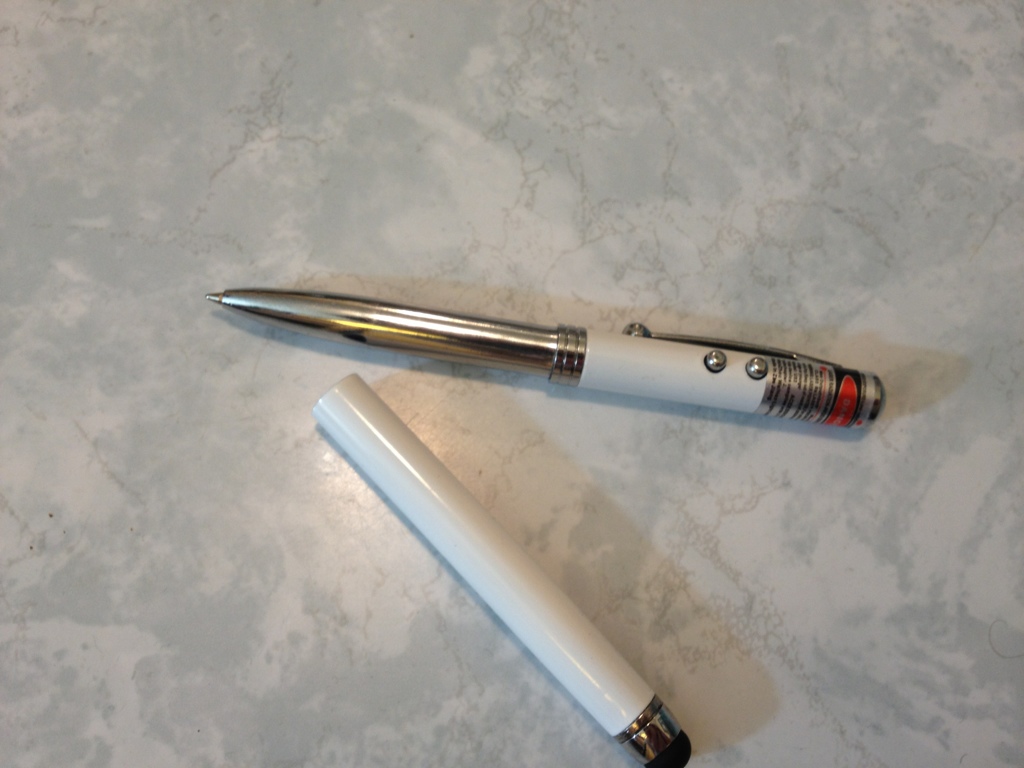
The light is really just a white LED that’s stuck in the end of the pen. There’s no focus, so it dissipates rather quickly. You could get an idea about the shape of a small room, find a key, or perhaps locate something stuck behind some furniture, but that’s about it. Nothing far away can be seen, and nothing in great detail. But it still works alright. Interestingly enough, both the light and laser can be turned on at the same time. The laser is dimmed significantly by this, but the light seems unaffected.

20150224-232415.jpg

The laser pointer works fine. It’s one of the standard cheap ones that can be found almost anywhere. It will hurt your eyes, but isn’t very bright on anything else. It isn’t very well focused and will spread out over long distances. But inside a regular sized room, it is very functional as both a people and cat toy.

20150224-232420.jpg

The stylus works with modern touch screens, and it’s fine. It’s so easy to make a stylus that works with these screens now it’s unremarkable. It’s a bit cheaper than the norm and seems like it might wear out, but I’d say the worst thing about it is that you have to watch out and not hit the buttons and blind yourself when using it.

Finally, the pen part. It works, actually quite well. The tip is very fine, but despite that, it writes quite smoothly with little pressure. The inks a standard, almost-black ballpoint ink that’s water-resistant. The cartridge can’t be replaced as far as I can tell, though the batteries can be. So when you run out of ink you’re out and just left with the other features. That would seem to indicate the pen is not a primary function. The sleeve with the stylus has to be removed to access the pen, and this is not held on very well. It slips and can come off with a bit of a shake. There’s also nowhere to put the sleeve when using the pen, meaning it’s a two-handed operation.

A couple of other things: the clip works well, there’s a warning under the laser but otherwise no information printed on the pen, and the white smooth color with “chrome” trim looks nice, but not very professional, and it’s quite slippery.

Overall, every action it performs is done passably, but not well. It’s a fun device to mess around with or have if you want any or all of the 4 uses, but won’t use any of them that much. The batteries don’t last that long, the ink cartridge is small and not replaceable, and the overall tolerances aren’t very tight. The metal construction is nice, but the product seems to be made with disposability in mind. It’s fun, and good for the money. Just don’t expect much out of it.

Mini Composition Showdown

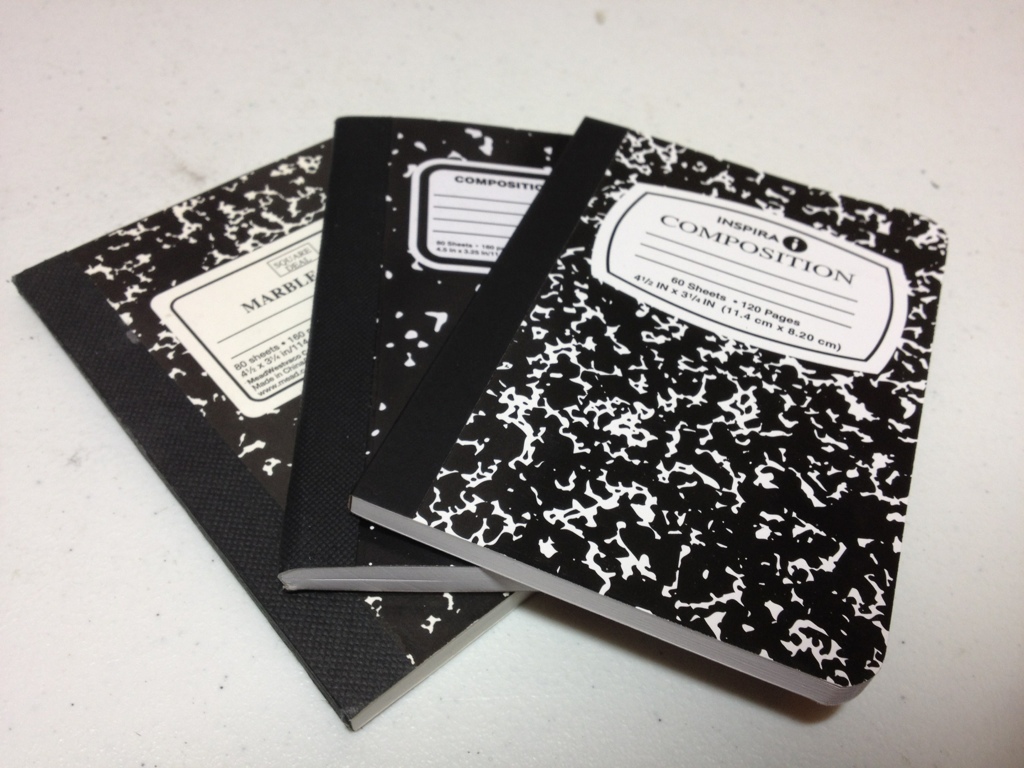
A while back I reviewed the Dolgen Inspira mini composition book. I have quite a few books like this and instead of reviewing them all I decided to just compare them all together. So here’s the mini composition showdown. Mead vs. Inspira vs. Top Flight.

First off, covers and binding. All the covers are the standard composition marble pattern, with the Inspira being the most crowded followed by the Mead and then the Top Flight. The binding on the Top Flight is a sturdy fold stitch with eight signatures, while the Mead and Inspira are weak, simple glue binding. All notebooks lie flay fairly well, though the Top Flight takes more breaking in. Cover durability again goes to the Top Flight with the other two tied. The cover corners are straight on some of the Mead, clipped on the Top Flight, and rounded on the Inspira, meaning the Mead with the square corners will most likely tear up quickest. Other Mead notebooks have rounded corners.  If you want color the Mead and the Top Flight are the way to go.

20130614-235313.jpg

Their dimensions are about the same, with Inspira being slightly taller and Mead being slightly wider. The Mead and Top Flight both have eighty pages, while the thinner Inspira has sixty. The smoothest paper belongs to the Mead, the roughest to the Inspira, and the Top Flight is very akin to newsprint, unfortunately, not very high quality. All are not archival quality paper and fade rather quickly on the shelf, though they are bright white out of the package. None are very good at holding ink, but the Inspira is best without bleeding, followed by Mead and Top Flight.

What will really make or break these books, though, is their large price difference. The Inspira are three for one dollar (U.S.) the Top Flight are five for three dollars, and the Mead are one to two apiece.

So if you can organize all that and determine the best for you you’ll end up with a very nice pocket book. Each one is suited subtly to a different task so the main challenge is finding out what is best for you. They are certainly not the best memo books by any means, but they’ll certainly work, especially in a pinch.

Review – Escalada 3.5 x 5.75 Pocket Journal

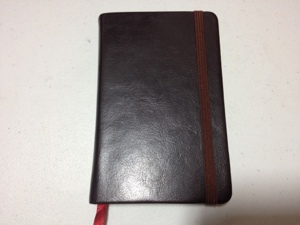
So, you’re out and about, you’ve just finished your last pocket notebook and are looking for a new one. You happen across one. It’s got 80 sheets of thick sketch paper and is only a couple bucks. It even looks kinda nice in its faux-leather binding. Is this small Escalada journal a good buy? Let’s see.

20130221-225351.jpg

We’ll start with the binding. It’s surprisingly good, it flexes well and doesn’t break under standard usage conditions. The binding, as well as the cover is of course cardboard covered in faux-leather with a slightly unattractive sheen. This layer holds up alright, though it does start to peel and rub off at the corners which is very unsightly. It also gets gummy in high temperatures and begins to take the shape of whatever is next to it, so where the elastic band is there will be a permanent set of grooves. But it hasn’t melted or gotten sticky in the time I’ve used it and I live in the middle of the desert.

20130221-225415.jpg

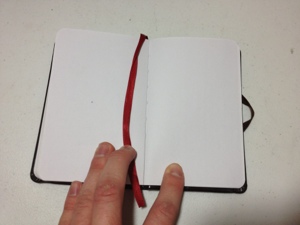
The paper is 80 sheets of 74 lb drawing paper. It’s thick but flimsy, it feels as if it’s falling apart sometimes and ink bleeds through and can be easily seen on the other side in some cases. Yet I have had no instances of marking on the next page. It has an easily visible grain and does at times warp ones drawings, mostly pencil though and not very much. The roughness is a bit unsightly to me but that’s just personal preference. Despite the flimsy feeling of the pages they are very stout and remain ridged most of the time. They resist bending, however I feel that if they did bend they would soon fall apart.

It’s an alright pocket sketchbook. It’s cheap, both in price and manufacturing, but it does do its job well enough. Just carrying it in a bag or a case won’t do much harm to it, especially since it only has eighty pages and can be run through fairly quickly. However, if your life is a bit more rough and tumble than most this is not for you, it will look ugly shortly and fall apart not long after. It does best if you’re looking for a notebook to store in your bag or somewhere on the cheap and don’t have too much preference as to the quality of the content you put in it.