Review – X-ACTO 3-hole binder Punch

Sometimes you need to do stuff with your art that isn’t art stuff. Sometimes you need to file it away, or keep it safe in a cover, or organize it in a binder. If you’re looking to do the last one, then you might need the X-ACTO 3-hole binder punch.

20130521-101541.jpg

This semi-sturdy piece of transparent plastic is designed to fit in a binder and easily punch holes through a few sheets of paper. I stress a few because on the box it says the limit is three. And yes, even three sheets is very stressful to this thing, and after that it just starts tearing the paper.

I said it was plastic earlier, but the punching apparatus is actually a nice metal piece on a hinge. It is easily as sturdy as any other hole punch I’ve used. The hinge, though, is so close to the paper that it is what you have to use to get a nice clean straight punch line and because it is a hinge this is very difficult.

Off to the bottom there is a guide that you can place your paper on and it works well. There is also a flimsy piece of loose-fitting plastic that I assume is supposed to act as a guide so the paper stays down, though it will hardly do this job well and seems as if it will snap at any moment. It also jiggles unnecessarily. On the front is a 10-inch ruler, which would be nicer if it was ruled correctly, as it is, it is about a quarter of an inch short.

20130521-102051.jpg

And finally on the back are a pair of fold-out binder loops that will allow you to stick this thing in any 3-hole binder you desire, though they will make a horrible grating sound and the plastic they’re screwed into looks like it can break in a hurry. They will never break off the binder rings on their own though.

Really this is just a cheap hole punch. The actual punch is quite nice, but its housing is lacking. If you only need to punch a few sheets every once in a while this is alright. Any more hole punching and this thing will be useless. It will certainly break within a year or two but it is quite cheap. So if that is what you want or need from your hole punch, go right ahead, otherwise try something further up the ladder.

Review – Uni Paint Pen

So you want to paint, but you’re better at drawing. Or you want to mark on some surface unsuitable for Sharpie or other permanent markers. Well, the Uni Paint PX-21 by Sanford may be for you.

This pen is oil-based and needs to be shaken up like a spray can before use. It has a “fine” point, which means a medium or even broad point if you compare it to anything that is a not a paint pen. The line it writes is solid and about as thick as a large Crayola marker. This particular version is the black version which is especially solid, though it is fairly shiny, somewhere between a Sharpie and a matte black spray in terms of marking on plastic. It does mark on literally anything, though some shiner plastics and polished metals have it wear off easily.

20130512-001155.jpg

The body of the pen is metal and feels solid in the hand. A shiny label has all the necessary information printed on it, including warnings and such. This label makes the pen slightly slippery in the hand so tight gripping is necessary.

The cap matches the color of the paint. It has ridges that are sharp and cut into the skin. It also fits very snugly onto the end, meaning it is quite difficult to remove, which is both a hindrance and a benefit.

20130512-001204.jpg

Also be warned that since it is an oil-based pen it stinks mightily and will give you a headache after a few minutes of constant exposure. The label even tells you to put the cap on immediately after use, though this is most likely also to not let the paint dry out.

Overall this is a great little painting device. It is especially handy for touchups on plastic and metal painting. Or, if you’re like my relatives and have a shop were regular markers and price tags have a hard time sticking to the stock. It’s not really a home item, or one that will be useful to canvas painters, but it certainly will have its place with sculptors and model builders.

Review – large Blank Moleskine

A little while ago I reviewed the Moleskine blank pocket book. Now in the same notebook direction I’ll take a quick look at the Moleskine blank large book. Will the classic renowned Moleskine hold up to closer scrutiny? We’ll see.

20130430-230325.jpg

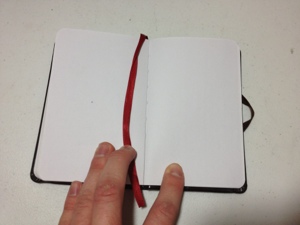
The cover is cardboard wrapped in faux-leather. It’s fairly sturdy, though it does begin to wear at the corners with continuous use. Though if you find a notebook that doesn’t I’ll be amazed. The binding is rounded, flexible and lies flat. It does have a tendency to crease when opened for too long. It also tears eventually, and if the book is really old it even begins to split down the back. This only happens toward the end of the book’s life (the last twenty pages or so). Around the cover is an elastic band which does a good job holding everything together but will eventually bend the cover in.

The pages are super thin. There are 240 of them in this half-inch book. They are of okay stock. Anything heavier than a ballpoint pen bleeds through but not usually onto the next page, it can just be seen through the page. The paper is smooth and writes well, the fine texture is just enough to prevent slips of the hand.

20130430-230332.jpg

The first and last pages are attached to the binding, rendering them mostly useless. In the back is the standard pocket, which contains the story of Moleskine (and a quality control number which is actually quite useful). In the front is a ‘who owns this’ page with a reward blank. I don’t find those particularly useful but they are there.

So are they worth it? Like all notebooks it depends on what you’re looking for (unless they just fall apart, those are useless no matter what). They are great for free range writing with sketches to enhance the look. As a sketchbook they work best with pencil as most anything else will bleed through. They are very solid in construction, the front cover especially can take a severe beating. They have very few organizational features, which some may find liberating and some infuriating. Like I said, best as a free range writing/sketch book. Alright as a travel log or such. They’re decent, and the ones I use all the time.

Review – Dolgen Mini Composition Book

Okay, this is kind of a cheat. But little notebooks are art supplies to someone. Even with the small price, should you get these small Dolgen composition books? Are they worth it?

20130427-234558.jpg

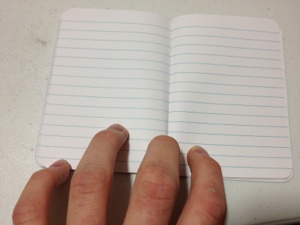
These little books contain about 60 pages of narrow lined paper. The stock is thin, and bleeds easily, but it is still about the same as average copy paper. They’re about 3½ X 2¼ inches, so they fit nicely into a pocket. They aren’t that great for drawing, but they excel at little notes and ideas.

The binding is fairly poor. I get the impression that it will fall apart quickly, but not as quickly as it takes to finish the book.

20130427-234604.jpg

These things are small, easy to carry, and really handy. They’re great for jotting down notes and the like. While they obviously aren’t made for drawing, a quick sketch or two definitely won’t hurt them, one just has the lines to contend with. At the three for a dollar price I paid for them, they are superb little notebooks.

Review – Higgins Black Waterproof India Drawing Ink

So a while back I reviewed Higgins black non-waterproof India ink for fountain pens. That’s a fine ink for fountain pens, but if one wants to do, say, an ink wash it doesn’t fare too well. There is a Higgins solution for this; Higgins black India drawing ink.

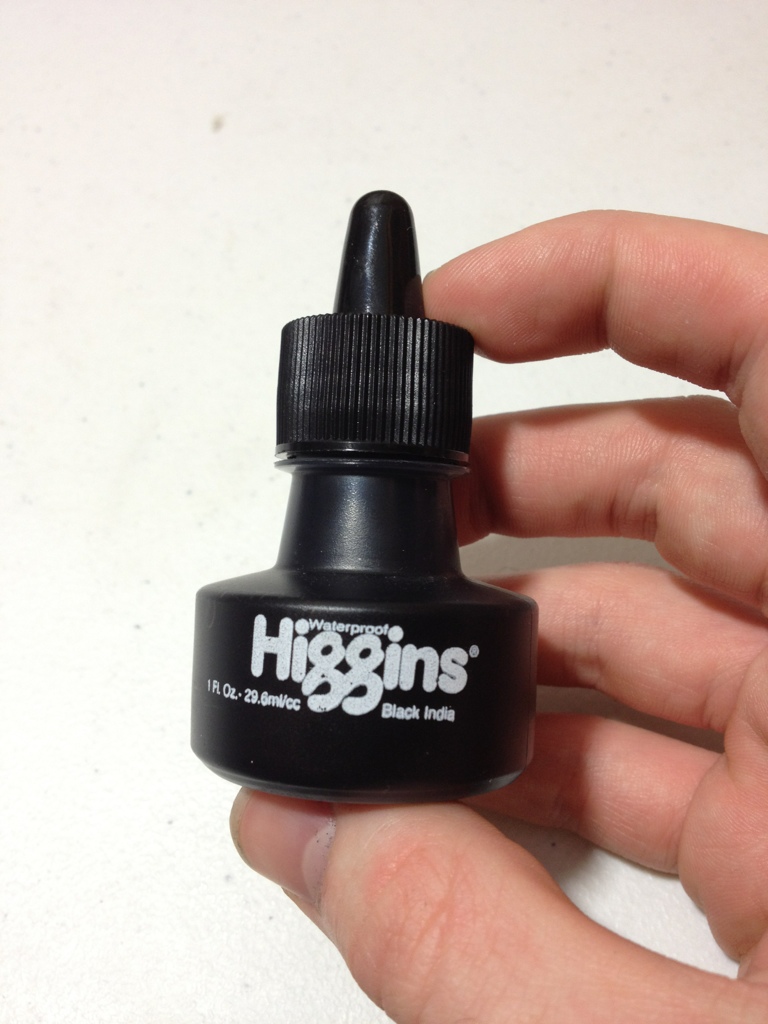
The ink comes in a tiny well with a small dropper. There is not nearly the same volume of ink, but the bottle takes up about the same amount of space.

20130411-232817.jpg

The ink itself is very black. Very, very black. It is waterproof and a little thin. It can be used to create a very dark line right out of the bottle, or diluted with water to make various shades of grey. Unlike the fountain pen ink, which turns a greenish color when diluted, the ink remains black or grey. It colors the water completely black no matter the solution, so measuring the amount of the mixture before hand is recommended.

Overall the ink is superb for what it is made for, which is brush inking and ink-washing. It is very dark and handles very well. It dilutes nicely to create shades, and covers well when it does. It does take a little practice to get good at using it but when you get the hang of it it works wonderfully.

Review – Westcott rulers

Well, when one is drawing, or drafting especially, it is useful, if not necessary, to have a ruler. And one might think that all rulers are the same. But they’re not. Some rulers have uneven edges, or mis-marked inches.

20130408-004500.jpg

A cheap ruler might cost half a dollar, and a good one might cost a full dollar. It’s not much difference and definitely worth it. The Westcott rulers that I have here are very functional, durable, and standard. Then have straight edges and correctly marked inches. One is clear acrylic and the other is steel. I use the steel for inking and the clear for sketching. I would recommend two rulers for that reason. And these are flexible, and the markings are wear-resistant. My only real complaint would be that the acrylic ruler scratches a bit too easily.

This sounds much more like a recommendation than a review, and it is, sort of. It’s a no-brainer to get a ruler. Getting a good one is not much more expensive than a cheap one, and these work great, they’re some of the best I’ve used.

Review – Swingline Personal Pencil Sharpener

Some people might not consider a pencil sharpener an art supply. But we’re using my definition of an art supply and if it in any way helps you with art it is now an art supply. Okay, maybe not exactly, but let’s just get into this Swingline Personal Pencil Sharpener.

20130328-234251.jpg

The sharpener itself is a chunky bubble of plastic with unappealing curves. It’s designed to be different rather than practical. It’s got a dust- and scratch-attracting polish on the front and a pleasing matte finish on the back. Also in the back are several fairly useless pencil holders. Back on the front is a dent that guides your pencil into the sharpener, or more likely just breaks your lead as you try. There is also a clear plastic shaving container that can be easily removed from the front.

The entire assembly is heavy and barely moves when one is sharpening. It feels solid and almost unbreakable. And with some nice rubber feet on the bottom it stays where you put it.

20130328-234258.jpg

The sharpening itself is alright. There is no swaying or destroying of the pencil. It sharpens fast and without any clogging problems. The point, however, is not as fine as it could be. It gets the job done and definitely counts as a sharpened pencil, but I generally prefer the finest of pencil tips for my work. These are simply sufficient for me.

Overall it’s a pencil sharpener, what do you expect nowadays? The build quality is nice if misguided, and the sharpening is good but lackluster. It’s sadly one of the better sharpeners on the market, beating the X-ACTO sharpeners you see in schools and offices. It doesn’t come close to a good Boston sharpener though and if you really want to get some sharpening done that’s what I’d recommend. This is only for people who just want a decent sharpener.

Review – Faber Castell 24 Colour Pencils

Colored pencils have been around for a long time. And now most of them are very cheap and often associated with kids or school. However, if one does want to look into the more expensive world of colored pencils there are plenty to choose from. Let’s take a look at the Faber-Castell box of 24 Colour pencils.

closed

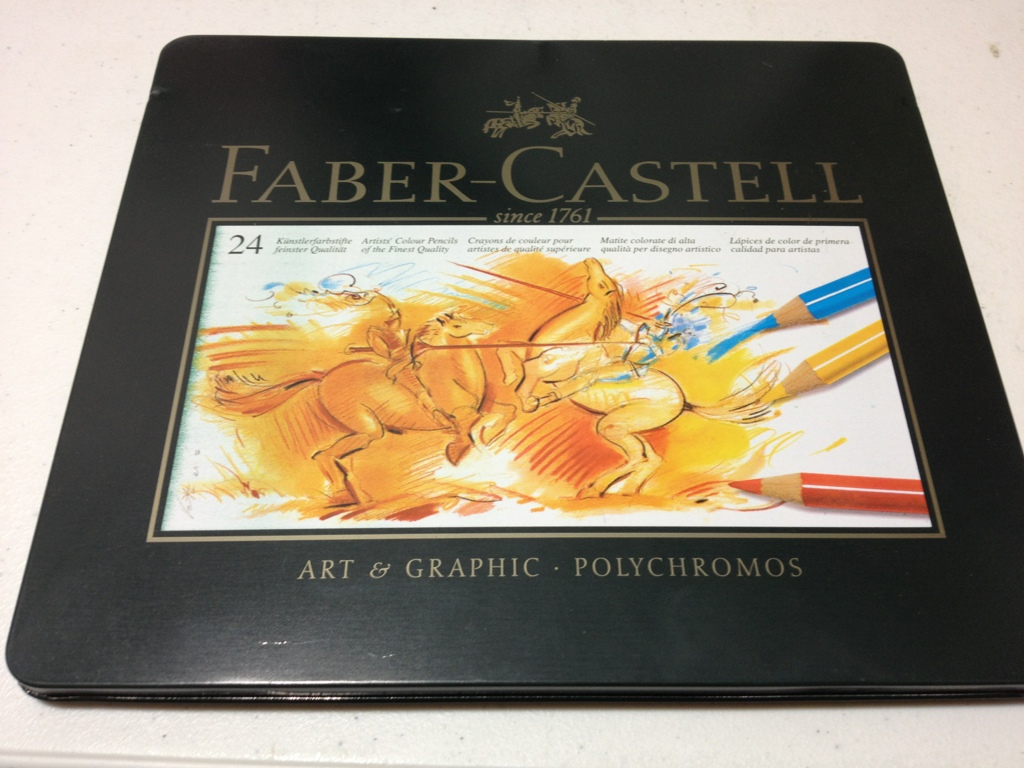
The pencils come in a nice, if easily dent-able metal case. Inside the case the pencils are stored in a row on a plastic tray. The pencils themselves are thicker than most pencils and nicely circular. They will sharpen in standard pencil sharpeners but be wary of the lead. On the side is a hard-to-read but nice logo and color information section. They are not slick and have a very matte finish that holds well in the hand. The color of this finish matches the color of the lead fairly well if not exactly.

The lead itself is hard and brittle. The colors are not nearly as vibrant as those of Crayola or other such colored pencils, giving them a much more realistic tone. The full range of colors is wonderful, with some very subtly different colors and some nice earth tones. The lead comes off well on paper and is quite opaque as most colored pencils are; they do not want to bleed or mix which is another reason why the full compliment of colors is nice. When drawing, it is best to watch how hard you push, as too hard can easily break the lead and not enough will lead to unsatisfactory coverage.

open

These colors are a huge upgrade from the standard “map colors” and such. Though they may be a bit pricy, they are great drawing implements. They seem to carry a certain prestige that transfers onto the paper (or other mediums). If you are will to spend the money I would certainly recommend these pencils. They are quite superb

Review – Toison D’or 1900 Pencil

This is another pencil review. So I’m gonna skip all the introduction and get right into talking about the Toison D’or 1900 2B pencil.

20130301-000103.jpg

It’s a nice pencil, about the size of a regular No.2 pencil. It’s black with gold, easy to read lettering. It has the mildly uncomfortable hexagonal body but with rounded corners.  The end is also rounded, making it a bit slippery. It sharpens well and is high-quality wood. It writes like a regular 2B but slips in the hand sometimes.

20130301-000111.jpg

It’s just a pencil. The only really deciding factor here is the black color and whether or not you mind a mildly slippery pencil. It is a remarkably average pencil in every other way.


Review – Escalada 3.5 x 5.75 Pocket Journal

So, you’re out and about, you’ve just finished your last pocket notebook and are looking for a new one. You happen across one. It’s got 80 sheets of thick sketch paper and is only a couple bucks. It even looks kinda nice in its faux-leather binding. Is this small Escalada journal a good buy? Let’s see.

20130221-225351.jpg

We’ll start with the binding. It’s surprisingly good, it flexes well and doesn’t break under standard usage conditions. The binding, as well as the cover is of course cardboard covered in faux-leather with a slightly unattractive sheen. This layer holds up alright, though it does start to peel and rub off at the corners which is very unsightly. It also gets gummy in high temperatures and begins to take the shape of whatever is next to it, so where the elastic band is there will be a permanent set of grooves. But it hasn’t melted or gotten sticky in the time I’ve used it and I live in the middle of the desert.

20130221-225415.jpg

The paper is 80 sheets of 74 lb drawing paper. It’s thick but flimsy, it feels as if it’s falling apart sometimes and ink bleeds through and can be easily seen on the other side in some cases. Yet I have had no instances of marking on the next page. It has an easily visible grain and does at times warp ones drawings, mostly pencil though and not very much. The roughness is a bit unsightly to me but that’s just personal preference. Despite the flimsy feeling of the pages they are very stout and remain ridged most of the time. They resist bending, however I feel that if they did bend they would soon fall apart.

It’s an alright pocket sketchbook. It’s cheap, both in price and manufacturing, but it does do its job well enough. Just carrying it in a bag or a case won’t do much harm to it, especially since it only has eighty pages and can be run through fairly quickly. However, if your life is a bit more rough and tumble than most this is not for you, it will look ugly shortly and fall apart not long after. It does best if you’re looking for a notebook to store in your bag or somewhere on the cheap and don’t have too much preference as to the quality of the content you put in it.