Review – Faber-Castell 033 Ballpoint Pen

I recently received a box of things my brother got for me on his trip to Peru. Inside were several pens that seemed to be commonly available there. Indeed, they are more common there than in the US, because all of the information I could find on them was in Spanish, or Russian (Ukrainian? Cyrillic of some sort). And they do say “Product of Peru” in Spanish. So let’s get to it and look at the first type I received, the Faber-Castell 033 ballpoint in black.

photo-156

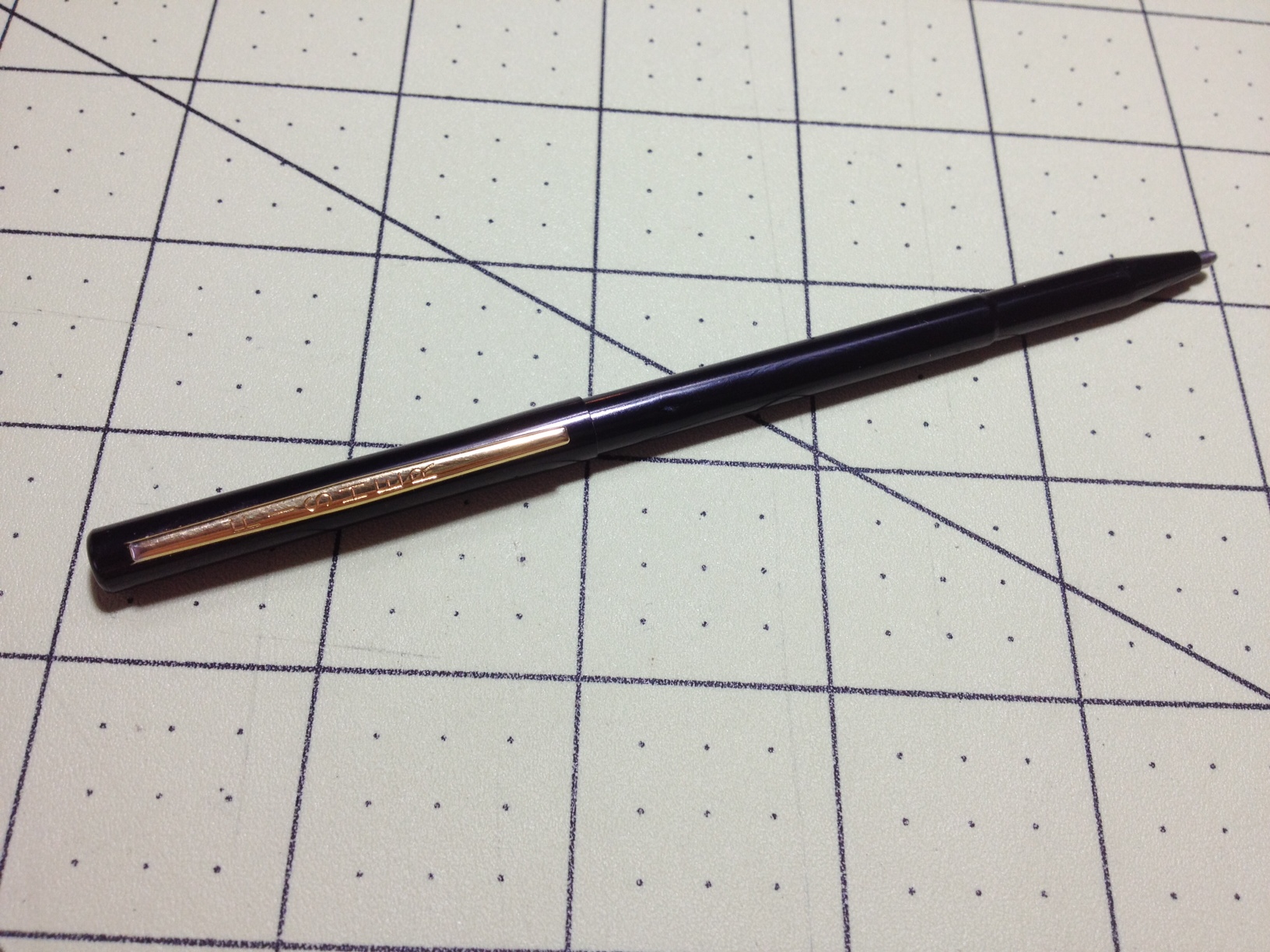
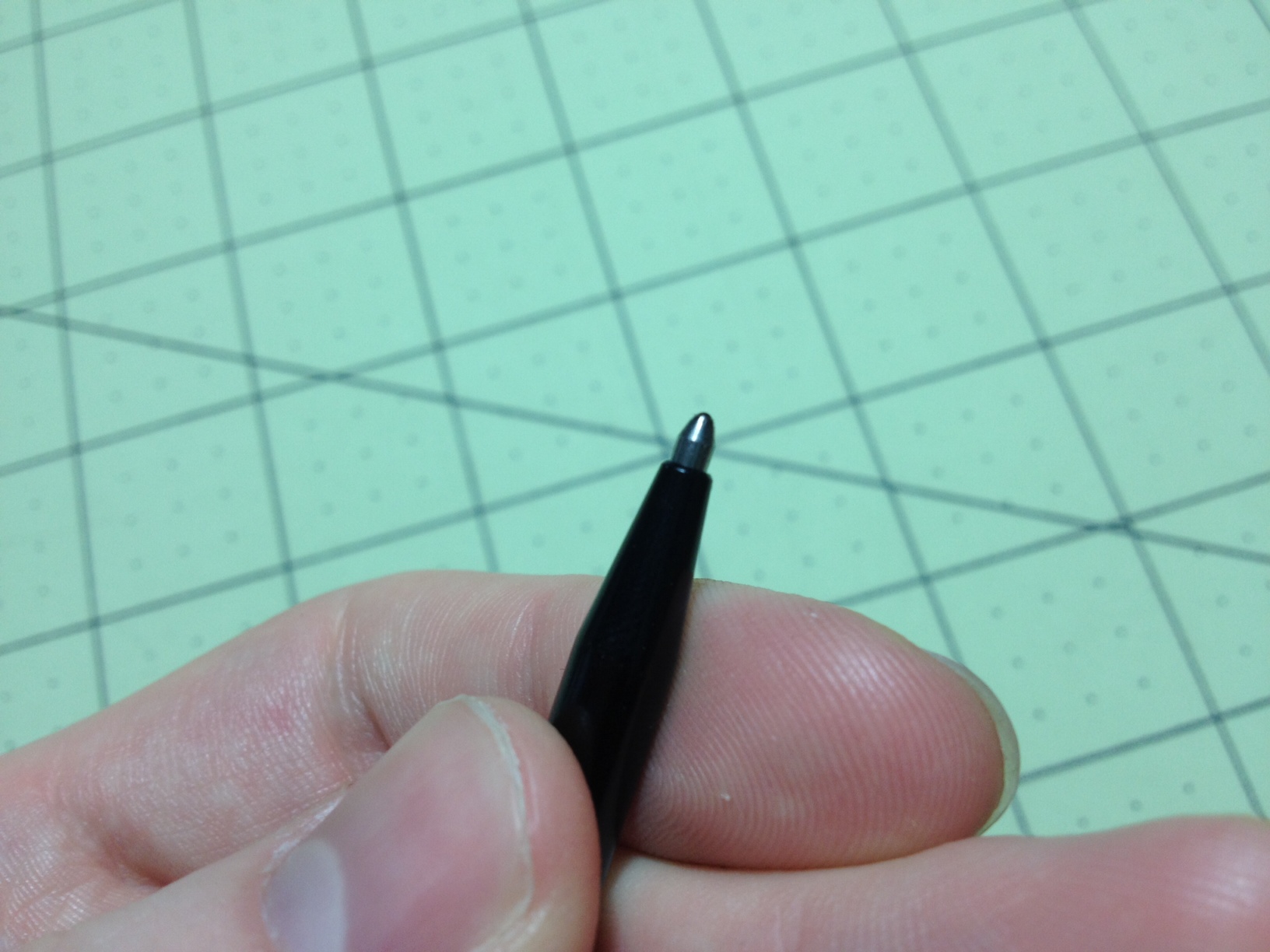
The pen has a very classic octagonal design, and it’s made with a plastic that feels much like the plastic that older pens and mechanical pencils were made out of, except it is much lighter and feels more brittle and thinner as a result. The faceted barrel is capped on the back by a step-down plug of a light grey color that allows the pen to be neatly posted, and the cap on the front is a very simple, if unsightly, ribbed design. The clip is molded in and works, but is quite filmsy, and I wouldn’t trust it. The cap does fit securely over the section, which is a simple taper in the barrel to a larger-than-normal metal cone, at the end of which is the ball. As far as I can tell, this tip is not removable, and thus the pen is not refillable. Stamped in gold on the side is just enough information to identify it, but not much more.

photo-157

Writing is surprisingly smooth for a ballpoint, but it does have occasional startup issues and more blobbing than I can get past. The ink is comparable to inexpensive Bic ink. It’s suitably dark and black, but it’s got a bit of a red sheen, and upon close inspection under a bright light it looks like a very dark purple. It’s still on the warmer side of things, though. It dries fast (except for the blobs), but with certain types of paper I wouldn’t try it left-handed. And its blobbing might cause it to smear for left-handers anyway. It is suitably waterproof like most ballpoint inks. I haven’t tested lightfastness, but in general even cheap black inks do well, but it isn’t archival quality.

Overall it’s a well-working, inexpensive pen. As far as super cheap pens go it isn’t the best, but it’s far from the worst. It writes well, but not perfectly. The body is simple with no frills and holds together despite being cheaply made. And there isn’t much more to it than that. I wouldn’t be going out to import them, but I would (and will) use them if I ended up with them (which I obviously did).

Review – Sharpie Industrial

Sharpie makes permanent markers, but permanent never really means permanent. Of course there are ways to remove traditional Sharpie ink, especially since it, like many modern inks, is alcohol based. So, in order to keep up with their permanent image Sharpie came up with its “Industrial” version. How permanent is it compared to the regular version? Let’s see.

photo-154

The body is virtually identical to that of a regular Sharpie, except for the information printed on it, which has been changed to reflect the more permanent nature and is in red. As far as writing on regular paper goes, it is a bit warmer than standard Sharpie ink, but not really any less or more black. The difference is barely noticeable. Also, like a regular Sharpie, it will not write on wet surfaces.

photo-155

But on to the permanence. I tested the ink on a piece of galvanized steel by making a small mark, letting it dry, and then applying pretty much anything I could think of that might clean it off. It held up remarkably well, but it was mostly resistant, and not fully “anything-proof”. By the end of my test the mark was quite faded but still readable, and it had withstood: water, fire, isopropyl alcohol, bleach, WD-40, ammonia, acetone, De-Solv-It (citrus based gunk remover), Lysol, Gojo hand cleaner (for grease and tar), dry cleaning fluid (because I couldn’t throw the kitchen sink at it), lighter fluid, paint thinner (mineral spirits), and gasoline. So I checked online and in several reviews people said that in laboratory settings the alcohol used would take the marker right off. So I went and attacked it with some denatured alcohol, and sure enough it broke it down to the most pale of lines possible, but it still wasn’t gone. So I tested on some other materials and another piece of galvanized steel. On plastic, the denatured alcohol removed it with very little problem. On aluminum it was also met with little resistance. On a tuna can (which could be either tin, steel, aluminum or a mixture) it was a little tougher but almost all of it was removed eventually. But, finally, on a galvanized trashcan the alcohol met its match, reducing it to a very faded line but it was still unable to remove it entirely. So there is likely some chemical that bonds directly to or gets through the galvanization on such materials.

Barely visible mark after denatured alcohol was applied

Barely visible mark after denatured alcohol was applied

All of this stands to reason. Modern inks are mostly made from an alcohol-based dye solution. This makes them dry faster and essentially water resistant, unlike their former water-based fountain pen ink relatives. But they still fall short of pigment-based inks on permanence, especially when it comes to alcohol, which in many cases will clean up both ballpoint ink and (permanent) marker ink by reactivating it for a short amount of time. Virtually any ink (but not all) will smear, bleed, or be removed when its base is reintroduced. But that’s why we have different bases in the first place.

In specific settings where large amounts of chemicals are continuously applied to surfaces, especially alcohol, these markers won’t work. But there are specialty markers made for work like that. As a general purpose marker that is meant to be used in tasks that are more demanding than standard household ones it works quite well. It does outperform the regular Sharpie and would work sufficiently well for many workplace or “industrial” tasks, but testing may be required before using it on the job.

Review – Sharpie Mean Streak White

I have a pretty liberal definition of what an art supply is. Not quite as liberal as those who say everything is an art supply because (almost) everything you do is art of some kind. But I do think more qualifies as art supplies than the average person does. For instance I would say that everything meant to make a mark is an art supply. And that assumption will be tested here where I take a look at the Sharpie Mean Streak “permanent marking stick”, and see if it has any real art applications.

photo-151

The body is quite large, being about half an inch in diameter. It’s got a good amount of information on the side, but it gets a bit cluttered-looking. The back is a twist knob, like a glue stick. The cap has a slight taper with several ridges for grip. Inside is a pointy cone that can shape or dent the “marking stick” if you put it in slightly wrong. Inside around the “marking stick” (grease, wax, or whatever it is) is a sizable ridge that is quite uncommon on writing implements. There is also no grip section area.

photo-152

There are two ways I can describe this, either as a permanent (wetter) crayon, or a more slick grease pencil. Neither of those descriptions really tell you exactly what these things are. The inside substance comes in a pointy cone that is pretty useless. It’s very putty- or grease-like and when used the point becomes very flat very fast. It writes similarly to a crayon, in that it isn’t easy to control or sharpen. When the tip is flattened beyond a certain point, the base can be twisted to extend the point, but it can’t be retracted, so remember to not twist it too far out (that shouldn’t be a problem unless you’re an impatient reviewer like I am). The feeling it has is very slippery, and quite a bit of material comes off for not a lot of writing, but there seems to be quite a bit of it in the barrel, so running out should not be a major problem.

Performance is a bit disappointing. The white color doesn’t cover very well at all, meaning use in art as either correction or even to mix with other colors is very limited or would require re-application. It can be used as a covering to make things “hazy” but the coating is quite unpredictable. It likes to clump up in certain areas and barely cover others at all, meaning detail work also shouldn’t be done with it. As far a permanence goes, it is, but not wholly. I did testing (not just normal use) on metal and paper. Both were reasonably water-proof, on metal flame did nothing to it and on paper it did resist the flame but once the paper burned it did too (not that anything else would have happened). Then on the metal piece it stood up to WD-40, which has a knack for removing regular Sharpie, but was easily wiped away by isopropyl alcohol. I also suspect it could fairly easily be scraped off or crack easily on pliable surfaces. It does go on whether the surface is wet or dry as advertised and does dry in a fairly short amount of time for how tacky it is to begin with.

I would still consider this an art supply, and it can work well in mixed media, but really it is much more at home in the garage or the toolbox. The tip and lack of sharpening or controlling method means it works quite a bit better when marking large surfaces. It is “permanent” in that it’s hard to purposefully get off, but it doesn’t penetrate and won’t wear terribly well. It’s an interesting item, but certainly not a general use-one.

Review – Sharpie Mini

I really like Sharpies, and I have talked about them a few times before. There’s a reason they’re so popular, and as they continue to become more used they are diversifying their product range. One such product that came out a while ago is the Sharpie Mini, which is, as the name would imply, much shorter than the average Sharpie.

photo-149

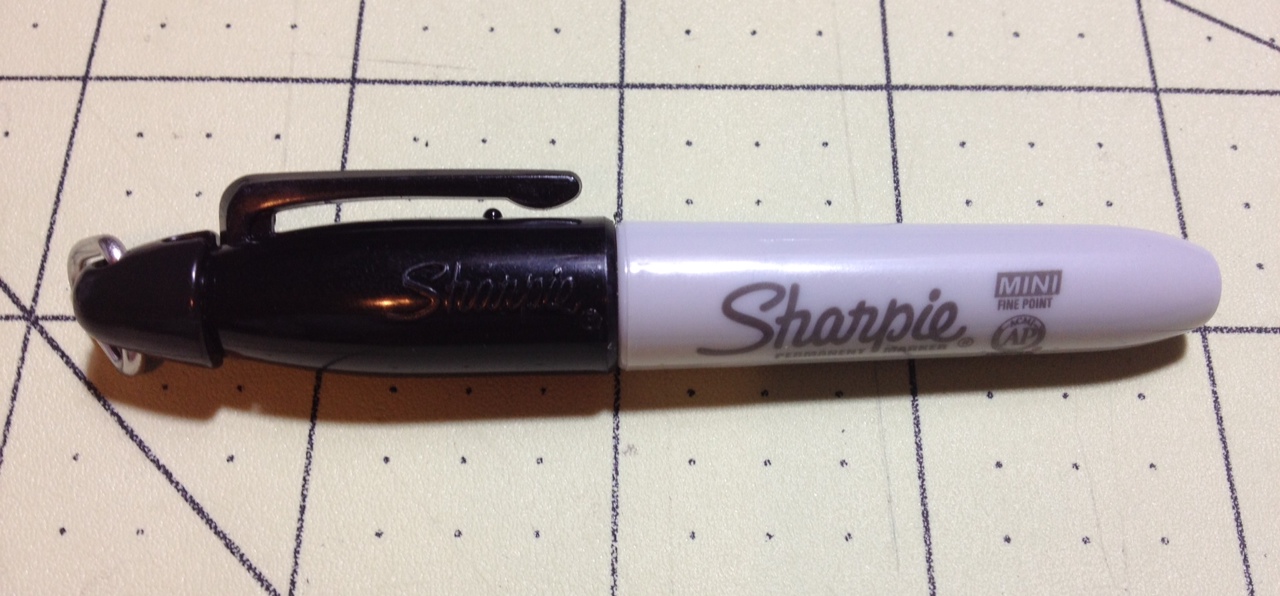
It has the same starting and ending diameters as the regular sized Sharpie, with an extra part on the tip that snaps on with a lanyard “ring” (triangle). Both the cap and body have been reduced in size, but proportionally the cap is larger. The clip is very similar, but shorter, and works well enough but not fantastically. The necessary information is still printed on the side.

photo-150

The size is quite small, at 3 and 11/16ths inches capped, down from a standard Sharpie’s 5 and ½ inches. Most people would find the uncapped marker uncomfortable to hold without posting, and it’s still only tolerable when it is. The odd shape of the cap and grip make it strange to hold. The rest of the writing is all the same as a regular Sharpie, with a cool black line, very permanent but not perfect (archival) qualities, a nice tip, fast drying, and the ability to smoothly put down a ton of ink.

There’s not much more to say than that they’re smaller Sharpies. And if you like Sharpies but want a more portable option, here it is. The only downsides are they are somewhat awkward to hold, and have less ink. I personally didn’t like the lanyard ring, but that just pops right on and off, so it’s no problem. I have Sharpies around with me a lot because they’re so versatile, and this is a great little thing to decrease their needed carrying size with.

Review – Dixon “My First” Ticonderoga

I’m not gonna lie; I find reviewing wood pencils difficult. I just don’t see enough difference in them to make it seem worth my while to look at each specific one. Ones like the My First Ticonderoga are easier, but still the discussion of them ends up being brief. That being said, let’s take a look.

photo-147

The pencil is almost solid yellow, with green accents on the information on the “barrel” and the metal eraser holder. It is a little more broken up by the eraser’s pink and the wood of the sharpened end. The eraser works well enough, and is quite large since the pencils size is increased. The body is half again to double the circumference of a standard pencil, making it much more comfortable to hold, in my opinion, but harder to store. It is completely round, making rolling quite easy, but its larger mass makes it less prone to ending up on the floor.

photo-146

The lead is standard fare for #2. It works well enough for drawing and writing, providing a medium line that can be both quite dark and quite light, though the largeness of the lead skews it to dark. Personally I haven’t used it much for that, but I have used it for marking wood in lieu of a carpenter’s pencil, a job at which this excels.

It’s a good pencil, both for kids and those who don’t want to or can’t hold the smaller standard pencils of today. The quality control isn’t the finest. I’ve found some wood and paint blemishes but these are quite minor and don’t affect the writing ability at all. The set I got also came with a plastic pencil sharpener that does what it’s supposed to, but is nothing special. They’re just a simple, good option for someone who wants a larger pencil.

Review – Fisher Space Pen Stowaway

The Fisher Space Pen has a reputation for being a very good pen, with many models being used by many people for many different things. But I feel that some models of space pen get more attention than others. And for some reason, the stowaway isn’t one of them, but it might be my favorite and I think it’s deserving of a look today.

photo-140 photo-141

The body is very simple. It’s a black metal cylinder with a plastic end cap and another slightly larger black cylinder fitting over it. Fitted to this top tube is a clip, which is longer than most pen clips I’ve seen and has “Fisher” stamped into it (not much else to say, it works as a clip should). On the section there is a slight but smooth step down, and then a taper to the point.

photo-144

Writing is fairly smooth, though it does require a bit more pressure than some of the more modern pens (but less pressure than the cheap ones). The pen itself is very thin in diameter, meaning one’s hand will begin to cramp if writing more than a few notes. The body is also very short, and generally requires the cap to be posted (placed on the back of the pen) in order to lie in the webbing of one’s hand and be comfortable. This small-ness is very useful when traveling, as this pen can fit just about anywhere (but not an Altoids tin or some similar sized case, which might be why “preppers” don’t use them very often). And even though it’s metal it weighs next to nothing. In most cases it will “stowaway” very easily.

photo-142 photo-143

I really like this pen. It goes with me almost everywhere (and I found an almost identically-sized pencil I will be talking about soon). Its slim body and black color make it very low profile and professional, while its all-metal construction and space pen (underwater, upside down, in space etc.) writing ability make it a very rugged writer. I did dent and scratch mine within a day of owning it, but I haven’t put anything on it since (and besides, that just adds character). The cartridges are even replaceable so you don’t have to throw out the pen each time as with many pens of this size. So, if you’re looking for an on-the-go sketching/writing/note taking pen that could also fit in with any of your other stuff at a moment’s notice, I’d say check this guy out.

Review – Pentel Sharplet-2 .9mm

Recently I was gifted several mechanical pencils from someone who is a fan of larger lead sizes, and they were attempting to convert me. I have to say I’m not convinced, but the pencils themselves were ones I hadn’t had previous experience with. That isn’t really surprising, considering the vast array of mechanical pencils on the market from companies like Pentel, such as the gift I’m looking at today: the Pentel Sharplet-2 in .9mm.

photo-138

The pencil has a very classic and simple design that’s been around the block. At the back there is a plastic, cylindrical cover for the eraser, which is the standard tiny variety and placed over the lead tube. This back bit also serves as the click-advance mechanism. The barrel is the same diameter as the back cover, and consistent all the way down. The clip is one piece of metal that is friction fit around the barrel; it is a little stiff but keeps the pencil where you clip it. The only other features of the barrel are the brand and model information (that is engraved in as well as painted on, making it harder to wear away than on most writing implements), and about an inch of tiny ridges on the “section” (there is no separate section so that is for you to decide) for grip. The plastic cone that screws on the front is straight and unspectacular, ending in a metal pipe that makes the pencil more drafting-friendly.

photo-137

The leads pencils normally come with are all pretty standard, straddling the line between super dark and super light. The wider leads, just by virtue of being larger, require less pressure to write darker, and write (or sketch) in general with a wider and darker line. There are no real problems or tricks one has to get used to when writing. The eraser is similarly plain. It erases well, but can have trouble getting rid of darker or thicker lines like all erasers of its size that come packed in with mechanical pencils. The pencil does come in different versions for lead sizes; these are color coded for easy identification (it looks like there is some variation in the eraser color, as well).

photo-139

Pentel makes a solid pencil, and this is no exception. The design is simple, comfortable, and durable. It’s really a no-frills pencil. Everything is basic and has a function, it’s easy to disassemble and parts could be easily replaced (though it isn’t expensive enough to justify the hassle of that, it certainly isn’t a disposable pencil, though). The mechanism is satisfying to use, the grip is not slippery, the clip holds, and the retro styling makes it look kinda trendy (not that I care). If you want a simple, solid pencil or want to buy a set with easily distinguishable lead sizes, these would fit the bill.

Review – Paper:Mate Mates Mechanical Pencil

The Paper:Mate Mates is obviously designed to be child’s pencil, considering that they unusually come in various colors or with various princesses or comic book characters. But the reason I have one is because it was given to me. I’m a thin lead kinda guy (0.5 most of the time) and the Mates only come in one size: 1.3mm. So they’re a cheap way to get the feel of a larger lead for those of us not used to it. But how does the rest of it work?

photo-135

The most interesting thing about this pencil is the body, which is a rounded-off triangular shape. It seems built up from a more standard size. Most ballpoint pens or (non-mechanical) pencils could fit inside of the Mates with no problem. It’s also longer than most other pens and pencils I have lying around. The overall design is very simple; it’s made to resemble a regular pencil. There is a triangular eraser on the back that is plugged into the back of the lead tube. It then expands to fit with the edge of the plastic it is held in by and creates a more “seamless” look. This bit is also the click-advance mechanism. Following that, there is some styling in the plastic that is meant to resemble the metal bit holding the eraser in on wood pencils. And beyond that is a smooth triangular barrel (with enough information printed on it) followed by a taper that is a little roughed up and meant to look like a sharpened wood pencil. There is no pipe to hold the lead here; it simply comes out of the end.

photo-136

Writing is simple, and what one would expect from a #2 pencil: smooth and somewhat dark. Due to the size of the lead, though, a lot more expression can be obtained from this pencil, as the lead can be flattened on one side and then flipped to allow for swapping between a very thin and very broad line. The triangular shape both helps and hinders this, making it easier to precisely rotate the pencil, but hard to exactly flip it over. The shape and the length, though, help the pencil ergonomically quite a bit, making the user in general much less prone to hand fatigue and cramping when using it for long periods of time. The fact that it is quite light for its size also helps with this, but contributes to a float-y feeling that I’m not much a fan of.

This pencil was made for kids as a school pencil. The ergonomics, large lead size, and HB (#2) lead grade all stem from filling in large amounts of scantron bubbles. But it does have other, more artistic (or even some office) uses. The lead is replaceable so it can be swapped for one more suitable for you, but a better eraser is needed. It isn’t the sturdiest pencil in the world, but there isn’t much that could go wrong with it and it should hold up in most use cases. So if you want to try out larger lead sizes pretty inexpensively, or are looking for a more ergonomic pencil experience, here would be a place to start.

Review – Sharpie Highlighter

At times I feel like there is very little for me to say about certain things. And highlighters are one of those things. I use them, but not so much that I’ve extensively tested many of them to find the best. And I only use them for highlighting, and not some of the more creative applications like using them similarly to a blue pencil. Still, a product that does its job well deserves some of my time to talk about it.

photo-133

This Sharpie highlighter was a pack-in with several Sharpie pens, but I’ve seen it on the shelf by itself as well. The body is very simple, being a translucent yellow cylinder with a “cone-shaped” stopper on the end. The cap is a solid piece of plastic with an integrated clip that works well for what it is. The section is also a simple cylinder after a step down from the barrel, and then there is a slight taper and protrusion at the (chisel) tip. Sharpie is on both the cap and barrel in various forms with the only other information being a nontoxic seal and the words “smear guard”.

photo-132

When writing, the ink goes on smoothly, and is very bright. So if you want to draw attention to something, this will work. The ink also resists smearing both what it is being applied over, and itself when wet. While it does smear and spread some when dampened, it isn’t too terrible, and during my tests only fountain pen (liquid, dye-based) ink smeared even a bit. I haven’t tested the longer-term effects, but I’d like to think Sharpie has experience with these things.

It’s a highlighter. It’s a good, simple, bright highlighter. If you aren’t looking for anything special from your highlighter, but don’t want smearing, these will work.

Review – Kutsuwa STAD Pencil Holder

Okay, I’m going to admit here that I don’t really know the name of this product as the only English I could find on the package was a URL, “made in China”, and STAD. But I do know it’s a pencil holder, so there is that. From my research I’ve found that this is a less-common or less-popular model (as in I couldn’t find it online at all). So I feel the need to say this is not a review of the “one-push” model.

photo-130

Pencil holders have been around for a while, and there are quite a few options to choose from. In fitting with my style, I got the cheapest one (okay it was given to me, but I think that sentence suits me. I haven’t been able to find a price on these, but I bet it isn’t much). After all, it’s just a metal tube to hold a stubby pencil; can it being cheap really hurt it very much?

photo-131

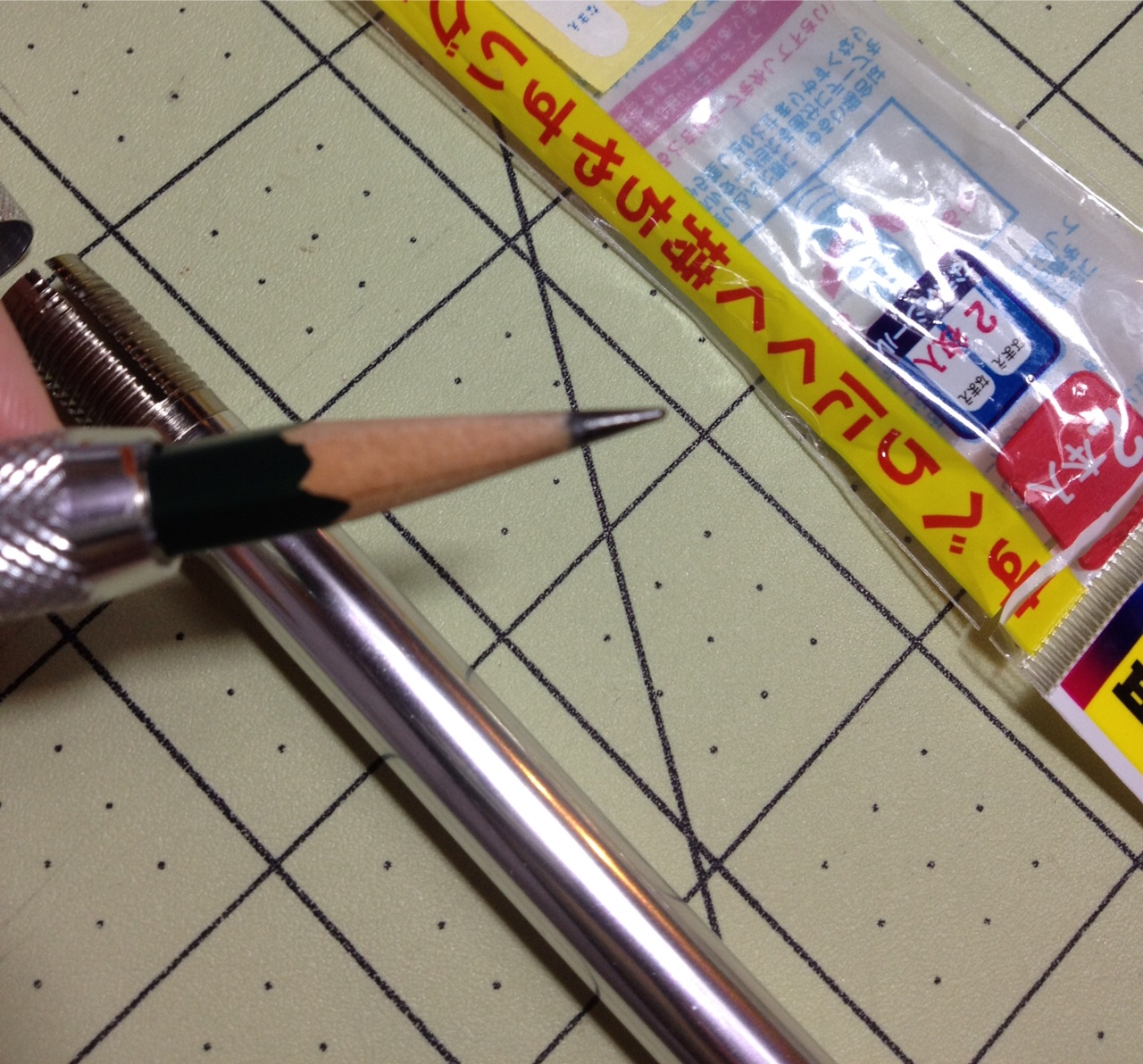
The item comes in a two pack with some labels that you can stick on the side when the pencils (or whatever you’re using) information is covered up or sharpened away. There are only two labels so use them wisely. The holders themselves are very simple: they are two pieces of aluminum, a straight barrel with a stop-bump followed by some threads with cuts in them that allow the second knurled cylinder, which is tapered on the inside, to screw on and force it to act like a collet, holding the pencil in place. The finish is smooth save the knurling and resists major scratching but is quite shiny and reflective.

The pencil is held quite securely inside the device. There is the tiniest amount of give even when tightened down as far I as think I could go before damaging either the pencil or the holder. It is easily enough to allow for comfortable writing or drawing and (fairly) easy sharpening. I’m sure one could throw it hard enough to knock the pencil out, but that isn’t a normal-use scenario. Being dropped from desk or hand height won’t hurt the holder or have the pencil fly out, but it might hurt the pencil. The grip works well enough, but it is a bit slippery, the length of the barrel is enough to allow one to rest it in the webbing between their thumb and forefinger on most hands, though it isn’t the most comfortable or ergonomic. It also seems a bit front heavy with the back of barrel empty when the pencil gets very short.

To be short, no, being cheap didn’t hurt this product very much. It doesn’t feel weighty or expensive, but it does do its job. It holds a pencil that would otherwise be very uncomfortable or hard to control in a way that makes it at least tolerable to work with. It’s simple to use, and easy to handle. And with how cheap it is, I would say it would certainly be worth looking at. It isn’t as nice as the more expensive ones, but if one isn’t very picky, like me, and if you happen to find one, get it.