Review – Tach-It Metal Tap Knife (Carton Cutter)

Depending on the size or type of art (or craft) works one is doing, carton or box cutters may or many not be on one’s radar or considered a useful tool. But even if one isn’t using them for opening supplies or actually during the art-making process, it still isn’t a bad idea to have one around since they’re cheap and easy to use. The dozen-for-five-dollars that these are priced at might be a bit larger set than most people would need, but it’s still inexpensive enough that it wouldn’t be hard to pick up.

photo-124

Tap knives are one of the simplest types of box cutter. On this model, the outside sleeve is a single aluminum piece that has been bent around on itself. Inside is another piece of aluminum that has been folded with a cutout at one end and a flare at the other. A standard single-edge razor blade fits in the cutout end (and can be replace by sliding the insert out of the housing) while the flare prevents the knife from protruding too far forward.

photo-125

Use is simple. Tapping the back of the knife against a hard surface will extend the blade until it is stopped by the protrusion on the back. And when the cutting is done, the front of the knife can be tapped on a hard surface to retract the blade. Very little of the blade is exposed making it fairly safe to cut with, and it’s held in securely enough that I wouldn’t worry too much about accidental deployment of the blade. How well it cuts and how long it lasts depends on the razor blade used. And the ones that come in the package are not the greatest. The points are especially brittle, and while they can keep an edge for a decent amount of time, they will crack and split with too much stress.

As far as a cheap, effective, and simple box cutter goes, they work well enough. The fit and finish leave something to be desired: the edges are rough, the tolerances vary quite a bit, and no surface is smoothed and finished, but they are so inexpensive they are practically disposable. They cut, they’re reasonably safe, and they could last quite a long time since there’s not much too them. One could get better quality, but I’m not convinced you’d really need to.

Review – Huion 17.7” Light Pad (L4S)

There have been some huge leaps in lightbox technology in recent years. I’ve owned 3 lightboxes in my time, one being a repurposed dental x-ray box, the second being a traditional style box and the third being this which I bought as a possibly temporary replacement for my more traditional-style box. But I might not be swapping back so soon.

Their photos look a lot better than mine

Their photos look a lot better than mine

The Light Pad itself is a rectangular prism that measures 17 7/8” diagonal and 14 1/8” x 10 5/8” x 3/16”, meaning it covers quite a large area, but is very slim. The workable white/translucent area has markings on the side indicated in centimeters 12 ¼” (31cm) x 8 ¼” (21cm) with a ½cm margin. The non-workable black margin is about ¾“ all the way around the pad and it’s only features are the power button and a logo. On the side of the device next to the power button is a micro USB port that is only used for power (this version has no internal batteries), and a red LED will come on when the device is correctly connected. On the back of the device there is some modest information and nicely padded feet that prevent the pad from sliding around when being used.

photo-123

Using the Light Pad is a breeze. Simply touching the power “button” lights up the entire workable area to the highest brightness setting (which isn’t very bright, and being shone through a white plastic makes it much less glaring on the eyes). Touching and holding the button will start the pad lighting up, and releasing the button during this will keep the pad at the current brightness setting. This setting is remembered and the next time one starts the device it will light up at the chosen setting unless you hold the button down again. The working area accommodates A4 and Letter sizes well, and the light on the brightest setting easily works with 2 sheets of 110lb cardstock. The plastic the surface is made from is very smooth, but resists sliding and scratches. The feet are also very nice and the device is stiff enough that it doesn’t bend around them under normal use (I still wouldn’t go stacking things on it).

photo-122

I don’t think I’m going to be going back to the more traditional lightboxes anytime soon. In my opinion the only advantage they offer is an angled working surface, which is a feature I never really used. The Huion Light Pad is a great lightbox; it’s sufficiently lighted and durable enough to be easy to work with, thin enough that is stores easily, and draws very little power. Its overall workspace footprint is very small, and its job is done almost flawlessly. I do find the red LED indicator light to be annoying but I can’t think of a better way to do things and it is much less troublesome than other indicator lights I’ve had to deal with. I also have no use for the multiple brightness settings but I suppose it’s better to have it than not. Still, the device has become a permanent feature of my workplace and I would recommend anyone looking for a lightbox to look at these cheaper and thinner LED alternatives to the traditional boxes.

photo-134

Review – Field Notes Bic Pen

Field Notes is a company that makes great notebooks, and they’ve always added a bit of a more personal touch to things. One of the ways they did that was by having branded pens and rubber bands readily available (I believe at some point in their orders, single pens and rubber bands were thrown in for free, but they can be purchased in larger packs easily.) The pens aren’t very expensive and fit very well with the brand’s style just on looks, but do they perform as well as the paper?

photo-120

The pen is actually just a branded Bic Clic pen, which isn’t a bad thing really. The entire design is a pleasant taper from the middle, where a ring separates the two halves of the pen. On the top there is a chrome-ish simple clip with Bic’s information on it, and a similarly-colored thin clicking mechanism (which give a very satisfying “click” when used). On the front of the pen, the ballpoint protrudes when the mechanism is depressed and the Field Notes information is printed on the barrel. The only colors of the pen are black, silver, and white, making the whole thing quite understated but also very nice.

photo-121

The writing is standard Bic writing. It is smooth enough, black enough, and steady enough to be serviceable in the vast majority of scenarios. It is a medium point, which is usually too broad for me, but definitely is unspectacular and fits with what most people are comfortable with. The ink is, of course, essentially waterproof once dry, with minimal skipping or blotting. I’m not particularly impressed by the writing, but I’m certainly not disappointed.

I’m sure the Field Notes Company did a bunch of research to find both a good enough and inexpensive enough pen for their brand that they wouldn’t have to try to make in-house. And I think they succeeded. The pens are dependable enough, sturdy enough, and simple enough to be almost entirely unremarkable (in both a good and a bad way). They fit the utilitarian image of the company, and are worth having at least as a backup pen.

Review – Parker Jotter Stainless Steel

There are many pen brands out there, specializing in various things. Most Americans who know more than nothing about pens would recognize the Parker brand as a longtime quality maker. One of the least expensive, most accessible, and longest running products they make is the Jotter ballpoint/gel/rollerball pen that utilizes Parker’s own refill type. I have here the “all stainless steel” version, how does it hold up?

photo-113

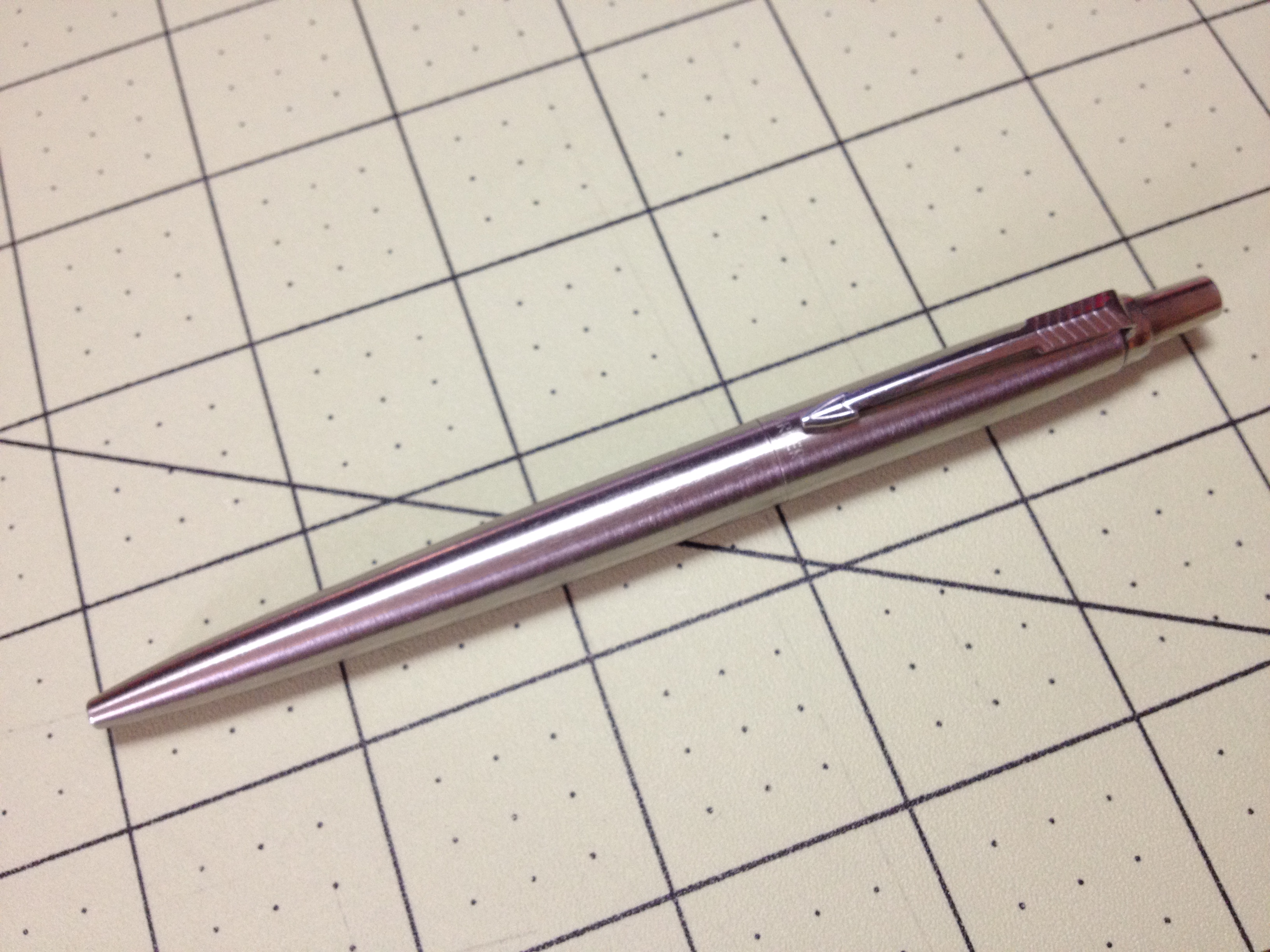
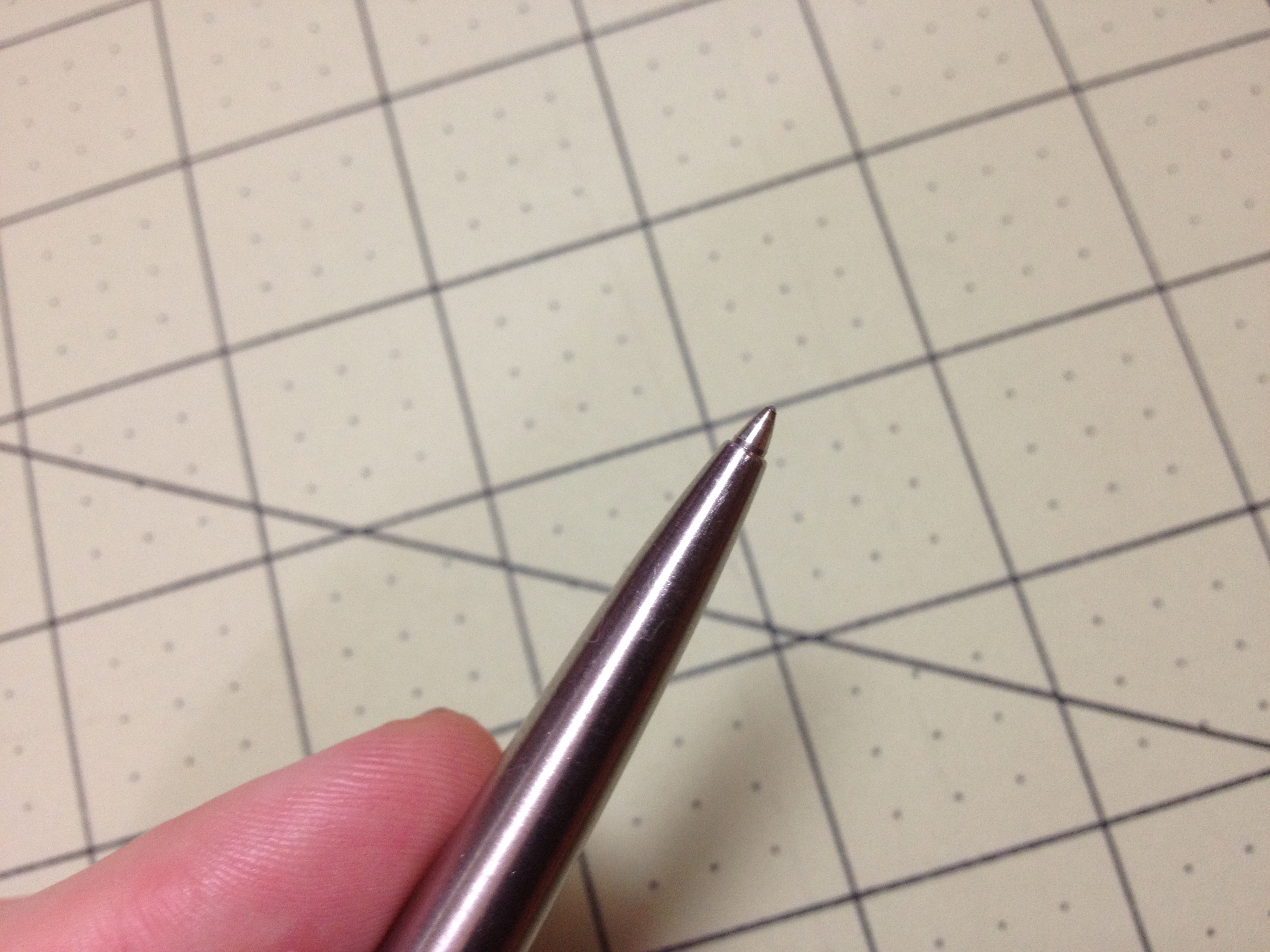
The pen itself is obviously all stainless steel. At the back is a very pleasantly tapered click button, followed immediately by the clip shaped as the famous Parker arrow. The pen from there slowly bulges and then tapers down to the end where it almost seamlessly meets with the pen’s point when it is not retracted, with only a slight seam 1/3 of the way down the pen where it is unscrewed to be refilled.

photo-112

Now I can’t speak to the Parker brand refill this pen came with as I don’t remember how it wrote and I currently have a Monteverde refill inside (that writes very well, as I said in my review). But I can talk about the feel and sturdiness, both of which are superb. The click mechanism is a bit different and it just feels not as advanced as some of the more modern pens, but it is very solid and satisfying. There’s nothing wrong with it, it just feels older (like using one of those drafting pencils that have been in production for 60 years). And the steel finish is very easy to grip, while beings stylish and well-wearing. Scratches and such barely show up, keeping the pen looking nice and professional for some time.

Overall it’s a great pen, and for the price (a little more expensive for the “all stainless” one) it is easily a great value as one pen could last a lifetime (though refills might not be cheap). It’s hardy, with a time tested, solid mechanism, and while it doesn’t look as nice or handle as well (or have as many expensive materials) as the more expensive ballpoints out there it still looks professional, fits in with both modern (stainless) and retro (colors) styling, and can take a rough and tumble life. It’s a tough little trooper.

Review – Slant Collections Mini Journals Preppy Stripe

I’m not exactly the type of person to be found in Tuesday Morning (the store) but I did find myself in there one day, and there was quite a bit of interesting stuff. And being someone who has been drawn to the stationery aisle since I was little I found myself in the stationery section, where I found a set of Slant Collections mini journals, this particular set in the discontinued “preppy stripe” (it was Tuesday Morning, after all). Let’s take a look.

photo-107

The books themselves are 3¼ x 5¼ inches, just smaller than a Moleskine pocket book. The cover feels like plastic-coated cardboard and in this version has a very simple design that comes in 3 colors. It is a single piece bent around and stitch-bound onto the 70 inside pages. These pages are lined with a thin 7mm ruling that is the same color as the main cover color, printed on a very white background.

photo-108

The paper itself is quite thick and a medium roughness. It is very bleed-and feathering-resistant despite this. Fountain and other liquid ink pens are handled well, and with most other writing utensils both sides of the paper can be used, though at this size I wouldn’t recommend that. The cover and binding are very well done and hold up (the stitching looks very slightly unsightly at times) and the corners are nicely rounded to prevent the corner bending that some books get. On the table the book lies adequately flat and while the cover does bend out of shape it bends back just as easily.

In the end I have been surprised by these little notebooks. They are hardy, easy to carry, great writing things. It has taken me some time to review them as they weren’t good enough to replace any of the books in my normal rotation (but that’s more because I prize consistency, a book would have to be head and shoulders above to get met to move something out of my rotation). I enjoyed using them very much (even the pink one) and if all of the Slant collection journals are as good as these were I’d consider more in the future.

Review – Rhodia Pads

I’ve been using Rhodia products for years now, and the way that I was introduced to them was their famous pad-style books. I got one as a gift and used it almost every day in school (only almost because I wasn’t taking notes with it but writing down ideas). And I’ve had a few around ever since. Let’s take a look at what made them so widely used and praised.

photo-104

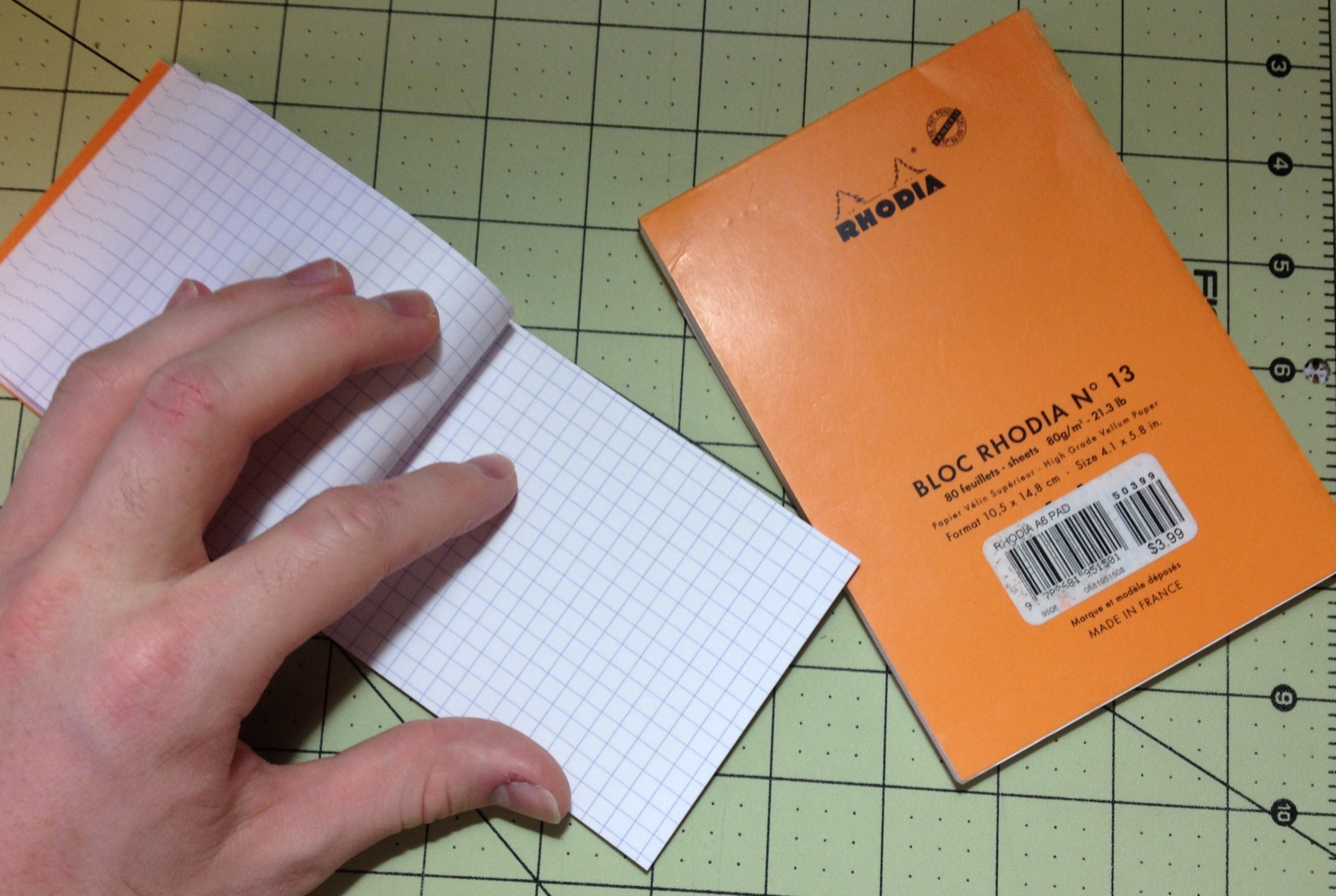
The pads themselves are simple, and have very few differences between the sizes. They are an orange rectangle, with one or two heavy-duty staples in the top and 3 creases on the cover to allow it to be folded over the spine easily and cleanly. Both the front and back have the Rhodia tree logo, with the back one being smaller and above some of the book’s specifications (in metric and imperial) and usually a price tag/bar code. Inside there are perforations on the top of each page, and with the thickness of the paper and the quality of the perforations, tearing out pages is easy, but they do not tend to fall out with hard use.

photo-105

The size of the paper in each book varies, and it comes in line or graph versions (dot in the premium editions, and unfortunately no blank). The ink used is a light blue-ish purple that doesn’t interfere with ink or pencil, the line paper is a bit darker. The paper is vellum and very ink resistant, meaning long dry times but little feathering, bleed through, and page crinkling. Show through can still be a problem, but most ballpoints and fountain pens write very well on the paper with almost no side effects. Paints and markers such as Sharpies are where the paper starts to not hold up as well, but the minimal crinkling, and the lack of bleed-through is still a very good performance. The coating on the paper also allows for very smooth writing, but one might have to press down hard with less wet pens.

photo-106

I might have already given away my opinion of the books in the first paragraph, but they are lovely. The writing experience is super smooth and pleasant; the worry that one might have with other papers when writing with liquid ink pens in non-existent. The binding is hardy and the cover wears very well with minimal things to be problematic. I’m generally not a fan of covers that fold over the top of the book, but I make an exception here. They make great traveling journals, school notebooks, coffee shop list makers, etc. And they can survive both fountain pens and being tossed around in a backpack. If the styling was a bit more my speed I would carry one around all the time. Still they are very versatile, and for the smaller ones, fairly inexpensive.

Review – Sharpie Colors Part 6 – Orange, Peach, And Yellow

And now, it is time for the final (for now) part of my look into the various colors of Sharpie markers (that I own). This section isn’t quite a “nice” as the others as I didn’t have another place to put the yellow that seemed appropriate, and there aren’t many oranges. Nevertheless, let’s take a look.

photo-96

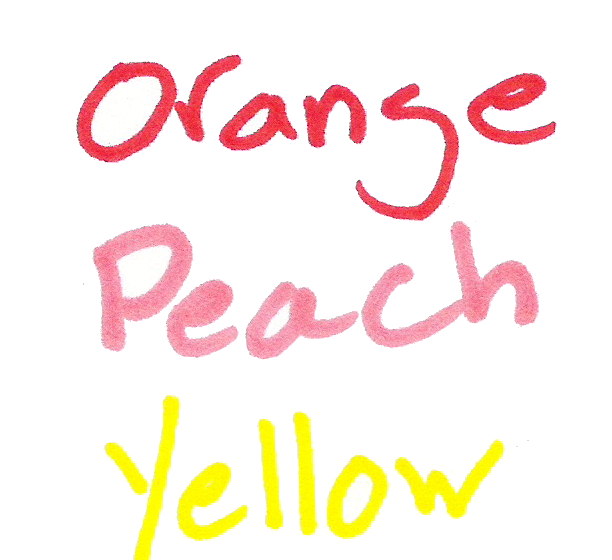
Orange – The standard orange is, like all standard Sharpie colors, quite dark. It doesn’t quite resemble the fruit enough for most renderings but is close enough. It’s not too bad on bleed-through, feathering, or shading. It’s well behaved, just not that useful.

sharpie colors oranges-yellows

Peach – Peach doesn’t quite look like a peach either. It’s more of a weird skin tone. But it is perhaps a bit more natural looking than the orange. It’s pretty bad on bleeding and feathering, with shading being noticeable. But it is pretty so if you like the look you might be able to find a use for it.

Yellow – And finally yellow. It isn’t something really spectacular. It is indeed stereotypically yellow, without much of a natural bent. It is hard to read in the dark and bordering on eye hurting in the light. It bleeds through, but feathering and shading are minimal. I would struggle to find a place for it due to its unnatural hard-to-read-ness but if yellow is your thing, it certainly gets it done.

And that’s the last set of the Sharpie colors that I have. It’s probably the most lackluster set (figuratively. Literally would be the neutrals). I would struggle to find a place either in art or at the office for them, but they do help round out any personal collections and would make eye-catching signs I guess.

Most of the Sharpie colors are more useful, though. The set I have would work both in the artistic and office realm. And it offers a large enough selection of colors to keep most people happy.

Review – Sharpie Colors Part 5 Reds – Red, Pink, Pink Lemonade, and Magenta

We’re five parts in to my look at the various Sharpie pen colors I have. This time I will be looking at some of the various shades of red.

photo-96

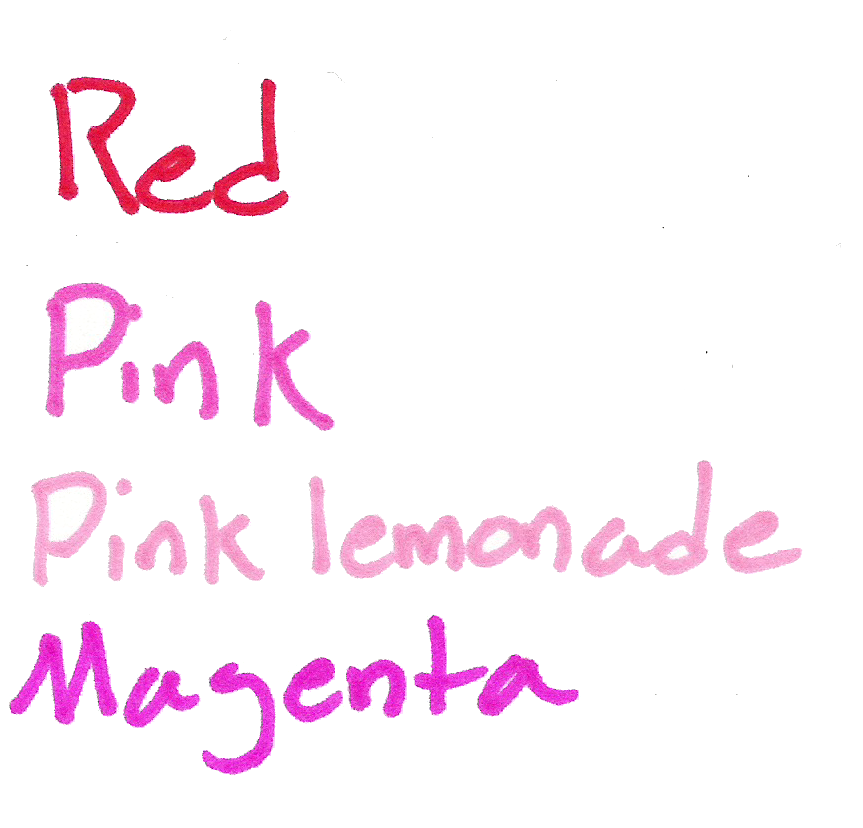
Red – The red itself is a deep, dark color. It’s close enough to the color of a red rose, and surprisingly (or unsurprisingly if the dye for both is those red bugs) ketchup. It’s not very aggressive or eye-hurting, but it stands out and is good for marking and work-appropriate. It’s not the best or worst on the bleed-through side of things, but has almost no shading or feathering. It’s a good color, if a bit boring.

sharpie colors reds

Pink – The pink is also a bit like a rose, not getting quite to the obnoxious hot pink style, but still bright and visible. It’s not the most natural color, but it does separate things out from the crowd. Bleeding is again medium, feathering and shading are a bit more pronounced than on the regular red, though.

Pink Lemonade – Pink lemonade is indeed the color of pink lemonade, or of a pink crayon or candle (something wax). It’s not unpleasing, but it’s also not a color I would keep coming back to. It’s fairy flat and doesn’t really pop out, but is differentiatable. Bleed-through and feathering are pretty bad, and shading is noticeable, though not too much.

Magenta – And now for the final color I’m a bit dubious about. I think it’s magenta. It’s a very deep pinkish color (should I say again like a rose? Roses occur in so many colors) which I can’t find many natural parallels to, nor any really solid work applications. It does look pretty (I guess) but that’s about it. Bleed-though and feathering are terrible with this one, but no shading is evident.

And that’s the reds. They look like flowers, and don’t work well at the stereotypical workplace. They work for organizing, but have some pretty extreme properties. They’re certainly the most eye-catching of the bunch (other than yellow).

Next week I’ll look at the Oranges (and yellow)

Review – Sharpie Colors Part 4 Purples – Purple, Berry, Boysenberry, and Lilac

All right, now it’s time for part 4 of my look at many of the Sharpie Colors. This time it’ll be the purple-ish set I’m looking at, so let’s get to it.

photo-96

Purple – The standard purple color is a very dark purple that looks much like the stereotypical purple. It looks almost bright enough to be some of the darker purple flowers, or a very near-night sky. It doesn’t have many applications in most workplaces either, and its darkness could make it hard to read. It’s middle of the road on bleed, through, for Sharpies, and almost doesn’t feather or shade, making it a pretty good all around color to use around the house.

sharpie colors purples

Berry – Berry certainly lives up to its name and provides a very reddish purple that is very similar to berry juice. It doesn’t have many other natural applications, though. It is bright and visible, with minimal bleeding, shading, and feathering. It’s a very good organizational color even if it might not be that work-friendly.

Boysenberry – This color is an interesting one. It’s a lighter, reddish purple that is akin to the fruit from which it takes its name. It is a much more appealing purple color and is useful in many situations. It’s prone to bleeding, but feathering and shading are minimal. I like it a lot, but it isn’t the most useful color.

Lilac – Lilac is a light, bluish purple. It is very similar to the flower and many other natural shades. It is bright and easy to read, but a bit unprofessional. It’s not bleed- or feathering-prone, but it shades a bit. It’s a nice looking color, and artistically or organizationally useful, but not really for a work environment.

And those are the purples. I like the colors, but they tend to be less useful. It’s just hard to find applications other than organization. But they work very well. Next week I’ll be looking at the various red colors I have.

Review – Sharpie Colors Part 2 Blues – Blue, Navy, Turquoise, Sky Blue, and Blue Ice

Now in the second part of my Sharpie color reviews I’ll be talking about the blues, a nice and varied set of colors.

photo-96

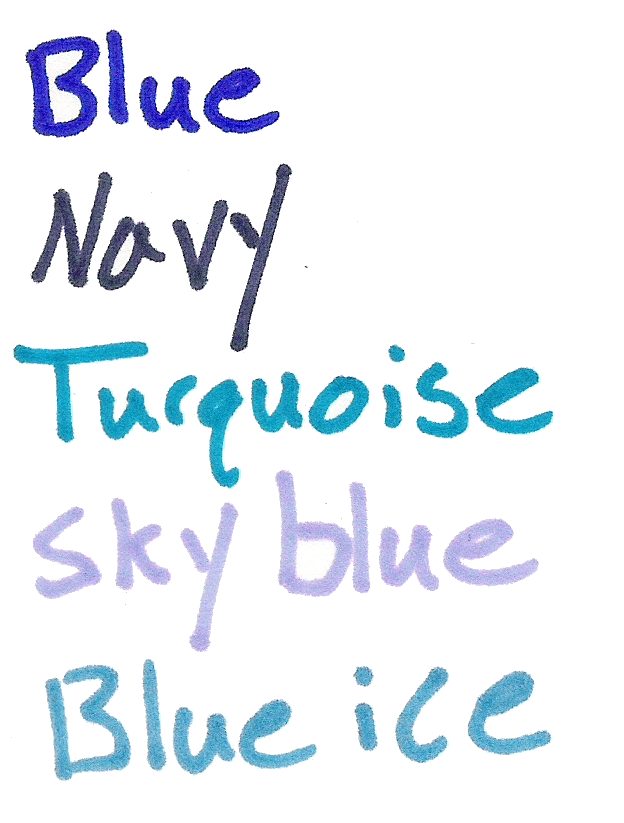
Blue – Blue is a very classic color and it looks quite a bit like the standard blue we’ve come to expect from various markers and pens. This one is a bit darker, though. The ink is more wet than the other standard colors and bleeds a bit. It’s also too dark to be natural and almost too much to be organizational, it is a bit too close to black in dark conditions, but with good eyes it can work. Still, it is very blue.

sharpie colors blues

Navy – This color is very close to the classic navy color, a bit close to black in low light, but it looks like a lot of navy colors. It’s a very dry color and has very little bleed and feathering/spreading. It’s a nice-looking color, but not a very useful one.

Turquoise – Turquoise is a difficult color to get down in ink, and none of them look quite like the stone. This one’s a bit dark, but it does make a good blue-green tone. The ink is very wet, and bleeds easily, but has very minimal feathering. It’s a very natural and pleasant tone, great for organization and for artistic purposes.

Sky Blue – This blue, like most of the blues in this set, is darker than it really should be. It’s more of an evening sky blue, or a wispy-cloudy blue. It bleeds a bit more than the turquoise and the blue, and is just as feathery. It’s a very nice looking and easily identifiable color that many office and artistic uses can be found for.

Blue Ice (Possibly Mystery Blue) – This color is the most contentious of the colors in my current review lineup. The package of markers I received was not marked, and of the other blue colors I looked at this one seemed closest. If you believe I am wrong in my categorization, I encourage you to leave a comment. This blue is a cool blue that I would say has no direct natural counterpart (certainly not ice, as this is the least aptly named), but it could be used as a substitute in many cases. I prefer it to the sky blue as a light blue. It can be used in art if one is creative and is very distinguishable from other colors for organization.

Overall, I really like the blue Sharpie colors. They are a bit bleed-prone, but they have a variety of uses and in many cases are work-appropriate. The tones are very natural and appealing. They’re a good set to get, if one can.

Next time I’ll be looking at a few of the greens that Sharpie has to offer.