Review – Sterling Studio 4-Piece Synthetic Brush Set SS-117

One of the problems with painting miniatures (doll houses, dioramas, war game pieces, etc…) is that it’s difficult to find brushes in the right sizes, and even then, brushes can be expensive. But if you’re not going to be doing a whole lot of work with them, how well would an inexpensive brush set like the Sterling Studio SS-117 work? Let’s take a look.

photo-165

Just a bit of a disclaimer, I’m not sure if this set is available anymore or even where one would get it. I got it at an outlet store at a considerable discount and waited to use it a few times before making this review.

photo-164

The bodies of the brushes are quite simple. They are a thin piece of wood painted a dark blue with “Sterling Studio” and the brush size written on the side in white. This is followed by a very cheap piece of crimped silver metal, which holds the orange synthetic bristles. The set include a round, two brights, and a spotter. The brights being flat-ish and semi-rectangular while the other two are rounder and pointier. The differences in the round and spotter are very little save one feels a bit stiffer, but I don’t know if that’s from other factors.
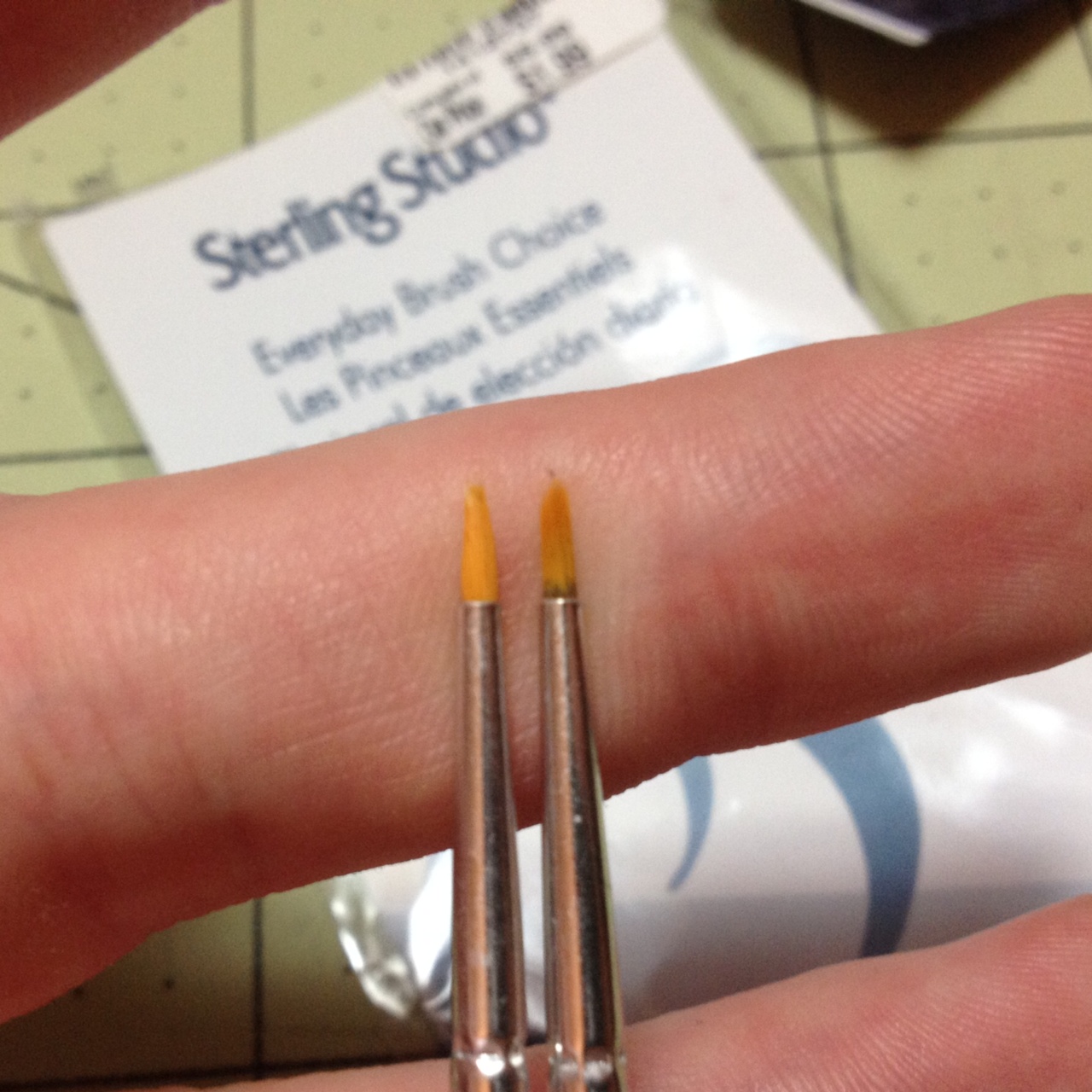
photo-167

The sizes are quite small, 10/0 (0000000000) and 2/0 (00) {Side note: paint brush sizing is weird sometimes} but they aren’t massively different. While the double zero (2/0) is noticeably larger I’m not sure how much of a difference it will make. The bristles are a pretty cheap synthetic material that is quite springy (which I hear is a bad thing, but my painting skill is not fine enough to really notice) save for one which is very stiff. They seem to wear quickly, but they are quite a small surface area so it stands to reason they wouldn’t take much abuse. I know they aren’t the best quality but I’d say they’re about medium seeing as I’ve used much worst brushes. Since they are so small they don’t hold a lot of paint, but they do work well for very fine detail or fine highlighting. I believe the common wisdom among mini painters is use the largest brush you can get away with, and these in most cases aren’t. And while I have used them, I can’t imagine too many scenarios where I would need to.

photo-166

They are quite a cheap set, the wood is weightless, the finish is far from perfect (though fortunately the crimping is not loose), and the brushes will wear out quick. But for the amount of times a brush of these sizes would be applicable (unless you were doing 6mm minis, all of the detail in an already small scale doll house, or all of the detail in an N scale train set) they will do just fine. I can’t say I’d recommend them, but if you might need to paint some fine detail every once in a while, I’d say pick them up if you run across them.

Review – Faber-Castell Lux 034

Last week I talked about a Faber-Castell ballpoint pen that was made in Peru, the 033. And this week I will continue my talk of Peruvian pens with the Faber-Castell 034 in all of the standard colors: black, blue, and red. And these seem much more like a Faber-Castell version of the inexpensive Bics and Paper:Mates that are used all the time.

photo-159

The body is as simple as it can be. It’s a straight cylinder with a small bit of fluting on the end that allows to cap the grip when posted. There is also some fluting on the slight step-down that is the section, and it is surprisingly comfortable and grippy. From there, there is a fairly standard looking cone that leads to the metal tip. As far as I can tell this is not removable and thus the pen is not refillable. The cap is a single piece of plastic with the same fluting on the top, and it has a slight taper to catch the section. The clip is molded in and does work, but not very well since it doesn’t ever meet the cap or barrel.

photo-158

Writing is fairly smooth and nice. There is globbing and occasionally startup issues. Red seems to have more problems with the former while black the latter. All tips are on the fine side of medium, and aren’t shielded from air by the cap so they will have startup problems if left out for some time. The ink is water-resistant and office-friendly,with a grayish, warm black, a dark-ish blue, and a deeper red. They are pretty similar to a Bic Stic/Cristal and a Paper:Mate Write Bros. The main differences are a darker red color, and a smoother writing experience.

Overall, I’m happy with them, but I wouldn’t go out of my way to find them. The writing is as good or better than most of the pens of comparable price in the US, but the bodies are made of what feels like a much more brittle plastic and they are very light weight and get float-y when writing. They are a good, solid, cheap office pen.

Review – Faber-Castell 033 Ballpoint Pen

I recently received a box of things my brother got for me on his trip to Peru. Inside were several pens that seemed to be commonly available there. Indeed, they are more common there than in the US, because all of the information I could find on them was in Spanish, or Russian (Ukrainian? Cyrillic of some sort). And they do say “Product of Peru” in Spanish. So let’s get to it and look at the first type I received, the Faber-Castell 033 ballpoint in black.

photo-156

The pen has a very classic octagonal design, and it’s made with a plastic that feels much like the plastic that older pens and mechanical pencils were made out of, except it is much lighter and feels more brittle and thinner as a result. The faceted barrel is capped on the back by a step-down plug of a light grey color that allows the pen to be neatly posted, and the cap on the front is a very simple, if unsightly, ribbed design. The clip is molded in and works, but is quite filmsy, and I wouldn’t trust it. The cap does fit securely over the section, which is a simple taper in the barrel to a larger-than-normal metal cone, at the end of which is the ball. As far as I can tell, this tip is not removable, and thus the pen is not refillable. Stamped in gold on the side is just enough information to identify it, but not much more.

photo-157

Writing is surprisingly smooth for a ballpoint, but it does have occasional startup issues and more blobbing than I can get past. The ink is comparable to inexpensive Bic ink. It’s suitably dark and black, but it’s got a bit of a red sheen, and upon close inspection under a bright light it looks like a very dark purple. It’s still on the warmer side of things, though. It dries fast (except for the blobs), but with certain types of paper I wouldn’t try it left-handed. And its blobbing might cause it to smear for left-handers anyway. It is suitably waterproof like most ballpoint inks. I haven’t tested lightfastness, but in general even cheap black inks do well, but it isn’t archival quality.

Overall it’s a well-working, inexpensive pen. As far as super cheap pens go it isn’t the best, but it’s far from the worst. It writes well, but not perfectly. The body is simple with no frills and holds together despite being cheaply made. And there isn’t much more to it than that. I wouldn’t be going out to import them, but I would (and will) use them if I ended up with them (which I obviously did).

Review – Sharpie Mini

I really like Sharpies, and I have talked about them a few times before. There’s a reason they’re so popular, and as they continue to become more used they are diversifying their product range. One such product that came out a while ago is the Sharpie Mini, which is, as the name would imply, much shorter than the average Sharpie.

photo-149

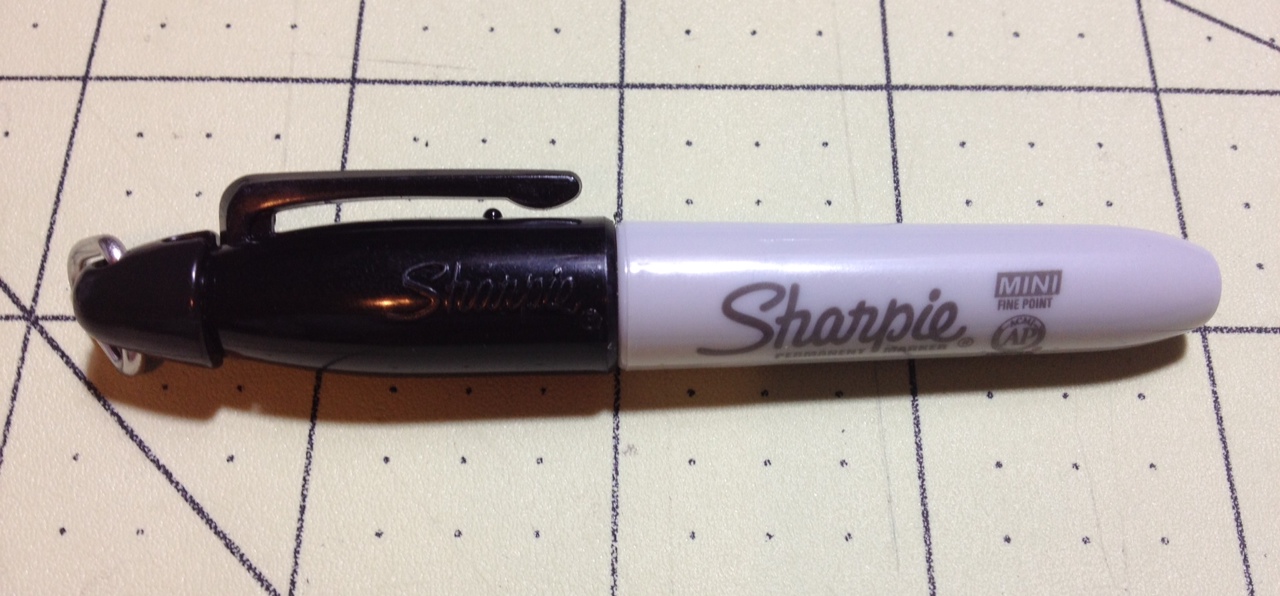
It has the same starting and ending diameters as the regular sized Sharpie, with an extra part on the tip that snaps on with a lanyard “ring” (triangle). Both the cap and body have been reduced in size, but proportionally the cap is larger. The clip is very similar, but shorter, and works well enough but not fantastically. The necessary information is still printed on the side.

photo-150

The size is quite small, at 3 and 11/16ths inches capped, down from a standard Sharpie’s 5 and ½ inches. Most people would find the uncapped marker uncomfortable to hold without posting, and it’s still only tolerable when it is. The odd shape of the cap and grip make it strange to hold. The rest of the writing is all the same as a regular Sharpie, with a cool black line, very permanent but not perfect (archival) qualities, a nice tip, fast drying, and the ability to smoothly put down a ton of ink.

There’s not much more to say than that they’re smaller Sharpies. And if you like Sharpies but want a more portable option, here it is. The only downsides are they are somewhat awkward to hold, and have less ink. I personally didn’t like the lanyard ring, but that just pops right on and off, so it’s no problem. I have Sharpies around with me a lot because they’re so versatile, and this is a great little thing to decrease their needed carrying size with.

Review – Dixon “My First” Ticonderoga

I’m not gonna lie; I find reviewing wood pencils difficult. I just don’t see enough difference in them to make it seem worth my while to look at each specific one. Ones like the My First Ticonderoga are easier, but still the discussion of them ends up being brief. That being said, let’s take a look.

photo-147

The pencil is almost solid yellow, with green accents on the information on the “barrel” and the metal eraser holder. It is a little more broken up by the eraser’s pink and the wood of the sharpened end. The eraser works well enough, and is quite large since the pencils size is increased. The body is half again to double the circumference of a standard pencil, making it much more comfortable to hold, in my opinion, but harder to store. It is completely round, making rolling quite easy, but its larger mass makes it less prone to ending up on the floor.

photo-146

The lead is standard fare for #2. It works well enough for drawing and writing, providing a medium line that can be both quite dark and quite light, though the largeness of the lead skews it to dark. Personally I haven’t used it much for that, but I have used it for marking wood in lieu of a carpenter’s pencil, a job at which this excels.

It’s a good pencil, both for kids and those who don’t want to or can’t hold the smaller standard pencils of today. The quality control isn’t the finest. I’ve found some wood and paint blemishes but these are quite minor and don’t affect the writing ability at all. The set I got also came with a plastic pencil sharpener that does what it’s supposed to, but is nothing special. They’re just a simple, good option for someone who wants a larger pencil.

Review – Paper:Mate Mates Mechanical Pencil

The Paper:Mate Mates is obviously designed to be child’s pencil, considering that they unusually come in various colors or with various princesses or comic book characters. But the reason I have one is because it was given to me. I’m a thin lead kinda guy (0.5 most of the time) and the Mates only come in one size: 1.3mm. So they’re a cheap way to get the feel of a larger lead for those of us not used to it. But how does the rest of it work?

photo-135

The most interesting thing about this pencil is the body, which is a rounded-off triangular shape. It seems built up from a more standard size. Most ballpoint pens or (non-mechanical) pencils could fit inside of the Mates with no problem. It’s also longer than most other pens and pencils I have lying around. The overall design is very simple; it’s made to resemble a regular pencil. There is a triangular eraser on the back that is plugged into the back of the lead tube. It then expands to fit with the edge of the plastic it is held in by and creates a more “seamless” look. This bit is also the click-advance mechanism. Following that, there is some styling in the plastic that is meant to resemble the metal bit holding the eraser in on wood pencils. And beyond that is a smooth triangular barrel (with enough information printed on it) followed by a taper that is a little roughed up and meant to look like a sharpened wood pencil. There is no pipe to hold the lead here; it simply comes out of the end.

photo-136

Writing is simple, and what one would expect from a #2 pencil: smooth and somewhat dark. Due to the size of the lead, though, a lot more expression can be obtained from this pencil, as the lead can be flattened on one side and then flipped to allow for swapping between a very thin and very broad line. The triangular shape both helps and hinders this, making it easier to precisely rotate the pencil, but hard to exactly flip it over. The shape and the length, though, help the pencil ergonomically quite a bit, making the user in general much less prone to hand fatigue and cramping when using it for long periods of time. The fact that it is quite light for its size also helps with this, but contributes to a float-y feeling that I’m not much a fan of.

This pencil was made for kids as a school pencil. The ergonomics, large lead size, and HB (#2) lead grade all stem from filling in large amounts of scantron bubbles. But it does have other, more artistic (or even some office) uses. The lead is replaceable so it can be swapped for one more suitable for you, but a better eraser is needed. It isn’t the sturdiest pencil in the world, but there isn’t much that could go wrong with it and it should hold up in most use cases. So if you want to try out larger lead sizes pretty inexpensively, or are looking for a more ergonomic pencil experience, here would be a place to start.

Review – Sharpie Highlighter

At times I feel like there is very little for me to say about certain things. And highlighters are one of those things. I use them, but not so much that I’ve extensively tested many of them to find the best. And I only use them for highlighting, and not some of the more creative applications like using them similarly to a blue pencil. Still, a product that does its job well deserves some of my time to talk about it.

photo-133

This Sharpie highlighter was a pack-in with several Sharpie pens, but I’ve seen it on the shelf by itself as well. The body is very simple, being a translucent yellow cylinder with a “cone-shaped” stopper on the end. The cap is a solid piece of plastic with an integrated clip that works well for what it is. The section is also a simple cylinder after a step down from the barrel, and then there is a slight taper and protrusion at the (chisel) tip. Sharpie is on both the cap and barrel in various forms with the only other information being a nontoxic seal and the words “smear guard”.

photo-132

When writing, the ink goes on smoothly, and is very bright. So if you want to draw attention to something, this will work. The ink also resists smearing both what it is being applied over, and itself when wet. While it does smear and spread some when dampened, it isn’t too terrible, and during my tests only fountain pen (liquid, dye-based) ink smeared even a bit. I haven’t tested the longer-term effects, but I’d like to think Sharpie has experience with these things.

It’s a highlighter. It’s a good, simple, bright highlighter. If you aren’t looking for anything special from your highlighter, but don’t want smearing, these will work.

Review – Kutsuwa STAD Pencil Holder

Okay, I’m going to admit here that I don’t really know the name of this product as the only English I could find on the package was a URL, “made in China”, and STAD. But I do know it’s a pencil holder, so there is that. From my research I’ve found that this is a less-common or less-popular model (as in I couldn’t find it online at all). So I feel the need to say this is not a review of the “one-push” model.

photo-130

Pencil holders have been around for a while, and there are quite a few options to choose from. In fitting with my style, I got the cheapest one (okay it was given to me, but I think that sentence suits me. I haven’t been able to find a price on these, but I bet it isn’t much). After all, it’s just a metal tube to hold a stubby pencil; can it being cheap really hurt it very much?

photo-131

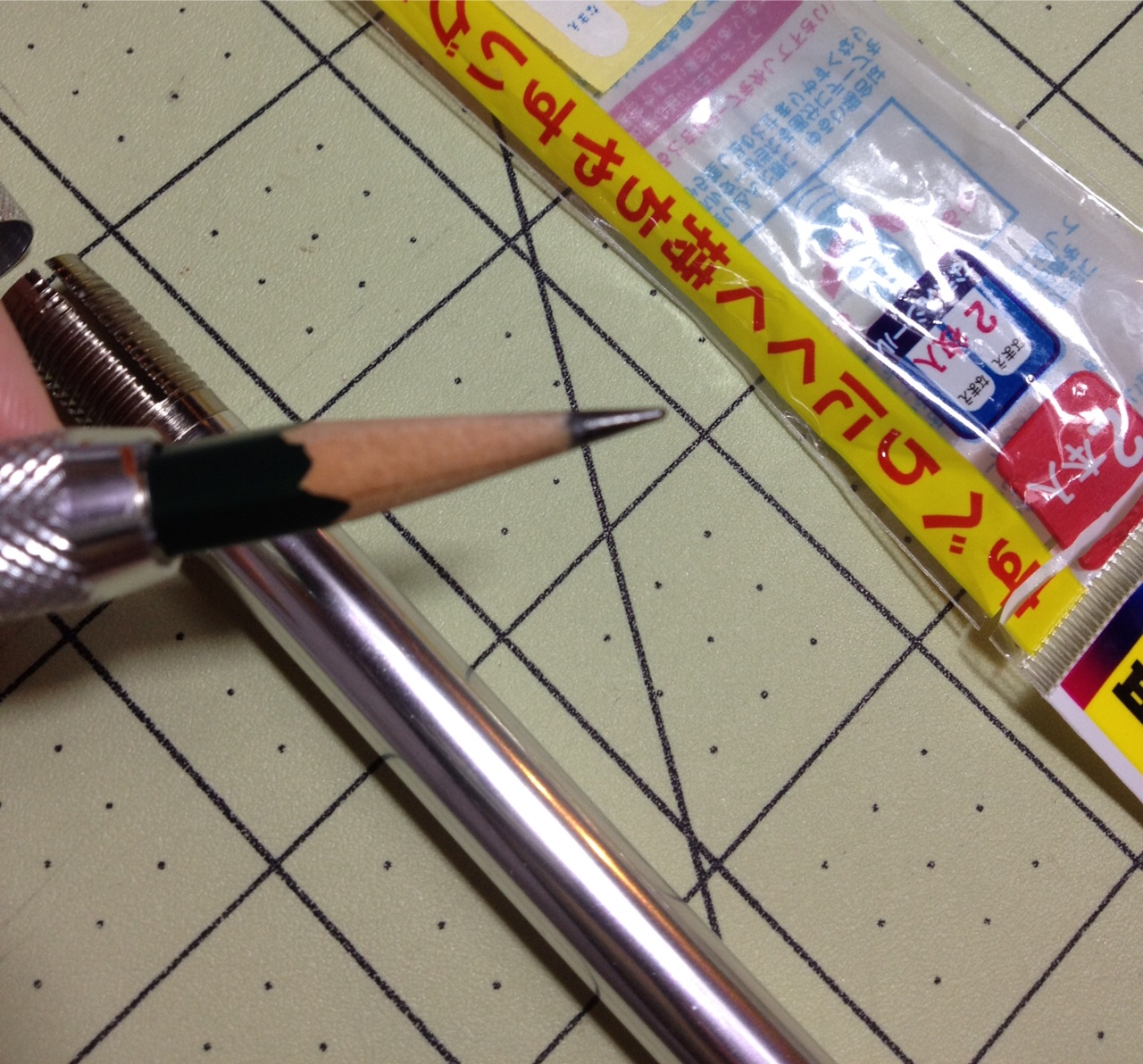
The item comes in a two pack with some labels that you can stick on the side when the pencils (or whatever you’re using) information is covered up or sharpened away. There are only two labels so use them wisely. The holders themselves are very simple: they are two pieces of aluminum, a straight barrel with a stop-bump followed by some threads with cuts in them that allow the second knurled cylinder, which is tapered on the inside, to screw on and force it to act like a collet, holding the pencil in place. The finish is smooth save the knurling and resists major scratching but is quite shiny and reflective.

The pencil is held quite securely inside the device. There is the tiniest amount of give even when tightened down as far I as think I could go before damaging either the pencil or the holder. It is easily enough to allow for comfortable writing or drawing and (fairly) easy sharpening. I’m sure one could throw it hard enough to knock the pencil out, but that isn’t a normal-use scenario. Being dropped from desk or hand height won’t hurt the holder or have the pencil fly out, but it might hurt the pencil. The grip works well enough, but it is a bit slippery, the length of the barrel is enough to allow one to rest it in the webbing between their thumb and forefinger on most hands, though it isn’t the most comfortable or ergonomic. It also seems a bit front heavy with the back of barrel empty when the pencil gets very short.

To be short, no, being cheap didn’t hurt this product very much. It doesn’t feel weighty or expensive, but it does do its job. It holds a pencil that would otherwise be very uncomfortable or hard to control in a way that makes it at least tolerable to work with. It’s simple to use, and easy to handle. And with how cheap it is, I would say it would certainly be worth looking at. It isn’t as nice as the more expensive ones, but if one isn’t very picky, like me, and if you happen to find one, get it.

Review – Master Mechanic Carton Cutter

With so many options, one carton cutter review just wasn’t enough, and I am now back to review one that has a higher price. But does that make it better quality?

photo-127

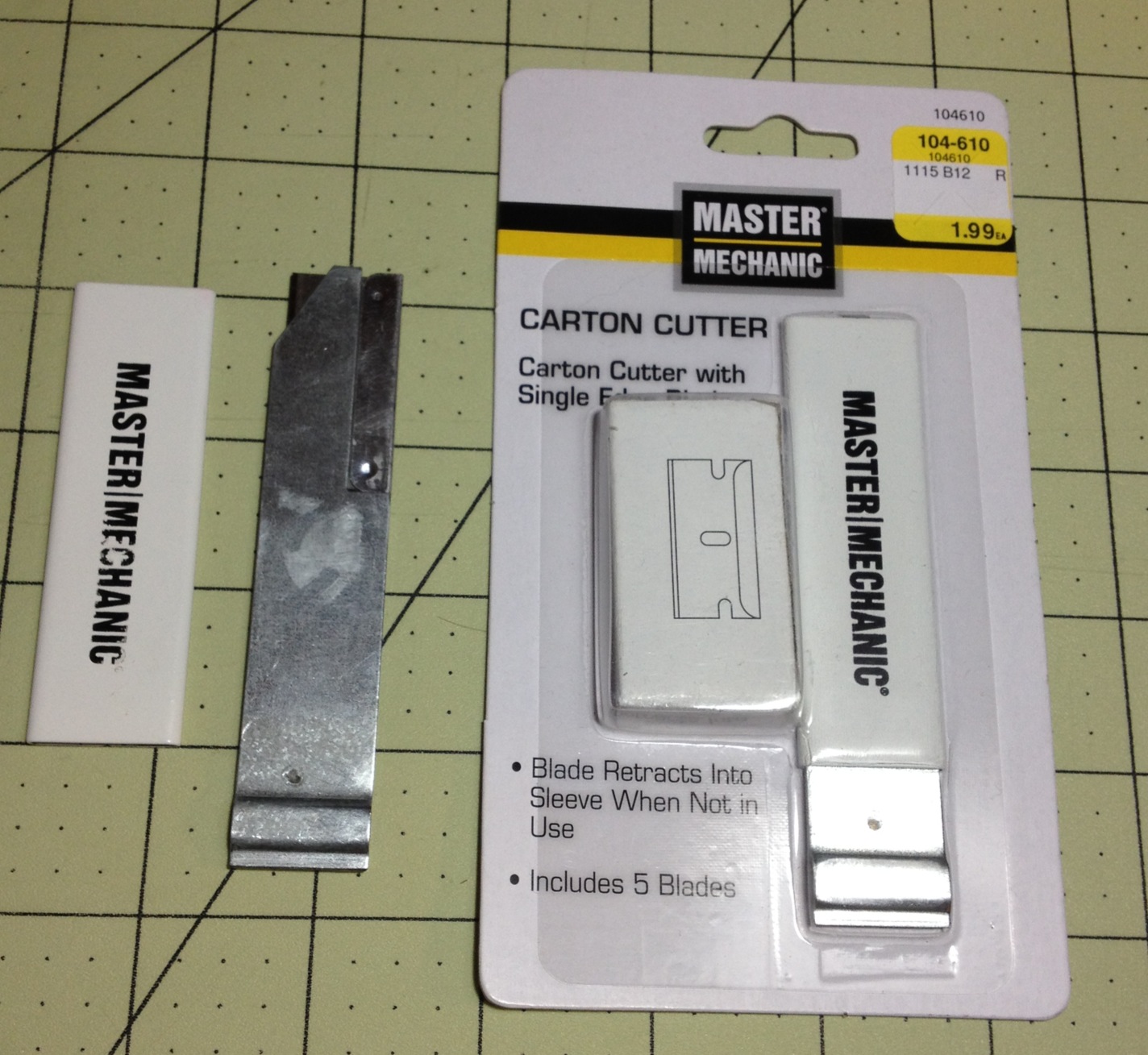
The short answer is yes: it is better quality, but I’ll just go over a few things. The cutter has a bent and nicely shaped/joined sleeve made out of an unknown metal (probably steel), with an insert that is a folded piece of metal that will hold a razor blade. It also has a cutout “spring” that creates the tension instead of the body doing that, making it more pleasant to use. The sleeve also has a nice, easy-to-hold white paint applied, which makes it easier to see. The Master Mechanic logo that is printed on top of this looks nice but wears off easily and looks unsightly when it does.

photo-128

Use is easy and smooth, tapping (a hard surface) both to deploy and retract the blade-holding mechanism (placing the back on a hard surface and pushing firmly will deploy the blade, and doing the reverse with the blunt part of the front will retract it), but it does have a way it “likes” to go in and works better that way. The razor blades that are included are also slightly better than the cheaper knife, but in general one won’t get much use out of single-edge razor blades, which are sharp but cheap and prone to snapping or deforming.

photo-129

Is it worth it to buy a better version of such simple product? Probably not for most people. While this is a better carton cutter than cheaper ones, it isn’t really less dangerous or easier to use per-se. The fit and finish are as good as one could reasonably expect on a product this cheap; the amount of friction on deployment is constant; and the device will likely last for a long time. Still, a carton cutter isn’t a tool most people will be worrying about, and the less expensive ones would be easier to replace if they were misplaced or damaged.

Review – Tach-It Metal Tap Knife (Carton Cutter)

Depending on the size or type of art (or craft) works one is doing, carton or box cutters may or many not be on one’s radar or considered a useful tool. But even if one isn’t using them for opening supplies or actually during the art-making process, it still isn’t a bad idea to have one around since they’re cheap and easy to use. The dozen-for-five-dollars that these are priced at might be a bit larger set than most people would need, but it’s still inexpensive enough that it wouldn’t be hard to pick up.

photo-124

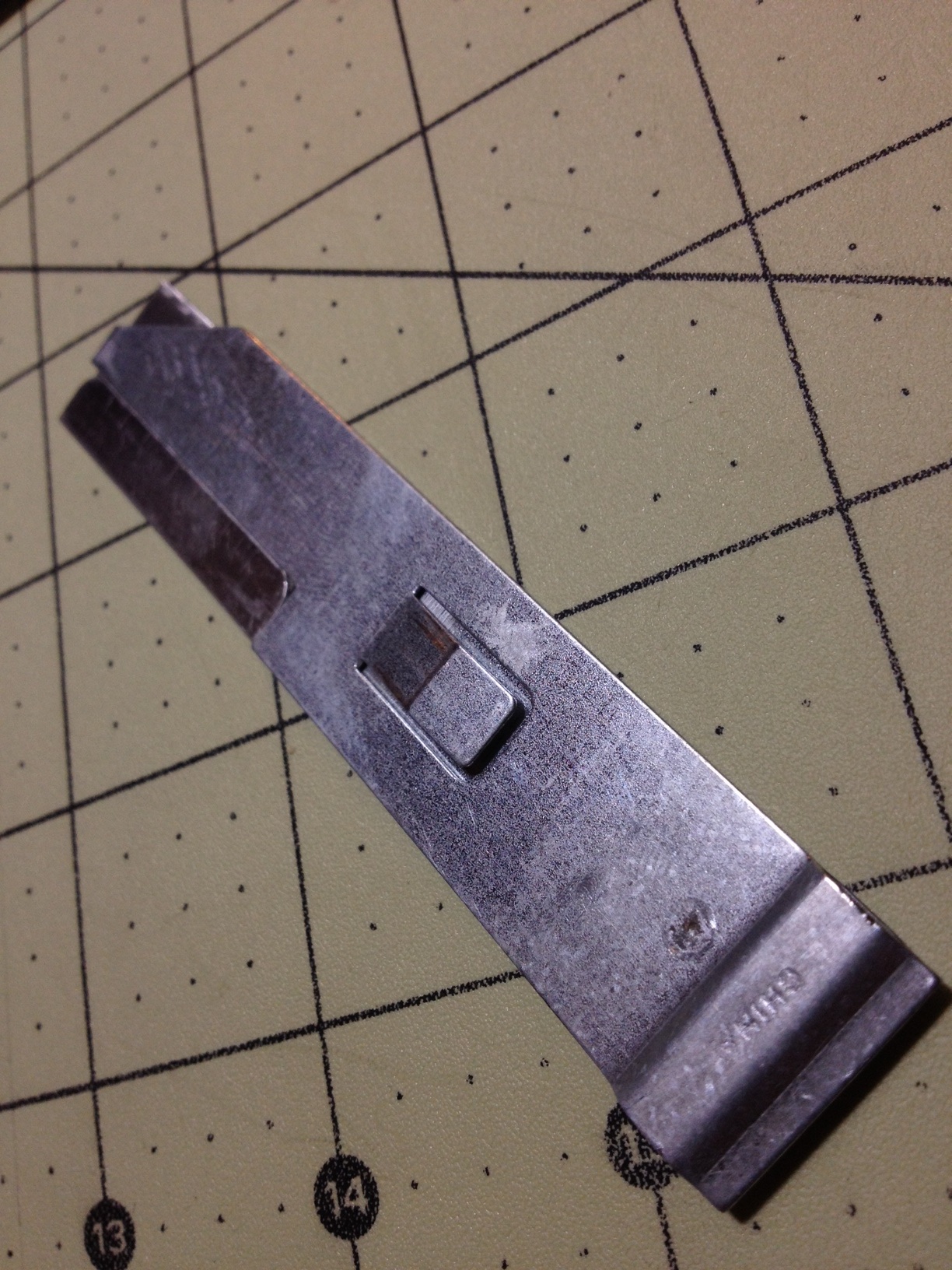
Tap knives are one of the simplest types of box cutter. On this model, the outside sleeve is a single aluminum piece that has been bent around on itself. Inside is another piece of aluminum that has been folded with a cutout at one end and a flare at the other. A standard single-edge razor blade fits in the cutout end (and can be replace by sliding the insert out of the housing) while the flare prevents the knife from protruding too far forward.

photo-125

Use is simple. Tapping the back of the knife against a hard surface will extend the blade until it is stopped by the protrusion on the back. And when the cutting is done, the front of the knife can be tapped on a hard surface to retract the blade. Very little of the blade is exposed making it fairly safe to cut with, and it’s held in securely enough that I wouldn’t worry too much about accidental deployment of the blade. How well it cuts and how long it lasts depends on the razor blade used. And the ones that come in the package are not the greatest. The points are especially brittle, and while they can keep an edge for a decent amount of time, they will crack and split with too much stress.

As far as a cheap, effective, and simple box cutter goes, they work well enough. The fit and finish leave something to be desired: the edges are rough, the tolerances vary quite a bit, and no surface is smoothed and finished, but they are so inexpensive they are practically disposable. They cut, they’re reasonably safe, and they could last quite a long time since there’s not much too them. One could get better quality, but I’m not convinced you’d really need to.