Review – Faber-Castell 033 Ballpoint Pen

I recently received a box of things my brother got for me on his trip to Peru. Inside were several pens that seemed to be commonly available there. Indeed, they are more common there than in the US, because all of the information I could find on them was in Spanish, or Russian (Ukrainian? Cyrillic of some sort). And they do say “Product of Peru” in Spanish. So let’s get to it and look at the first type I received, the Faber-Castell 033 ballpoint in black.

photo-156

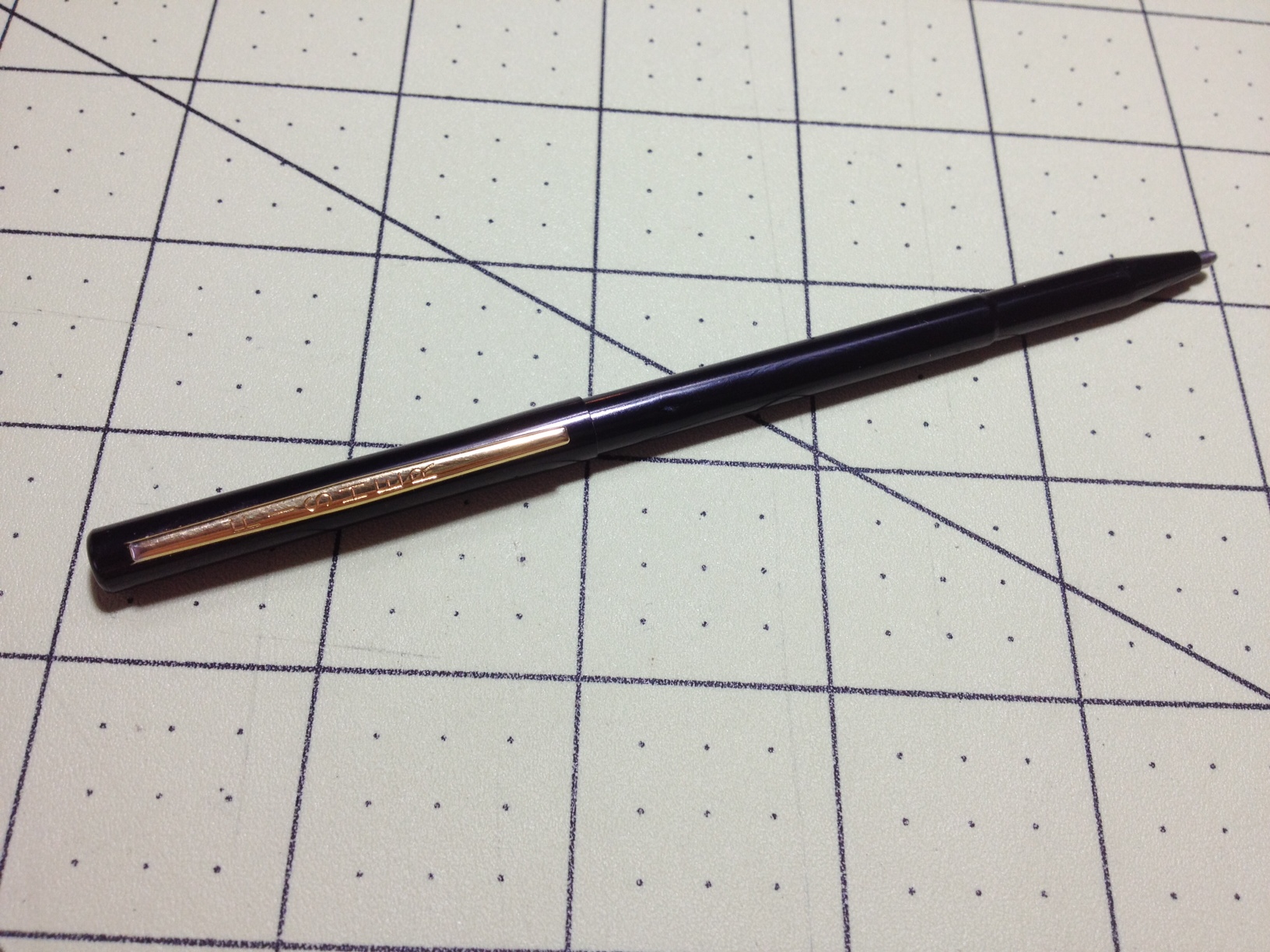
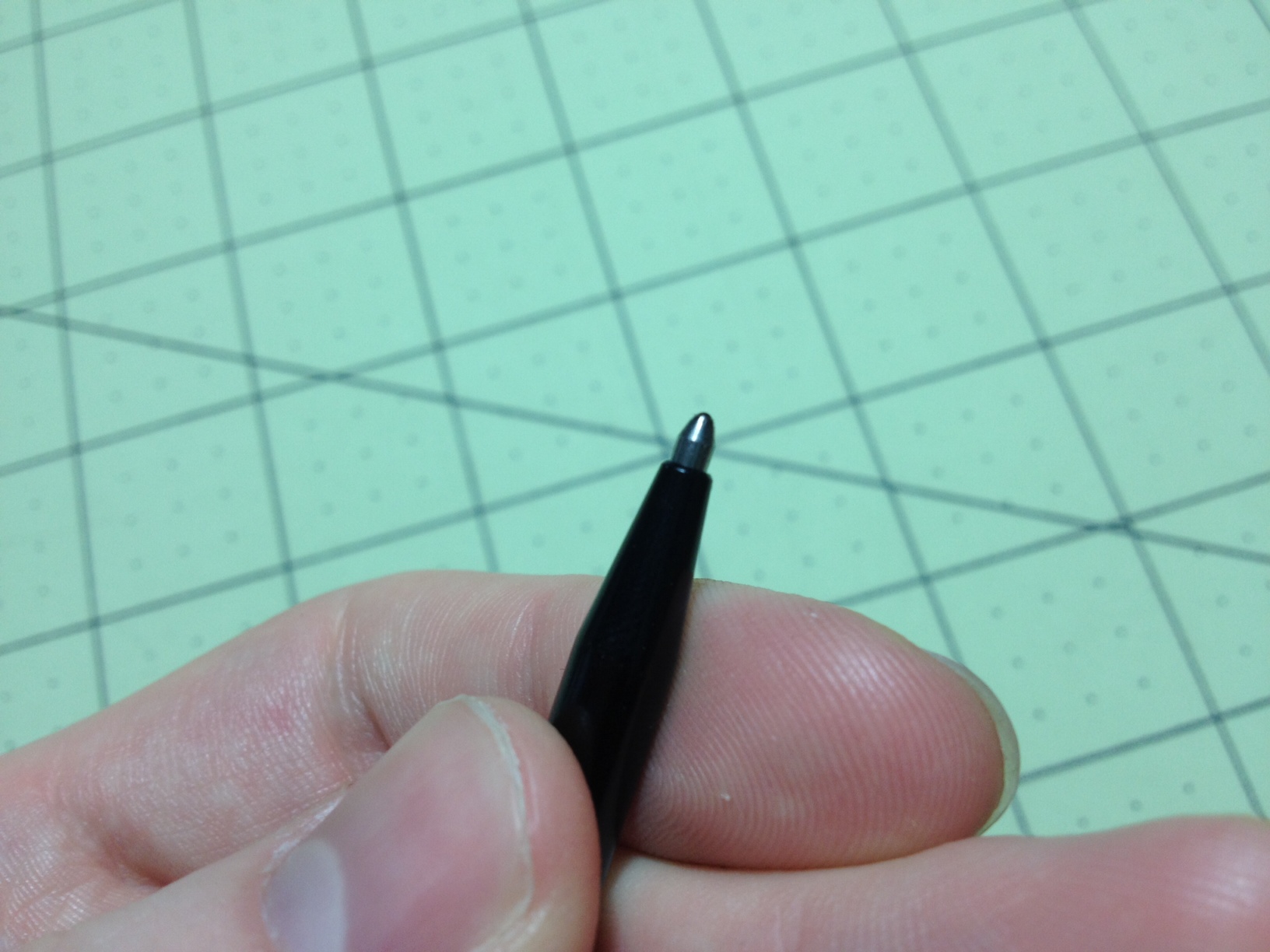
The pen has a very classic octagonal design, and it’s made with a plastic that feels much like the plastic that older pens and mechanical pencils were made out of, except it is much lighter and feels more brittle and thinner as a result. The faceted barrel is capped on the back by a step-down plug of a light grey color that allows the pen to be neatly posted, and the cap on the front is a very simple, if unsightly, ribbed design. The clip is molded in and works, but is quite filmsy, and I wouldn’t trust it. The cap does fit securely over the section, which is a simple taper in the barrel to a larger-than-normal metal cone, at the end of which is the ball. As far as I can tell, this tip is not removable, and thus the pen is not refillable. Stamped in gold on the side is just enough information to identify it, but not much more.

photo-157

Writing is surprisingly smooth for a ballpoint, but it does have occasional startup issues and more blobbing than I can get past. The ink is comparable to inexpensive Bic ink. It’s suitably dark and black, but it’s got a bit of a red sheen, and upon close inspection under a bright light it looks like a very dark purple. It’s still on the warmer side of things, though. It dries fast (except for the blobs), but with certain types of paper I wouldn’t try it left-handed. And its blobbing might cause it to smear for left-handers anyway. It is suitably waterproof like most ballpoint inks. I haven’t tested lightfastness, but in general even cheap black inks do well, but it isn’t archival quality.

Overall it’s a well-working, inexpensive pen. As far as super cheap pens go it isn’t the best, but it’s far from the worst. It writes well, but not perfectly. The body is simple with no frills and holds together despite being cheaply made. And there isn’t much more to it than that. I wouldn’t be going out to import them, but I would (and will) use them if I ended up with them (which I obviously did).

Review – Sharpie Mean Streak White

I have a pretty liberal definition of what an art supply is. Not quite as liberal as those who say everything is an art supply because (almost) everything you do is art of some kind. But I do think more qualifies as art supplies than the average person does. For instance I would say that everything meant to make a mark is an art supply. And that assumption will be tested here where I take a look at the Sharpie Mean Streak “permanent marking stick”, and see if it has any real art applications.

photo-151

The body is quite large, being about half an inch in diameter. It’s got a good amount of information on the side, but it gets a bit cluttered-looking. The back is a twist knob, like a glue stick. The cap has a slight taper with several ridges for grip. Inside is a pointy cone that can shape or dent the “marking stick” if you put it in slightly wrong. Inside around the “marking stick” (grease, wax, or whatever it is) is a sizable ridge that is quite uncommon on writing implements. There is also no grip section area.

photo-152

There are two ways I can describe this, either as a permanent (wetter) crayon, or a more slick grease pencil. Neither of those descriptions really tell you exactly what these things are. The inside substance comes in a pointy cone that is pretty useless. It’s very putty- or grease-like and when used the point becomes very flat very fast. It writes similarly to a crayon, in that it isn’t easy to control or sharpen. When the tip is flattened beyond a certain point, the base can be twisted to extend the point, but it can’t be retracted, so remember to not twist it too far out (that shouldn’t be a problem unless you’re an impatient reviewer like I am). The feeling it has is very slippery, and quite a bit of material comes off for not a lot of writing, but there seems to be quite a bit of it in the barrel, so running out should not be a major problem.

Performance is a bit disappointing. The white color doesn’t cover very well at all, meaning use in art as either correction or even to mix with other colors is very limited or would require re-application. It can be used as a covering to make things “hazy” but the coating is quite unpredictable. It likes to clump up in certain areas and barely cover others at all, meaning detail work also shouldn’t be done with it. As far a permanence goes, it is, but not wholly. I did testing (not just normal use) on metal and paper. Both were reasonably water-proof, on metal flame did nothing to it and on paper it did resist the flame but once the paper burned it did too (not that anything else would have happened). Then on the metal piece it stood up to WD-40, which has a knack for removing regular Sharpie, but was easily wiped away by isopropyl alcohol. I also suspect it could fairly easily be scraped off or crack easily on pliable surfaces. It does go on whether the surface is wet or dry as advertised and does dry in a fairly short amount of time for how tacky it is to begin with.

I would still consider this an art supply, and it can work well in mixed media, but really it is much more at home in the garage or the toolbox. The tip and lack of sharpening or controlling method means it works quite a bit better when marking large surfaces. It is “permanent” in that it’s hard to purposefully get off, but it doesn’t penetrate and won’t wear terribly well. It’s an interesting item, but certainly not a general use-one.

Review – Dixon “My First” Ticonderoga

I’m not gonna lie; I find reviewing wood pencils difficult. I just don’t see enough difference in them to make it seem worth my while to look at each specific one. Ones like the My First Ticonderoga are easier, but still the discussion of them ends up being brief. That being said, let’s take a look.

photo-147

The pencil is almost solid yellow, with green accents on the information on the “barrel” and the metal eraser holder. It is a little more broken up by the eraser’s pink and the wood of the sharpened end. The eraser works well enough, and is quite large since the pencils size is increased. The body is half again to double the circumference of a standard pencil, making it much more comfortable to hold, in my opinion, but harder to store. It is completely round, making rolling quite easy, but its larger mass makes it less prone to ending up on the floor.

photo-146

The lead is standard fare for #2. It works well enough for drawing and writing, providing a medium line that can be both quite dark and quite light, though the largeness of the lead skews it to dark. Personally I haven’t used it much for that, but I have used it for marking wood in lieu of a carpenter’s pencil, a job at which this excels.

It’s a good pencil, both for kids and those who don’t want to or can’t hold the smaller standard pencils of today. The quality control isn’t the finest. I’ve found some wood and paint blemishes but these are quite minor and don’t affect the writing ability at all. The set I got also came with a plastic pencil sharpener that does what it’s supposed to, but is nothing special. They’re just a simple, good option for someone who wants a larger pencil.

Review – Fisher Space Pen Stowaway

The Fisher Space Pen has a reputation for being a very good pen, with many models being used by many people for many different things. But I feel that some models of space pen get more attention than others. And for some reason, the stowaway isn’t one of them, but it might be my favorite and I think it’s deserving of a look today.

photo-140 photo-141

The body is very simple. It’s a black metal cylinder with a plastic end cap and another slightly larger black cylinder fitting over it. Fitted to this top tube is a clip, which is longer than most pen clips I’ve seen and has “Fisher” stamped into it (not much else to say, it works as a clip should). On the section there is a slight but smooth step down, and then a taper to the point.

photo-144

Writing is fairly smooth, though it does require a bit more pressure than some of the more modern pens (but less pressure than the cheap ones). The pen itself is very thin in diameter, meaning one’s hand will begin to cramp if writing more than a few notes. The body is also very short, and generally requires the cap to be posted (placed on the back of the pen) in order to lie in the webbing of one’s hand and be comfortable. This small-ness is very useful when traveling, as this pen can fit just about anywhere (but not an Altoids tin or some similar sized case, which might be why “preppers” don’t use them very often). And even though it’s metal it weighs next to nothing. In most cases it will “stowaway” very easily.

photo-142 photo-143

I really like this pen. It goes with me almost everywhere (and I found an almost identically-sized pencil I will be talking about soon). Its slim body and black color make it very low profile and professional, while its all-metal construction and space pen (underwater, upside down, in space etc.) writing ability make it a very rugged writer. I did dent and scratch mine within a day of owning it, but I haven’t put anything on it since (and besides, that just adds character). The cartridges are even replaceable so you don’t have to throw out the pen each time as with many pens of this size. So, if you’re looking for an on-the-go sketching/writing/note taking pen that could also fit in with any of your other stuff at a moment’s notice, I’d say check this guy out.

Review – Paper:Mate Mates Mechanical Pencil

The Paper:Mate Mates is obviously designed to be child’s pencil, considering that they unusually come in various colors or with various princesses or comic book characters. But the reason I have one is because it was given to me. I’m a thin lead kinda guy (0.5 most of the time) and the Mates only come in one size: 1.3mm. So they’re a cheap way to get the feel of a larger lead for those of us not used to it. But how does the rest of it work?

photo-135

The most interesting thing about this pencil is the body, which is a rounded-off triangular shape. It seems built up from a more standard size. Most ballpoint pens or (non-mechanical) pencils could fit inside of the Mates with no problem. It’s also longer than most other pens and pencils I have lying around. The overall design is very simple; it’s made to resemble a regular pencil. There is a triangular eraser on the back that is plugged into the back of the lead tube. It then expands to fit with the edge of the plastic it is held in by and creates a more “seamless” look. This bit is also the click-advance mechanism. Following that, there is some styling in the plastic that is meant to resemble the metal bit holding the eraser in on wood pencils. And beyond that is a smooth triangular barrel (with enough information printed on it) followed by a taper that is a little roughed up and meant to look like a sharpened wood pencil. There is no pipe to hold the lead here; it simply comes out of the end.

photo-136

Writing is simple, and what one would expect from a #2 pencil: smooth and somewhat dark. Due to the size of the lead, though, a lot more expression can be obtained from this pencil, as the lead can be flattened on one side and then flipped to allow for swapping between a very thin and very broad line. The triangular shape both helps and hinders this, making it easier to precisely rotate the pencil, but hard to exactly flip it over. The shape and the length, though, help the pencil ergonomically quite a bit, making the user in general much less prone to hand fatigue and cramping when using it for long periods of time. The fact that it is quite light for its size also helps with this, but contributes to a float-y feeling that I’m not much a fan of.

This pencil was made for kids as a school pencil. The ergonomics, large lead size, and HB (#2) lead grade all stem from filling in large amounts of scantron bubbles. But it does have other, more artistic (or even some office) uses. The lead is replaceable so it can be swapped for one more suitable for you, but a better eraser is needed. It isn’t the sturdiest pencil in the world, but there isn’t much that could go wrong with it and it should hold up in most use cases. So if you want to try out larger lead sizes pretty inexpensively, or are looking for a more ergonomic pencil experience, here would be a place to start.

Review – Tach-It Metal Tap Knife (Carton Cutter)

Depending on the size or type of art (or craft) works one is doing, carton or box cutters may or many not be on one’s radar or considered a useful tool. But even if one isn’t using them for opening supplies or actually during the art-making process, it still isn’t a bad idea to have one around since they’re cheap and easy to use. The dozen-for-five-dollars that these are priced at might be a bit larger set than most people would need, but it’s still inexpensive enough that it wouldn’t be hard to pick up.

photo-124

Tap knives are one of the simplest types of box cutter. On this model, the outside sleeve is a single aluminum piece that has been bent around on itself. Inside is another piece of aluminum that has been folded with a cutout at one end and a flare at the other. A standard single-edge razor blade fits in the cutout end (and can be replace by sliding the insert out of the housing) while the flare prevents the knife from protruding too far forward.

photo-125

Use is simple. Tapping the back of the knife against a hard surface will extend the blade until it is stopped by the protrusion on the back. And when the cutting is done, the front of the knife can be tapped on a hard surface to retract the blade. Very little of the blade is exposed making it fairly safe to cut with, and it’s held in securely enough that I wouldn’t worry too much about accidental deployment of the blade. How well it cuts and how long it lasts depends on the razor blade used. And the ones that come in the package are not the greatest. The points are especially brittle, and while they can keep an edge for a decent amount of time, they will crack and split with too much stress.

As far as a cheap, effective, and simple box cutter goes, they work well enough. The fit and finish leave something to be desired: the edges are rough, the tolerances vary quite a bit, and no surface is smoothed and finished, but they are so inexpensive they are practically disposable. They cut, they’re reasonably safe, and they could last quite a long time since there’s not much too them. One could get better quality, but I’m not convinced you’d really need to.

Review – Field Notes Bic Pen

Field Notes is a company that makes great notebooks, and they’ve always added a bit of a more personal touch to things. One of the ways they did that was by having branded pens and rubber bands readily available (I believe at some point in their orders, single pens and rubber bands were thrown in for free, but they can be purchased in larger packs easily.) The pens aren’t very expensive and fit very well with the brand’s style just on looks, but do they perform as well as the paper?

photo-120

The pen is actually just a branded Bic Clic pen, which isn’t a bad thing really. The entire design is a pleasant taper from the middle, where a ring separates the two halves of the pen. On the top there is a chrome-ish simple clip with Bic’s information on it, and a similarly-colored thin clicking mechanism (which give a very satisfying “click” when used). On the front of the pen, the ballpoint protrudes when the mechanism is depressed and the Field Notes information is printed on the barrel. The only colors of the pen are black, silver, and white, making the whole thing quite understated but also very nice.

photo-121

The writing is standard Bic writing. It is smooth enough, black enough, and steady enough to be serviceable in the vast majority of scenarios. It is a medium point, which is usually too broad for me, but definitely is unspectacular and fits with what most people are comfortable with. The ink is, of course, essentially waterproof once dry, with minimal skipping or blotting. I’m not particularly impressed by the writing, but I’m certainly not disappointed.

I’m sure the Field Notes Company did a bunch of research to find both a good enough and inexpensive enough pen for their brand that they wouldn’t have to try to make in-house. And I think they succeeded. The pens are dependable enough, sturdy enough, and simple enough to be almost entirely unremarkable (in both a good and a bad way). They fit the utilitarian image of the company, and are worth having at least as a backup pen.

Review – Poppin Fineliners

Poppin is a company that I don’t know much about, but their pens definitely catch the eye. When I saw this set of fineliners (felt tip pens) from them, I knew I had to pick a set up. The packaging and the feeling of the pens themselves appears quality, but do they live up to their first impressions?

photo-118

The outsides themselves are very nice looking. At the bottom is a small inset for posting the cap, which connects via a visible seam to a very smooth and featureless barrel. Underneath the cap are a series of step downs that are quite short and would be uncomfortable to hold, leading quickly to a standard-looking felt tip point, making it more comfortable to hold the pen by the barrel when writing. The cap, when on, has a slight step up from the barrel but is equally pleasantly smooth, and its only features are a dimple in the top and a rather unique u-like clip that looks like a Lamy wire clip that has been flattened.

photo-117

Functionally, the clip is about useless. It doesn’t have any dimple with which to grip, and is spaced farther from the cap than the width of most fabrics, meaning friction won’t be holding it in. The tips themselves aren’t that great, either. Like most fineliners, they do write with minimal pressure, but unlike most they do not give a consistent line. Dots very quickly form when writing or drawing due to having a very fluid ink not well controlled, and when writing fast at times skips can even develop, though this is rare.

photo-119

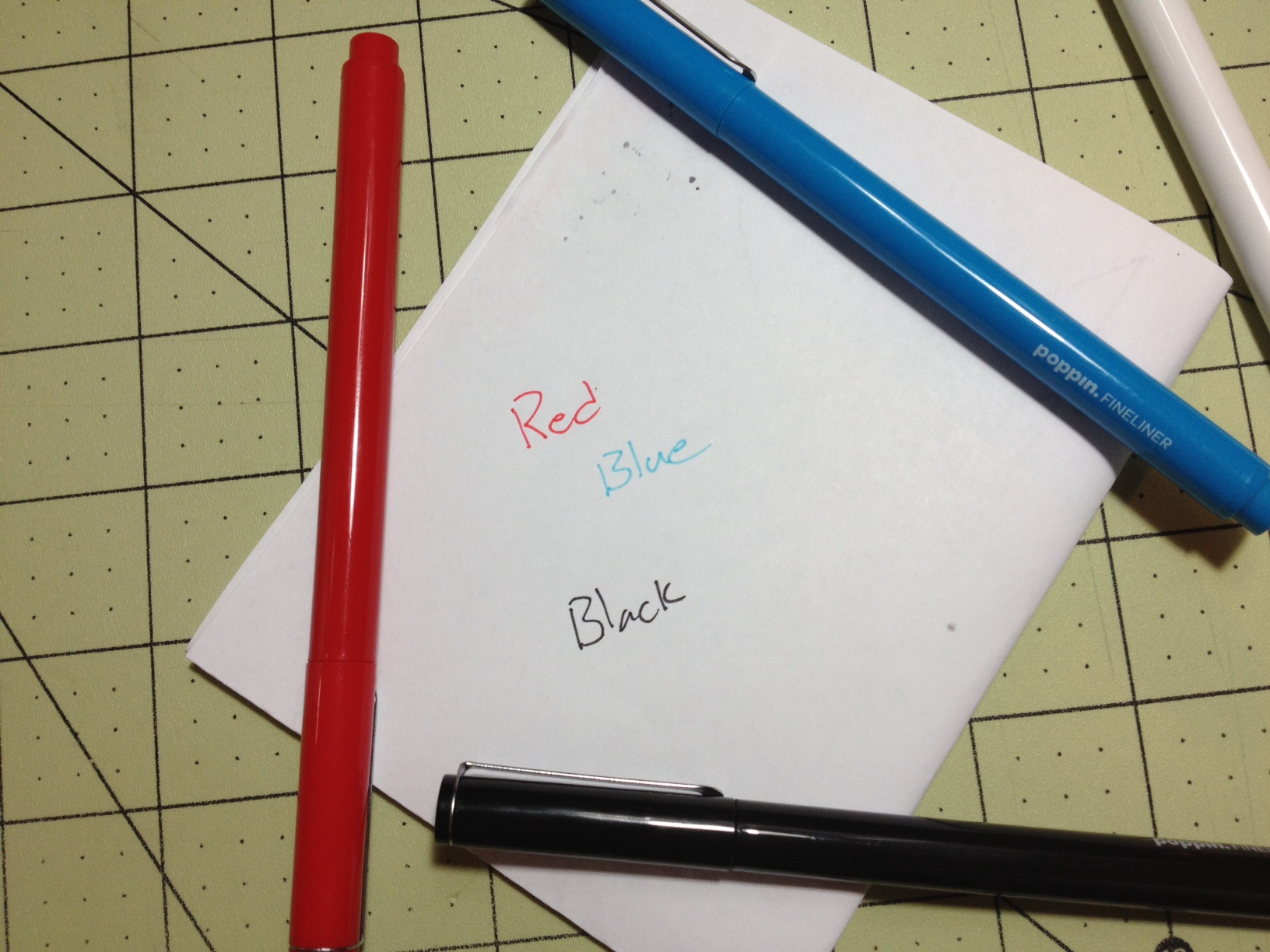
The colors of black, blue, and red are very standard, but the two extra colors are very washed out, blue especially. The blue is very pleasant sky blue when controlled well, but becomes darker quickly. But it still sticks out compared to other office blues. Red is nice and vibrant, though its tone is closer to that of a pink. It’s the least prone to problems as the ink is a bit thinner and less likely to dot. The black is fortunately a black and not a very deep purple or gray as some are. It is slightly on the cool side, which is unusual. The colors do match their corresponding pen bodies fairly well, but the inclusion of a 4th pen that has a white body, but also black ink, is slightly confusing. They unfortunately do bleed through the paper, but have minimal shading and resist water (while they do spread slightly when wet, they remain easily readable).

Overall I think the pens aren’t really up to par with what one can get for their office. They are sturdy and the ink works well, but without functional clips, they must remain at the desk or in a case, and their writing performance leaves much to be desired. The user just ends up with a pen that feels slightly rough and dry. If style and durability are your main concerns (and potentially ease of writing as the ink almost jumps from pen to page on contact) these might work for you. But for those looking for the superior, super-smooth and comfortable writing experience, or a portable reliable writer, these can be easily passed up.

Review – Office Depot Ballpoint Pens

Most stores have generic in-store brands or store branded products for various merchandise. That is the case here, with these Office Depot branded ballpoint pens. I don’t know what they cost originally, but they were marked down twice to 50 cents and then 3 packages for $1. Which means I picked up 30 for a $1. There are very few things I wouldn’t say are a good value for that price (I’d probably say stale gum was worth 30 pieces for $1) so it would be hard for these things to let me down. So let’s see how they perform.

photo-114

The bodies of the pens are super simple. They are round and straight with a cap on the end to hold the ink cartridge in on the back, and a slight bump (to hold the cap on) followed by a taper and then the point of the front. The cap is fairly generic with an integrated clip that works but isn’t great. They are all made of translucent plastic that matches the ink and have “Office Depot” printed on the side.

photo-115

Writing is surprisingly smooth, especially for mediums (they’re a bit broader than normal mediums I would say) and at times they can write with minimal pressure. The packages say “No skip guarantee” which isn’t true, but it wouldn’t be for any pen. It blobs after a certain amount of writing time but I don’t know a pen that wouldn’t, and it’s less than expected. They do tend to have (sometimes severe) startup issues though, especially the longer they are left capped, as do most cheap ballpoint pens.

photo-116

The colors are fairly standard office colors, nothing at all natural looking. The black is just off-black and slightly warm. The red is deep and doesn’t shade much, but still very noticeable. And the blue is quite dark, but still differentiate-able from the black except in the lowest of lights. All are essentially waterproof and dry quickly.

Overall, I’d say the pens are probably worth it. They have no frills, and likely a high margin of error. Any problems, though, and the pen can simply be tossed. They do come with wax-sealed tips, meaning they will last longer in storage, but after that they need to be used fast before they dry up. The bodies are sufficiently hardy to last easily for the life expectancy of a pen like this. The cap seals, the clip holds, and the tip writes. Everything’s functional and unspectacular. If you’re running a business where pens are needed frequently by customers or employees, or you’re just forgetful and lose your pen, these are cheap and they work until they disappear. But they won’t be impressing anyone.

Review – Parker Jotter Stainless Steel

There are many pen brands out there, specializing in various things. Most Americans who know more than nothing about pens would recognize the Parker brand as a longtime quality maker. One of the least expensive, most accessible, and longest running products they make is the Jotter ballpoint/gel/rollerball pen that utilizes Parker’s own refill type. I have here the “all stainless steel” version, how does it hold up?

photo-113

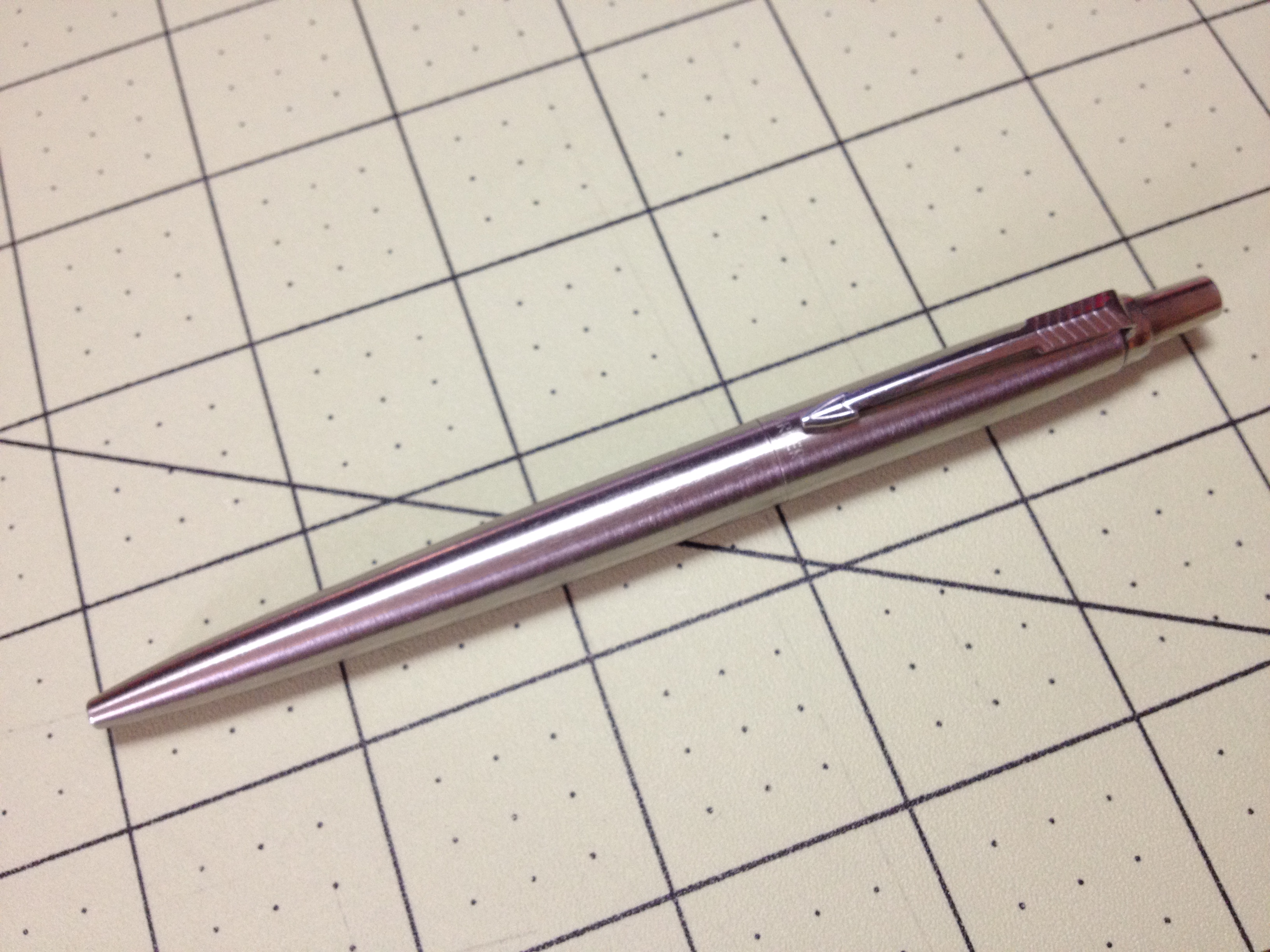
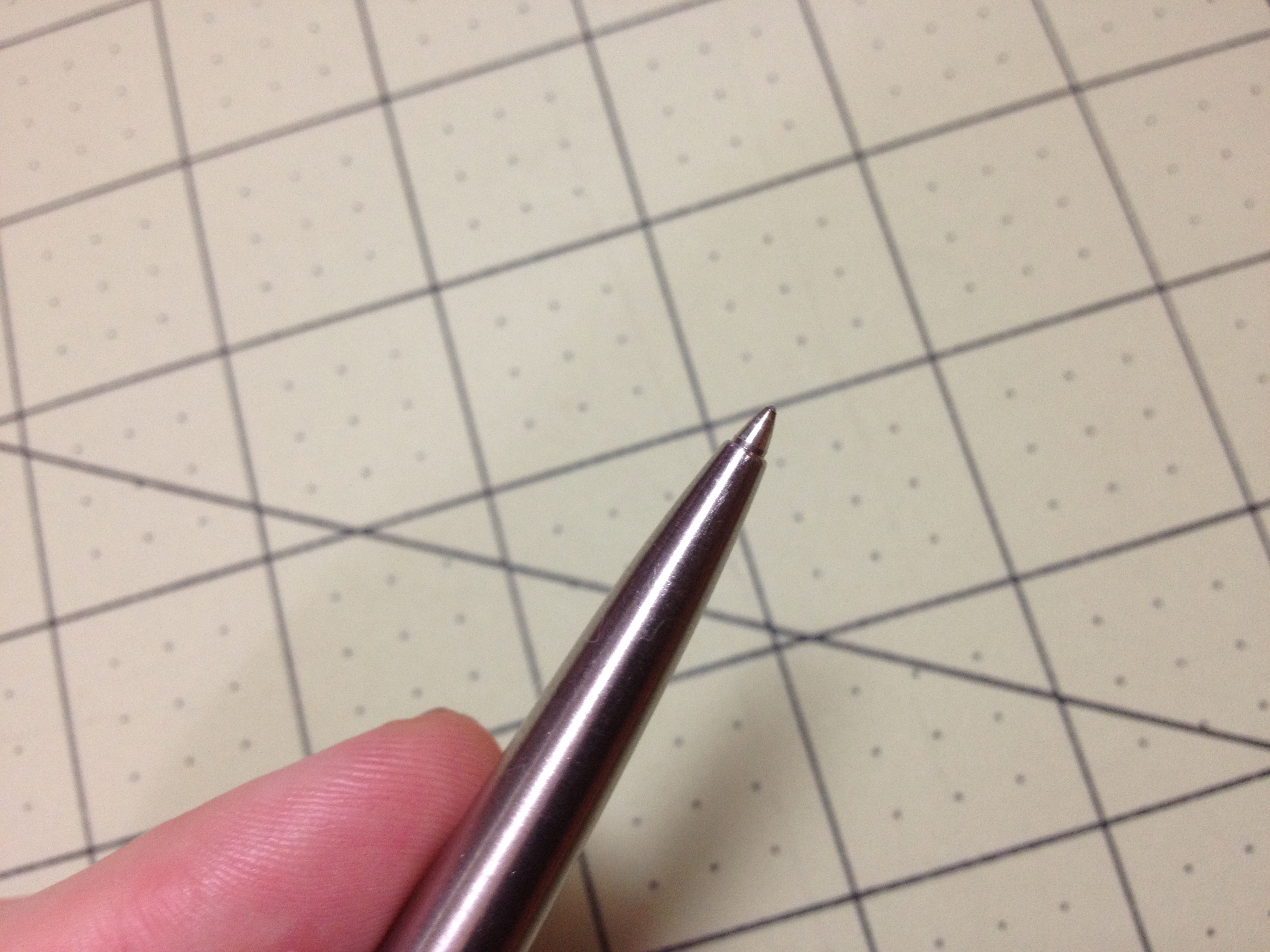
The pen itself is obviously all stainless steel. At the back is a very pleasantly tapered click button, followed immediately by the clip shaped as the famous Parker arrow. The pen from there slowly bulges and then tapers down to the end where it almost seamlessly meets with the pen’s point when it is not retracted, with only a slight seam 1/3 of the way down the pen where it is unscrewed to be refilled.

photo-112

Now I can’t speak to the Parker brand refill this pen came with as I don’t remember how it wrote and I currently have a Monteverde refill inside (that writes very well, as I said in my review). But I can talk about the feel and sturdiness, both of which are superb. The click mechanism is a bit different and it just feels not as advanced as some of the more modern pens, but it is very solid and satisfying. There’s nothing wrong with it, it just feels older (like using one of those drafting pencils that have been in production for 60 years). And the steel finish is very easy to grip, while beings stylish and well-wearing. Scratches and such barely show up, keeping the pen looking nice and professional for some time.

Overall it’s a great pen, and for the price (a little more expensive for the “all stainless” one) it is easily a great value as one pen could last a lifetime (though refills might not be cheap). It’s hardy, with a time tested, solid mechanism, and while it doesn’t look as nice or handle as well (or have as many expensive materials) as the more expensive ballpoints out there it still looks professional, fits in with both modern (stainless) and retro (colors) styling, and can take a rough and tumble life. It’s a tough little trooper.